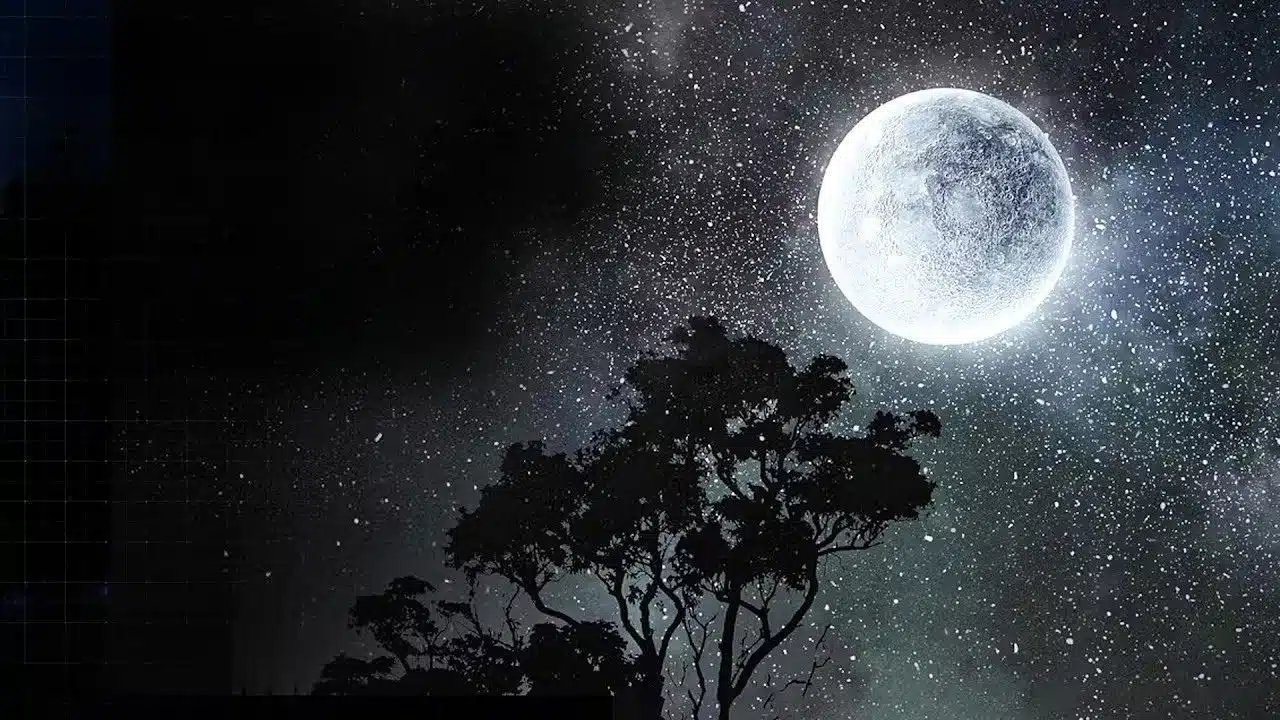
Stargazers across the United States and the United Kingdom are preparing for a celestial treat as the Harvest Supermoon graces the night sky, reaching its peak brilliance late on Monday, October 6, and into the early hours of Tuesday, October 7, 2025. This isn’t just any full moon; it’s the first of three consecutive supermoons and is notable for being the largest and brightest full moon of the year, offering a stunning astronomical display.
The full moon, which will appear up to 14% larger and 30% brighter than a typical full moon, earns its “supermoon” status by coinciding with its closest approach to Earth, a point in its orbit known as perigee. This proximity makes the lunar disk appear significantly more impressive in the night sky. The name “Harvest Moon” is given to the full moon that occurs closest to the autumnal equinox. While this title often falls in September, in 2025, the October full moon is the closer of the two, making this a relatively uncommon October Harvest Moon.
What Happened: A Celestial Confluence
The October 2025 full moon is a convergence of two astronomical phenomena. Firstly, it is a supermoon. This term, popularized by astrologer Richard Nolle in 1979, describes a full moon that occurs when our natural satellite is within 90% of its closest approach to Earth in its elliptical orbit. Because its orbit is not a perfect circle, the moon’s distance from Earth varies. During a supermoon, the closer proximity results in a more striking visual spectacle.
Secondly, it is the Harvest Moon. This name is a relic of agricultural tradition, rooted in the days before artificial lighting. The bright light of the full moon closest to the autumn equinox would extend the daylight hours for farmers, allowing them to continue harvesting their crops late into the evening. Typically, the September full moon claims this title, but astronomical cycles dictate that in 2025, the October full moon has the honor.
Latest Data & Statistics
- Peak Illumination Time: The moon will become technically full at 03:48 Coordinated Universal Time (UTC) on October 7, 2025. This corresponds to 11:47 PM EDT on October 6 in the Eastern Time Zone of the United States and 4:48 AM BST on October 7 in the United Kingdom.
- Apparent Size and Brightness: Compared to a micromoon (a full moon at its farthest point, or apogee), this supermoon will appear about 14% larger in diameter and 30% brighter.
- Upcoming Supermoons: This is the first of three supermoons to close out 2025. The next, the Beaver Moon on November 5, 2025, will be the closest supermoon of the year. The final one, the Cold Moon, will occur on December 4, 2025.
Official Responses & Expert Analysis
Astronomical institutions have been keen to guide public viewing for this event. Jessica Lee, an astronomer at the Royal Observatory Greenwich, explained the phenomenon, stating, “A supermoon occurs because the Moon’s orbit around the Earth is not a perfect circle. Sometimes it’s a bit closer to us and appears slightly bigger, sometimes it’s further away and appears slightly smaller.”
Experts universally recommend a simple viewing strategy: find a clear view of the horizon. “The best time to see October’s full moon is early evening. When it’s still close to the horizon, you’re in for a chance to experience a phenomenon known as the ‘moon illusion’,” Lee further advised. This optical illusion occurs when the moon is near the horizon, and our brains compare its size to terrestrial objects like trees and buildings, making it seem colossal.
Impact on People: Best Viewing Tips
For those in the US and UK, the good news is that no special equipment is needed to enjoy the Harvest Supermoon. The key is to escape the glare of city lights.
- Find an Unobstructed Horizon: An open field, a hilltop, or a coastline provides the best stage for the rising full moon.
- Timing is Everything: Start watching just after your local sunset time on Monday, October 6. This is when the moon will begin its ascent in the eastern sky, appearing as a large, often orange-hued orb.
- Use Binoculars: While not essential, a standard pair of binoculars can dramatically enhance the view, revealing details of the lunar surface like seas (maria) and larger craters.
- Check the Weather: Cloud cover is the single biggest obstacle to moon-gazing. Check your local forecast in advance.
One amateur astronomer from a forum shared their anticipation: “I’ve marked my calendar for the 6th. There’s a spot by the coast I go to for every supermoon. Seeing it rise over the water is an experience that never gets old. It reminds you of the clockwork of the universe.” (Paraphrased from a public astronomy forum).
What to Watch Next
The celestial excitement doesn’t end with the Harvest Supermoon. Skywatchers should mark their calendars for the next two full moons, which are also supermoons.
- November 5, 2025 (Beaver Moon): This will be the closest and therefore the largest and brightest supermoon of 2025.
- December 4, 2025 (Cold Moon): The final supermoon of the year will provide another opportunity for a brilliant lunar display.
Later in October, the Orionids meteor shower is expected to peak on the nights of October 21 and 22. However, the brightness of the waning moon may interfere with viewing the fainter meteors this year.
The 2025 Harvest Supermoon is more than just a beautiful sight; it is a conjunction of orbital mechanics and cultural history. It offers a moment to connect with the natural rhythms of our solar system, a tradition shared by our agricultural ancestors. Whether you are a seasoned astronomer or a casual observer, the bright glow of this supermoon provides a perfect, accessible opportunity to look up and appreciate the grandeur of the cosmos.