

Living in Dubai offers a lifestyle of luxury and sunshine, but it also presents a unique set of challenges for your home’s interior, specifically, your wooden floors. While hardwood flooring adds timeless elegance and warmth to a villa or apartment, the harsh desert environment acts as a constant aggressor against natural wood. If you are searching for the best practices regarding hardwood floor maintenance in Dubai, you have likely already noticed the fine dust settling in corners or the intense afternoon sun bleaching your parquet.
The short answer to keeping your floors pristine in this climate is consistency. In Dubai, you should generally schedule a professional screen and recoat every 3 to 5 years. However, high-traffic areas or homes with heavy sand intrusion may need this “refresh” as often as every 18 months to prevent permanent damage.
This guide will walk you through a complete maintenance calendar, the science behind why Dubai homes are different, and how to distinguish between a simple polish and a full restoration.
Key Takeaways
-
Sand is the Enemy: Dust your floors daily with microfiber to prevent “micro-sanding” from silica dust.
-
The 3-Year Rule: Plan for a screen and recoat every 3 to 5 years to replenish the protective wear layer.
-
Control the Climate: Keep indoor humidity stable to prevent gapping. Don’t turn the AC off completely for long periods.
-
Water Test: If water soaks into your floor, you are past the point of polishing—you need a refinish.
-
Mats Matter: Double-mat your entryways to trap the desert sand before it enters your living space.
The “Dubai Factor”: Why Your Floors Age Faster Here
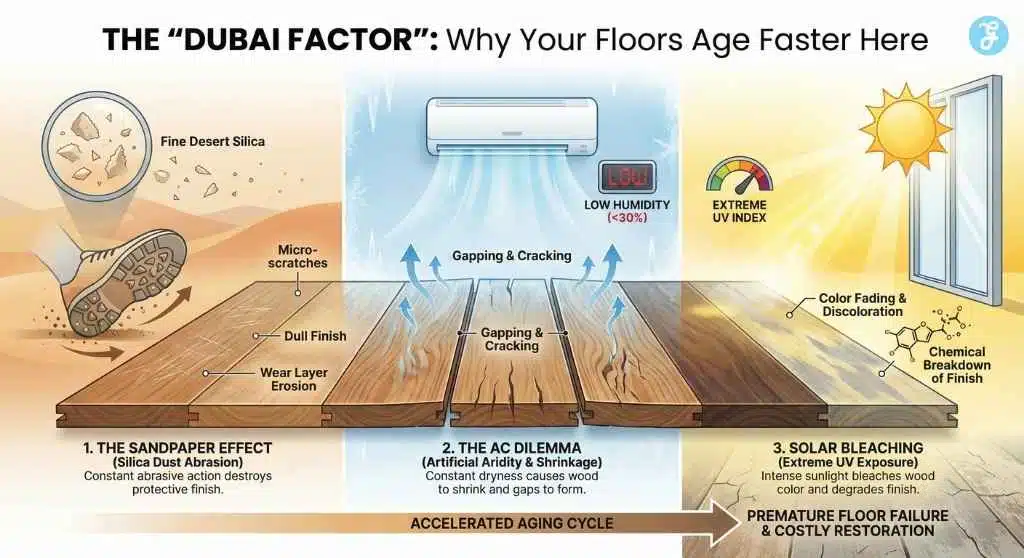
To understand how to protect your investment, you first need to understand the enemies your floor faces daily. In Europe or North America, water and mud are the primary threats. In the UAE, the threats are invisible and abrasive.
1. The Sandpaper Effect (Silica Dust)
The most significant threat to hardwood floor maintenance in Dubai is sand. It is not just the visible sandstorms; it is the microscopic silica dust that is always present in the air. When this dust settles on your floor, it acts like thousands of tiny shards of glass. Every time you walk across a dusty floor, your shoes grind this silica into the finish, effectively sanding down your protective coating day by day. This “micro-abrasion” dulls the shine of polyurethane finishes much faster than in non-desert climates.
2. The AC Dilemma (Artificial Aridity)
Dubai is humid outside, but your home is likely an artificial desert. Because air conditioning runs almost 24/7, the indoor relative humidity can drop significantly (often below 30%). Wood is hygroscopic, meaning it breathes. In such a dry environment, wood planks lose moisture and shrink, leading to “gapping”—those unsightly spaces that open up between boards. Conversely, if you turn the AC off while on holiday, the sudden spike in humidity can cause the wood to swell and “cup” (curl up at the edges).
3. Solar Bleaching (UV Damage)
The UV index in the UAE is extreme. Modern villas often feature floor-to-ceiling windows, which look stunning but act as magnifying glasses for UV rays. Prolonged exposure breaks down the chemical bonds in floor finishes and alters the cellular structure of the wood itself. Walnut floors will bleach into a pale yellow, while Oak can turn an amber orange.
Which Wood Survives Dubai Best?
If you are planning a renovation, note that not all woods can handle the UAE climate.
-
Best Suited: Engineered Oak or Teak. Engineered planks have a plywood base that resists the expansion/contraction caused by Dubai’s AC usage better than solid wood.
-
High Risk: Solid Maple or Beech. These are “nervous” woods that react dramatically to humidity changes, leading to frequent gapping or cracking in desert villas.
Your Maintenance Calendar: A Schedule for Success
Consistency is cheaper than restoration. By adhering to this schedule, you can delay the expensive and messy process of full sanding by years.
Daily & Weekly Routine
| Frequency | Task | The “Why” for Dubai Homes |
| Daily | Microfiber Dusting | Crucial: You must remove the fine silica dust before it is walked on. Brooms are ineffective as they just push dust into the air; a treated microfiber pad traps the particles. |
| Weekly | Vacuuming | Use a canister vacuum with a soft-bristle floor attachment. Never use a vacuum with a “beater bar” (rotating brush), as it will hammer sand granules into the finish. |
| Weekly | Damp Mopping | Use a pH-neutral cleaner specifically for wood. The mop should be “damp,” not wet. In Dubai’s AC environment, water evaporates quickly, but standing water is still the enemy. |
| Monthly | The “Gray Check” | Inspect high-traffic zones (hallways, entryways). If you see the wood grain turning gray, the finish has worn through, and water/dirt is penetrating the raw wood. |
Long-Term Care: The Recoat vs. Refinish Cycle
Many homeowners confuse “recoating” with “refinishing.” Knowing the difference can save you thousands of Dirhams.
Every 3–5 Years: The Screen & Recoat (The Refresh)
This is the maintenance step most people skip, leading to ruined floors.
-
What it is: A professional uses a buffer with a fine abrasive screen to lightly scratch the top layer of your existing finish. This removes surface scuffs and contaminants. Then, a fresh coat of polyurethane is applied.
-
The Result: Your floor looks brand new, the shine is restored, and the protective “wear layer” is thickened.
-
Time: usually takes 1 day.
-
Mess: Minimal dust.
Every 7–10 Years: The Full Sand & Refinish (The Reset)
If you skip the recoats, you will eventually need this.
-
What it is: Heavy sanding machines strip the floor down to the raw timber, removing the old finish and a thin layer of the wood itself. This eliminates deep gouges, sun damage, and gray oxidation.
-
The Result: A completely raw surface that can be stained a new color (e.g., changing from dark Walnut to a modern “Greige” Oak) and sealed.
-
Time: 3 to 5 days + curing time.
-
Mess: Significant dust (even with “dust-free” systems).
The “Seasonal Shift” Strategy (Winter vs. Summer)
In Dubai, your floor’s biggest stressor isn’t just time—it’s the change in your AC habits between winter and summer.
-
Summer (April – October): You likely run the AC 24/7. This keeps the home consistently dry. Action: If you travel for the summer, do not turn the AC off completely. Set it to 24°C-25°C. If you turn it off, the indoor humidity will spike to 70%+, causing your wood floors to absorb moisture and “cup” (curl up at the edges).
-
Winter (November – March): You might open windows to enjoy the breeze. While pleasant, this introduces drastic humidity fluctuations. Action: Keep an eye on your floor gaps. If the fresh air dries out the wood too much (desert nights are dry), you may see gaps widen.
Deep Dive: Signs Your Floor Needs Professional Attention
How do you know if you need a simple recoat or a full sanding? Perform these simple tests.
1. The Water Droplet Test
Pour a tablespoon of water onto a high-traffic area.
-
Result A (Beads up): Your finish is intact. Keep cleaning.
-
Result B (Soaks in slowly): Your finish is thinning. Schedule a Screen & Recoat soon.
-
Result C (Soaks in immediately/Darkens): The finish is breached. You have raw wood exposed. You need a Full Refinish.
2. The Glare Test
Stand with your back to a window and look at the floor at an angle.
-
Haze: If you see a cloudy, white haze that doesn’t wipe off, this is a buildup of wrong cleaning products (like oil soaps or wax). This requires a professional chemical strip before any recoating can happen.
-
Spiderwebs: Tiny, circular micro-scratches indicate sand damage. A recoat will fill these in and restore clarity.
Proactive Strategies for the UAE Climate
Beyond the calendar, there are environmental controls you can implement to extend the life of your hardwood floor maintenance in Dubai.
Managing Indoor Humidity
As mentioned, the AC dries out wood. Ideally, hardwood prefers a relative humidity (RH) of 45% to 55%. In a Dubai apartment running AC at 22°C, the humidity can drop to 30%.
-
The Solution: Use portable humidifiers in rooms with expensive parquet.
-
The Benefit: This prevents the wood from shrinking and stops those annoying “cracking” sounds you hear when walking at night.
Combatting UV Damage
You cannot move the sun, but you can block it.
-
Window Film: Install clear, UV-blocking films on large windows. High-quality films can block 99% of UV rays without darkening the room.
-
Rug Rotation: If you have area rugs, move them a few inches every few months. This prevents “picture framing,” where the floor under the rug remains dark while the surrounding floor fades.
The “No-Shoe” Policy
In many cultures, removing shoes is standard. For hardwood floor maintenance in Dubai, it is a technical necessity.
-
The Logic: Shoes trap sand in their treads. Walking inside with shoes is essentially taking 60-grit sandpaper to your luxury floor.
-
The Fix: Place high-quality “dirt-trapper” mats outside and inside the main door. The outside mat scrapes large debris; the inside mat captures fine dust.
The “Melting Mat” Warning: Rug Safety
Be extremely careful with the rugs you buy in the UAE. Many affordable rugs sold in local hypermarkets have a synthetic rubber or latex backing.
-
The Risk: In Dubai’s heat (even with AC), the plasticizers in these rubber backings can chemically react with your floor’s polyurethane finish. Over time, they can bond to the floor or leave a yellow, honeycomb-patterned stain that cannot be removed.
-
The Fix: Always buy a felt or natural rubber rug pad. If you already have a rubber-backed rug, never place it directly on the wood; use a felt barrier.
Choosing the Right Finish for Dubai
If you are refinishing your floors, the type of product you choose matters immensely in this heat.
Water-Based Polyurethane
-
Best for: Modern, light-colored floors (Maple, White Oak).
-
Why: It is clear and does not yellow over time (unlike oil-based, which turns amber). It dries fast (2-4 hours), which is great for busy Dubai households.
-
Durability: High-quality “Two-Component” (2k) water-based finishes are incredibly tough and resistant to the silica abrasion common in the region.
Oil-Based Polyurethane
-
Best for: Traditional, dark woods (Walnut, Mahogany).
-
Why: It adds a rich, amber glow.
-
The Downside: It smells strong and takes days to cure. It will yellow significantly under Dubai’s UV rays, so avoid this for white or grey floors.
Hardwax Oils (Natural Oils)
-
Best for: Matte, natural looks.
-
Why: It penetrates the wood rather than sitting on top.
-
Maintenance: These require more frequent maintenance (applying maintenance oil every 6-12 months) but are easier to spot-repair. If you scratch a lacquered floor, you have to refinish the whole room. If you scratch an oiled floor, you just sand that spot and add oil.
Troubleshooting Common Dubai Floor Issues
“My floors are making a popping sound.”
This is usually due to the AC. The wood has dried out and shrunk, causing movement between the planks and the subfloor (or the glue has become brittle).
-
Fix: Check your humidity levels. Introducing moisture (a humidifier) can sometimes re-expand the wood and stop the noise. If the glue has failed, a professional can use an injection kit to fix the hollow spot without removing the plank.
“I have white stains near the balcony door.”
This is likely water damage from condensation or an old planter pot.
-
Fix: If the white stain is in the finish, a recoat might hide it. If the wood itself is black/grey, the tannins in the oak have reacted with water. This requires sanding and bleaching the wood (using oxalic acid) before refinishing.
“The floor looks dull no matter how much I clean it.”
You are likely using the wrong cleaner. Many “supermarket” floor cleaners contain acrylic polish or wax. These leave a sticky residue that traps dust.
-
Fix: Stop using the product immediately. Use a professional deep-cleaning machine (scrubber-dryer) with a high-alkaline cleaner to strip the residue, then switch to a neutral pH cleaner.
Hiring a Pro in Dubai: The Vetting Checklist
The Dubai maintenance market varies wildly in quality. Before hiring a company for a “Screen & Recoat,” ask these 3 questions to avoid scammers:
-
“Do you use a dust-containment system?”
-
Correct Answer: “Yes, our sanders are connected to a HEPA vacuum unit.”
-
Red Flag: “Don’t worry, we will sweep up after.” (This will ruin your AC ducts with fine dust).
-
-
“What brand of finish do you use?”
-
Good Brands available in the UAE: Bona, Loba, Pallmann.
-
Red Flag: Unlabeled jerry cans or generic “varnish.”
-
-
“Can you do a test patch?”
-
Correct Answer: “Yes, we can test a small corner to ensure the new coat sticks to your old finish.”
-
Frequently Asked Questions (FAQ)
1. Can I recoat my engineered wood floors, or is that only for solid wood?
Yes, you can recoat engineered wood! In fact, recoating is safer for engineered wood than refinishing. Since engineered wood has a thin top layer of real hardwood (usually 3mm-6mm), you can only fully sand it 1 or 2 times before hitting the plywood core. Recoating adds protection without removing any wood, extending the life of engineered floors indefinitely.
2. How long do I need to stay out of my house during a recoat?
For a screen and recoat using water-based polyurethane, the disruption is minimal. The crew can usually finish in one day. You can walk on the floor in socks after 4-6 hours, and move furniture back after 24 hours. If you choose an oil-based finish, you may need to vacate for 2-3 days due to fumes and slow drying times.
3. Will a recoat fix the deep scratches from my dog?
No. A screen and recoat is cosmetic—it fixes scuffs, dullness, and surface scratches in the clear coat. If a scratch has penetrated the color or dented the wood fibers (i.e., you can feel it with your fingernail), a recoat will simply coat over the scratch. To remove deep scratches, you must sand the floor down (refinish).
4. Is “dust-free” sanding actually dust-free?
In Dubai, many companies claim “dust-free,” but it is technically “dustless.” Professional companies use massive HEPA vacuums attached to their sanders that capture about 98-99% of the dust. You will still find a fine film of dust on baseboards or shelves, but it is nothing like the dust storm created by traditional sanding methods. Always ask your contractor what type of dust containment system they use.
5. My floors have yellowed near the window. Will polishing fix this?
Polishing (recoating) will not fix the color. The yellowing is a chemical change inside the wood or the old finish caused by UV exposure. To fix the color, you must sand off the old yellowed finish and the top layer of damaged wood, then apply a new, UV-resistant finish.
Final Thoughts: The Art of Preservation in a Desert Climate
Owning hardwood floors in Dubai is a statement of luxury, bringing natural warmth to the often cool, modern architecture of the city. However, just as you wouldn’t drive a high-end car in this heat without regular servicing, your floors demand specific respect to survive the environment.
The “invisible enemies” of the UAE—microscopic silica dust and extreme UV rays—are relentless, but they are manageable. By shifting your mindset from reactive cleaning to proactive maintenance, you do more than just keep your floors shiny. You protect the structural integrity of a significant financial asset.
Remember, a screen and recoat every 3 to 5 years is not an expense; it is an insurance policy against a full, messy restoration. Don’t wait for the deep scratches to tell you it’s too late. In Dubai, the true secret to lasting elegance isn’t just the quality of the wood you buy, but the consistency of the care you give it.





























