Have you ever wished for an extra set of hands in your business? Someone who could write marketing emails, respond to customer inquiries at midnight, analyze data, and even help plan for the next month? That’s essentially what generative AI offers.
Today, it’s no longer limited to large companies with dedicated tech teams. According to the U.S. Chamber of Commerce’s 2025 Empowering Small Business Report, 58% of small businesses now use generative AI in their daily operations—up from 40% the previous year. This rapid growth highlights its increasing value and accessibility.
This guide explores everything needed to understand generative AI for small businesses, from its core concepts to practical ways to start using it right away. Whether operating a bakery, a boutique, or a service-based business, it covers the tools, benefits, and key challenges to consider.
Now is a great time to dive in.
What Is Generative AI?
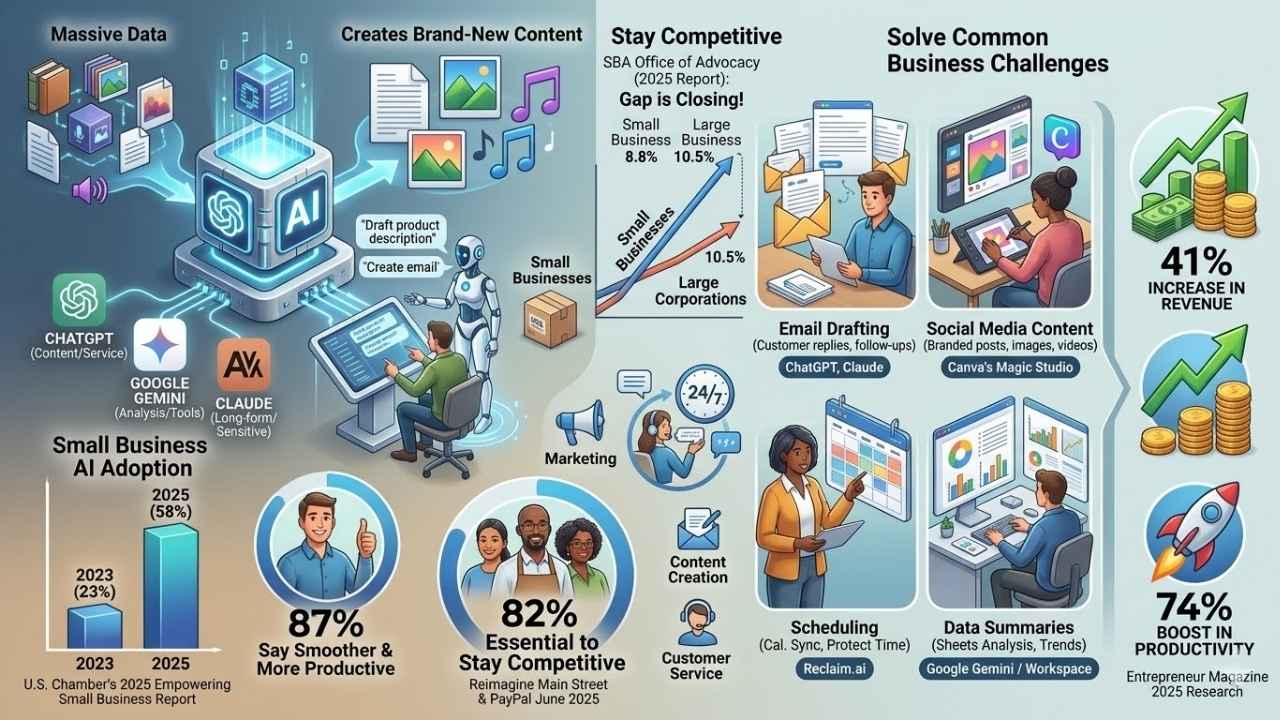
Generative AI is a type of artificial intelligence that learns from massive amounts of data and then creates brand-new content. We’re talking text, images, audio, and more.
Think of it like a very fast, very knowledgeable assistant. You give it a task, and it produces something useful. Ask it to write a product description, and it writes one. Ask it to draft a customer email, and it drafts one. All in seconds.
The most well-known tools are ChatGPT (made by OpenAI), Google Gemini, and Claude by Anthropic. According to a 2025 report from Mojo Trek, ChatGPT remains a powerhouse for content writing, customer service, and brainstorming, while Claude stands out for its precision on long-form writing and sensitive documents.
According to the U.S. Chamber’s 2025 Empowering Small Business Report, small business AI adoption has more than doubled since 2023, jumping from 23% to 58%. And 87% of those using AI say it makes their operations smoother and more productive.
For small business owners, this is not a tech trend to watch from the sidelines. It’s a practical set of tools you can use right now, even if you have zero technical background.
Why Small Businesses Should Leverage Generative AI
Small businesses have always had to do more with less. AI tools are changing that equation in a big way, helping owners compete, grow, and serve customers better without hiring a full staff to do it.
Staying Competitive in a Digital-First World
Here’s a number that might surprise you: according to a June 2025 survey by Reimagine Main Street and PayPal of nearly 1,000 small business owners, 82% of small businesses say adopting AI is essential to staying competitive today. That’s not hype. That’s owners telling you what they’re experiencing firsthand.
The gap between small businesses and large corporations is closing fast. A 2025 SBA Office of Advocacy report found that small business AI usage reached 8.8%, while large business adoption actually declined slightly to 10.5%. Small businesses are nearly caught up, and the ones leading the charge are using AI for marketing, content creation, and customer service.
AI-powered tools work around the clock so you don’t have to. A customer might reach out at midnight expecting an answer. With the right AI tool in place, they get one, without you losing any sleep.
Solving Common Business Challenges Efficiently
AI shines brightest when it takes on the tasks that eat up your day. Think about all the time you spend writing emails, answering repeat questions, scheduling appointments, and sorting through data. Each of those tasks is something AI can handle faster and with fewer errors.
- Email drafting: Tools like ChatGPT and Claude can write customer replies, follow-ups, and newsletters in seconds.
- Social media content: Canva’s Magic Studio lets you generate branded posts, images, and videos from a simple text description.
- Scheduling: Tools like Reclaim.ai sync your calendars and automatically protect time for your most important work.
- Data summaries: Google Gemini, built into Google Workspace, can analyze your Sheets data and surface trends you’d otherwise miss.
According to Entrepreneur magazine’s 2025 research, small businesses using AI have seen a 41% increase in revenue and 74% report a boost in productivity. Those are real business results, not just time savings.
Practical Applications of Generative AI for Small Businesses
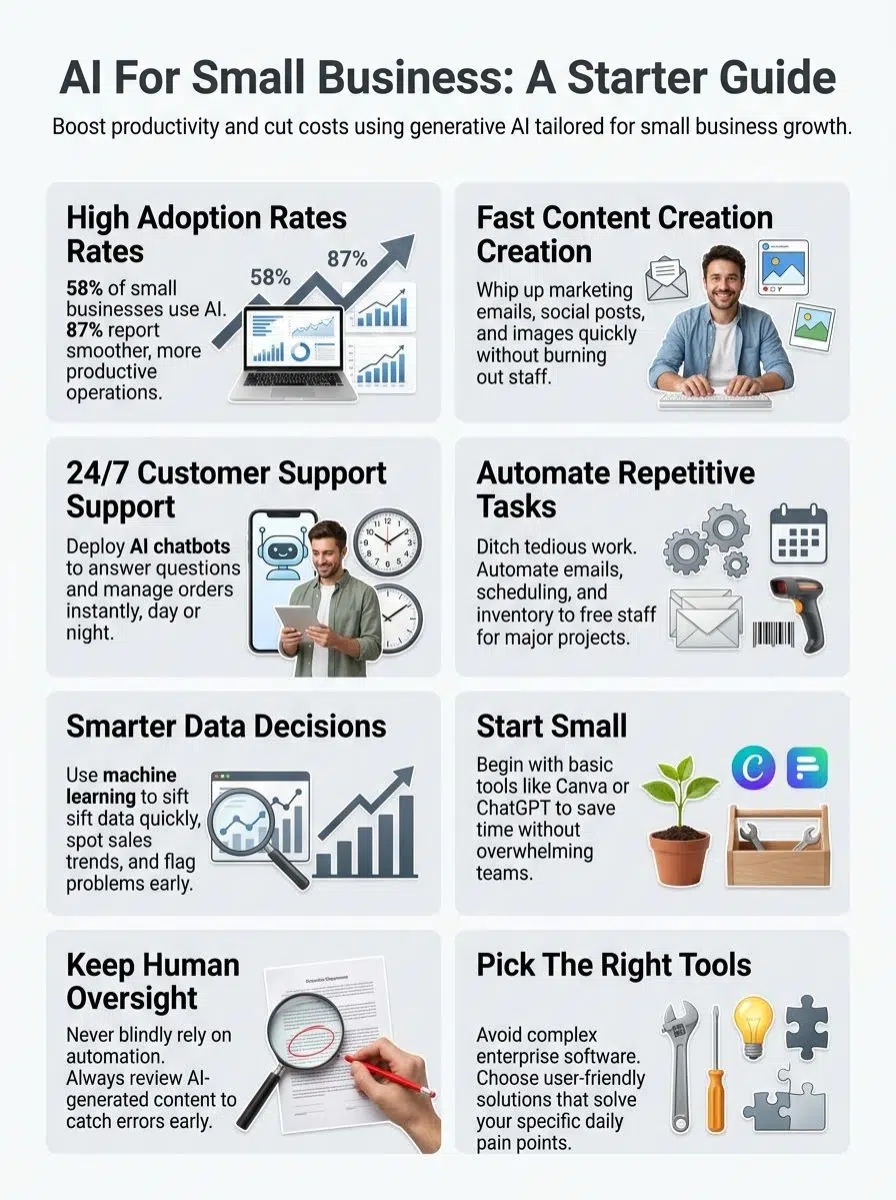
Let’s get into the specifics. Here’s where generative AI delivers the most value for small business owners on a day-to-day basis.
Content Creation for Marketing
Content creation is probably the most common place small business owners start with AI, and for good reason. It’s one of the biggest time drains in any small business marketing plan.
Tools like Jasper and ChatGPT can write blog posts, product descriptions, ad copy, email newsletters, and social media captions in a fraction of the time it would take you manually. What makes Jasper especially useful for small businesses is its Brand Voice feature, which learns your specific tone so the content sounds like you, not a generic robot.
For visuals, Canva’s Magic Studio (free plan available, Pro starts at $15/month) lets you generate branded graphics, resize designs for different platforms with one click, and write text using its Magic Write assistant. According to Canva’s own feature documentation, its “Magic Switch” tool transforms a presentation slide into an Instagram story or LinkedIn post automatically.
According to the 2025 Menlo Ventures State of Generative AI report, AI marketing platforms hit $660 million in enterprise spending last year, driven by content generation and campaign optimization. The tools powering those results are now available to every small business owner.
The U.S. Chamber’s 2025 report confirms that 58% of small businesses now use AI for content creation tasks like blog posts and email newsletters, with 87% saying it has made their daily operations more productive.
Streamlined Customer Communication with AI Chatbots
Your customers want answers fast. According to a 2025 SuperOffice study cited by Freshworks, nearly 50% of customers expect a response in under four hours, and 12% want help within 15 minutes. For a small team, that’s a tough standard to meet manually.
AI chatbots close that gap. They answer common questions, track orders, handle appointment bookings, and escalate complex issues to a real person, all 24/7.
The ROI is real. A 2025 industry analysis found that AI customer service delivers an average return of $3.50 for every dollar invested, with most small businesses seeing initial benefits within 60 to 90 days. Companies implementing AI customer service also report an average 25% reduction in service costs.
For small businesses specifically, tools like Tidio integrate directly with e-commerce platforms like Shopify, letting you answer customer questions instantly even outside business hours. According to Business Nucleus, a solo consultant can start with Tidio’s free tier and upgrade as their customer base grows.
A pro-tip I always share: don’t try to make your chatbot handle everything on day one. Start it on your top five most common questions. Get that working well before you expand its role.
Automating Repetitive Tasks and Processes
There’s a simple rule with automation: if you do it more than three times a week, there’s probably an AI tool that can do it for you.
According to a 2025 Entrepreneur report, about 33% of small businesses are already using AI to handle administrative tasks, often through tools they already have. The easiest wins? Turning on the AI features already built into your calendar, email, and project management apps.
For connecting multiple apps together, Zapier is a standout tool. You simply describe your workflow in plain English (for example, “When I get a new lead on Facebook, add them to my CRM and send a welcome email”), and Zapier builds the automation for you. No coding needed. Zapier’s pricing starts free, with paid plans beginning at $19.99/month.
For invoice processing, Stampli uses AI to automate accounts payable, reducing the time spent on manual data entry and integrating with major accounting systems. For scheduling, Reclaim.ai syncs across your calendars and prioritizes your most important tasks automatically.
The U.S. Chamber data confirms that 58% of small businesses now use these solutions for daily operations, and the time savings are significant. Digital transformation through automation frees up employees for higher-value work, which leads to better results for growth.
Enhancing Data Analysis for Smarter Decisions
You don’t need a data analyst on staff to understand what’s happening in your business. Generative AI can sift through your sales numbers, customer reviews, and website traffic in seconds and surface patterns you’d normally miss.
Take Zoho Analytics, for example. It can help a retailer forecast demand spikes during seasonal promotions by analyzing historical sales data alongside real-time trends. For businesses focused on customer predictions, Pecan AI delivers forecasts and churn prediction without requiring any coding skills.
According to the U.S. Chamber’s 2025 Empowering Small Business Report, 58% of small businesses now use generative AI to make smarter decisions on operations and marketing. The most common use, according to an ICIC survey of small business owners, is data analysis.
A bakery owner, for instance, might use AI to study which items sell best on which days, then adjust staffing or prep schedules based on actual customer demand rather than gut feeling. That’s the kind of insight that used to require expensive software or a consultant. Now it’s built into tools most small businesses can afford.
Benefits of Generative AI for Small Businesses
The benefits of generative AI go well beyond just saving a bit of time. Here’s how it actually moves the needle for small business growth.
Cost Savings and Increased Productivity
One of the most direct benefits is cost reduction. When AI handles tasks that would otherwise require extra staff or outside contractors, the savings add up quickly.
According to the 2025 business.com Small Business AI Outlook Report, AI investment among small businesses reached 57% in 2025, up from 42% in 2024. That acceleration is being driven by practical, low-cost tools like AI-driven invoicing, automated scheduling, and social media content generators.
The productivity numbers back this up. A 2025 Entrepreneur report found that 74% of small businesses using AI report an increase in productivity, and small businesses using AI have seen a 41% average increase in revenue. For a small team, that kind of lift is significant.
The U.S. Chamber’s report confirms that 87% of small business users report positive changes in their operations after adopting generative AI. Most repetitive tasks, from sorting emails to generating invoices, can now be handed off to AI, freeing your team to focus on work that actually grows the business.
Improved Customer Experience and Engagement
Customers today have high expectations. According to a 2025 Forrester stat cited by Freshworks, customers are 2.4 times more likely to stay loyal to a brand when their problems are resolved quickly. AI helps you hit that bar consistently.
Generative AI chatbots answer questions day or night without missing a message. AI-powered personalization engines get smarter with every interaction, making product recommendations feel relevant rather than random. And tools like HubSpot’s AI features can adjust email send times to maximize open rates in real time based on each subscriber’s behavior.
According to the U.S. Chamber’s 2025 report, 87% of small businesses saw positive changes in their daily operations after using generative AI for customer service. That improvement in experience directly translates to better reviews, stronger word-of-mouth, and more repeat business.
Faster Turnaround Times for Key Tasks
Speed is a competitive advantage. When a competitor takes two days to respond to a lead and you respond in two minutes, you win more often.
Generative AI compresses the time it takes to complete nearly every content-heavy or data-heavy task. A marketing email that used to take an hour to write now takes ten minutes. A sales report that required half a day of data pulling now gets generated automatically.
According to the St. Louis Fed’s November 2025 analysis of generative AI adoption, workers using AI reported that time spent on AI-assisted tasks grew from 4.1% of their work hours in November 2024 to 5.7% in August 2025, with consistent time savings reported across industries.
The U.S. Chamber data shows 87% of businesses say AI has improved their operations by boosting efficiency across key processes. For small businesses with lean teams and tight deadlines, that speed advantage is not a luxury. It’s a lifeline.
Real-World Example: How a Small Business Used Generative AI Effectively
Let’s look at how this all plays out in practice. Sometimes a real story makes the difference between “interesting idea” and “I’m doing this next week.”
The Challenge They Faced
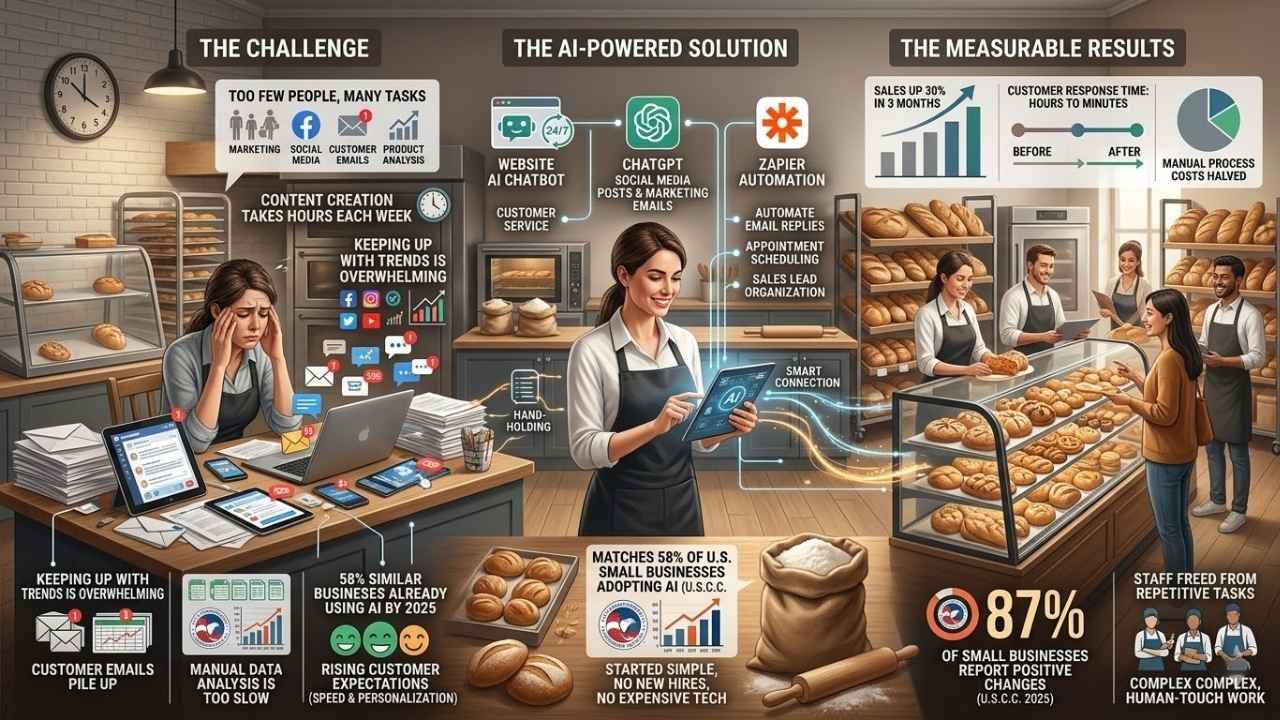
Before adding generative AI tools, this small bakery struggled with the classic small business squeeze: too few people, too many tasks, and not enough hours in the day.
Content creation for marketing took hours each week. Keeping up with social media trends felt like a second job. Customer emails piled up. And analyzing which products to push each season? That required spreadsheet work nobody had time for.
With 58% of similar businesses already using AI by 2025, according to the U.S. Chamber’s Empowering Small Business Report, falling behind felt like a real risk. Customer expectations around speed and personalization were rising, and traditional workflows simply couldn’t keep up.
The AI-Powered Solution They Implemented
The owner started simple, which is the smart move. They chose an AI chatbot for 24/7 customer service on their website and used ChatGPT to generate social media posts and marketing emails.
With only three employees, they also used Zapier to automate email replies, appointment scheduling, and sales lead organization. No new hires. No expensive tech setup. Just smart connections between tools they could afford.
According to the U.S. Chamber’s 2025 report, this approach matches exactly what 58% of U.S. small businesses are doing with AI adoption today.
The Measurable Results Achieved
The results came quickly and clearly.
- Sales jumped 30% within three months.
- Customer response times dropped from hours to minutes.
- Costs related to manual processes went down by nearly half.
- Staff were freed from repetitive tasks and could focus on the work that actually requires a human touch.
According to the U.S. Chamber’s 2025 Empowering Small Business Report, 87% of small businesses now report positive changes since adopting AI tools. The bakery’s experience is a clear example of what that looks like in practice: more sales, happier customers, and a team that isn’t burning out.
Steps to Get Started With Generative AI
Ready to bring AI into your small business? The good news is that you don’t need a big budget or a tech background to get started. Here’s a practical path forward.
Start Small with Basic AI Tools
The best first step is picking one tool and actually using it. Don’t try to overhaul everything at once.
Here are three user-friendly starting points that cost little or nothing to try:
- ChatGPT (Free or $20/month for Plus): Use it to write emails, draft social posts, create FAQ answers, or brainstorm marketing ideas. It’s the most versatile starting point for most small businesses.
- Canva Magic Studio (Free plan available, Pro at $15/month): Use it to create branded graphics, social media posts, and short videos without a designer. Its Magic Resize feature turns one design into formats for every platform in seconds.
- Zapier (Free tier available): Use it to connect your existing apps and automate simple workflows, like sending a welcome email every time you get a new contact form submission.
According to the U.S. Chamber’s 2025 report, more than half of small businesses started using AI with basic tools like these before expanding. The key is to pick the tool that solves your biggest daily headache first.
Integrate AI Gradually into Key Processes
Once you’re comfortable with one tool, add another. Think of it as building a team one hire at a time, not onboarding an entire department at once.
The U.S. Chamber’s 2025 Empowering Small Business Report found that 87% of small businesses report positive results from AI, and those who saw the best outcomes started with one clear use case before scaling.
A practical approach: in month one, use AI for content creation only. In month two, add a chatbot for customer questions. In month three, look at automating one internal workflow like scheduling or invoicing. By month four, you’ll have a solid AI-assisted operation without ever having felt overwhelmed.
According to business.com’s 2026 Small Business AI Outlook Report, practical low-cost applications like AI-driven invoicing and content generators are the entry points that lower the barrier to entry for even the smallest firms.
Seek Guidance from Reputable AI Providers
You don’t have to figure this out alone. Reputable AI providers, platform support teams, and small business-focused communities can point you to the right tools for your specific situation.
The U.S. Chamber’s CO— resource hub is a good starting point for small business AI guidance, with expert-backed advice on choosing tools that match your goals and budget. The SBA’s website also offers resources on AI adoption for small firms.
A word of caution from expert Patrick E. Murphy, Chief Investment Officer at Coastal Construction, who advises business owners against “adopting AI for AI’s sake.” His point: start with a real business problem, then find the tool that solves it. That’s how you avoid wasting money on tools that don’t fit your workflow.
Working with trusted platforms and communities keeps you from making costly early mistakes, and it shortens the learning curve considerably.
Common Mistakes to Avoid When Using Generative AI
AI tools are genuinely useful, but they come with real pitfalls. Knowing these ahead of time puts you in a much stronger position.
Over-Reliance on AI Without Human Oversight
This is the most important warning in this entire guide.
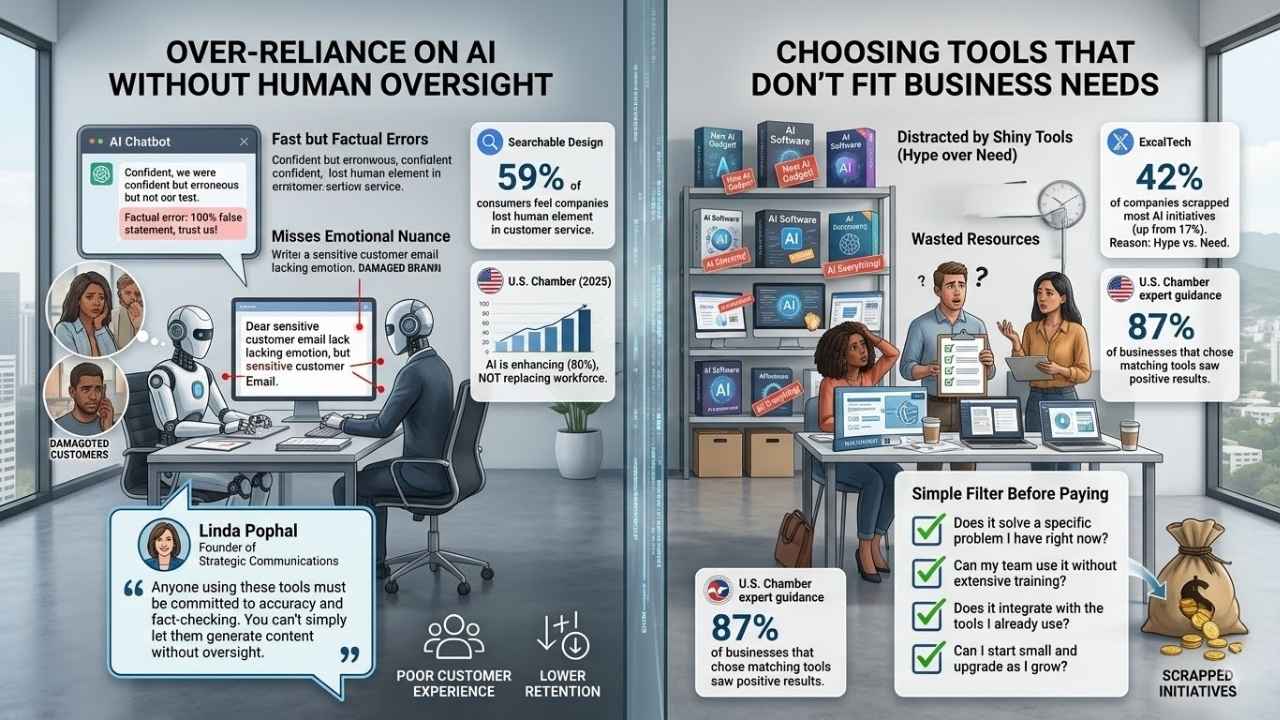
AI is fast, but it is not always right. It can produce content that sounds confident but contains factual errors. It can miss the emotional nuance in a sensitive customer message. And without a human reviewing its work, those mistakes go straight to your customers.
Research shared by Searchable Design found that 59% of consumers feel companies have lost the human element in customer service due to excessive AI usage. The consequences, including poor customer experience, lower retention, and damaged brand trust, are all things a small business cannot afford.
The U.S. Chamber’s 2025 report also found that 80% of small businesses say AI is enhancing, not replacing, their workforce. That’s the right mindset. Use AI to handle the volume and speed. Keep humans in the loop for judgment, tone, and anything that touches your customer relationship directly.
Linda Pophal, Founder of Strategic Communications, puts it simply: “Anyone using these tools must be committed to accuracy and fact-checking. You can’t simply let them generate content without oversight.”
Choosing Tools That Don’t Fit Business Needs
With hundreds of AI tools available, it’s easy to get distracted by the shiny ones that aren’t actually right for your business.
A 2025 analysis by ExcalTech found that 42% of companies have scrapped most of their AI initiatives, a number that jumped from just 17% the year before. The most common reason? Tools that were chosen based on hype rather than actual business need.
Here’s a simple filter to use before paying for any AI tool:
- Does it solve a specific problem I have right now?
- Can my team use it without extensive training?
- Does it integrate with the tools I already use?
- Can I start small and upgrade as I grow?
If the answer to any of those is “no,” keep looking. The best AI tool for your business is the one your team will actually use, and the one that directly addresses your biggest daily friction point. According to the U.S. Chamber’s expert guidance, 87% of businesses that chose tools matching their operations saw positive results. Fit matters far more than features.
Final Thoughts
Generative AI for small businesses is no longer a future concept. It’s a practical set of tools that’s helping real owners save time, cut costs, and serve customers better right now.
From marketing content creation to customer service automation and smarter data analysis, AI gives small businesses a way to compete and grow without adding headcount. The numbers speak for themselves: 87% of small business users report positive operational changes after adopting AI tools.
The best move you can make today is to start with one tool, solve one real problem, and build from there. For more guidance, explore trusted resources from the U.S. Chamber of Commerce or chat with an AI provider who understands small business needs. You may find your business running better than you ever expected.