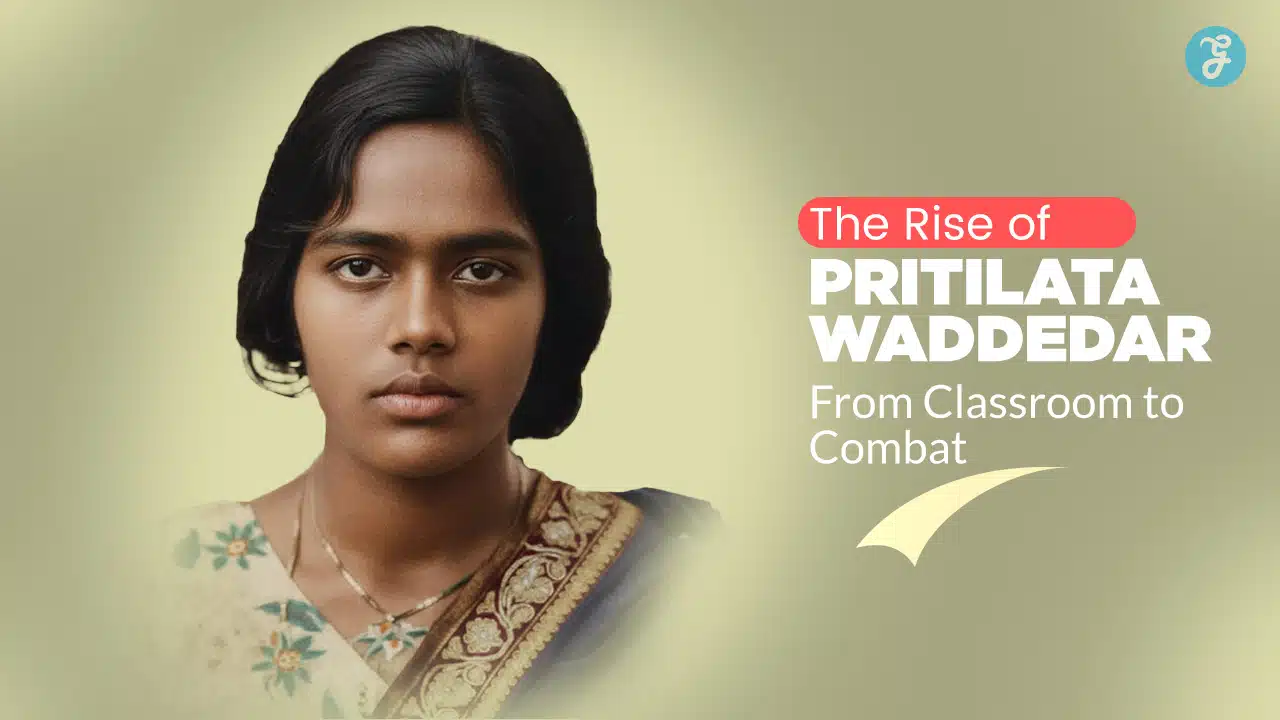
Pritilata Waddedar was a brilliant student, a devoted schoolteacher, and a fearless Bengali revolutionary from Chittagong. Born in 1911, she grew up in a family that valued learning and duty. She topped exams, studied philosophy, and taught in girls’ schools. But the world around her was harsh and unequal under the British Raj. Clubs and public spaces enforced racist rules. Ordinary people faced daily humiliation. Pritilata chose to resist. In this article, we trace from classroom to combat pritilata waddedar, exploring how a quiet educator became a symbol of courage.
Guided by Masterda Surya Sen and inspired by the Chittagong uprising, she moved from classroom plans to covert plans. She learned discipline, secrecy, and courage. On the night of September 23–24, 1932, she led a raid on the European-only club at Pahartali—a site often remembered for the message “Dogs and Indians not allowed.” The action aimed to shake a system that treated Indians as lesser. Wounded and surrounded, she took cyanide to avoid capture and protect her comrades. She was only twenty-one.
Today, Pritilata Waddedar stands as a symbol of resolve and dignity. Her story links education with action, and personal excellence with public courage. It shows how a young woman challenged empire, inspired other women freedom fighters, and left a legacy that still moves South Asia and the world.
From classroom to combat pritilata waddedar — a story of resolve
A single life can reveal how ideas turn into action. This subhead signals the path we follow: education and ethics on one side, risk and responsibility on the other. It is the arc that defines Pritilata’s rise.
Who Was Pritilata Waddedar?
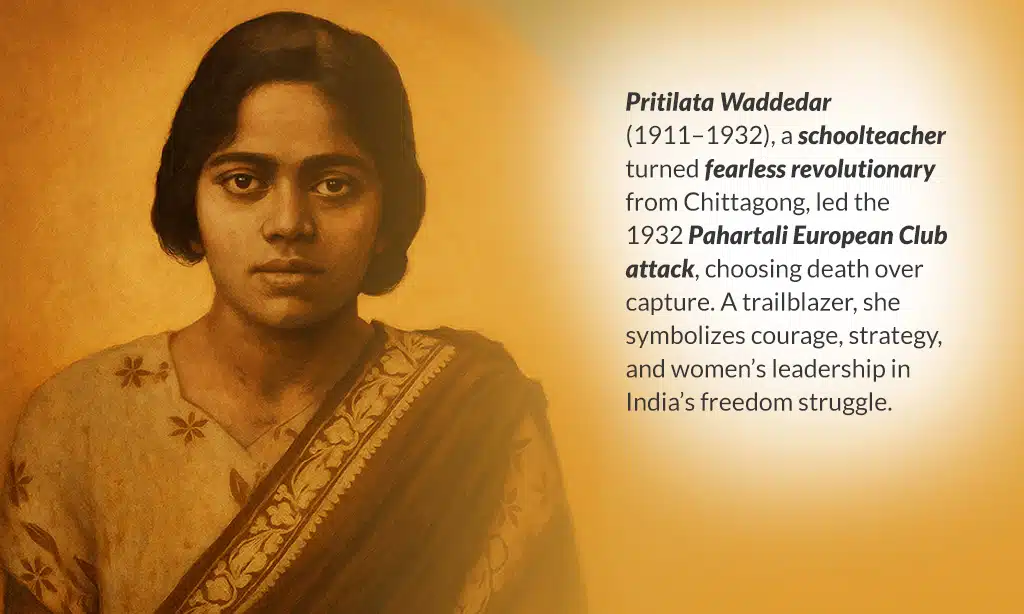
Before she became a legend, Pritilata was a steady, focused young woman who believed learning could change lives. She did not reach revolution by impulse. She reached it through thought, study, and a teacher’s instinct to protect her community. Bengal in the early 1930s was a furnace of ideas—self-respect, civil rights, and the right to dignity. She absorbed these currents and shaped them into action. To know her is to see both sides at once: the calm educator who prized discipline and the strategist who knew symbols can strike harder than slogans.
At a glance
| Fact | Detail |
| Full name | Pritilata Waddedar |
| Birth | May 5, 1911 (Dhalghat, Patiya, Chittagong; now Chattogram, Bangladesh) |
| Family | Middle-class, education-focused household |
| Calling | Schoolteacher; later revolutionary |
| Known for | Leading the 1932 Pahartali European Club attack |
| Death | Night of Sept 23–24, 1932; cyanide to avoid capture |
| Legacy | Symbol of women’s leadership in India’s freedom struggle |
Early Life & Education: The Making of a Rebel
Pritilata’s childhood was ordinary in the best way: books on the table, respect for teachers, and a home that treated diligence as a virtue. Yet the classrooms she excelled in stood within a larger system that limited what Indians could dream for themselves. Exams measured knowledge. The Raj measured obedience. That friction—between brilliance and boundaries—shaped her temperament. By the time she completed higher studies, she had a teacher’s clarity about right and wrong, and a student’s hunger to test ideas against the real world.
Quick scan: early life and studies
| Item | Snapshot |
| Schooling | Dr. Khastagir Government Girls’ School, Chittagong |
| College (Dhaka) | Eden College; ranked at the top in board exams |
| College (Calcutta) | Bethune College; Philosophy (noted for distinction) |
| Early activism | Women’s groups such as Dipali Sangha and Chhatri Sangha |
| Skills shaped | Rigor, discipline, public-spiritedness, clarity of purpose |
Why this matters: Education did not pull her away from civic duty. It trained her for it. Study gave her the language to name injustice and the habits to resist it with care.
Joining the Underground: Mentors, Networks, Ideology
Revolutionary circles did not recruit loudly. They watched, they waited, and they chose carefully. Pritilata stood out for her self-command and for a style that did not dramatize danger. She entered a tight network where messages moved by word of mouth, plans were broken into small parts, and no one carried more information than they needed. In that world of whispers, mentors mattered. They trained her to read a street, weigh a risk, and keep the mission above ego. Ideology was not abstract there; it was a working code: protect the weak, accept hardship, and never betray the team.
How the network worked
| Element | Description |
| Mentor | Masterda Surya Sen, leader of the Chittagong revolutionaries |
| Allied women | Kalpana Datta and others; women took on active roles |
| Training | Disguise, observation, signals, courier routes, small-arms basics |
| Cells & secrecy | Compartmentalized teams; strict “need-to-know” rules |
| Personal traits | Patience, precision, and calm under pressure |
Context: Women were seldom admitted to violent underground work. By earning trust through performance and discipline, Pritilata helped widen the space for women in high-risk operations.
Planning the Pahartali European Club Attack (1932)
The target was not random; it was rhetorical. The European Club stood for a rulebook that separated, insulted, and normalized exclusion. The plan aimed to puncture that rulebook in public view. Preparation meant more than weapons. It meant mapping routes, memorizing guard habits, checking the light at different hours, and knowing when noise was a tactic and when silence saved lives. Logistics had to look ordinary enough to pass unnoticed and precise enough to work under pressure. The goal was to turn a building into a message: this line you drew between “us” and “them” will not hold.
Planning highlights (reader-friendly)
| Step | Focus | What it looked like |
| Target selection | Symbol over scale | A whites-only club with deep local resentment |
| Reconnaissance | Schedules, guards, exits | Quiet visits, timing notes, fallback routes |
| Team roles | Small, coordinated units | Clear duties and simple signals |
| Supplies & safety | Arms, disguise, cyanide | Cyanide carried to prevent network exposure |
| Intended effect | Moral shock over body count | A public message against racial segregation |
Note on the club’s sign: The phrase “Dogs and Indians not allowed” appears in many accounts and local memories. Some phrase it slightly differently. In any form, the remembered message conveys racist exclusion that the action aimed to confront.
The Night of the Raid: Strategy, Execution, Aftermath
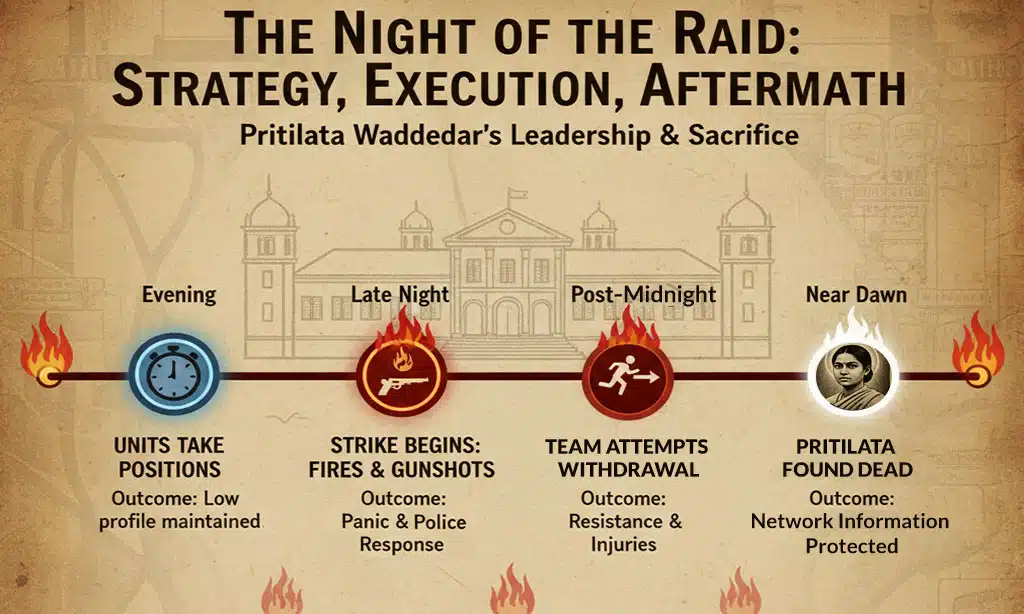
Operations look tidy on paper; real nights are messy. The team carried a simple brief—strike fast, create shock, slip out. Pritilata’s leadership showed in small things: staggered approach, clear hand signals, and quiet role swaps if anything changed. Once the first move was made, time compressed. Every sound was data; every light could give them away. The team set parts of the building on fire to sow panic. Gunfire followed. A police response came quickly. Accounts suggest one European woman died and others were injured. The attackers tried to scatter in pre-planned directions. In the exchange, Pritilata was wounded.
With escape routes closing and capture likely, she followed orders agreed before the mission and ingested cyanide. She died before interrogation. For the network, that choice acted like a firewall. The next day, police identified her body and recovered items that tied her to the plan. The story spread fast. People did not only talk about the attack. They talked about the leader—young, trained, and determined.
Raid timeline (condensed)
| Time (approx.) | Action | Outcome |
| Evening | Units take positions | Low profile maintained |
| Late night | Strike begins; fires and gunshots | Panic and police response |
| Post-midnight | Team attempts withdrawal | Resistance and injuries |
| Near dawn | Pritilata found dead | Network information protected |
Why this matters: The raid was intended as a symbolic strike. The aftermath shows how symbols travel. The building was a site; the story was the signal.
Martyrdom & Message: Why Pritilata Chose Cyanide
In this context, cyanide was not an act of despair; it was a known response to a predictable threat—interrogation designed to break bodies and expose networks. Pritilata accepted that burden before the mission began. Her final act must be read through that lens of duty: one life measured against many lives and the secrecy that protected them. It also reframed the narrative. Martyrdom, for her, was not spectacle; it was protection. The message that survived was not only defiance of empire but loyalty to comrades and cause.
Ethical context at a glance
| Question | Short answer |
| Why carry cyanide? | To block forced disclosure under torture if captured |
| Was it planned? | Yes; a rule agreed for some high-risk missions |
| Is it celebrated? | It is treated as duty and agency, not romance |
| Historical effect | Preserved networks and hardened public resolve |
Broader debate: India’s freedom struggle had many approaches. Some were non-violent. Some were armed. Pritilata’s choice sits inside that wider debate. Understanding it does not require agreement with violence. It asks for clarity about what high-risk resistance meant under a coercive state.
Legacy & Impact on Women in India’s Freedom Struggle
After the raid, the region did not only remember the explosion; it remembered who led it. For young women, Pritilata’s example redrew the map of what was possible. She proved that discipline, study, and steady nerves—not brute force—decide who can lead. Her name threaded into hostels, halls, road signs, and campus debates, turning memory into mentorship. Each commemoration told students: your mind is your first tool; your courage is your second. In this way, the phrase from classroom to combat pritilata waddedar became more than a line—it became an educational promise.
Where the legacy lives
| Place / Institution | What it honors | Why it matters |
| Memorial near former European Club, Chittagong | Bust and plaques | Marks the site of her last mission |
| University halls named after her | Safe, dignified student housing | Normalizes women as leaders |
| Annual observances | Talks, essays, student programs | Turns memory into public learning |
| Women’s history syllabi | Case studies and debates | Helps students see agency and risk |
| Civic life & media | Documentaries, features, plays | Keeps her story in public view |
Impact on participation: Stories like hers encouraged more women to step into organizing, logistics, and sometimes combat roles. They also reshaped how the public viewed women’s competence in crisis.
How History Remembers Her: Textbooks, Films, Memorials
History is never fixed; it is rewritten by each generation’s questions. Pritilata’s story has moved from footnotes to features, from local legend to national teaching. Textbooks seek balance, films seek emotion, and memorials seek permanence. Together they create a composite picture that keeps evolving. In some tellings she is the daring commander; in others she is the scholar who became a symbol. Tracking these versions does not dilute her legacy—it shows how a single life can speak to different needs across time and borders.
Memory & media map
| Medium | Examples / Notes | Use in classrooms |
| Textbooks | Short biographies, exam notes, timelines | Quick recall of dates and deeds |
| Historical monographs | Detailed chapters on Chittagong uprising | Deeper context and sources |
| Memoirs | First-person accounts by contemporaries | Lived experience of risk and duty |
| Films / theatre | Biographical scenes and composite characters | Emotional connection for students |
| Public memorials | Busts, plaques, named buildings | Place-based learning and field visits |
Reading the shifts: Over time, feminist readings have emphasized her agency and leadership. Regional histories have filled in local voices. Popular culture has widened the audience. Each layer adds to understanding.
Lessons for Today: Courage, Identity, and Resistance
You do not have to live under empire to learn from Pritilata. Her method applies to any high-stakes challenge: understand the system, pick the point of leverage, plan for failure, and protect your team. She teaches that symbols matter—choose them with care. She also shows that leadership is a craft, not a personality trait. You build it through reading, rehearsal, and reflection. In workplaces, classrooms, and communities, those habits still move the needle. For teams, repeating from classroom to combat pritilata waddedar can work like a mantra: prepare well, act bravely, protect each other.
Actionable takeaways (modern life)
| Challenge | Her method | Your move today |
| Complex problem | Break it into units | Small tasks, clear owners |
| Public message | Choose the right symbol | Define what the action stands for |
| Risk management | Plan fallbacks | “If-this-then-that” checklists |
| Team safety | Protect information routes | Need-to-know sharing |
| Personal growth | Train before crunch time | Practice under low stakes |
Why from classroom to combat pritilata waddedar Still Matters
From classroom to combat pritilata waddedar is more than a phrase—it is the shape of her life. She excelled in school, joined women’s networks, and stepped into a high-risk mission that challenged both colonial rule and gender norms. The raid at the Pahartali European Club made a moral point: racial exclusion would not go unchallenged. Her death at twenty-one froze that message in time. Monuments and university halls keep her name alive, but her deeper legacy is a blueprint for courage, preparation, and purpose. In our moment, remembering from classroom to combat pritilata waddedar reminds us to study hard, organize well, choose symbols with care, and act with integrity.