
Executive leadership is undergoing a radical transformation. For decades, the standard playbook for growing companies was rigid: you hire full-time executives, pay them six-figure salaries, and hope they fit the long-term culture. But in 2025, that model is breaking down. Startups and mid-sized enterprises are realizing they don’t always need a permanent Chief Technology Officer (CTO) warming a seat 40 hours a week. What they need is high-level strategy, agility, and technical roadmap execution—often for just a fraction of the time.
Enter the Fractional CTO. This shift isn’t just a temporary gig-economy fad; it is a fundamental restructuring of how businesses access elite talent. By hiring a part-time CTO, companies can tap into the expertise of a seasoned veteran who has led exits and digital transformations, without the crushing overhead of a full-time executive package. Whether you are navigating a Series A fundraise, tackling technical debt, or integrating AI into legacy systems, the fractional leadership model offers a surgical, cost-effective solution to complex problems.
What is a Fractional CTO?
A Fractional CTO is an experienced technology executive who serves your company on a retainer or part-time basis. They are not consultants who merely write reports and leave; they are operational leaders who sit on your leadership team, own the technology strategy, manage developers, and make critical architectural decisions.
Defining the Role: Strategic vs. Hands-On
The primary function of a Fractional CTO is to bridge the gap between business goals and technical execution. In the early stages of a partnership, they might spend time auditing code or setting up CI/CD pipelines (hands-on). However, their true value lies in high-level strategy:
- Roadmapping: Defining what to build, when to build it, and—crucially—what not to build.
- Vendor Selection: Negotiating contracts with cloud providers or software vendors to prevent lock-in and overspending.
- Team Structuring: Deciding whether to hire in-house, outsource to an agency, or build a hybrid team.
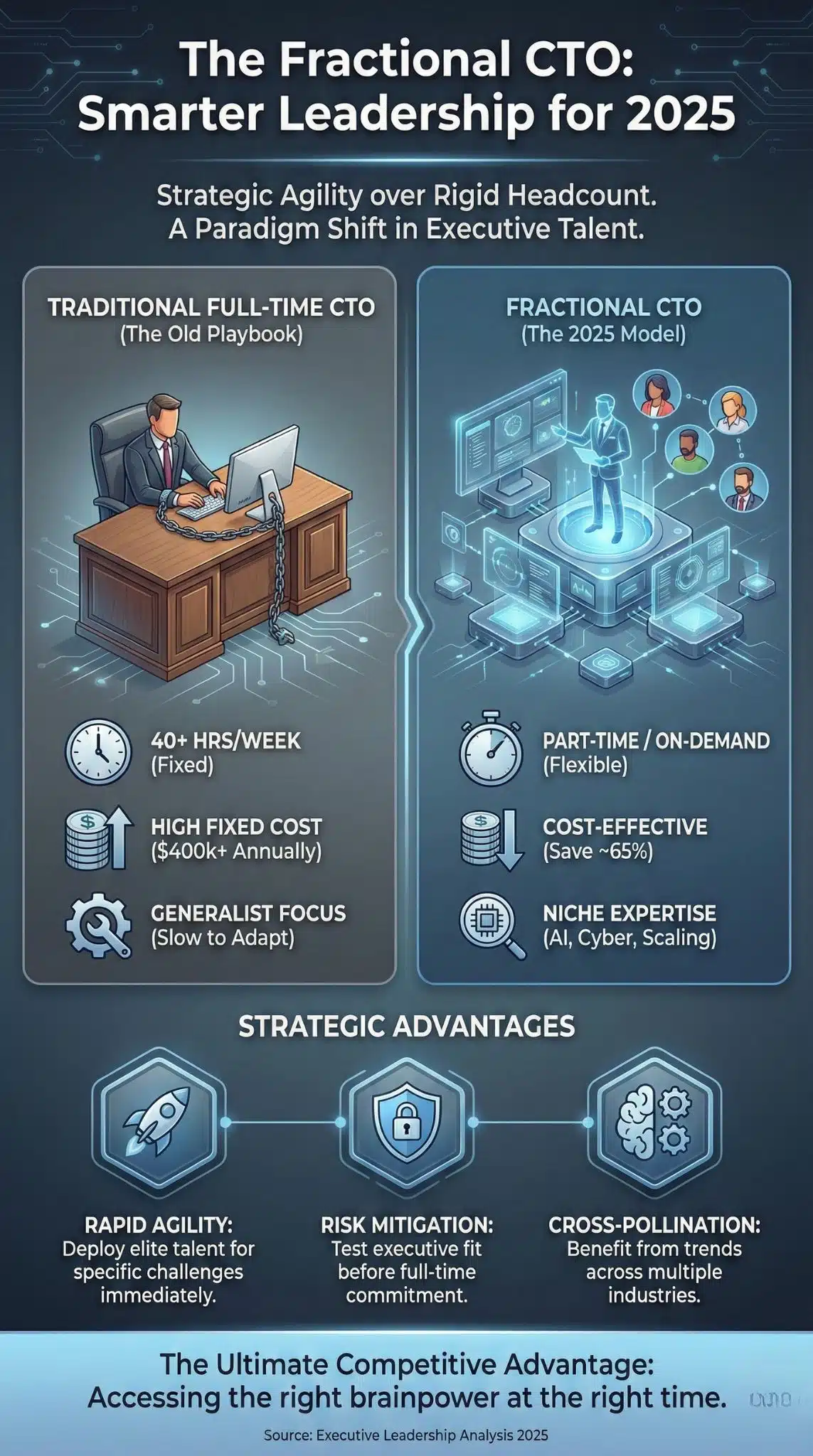
They operate with the authority of a C-level executive but spread their time across 2–4 non-competing clients. This “portfolio” approach ensures they stay sharp, seeing trends across multiple industries rather than getting siloed in one company’s tech stack.
Fractional vs. Interim vs. Full-Time
It is vital to distinguish between these roles. An Interim CTO is a stop-gap measure—someone hired full-time for a short period (3–9 months) to keep the lights on while you search for a permanent hire. A Fractional CTO is a long-term partner who works part-time (e.g., 5–10 hours a week) indefinitely.
The table below clarifies the differences to help you decide which model fits your current growth stage.
Leadership Model Comparison
| Feature | Fractional CTO | Interim CTO | Full-Time CTO |
| Commitment | Part-time (ongoing, long-term) | Full-time (short-term, fixed) | Full-time (permanent) |
| Primary Goal | Strategic guidance & scalability | Crisis management & stability | Deep cultural integration & operations |
| Cost Model | Monthly retainer ($5k–$15k) | High monthly salary ($20k+) | Salary + Equity + Benefits ($250k+) |
| Best For | Seed/Series A Startups, SMEs | Leadership transition gaps | Late-stage Scaleups, Enterprises |
| Flexibility | High (scale hours up/down) | Low (fixed duration) | Low (rigid employment contract) |
The Economic Driver: Why the Trend is Exploding
The surge in hiring a part-time CTO is largely driven by simple economics. In 2024 and 2025, capital efficiency became the primary metric for investors. Growth at all costs is out; sustainable unit economics are in.

The Cost-Benefit Analysis
Let’s look at the hard numbers. A competent, experienced full-time CTO in a major tech hub (US/Europe) commands a base salary between $200,000 and $300,000. When you add payroll taxes, health insurance, bonuses, and equity grants, the “fully loaded” cost often exceeds $400,000 per year.
For a startup with $2M in funding or a mid-sized business with $5M in revenue, spending nearly half a million dollars on a single role is rarely justifiable—especially if the technology strategy doesn’t require 40 hours of maintenance every week.
In contrast, a Fractional CTO might charge a retainer of $8,000 to $12,000 per month. That totals $96,000 to $144,000 annually. This represents a direct cash savings of nearly 65%, capital that can be reinvested into product development, marketing, or extending the company’s runway.
Hidden Costs of Full-Time Hires
Beyond the salary, full-time executives carry hidden financial risks:
- Equity Dilution: Full-time CTOs often expect 1%–5% equity. Fractional leaders usually take cash, or a very small advisory slice (0.25%), preserving the cap table for founders and investors.
- Severance and Recruiting: Hiring the wrong full-time CTO is disastrous. Executive recruiters charge 20–30% of the first year’s salary (up to $90k) just to find candidates. If the hire fails, severance packages can cost another 3–6 months of salary. Fractional agreements can typically be terminated with a simple 30-day notice.
Cost Comparison Breakdown (Annual)
| Expense Category | Full-Time CTO | Fractional CTO | Savings |
| Base Compensation | $250,000 | $120,000 (avg. retainer) | $130,000 |
| Benefits/Taxes (30%) | $75,000 | $0 (Contractor) | $75,000 |
| Recruiting Fees | $60,000 (one-time) | $0 | $60,000 |
| Equity Value (Est.) | $100,000+ | $0 – $10,000 | ~$90,000 |
| Total First Year Cost | ~$485,000 | ~$130,000 | ~$355,000 |
Strategic Agility: Accessing Top-Tier Talent on Demand
Cost is a major factor, but agility is why companies stay with the model. The technology landscape moves too fast for a generalist to master everything. A full-time CTO might be great at managing people but weak on AI implementation.
Niche Expertise: AI, Cybersecurity, and Compliance
One of the most compelling reasons for hiring a part-time CTO is the ability to rent “super-specialized” skills.
Imagine you are a healthcare fintech company. You need a leader who understands HIPAA compliance, blockchain security, and legacy banking integration. Finding one person with all three skills willing to work full-time is a “purple squirrel” hunt—nearly impossible and incredibly expensive.
With the fractional model, you can hire a Fractional CTO who specializes specifically in FinTech Security for the 12 months you need to build the infrastructure. Once the system is stable, you might rotate them out for a leader who specializes in scaling data teams or AI product features. This modular approach keeps your leadership aligned with your immediate technical challenges.
The “Portfolio Career” Advantage
Fractional leaders often work with 3–4 companies simultaneously. This gives them a unique “cross-pollination” advantage. A problem your company faces today (e.g., a specific AWS scaling bottleneck) might be something they solved for another client last week.
They bring a library of templates, vendor relationships, and best practices that a full-time employee, who has been heads-down in one company for five years, simply doesn’t have. They know which dev shops are reliable, which project management tools actually work, and which “trends” are just marketing hype.
Expertise Domains & Use Cases
| Domain | Typical Fractional Use Case | Business Impact |
| AI & Machine Learning | Implementing LLMs into existing SaaS products. | Accelerates feature release by 6–12 months. |
| Cybersecurity | Preparing for SOC2 or ISO 27001 audits. | Unlocks enterprise deals requiring compliance. |
| Due Diligence | Reviewing code/tech before an M&A event. | Prevents acquiring “lemon” technology stacks. |
| Turnaround | Rescuing a failing software project. | Stops cash burn on non-viable development. |
5 Signs Your Business Needs a Fractional CTO
Not every company needs a Fractional CTO. If you are a pre-revenue startup, a Lead Developer is likely enough. If you are a Google-sized enterprise, you need full-time VPs. The sweet spot is the “Scale-Up” phase. Here are the five clearest signs it is time to make the hire.
1. The “Technical Debt” Trap
Your early engineers built quickly to get an MVP to market. Now, the system crashes when traffic spikes, features take weeks to release instead of days, and your developers spend 80% of their time fixing bugs. This is technical debt. A Fractional CTO can pause the chaos, audit the architecture, and implement a “refactoring roadmap” that balances new features with system stability.
2. Investor Readiness and Due Diligence
You are raising a Series A. Investors are asking for your technical roadmap, security protocols, and disaster recovery plans. If your answer is “our lead dev handles that,” you look risky. A Fractional CTO speaks “investor language.” They can create professional artifacts (diagrams, documentation) that prove your technology is an asset, not a liability, increasing valuation confidence.
3. Scaling Pains and Bottlenecks
You have hit $1M ARR and want to grow to $10M. The processes that worked for a team of three developers will break a team of ten. You need formalized code reviews, staging environments, and automated testing. A Fractional CTO installs these “big company” processes tailored to your size, preventing the growing pains that kill momentum.
4. Managing Vendors vs. Managing Code
Non-technical founders often rely on external dev agencies. Without technical oversight, these agencies can bloat hours, use outdated tech, or hold IP hostage. A Fractional CTO acts as your advocate, auditing the agency’s code, enforcing deadlines, and ensuring you actually own the software you are paying for.
5. The “Lonely” Lead Developer
Your current most senior tech person is a brilliant coder but hates management. They are burnt out because they are trying to code all day and manage the team all night. Bringing in a Fractional CTO to handle the leadership (hiring, strategy, vendor management) frees up your lead developer to do what they love—write great code.
Diagnostic Checklist
| Symptom | Diagnosis | Fractional Solution |
| Feature delays | “Spaghetti code” & lack of process. | Implement Agile/Scrum & CI/CD pipelines. |
| High cloud bills | Unoptimized infrastructure. | Audit AWS/Azure usage & negotiate credits. |
| Security anxiety | No disaster recovery or compliance. | Conduct security audit & set up SOC2 prep. |
| Vendor friction | Agency overpromising/underdelivering. | enforce strict SLAs & code quality reviews. |
How to Hire and Manage a Fractional CTO
Hiring a fractional leader is different from hiring an employee. You are essentially procuring a high-value service.
Where to Find Them
Avoid standard job boards like Indeed. Top-tier fractional talent rarely applies to blind ads.
- Specialized Agencies: Firms like Fractional or CTO Craft curate vetted networks of leaders.
- Referral Networks: Ask VCs or advisors. They often have a “rolodex” of trusted tech leaders they parachute into portfolio companies.
- LinkedIn Search: Look for keywords like “Fractional CTO,” “Advisory CTO,” or “Portfolio Executive.”
Setting KPIs and Expectations (The First 90 Days)
Success depends on clear alignment. Since they aren’t there 40 hours a week, you must define output, not input.
- Month 1 (Discovery): They should interview the team, audit the code, and review the budget. Deliverable: A “State of Tech” report and a 12-month Roadmap.
- Month 2 (Stabilization): Implement quick wins—fixing a critical bug, firing a bad vendor, or setting up a deployment process. Deliverable: measurable uptime improvement or cost reduction.
- Month 3 (Execution): begin hiring key roles or leading the build of major architecture. Deliverable: Successful key hire or feature launch.
Managing the Relationship
Treat them as a partner, not a vendor. Invite them to board meetings. Add them to the company Slack. Ensure they have authority. If the engineering team sees the Fractional CTO as an “outsider” whose advice is optional, the engagement will fail. You must empower them to make decisions.
Onboarding & Management Checklist
| Phase | Action Item | Success Metric |
| Pre-Hire | Define specific problem (e.g., “Fix our mobile app”). | Clear Scope of Work (SOW). |
| Week 1 | Grant access to GitHub, AWS, Jira, Slack. | Full system visibility. |
| Monthly | Strategic alignment meeting with CEO. | Roadmap on track vs. budget. |
| Quarterly | Review ROI of the engagement. | measurable $ savings or % speed increase. |
Final Thoughts
The rise of Fractional Leadership signifies a maturity in the tech ecosystem. Companies are moving away from vanity metrics—like headcount—and toward efficiency and expertise. Hiring a part-time CTO allows ambitious businesses to punch above their weight class, leveraging the wisdom of a seasoned executive without the crushing financial weight of a full-time C-suite package.
In a market defined by rapid AI advancement and economic scrutiny, the ability to access the right brainpower at the right time is the ultimate competitive advantage. Whether you need to clean up technical debt, prepare for an exit, or simply stop bleeding money on cloud costs, a Fractional CTO is often the smartest investment you can make in 2025.