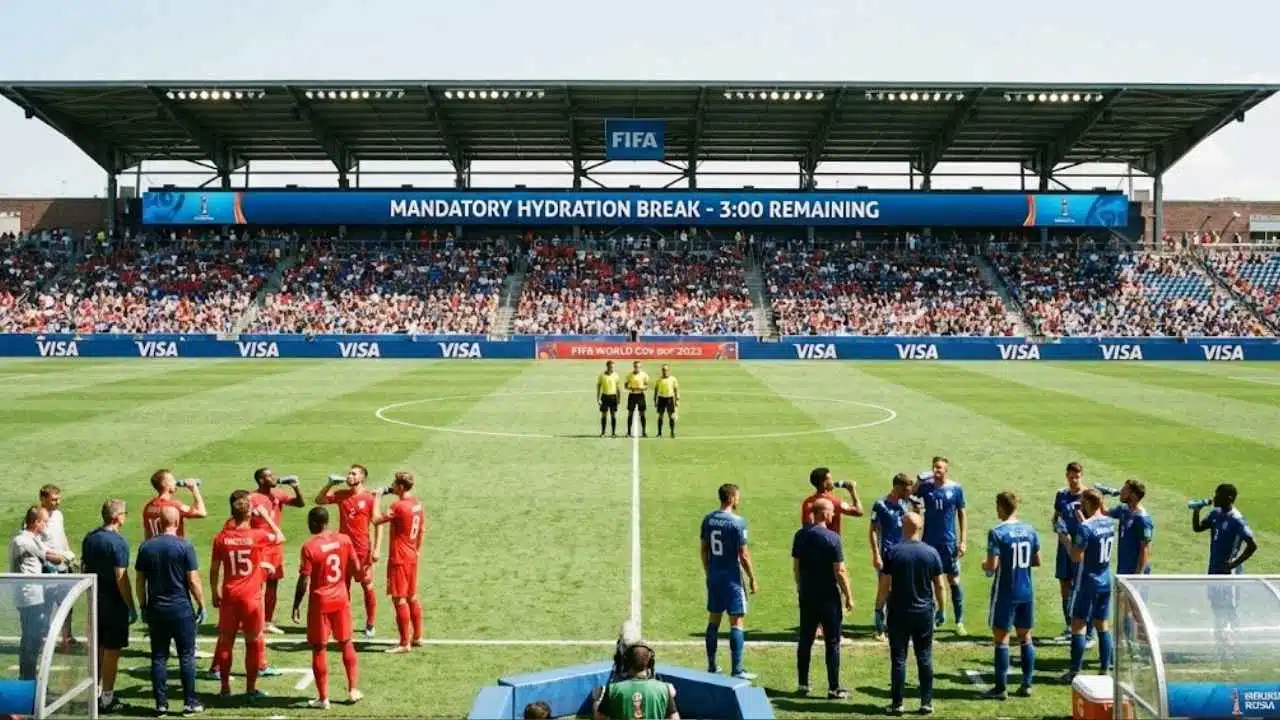
The beautiful game is getting a new rhythm, and purists are already crying foul. In a move that fundamentally alters the structure of the sport, FIFA confirmed this week that every match at the 2026 World Cup in North America will feature a mandatory three-minute “hydration break” in each half.
Gone are the days when these pauses were reserved for scorching heat or high humidity. Under the new regulations, referees will stop play at the 22nd minute of each half, regardless of the weather. Whether it is a sweltering afternoon in Miami or a climate-controlled evening under the roof of Dallas’s AT&T Stadium, the whistle will blow, the clock will stop, and the game will pause.
Safety First or Commercials First? FIFA’s Chief Tournament Officer, Manolo Zubiria, pitched the change as a non-negotiable safety measure. This is about player welfare,” the governing body stated, citing the extreme summer temperatures expected across host cities in the U.S., Mexico, and Canada. The decision follows complaints from the 2025 Club World Cup, where players struggled in the American heat even when temperatures technically stayed below the old “danger threshold.” By making the breaks mandatory, FIFA claims it ensures “equal conditions” for all 48 teams.
However, the skepticism from fans and pundits has been immediate and loud. Critics argue that by standardizing these stops, FIFA has effectively sliced the traditional 90-minute game into four distinct quarters.
“It’s the Americanization of football,” wrote one European analyst. The standardized 22nd-minute pause provides broadcasters—particularly Fox Sports in the U.S.—with a predictable, lucrative window for television commercials. In a sport famous for its continuous, uninterrupted flow, a guaranteed three-minute slot in the middle of the action is a goldmine for advertisers, estimated to generate millions in additional revenue.
A Tactical Timeout Beyond the commercial cynicism, the rule introduces a massive tactical shift. Soccer has traditionally been a game where managers can only influence play from the sidelines or at halftime. Now, coaches effectively get two “timeouts” per match.
Expect to see tactics boards coming out in the 22nd and 67th minutes. A team under immense pressure can now count on a guaranteed breather to regroup, kill the opponent’s momentum, and reorganize. Conversely, a team on a counter-attacking hot streak might find their rhythm totally disrupted by the referee’s whistle.
The “Super Bowl” Era of Soccer With the 2026 tournament already expanded to 48 teams and 104 matches, this rule change signals a deeper shift in how the World Cup is presented. Between the halftime shows planned for the final and now the “quarter-break” structure, the world’s most popular sport is adapting to the hosting style of the New World.
For the players, it may be a welcome relief from the heat. But for the fans, the 2026 World Cup will ask a new question: Can the drama of soccer survive the interruption?