

The entertainment world is expanding fast, powered by streaming platforms, gaming, digital media, and the creator economy. For anyone exploring entertainment industry careers, this is a powerful moment to get in.
As audiences spend more time consuming stories, music, experiences, and interactive formats, new roles are emerging while traditional ones continue to evolve. Today’s landscape blends creativity with technology, opening doors for writers, performers, designers, analysts, and digital creators alike.
Demand is rising across production, storytelling, virtual production, social content, live events, and data-driven roles. Whether you’re starting fresh or shifting from another field, the industry now offers more pathways—and more flexibility—than ever before.
Why entertainment industry careers are booming

The entertainment and media market is expanding quickly, driven by digital platforms, advertising, and new technologies like AI and virtual production. Global revenue is already in the trillions of dollars and is forecast to grow steadily over the rest of this decade.
At the same time, the creator economy is exploding. Millions of individuals now earn directly from fans through video, podcasts, newsletters, and social platforms. Market reports estimate the creator economy at around 150–200+ billion USD in 2024, with forecasts pointing to several hundred billion — even above 1 trillion — within the next decade.
Traditional jobs such as acting, directing, sound design, and event production sit beside newer roles like virtual production specialist, narrative designer, esports manager, and audience data analyst. Together, these entertainment industry careers offer a wide range of creative, technical, and business paths.
| Trend or fact | What it means for your career |
| Global E&M revenues rising toward 3.5 trillion USD by 2029 | More shows, games, campaigns, and platforms need skilled people |
| Creator economy is worth 150–200+ billion USD and growing fast | New roles around content, community, and monetization |
| Video games set to exceed 300 billion USD in the coming years | Strong demand for designers, writers, producers, and esports staff |
| Digital advertising and AI-powered media are growing rapidly | Increasing need for marketing, data, and product talent |
| Live events and cinema are recovering and expanding again | More opportunities in production, logistics, and experiential design |
20 Entertainment Industry Careers Set to Boom
See what each role involves, why demand is rising, and how to start building a future-proof path in entertainment.
On-screen and storytelling careers
These careers sit close to the stories audiences see and hear — in film, TV, streaming, games, animation, and podcasts.
| Role group | Example careers in this section |
| Performance | Film/TV actors, voice actors, podcast hosts |
| Story and script | Screenwriters, showrunners, narrative designers |
| Audio and voice | Voice talent for dubbing, games, and audiobooks |
1. Film and streaming actors
Streaming platforms and regional content hubs release thousands of hours of scripted content each year. That means constant demand for leads, supporting roles, and extras across genres and languages.
What they do
- Portray characters in films, series, ads, and web shows
- Attend auditions, rehearsals, and table reads
- Work with directors to shape performances
How to start
- Join acting classes or workshops
- Build a showreel from short films, student projects, or indie web series
- Use online casting platforms and social media to showcase your range
2. Screenwriters and showrunners
Streaming has increased demand for limited series, spin-offs, and cross-platform storytelling. Writers shape the blueprint of all this content.
What they do
- Create original scripts, adapt books, or develop franchise spin-offs
- Structure season arcs and episode outlines
- Collaborate in writers’ rooms and pitch to producers
How to start
- Write short scripts and complete samples (short films, pilot episodes)
- Enter competitions and labs, or submit to open calls
- Work as a writer’s assistant, script reader, or script editor
3. Narrative designers for games and interactive media
Games and interactive experiences need strong characters, worlds, and choice-driven stories. The global games market is worth close to 200 billion USD and is projected to keep growing toward 300 billion within a few years.
What they do
- Write branching dialogue, quests, and lore for games
- Collaborate with designers, artists, and engineers
- Ensure that gameplay and story feel connected
How to start
- Build small narrative games using tools like Twine or game engines
- Contribute writing to mods or indie game projects
- Study both storytelling and game design fundamentals
4. Voice actors for animation, games, and dubbing
Voice talent is in demand for animated films, games, international dubbing, audiobooks, and branded audio content.
What they do
- Perform character voices, narration, and dubbing
- Work from studios or professional home setups
- Take direction live or remotely during recording
How to start
- Train your voice (acting, diction, accents, vocal health)
- Record a short, clean demo covering different styles
- Join reputable casting platforms and agencies
5. Podcast hosts and audio storytellers
The audio space covers long-form podcasts, short news shows, branded series, and audio documentaries. Growth in digital audio and podcast advertising continues to attract media companies and brands.
What they do
- Host shows, interview guests, and guide stories
- Help shape episode outlines and questions
- Work with producers on editing and promotion
How to start
- Launch a simple show with a clear niche (for example, local film scene, gaming culture)
- Practice interviewing and storytelling skills
- Pitch concepts to podcast networks or media brands once you have proof of concept
| Career | Why is demand rising | Typical entry route |
| Film/streaming actor | More global series and local productions | Acting classes, short films, web series |
| Screenwriter/showrunner | Growing demand for scripted content | Spec scripts, labs, writers’ rooms |
| Narrative designer | Expanding games and interactive media | Indie game projects, narrative samples |
| Voice actor | Animation, games, audiobooks, dubbing | Demo reels, online casting |
| Podcast host | Surge in digital audio and branded shows | Self-produced podcast, audio portfolio |
Tech and production careers are shaping the industry
Behind every hit show, concert, or game is a large team of producers, technicians, and creators using advanced tools and workflows.
| Role group | Example careers in this section |
| Creative leadership | Producers and directors |
| Virtual and digital production | Virtual production specialists, VFX, and animation |
| Immersive and sound | AR/VR designers, sound designers |
| Live events | Experiential and event producers |
6. Producers and directors
Producers and directors oversee projects from concept to final release. In many countries, these roles are projected to grow faster than the average occupation, with thousands of openings each year.
What they do
- Develop ideas, secure funding, and hire key staff
- Manage budgets, schedules, and production logistics
- Shape the creative vision on set and in post-production
How to start
- Work as a production assistant or coordinator
- Produce short films, web series, or branded videos
- Learn budgeting, scheduling, and basic legal concepts
7. Virtual production specialists
Studios now combine LED walls, real-time engines, and camera tracking to create virtual sets. This “virtual production” trend is transforming how films, series, and ads are made.
What they do
- Build digital environments in real-time engines
- Coordinate between the camera, lighting, and VFX departments
- Operate LED stages and manage technical pipelines
How to start
- Learn tools like Unreal Engine or similar platforms
- Take specialized courses in virtual production
- Assist on shoots that use green screen or LED volumes
8. VFX and 3D animation artists
From superhero movies to streaming intros and mobile games, visual effects and animation are everywhere.
What they do
- Create 3D models, environments, and characters
- Composite live-action and digital elements
- Design motion graphics for titles and explainers
How to start
- Build a reel with short shots (before/after, if possible)
- Learn industry tools (for example, Maya, Blender, Nuke, After Effects)
- Apply to junior roles at studios, agencies, and post-production houses
9. AR/VR and immersive experience designers
Immersive projects are growing across games, themed attractions, live events, and branded installations.
What they do
- Design user journeys in AR, VR, and mixed reality
- Combine storytelling, interaction design, and 3D space
- Prototype and test experiences with real users
How to start
- Learn a real-time engine and basic UX design
- Build small AR filters, VR scenes, or mixed-reality demos
- Collaborate with artists, coders, and sound designers
10. Sound designers and audio engineers
High-quality audio is now a key differentiator in streaming, gaming, film, and immersive media.
What they do
- Record, edit, and mix dialogue, music, and sound effects
- Create soundscapes for films, shows, games, and podcasts
- Work in stereo, surround, or spatial audio formats
How to start
- Learn a digital audio workstation (for example, Pro Tools, Reaper, Logic)
- Practice on short films, podcasts, or game jams
- Build a portfolio with before/after audio examples
11. Live events and experiential producers
Even with digital growth, live and experiential entertainment still accounts for a major share of consumer spending worldwide.
What they do
- Plan concerts, festivals, fan conventions, and brand activations
- Coordinate venues, permits, staffing, and safety
- Integrate physical events with live streams and social coverage
How to start
- Volunteer or intern at festivals and events
- Support production companies with logistics and coordination
- Learn the basics of event budgeting and risk management
| Career | Key tools/skills | Common employers |
| Producer/director | Project management, leadership, and budgeting | Studios, streamers, agencies, production houses |
| Virtual production specialist | Real-time engines, camera tracking | Film/TV studios, ad agencies, tech labs |
| VFX/3D artist | 3D software, compositing, design | VFX studios, game studios, creative agencies |
| AR/VR designer | Game engines, UX, prototyping | Game companies, experiential agencies, theme parks |
| Sound designer | DAWs, recording, mixing | Post houses, studios, games, podcasts |
| Live event producer | Logistics, sponsorship, crowd management | Promoters, venues, brands, festivals |
Digital-first and creator economy careers
Here we enter the heart of online content: creators, communities, gaming, and music. These roles are central to the fastest-growing part of the entertainment industry.
| Role group | Example careers in this section |
| Individual creators | Video creators, influencers |
| Audience growth | Social media and community managers |
| Gaming and esports | Players, coaches, operations staff |
| Music and sync | Music producers and licensing experts |
12. Digital content creators and influencers
Reports place the creator economy above 150–200 billion USD in 2024, with forecasts pointing to a several-hundred-billion-dollar value within the next decade.
What they do
- Make videos, posts, or streams for platforms like YouTube, TikTok, and Instagram
- Build a niche brand (for example, film reviews, gaming, lifestyle, education)
- Monetize via ads, sponsorships, memberships, and merchandise
How to start
- Pick a clear niche and audience
- Publish consistently and analyze what performs best
- Learn basic video, audio, and thumbnail design skills
13. Social media managers for entertainment brands
Media companies, artists, films, and games depend on social media to reach fans.
What they do
- Design content calendars and campaign plans
- Write and schedule posts, short videos, and stories
- Track metrics like reach, watch time, and engagement
How to start
- Manage social channels for a small brand, artist, or student group
- Build a portfolio showing growth and campaign results
- Learn social analytics and basic ad buying
14. Community managers for fandoms and games
Fan communities live on Discord servers, subreddits, and other platforms. Managing them is now a serious job.
What they do
- Moderate chats and forums, set rules, and keep spaces safe
- Organize events, AMAs, watch parties, and tournaments
- Report feedback to game studios, streamers, or IP owners
How to start
- Volunteer as a mod for a small community
- Show how you improved engagement or reduced issues
- Learn conflict resolution and community tools
15. Esports players, coaches, and operations staff
Esports is now a global business with leagues, sponsorships, and streaming rights. Revenues from games and competitive scenes continue to grow.
What they do
- Players: compete on teams in organized leagues
- Coaches/analysts: review gameplay and design strategies
- Operations: manage events, logistics, and league operations
How to start
- Play competitively on ranked ladders and local tournaments
- Create content (streams, analysis videos) to build visibility
- Volunteer at events to understand the operations side
16. Music producers and sync licensing specialists
Streaming, short-form video, games, and ads need a constant flow of music.
What they do
- Produce tracks for artists or media projects
- Create library music for TV, games, and ads
- Pitch songs for sync in series, films, trailers, and commercials
How to start
- Learn a DAW and produce short instrumental cues
- Upload to libraries and seek placements in indie projects
- Network with directors, editors, and music supervisors
| Career | Main revenue streams | Good starting moves |
| Digital creator/influencer | Ads, sponsors, merch, memberships | Consistent content, niche focus |
| Social media manager | Salary, performance bonuses | Freelance management for small brands |
| Community manager | Salary, consulting fees | Volunteer mod roles with measurable impact |
| Esports talent and staff | Prize money, salary, and sponsors | Compete, stream, and assist at events |
| Music producer/sync specialist | Royalties, sync fees, work-for-hire | Produce cues, pitch to small projects |
Business, data, and support roles in entertainment
You do not have to be on stage or behind a camera to build a strong entertainment industry career. Business, product, and data roles are growing just as fast.
| Role group | Example careers in this section |
| Marketing and partnerships | Entertainment marketing managers |
| Talent and deals | Talent managers and digital agents |
| Product and UX | Designers for streaming and gaming platforms |
| Data and insights | Analysts who guide decisions |
17. Entertainment marketing and partnership managers
As advertising and brand integrations grow, so does the need for specialists who connect brands with shows, creators, and events.
What they do
- Design campaigns around films, games, tours, or creators
- Negotiate sponsorships and product placements
- Coordinate across creative, media buying, and partner teams
How to start
- Work in digital marketing or account management
- Specialize in entertainment clients or campaigns
- Build case studies showing measurable impact
18. Talent managers and digital agents
The rise of digital-first talent means more demand for professionals who handle deals, strategy, and long-term branding.
What they do
- Represent actors, musicians, creators, or esports players
- Negotiate contracts, brand deals, and appearances
- Plan long-term positioning, PR, and crisis response
How to start
- Intern at talent agencies, labels, or creator-focused firms
- Learn the basics of contracts, IP, and influencer marketing
- Build relationships with rising talent early
19. UX and product designers for entertainment platforms
Streaming services, game launchers, ticketing apps, and music platforms need clean, engaging design.
What they do
- Design flows for sign-up, search, discovery, and playback
- Run user research, usability tests, and A/B experiments
- Collaborate with engineers and data teams on features
How to start
- Build UX case studies based on existing apps (for example, redesign a streaming home screen)
- Learn UX research, wireframing, and prototyping tools
- Apply for junior product or UX design roles at media or tech firms
20. Data analysts and audience insights specialists
Entertainment companies increasingly use data to decide what to greenlight, how to market it, and which audiences to target.
What they do
- Analyze streaming metrics, game telemetry, ticket sales, and social analytics
- Build dashboards and reports for executives and creative teams
- Help forecast performance and segment audiences
How to start
- Learn data tools (Excel, SQL, Python/R, BI dashboards)
- Work on side projects analyzing public entertainment data
- Apply for analyst roles at studios, agencies, or platforms
| Career | Key strengths | Typical background |
| Marketing/partnership manager | Storytelling, negotiation, campaign planning | Marketing, business, communications |
| Talent manager/digital agent | Relationship building, contract literacy | Law, business, PR, or talent agency experience |
| UX/product designer | User-centric thinking, prototyping | Design, HCI, front-end, or self-taught UX |
| Data analyst | Quantitative skills, curiosity, and communication | Data science, economics, statistics, or analytics bootcamps |
Future-proof skills for entertainment professionals
Regardless of which of the 20 paths you choose, certain skills will keep you relevant as the industry evolves.
| Skill area | Why it matters now |
| Storytelling | Every role ultimately serves a story or experience |
| Digital and AI literacy | Tools are changing fast; new workflows appear every year |
| Business basics | Contracts, rights, and monetization shape your income |
| Soft skills | Networking, resilience, and collaboration open doors |
Creative and storytelling skills
- Understanding character, conflict, and theme helps you in acting, writing, design, and marketing.
- Even analysts and product designers benefit from telling persuasive stories with data and prototypes.
Digital and AI skills
- Real-time engines, collaboration platforms, and AI-powered tools now sit in many entertainment workflows.
- Being comfortable with new software and automation makes you faster and more attractive to employers.
Business literacy
- Know the basics of copyright, contracts, royalties, and revenue-sharing.
- Read payment terms carefully and keep written agreements, even for small gigs.
Soft skills: networking and resilience
- The sector is competitive and project-based. You will hear “no” far more often than “yes”.
- Building authentic relationships, keeping promises, and staying active in communities make a big difference to long-term success in entertainment industry careers.
Choosing the right path in entertainment
With so many options, it is easy to feel overwhelmed. A simple framework can help.
| Question | What to reflect on |
| What do I enjoy doing daily? | Performing, analyzing, designing, organizing, selling? |
| How much income stability do I need? | Am I comfortable with freelance life, or prefer a salary? |
| How much do I want to work online vs on set or on stage? | Remote or in-person work preferences |
| Am I willing to relocate? | Some roles still cluster in major media hubs |
Match your strengths to role types
- If you love performance and being visible, consider acting, voice work, hosting, or streaming.
- If you enjoy building things, look at production, VFX, sound, or AR/VR design.
- If you like strategy and numbers, think about marketing, partnerships, or data.
Balance passion and risk
- High-profile creative roles can be risky but also bring big rewards.
- Support roles (UX, data, marketing) can provide more stable income while still keeping you inside the entertainment ecosystem.
Think portfolio careers
Many professionals mix paths: for example, a music producer who also runs a YouTube channel and teaches online, or a game narrative designer who writes comics on the side. That diversity spreads risk and keeps work interesting.
Step-by-step roadmap to enter the entertainment industry careers
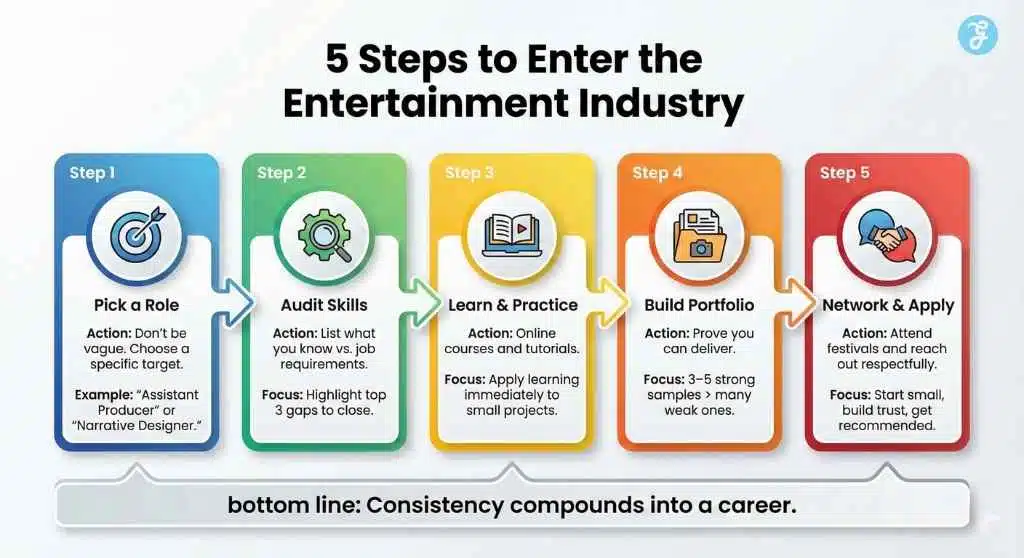
This section gives a simple, repeatable plan you can adapt to almost any role.
| Step | What to do | Example |
| 1 | Pick a specific starting role | “Junior video editor for streaming content” |
| 2 | Audit your skills | List what you can already do and gaps |
| 3 | Learn and practice | Courses, self-study, volunteering |
| 4 | Build a focused portfolio | 3–5 strong samples rather than many weak ones |
| 5 | Network and apply | Meet people, send tailored applications |
Step 1: Choose a clear starting point
Do not start with “I want to work in entertainment”. Instead, say:
- “I want to become an assistant producer for a web series.”
- “I want to be a narrative designer for mobile games.”
- “I want to manage social media for a streaming platform.”
A focused target makes your next steps much easier.
Step 2: Map your skills and gaps
- List what you already know (software, languages, past work).
- Compare that list with real job ads in your chosen role.
- Highlight the 3–4 most important gaps to close first.
Step 3: Learn and practice
- Use online courses, workshops, and tutorials for targeted learning.
- Apply what you learn immediately in small projects.
- Join communities where others share feedback and job leads.
Step 4: Build a portfolio that proves you can deliver
- For creative roles: 3–10 strong pieces (films, designs, audio, scripts).
- For data roles: 2–5 clear case studies with problem, method, and result.
- For marketing or community roles: screenshots and metrics that show growth.
Step 5: Network and land your first paid work
- Attend festivals, conferences, or online meetups.
- Reach out to people with short, respectful messages and specific questions.
- For freelance paths, start with small paid gigs, then raise your rates as your reputation grows.
Over time, these steps compound. You become known, recommended, and trusted — the real currency in entertainment industry careers.
FAQs on entertainment industry careers
1. Do I need a degree to work in entertainment?
A degree can help for certain roles (for example, film schools, business programs, and data science). But many employers care more about your portfolio, reliability, and ability to collaborate.
2. Which entry-level roles are friendliest for beginners?
Good starting points include:
- Production assistant
- Junior editor
- Social media assistant
- Community moderator
- Runner or event assistant
These roles help you learn how the industry actually works daily.
3. How long does it take to build a stable career as a creator or influencer?
It varies. Some creators grow fast; most grow slowly. Data shows that only a minority reach full-time income levels, but the number is growing as platforms and monetization options expand.
Treat content creation like a serious job: consistent output, clear niche, and smart experiments.
4. How will AI affect entertainment jobs?
AI will automate some tasks (for example, rough edits, basic artwork, and content recommendations) but will also create new roles in prompt design, oversight, and hybrid workflows. People who combine human creativity with smart tool usage will be in a strong position.
5. Can I move into entertainment from another industry?
Yes. Many skills transfer well:
- From marketing → entertainment campaigns and partnerships
- From software → game dev, product, or tools engineering
- From finance → production budgeting or business affairs
- From teaching → content creation, community management, or training roles
The key is to show how your past wins match the needs of your new target role.
Final Thought: building a sustainable future with entertainment industry careers
Entertainment is no longer limited to red carpets and a few big studios. It is a global network of streaming platforms, games, live experiences, creator-led brands, and data-driven companies. That shift has opened many doors for people with different strengths — creative, technical, analytical, or organizational.
To make the most of these entertainment industry careers:
- Choose a clear starting role instead of chasing everything at once
- Learn the tools and skills that matter most for that role
- Build small but focused portfolios that prove you can deliver
- Stay curious, keep updating your skills, and nurture long-term relationships
The industry will keep changing, but people who combine creativity, technology, and business sense will always be in demand. If you take consistent, strategic steps today, you can build a resilient, rewarding place for yourself in the future of entertainment.































