
When you spend years grinding through a computer science degree, only to find yourself deep in the backend, spinning up microservices and wrestling with the command-line interface for ambitious projects, you develop a certain hubris. We genuinely believed we were untouchable. We were the architects of the new digital economy; automation was a tragedy reserved for factory floors and call centres, not for those of us pushing commits. But the recent bloodbath of 45,000 jobs evaporating across Big Tech has shattered that cosy illusion. We are not experiencing a temporary market correction or a brief pause in hiring. We are witnessing the brutal, unceremonious end of the tech worker era.
The laptop class is finally getting a taste of the industrial revolution, and the social contract of white-collar work is being rewritten in real-time by the very algorithms we built. To understand the sheer scale of this betrayal, we have to look at how quickly the culture of Silicon Valley has curdled into a hyper-efficient machine.
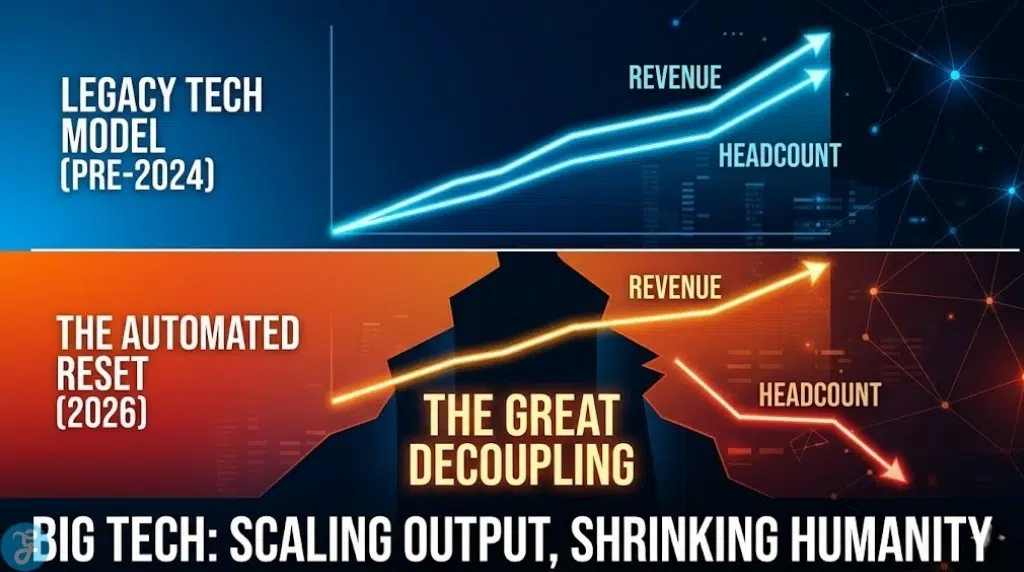
The Death of the Adult Playground
For the better part of a decade, tech companies operated like adult playgrounds. The “day-in-the-life” social media videos featuring free matcha lattes, nap pods, and ping-pong tables were symptoms of a zero-interest-rate phenomenon where hoarding talent was more important than actual productivity. You were hired not necessarily for what you could build today, but to ensure a competitor could not hire you tomorrow.
That era of bloated headcount is entirely dead. The 45,000 workers handed their notices this quarter are not victims of a dying industry; they are casualties of a profoundly successful one. The AI-driven restructuring we are seeing is a permanent reset in the human-to-output ratio. Big Tech has realised that a senior developer paired with a suite of advanced generative AI copilots can do the work of a five-person team. They do not need a sprawling campus of mid-level programmers writing boilerplate code anymore. They need a handful of editors managing automated output.
This drastic reduction in human capital fundamentally changes the mathematics of running a technology firm. The following table illustrates exactly how the expectations for human labour have been permanently decoupled from corporate output.
| The Legacy Tech Model (Pre-2024) | The Automated Tech Model (2026) |
| Growth Strategy: Scale revenue by aggressively scaling human headcount. | Growth Strategy: Scale revenue while actively and permanently shrinking headcount. |
| The Developer’s Role: Writing code from scratch; manual debugging and testing. | The Developer’s Role: Orchestrating AI agents; code review, architecture, and prompt engineering. |
| The Social Contract: Job security in exchange for long hours and dedication to “company culture.” | The Social Contract: Pure transactional utility; immediate replacement by superior algorithmic models. |
| Middle Management: Sprawling hierarchy required to manage large, siloed teams. | Middle Management: Eliminated. AI handles project tracking, sprint allocation, and reporting. |
Recognising this mathematical shift is sobering, but it is entirely necessary if you want to survive the current transition. The industry is no longer calculating your value based on your ability to type syntax; it is calculating your cost against the API calls required to replace you.
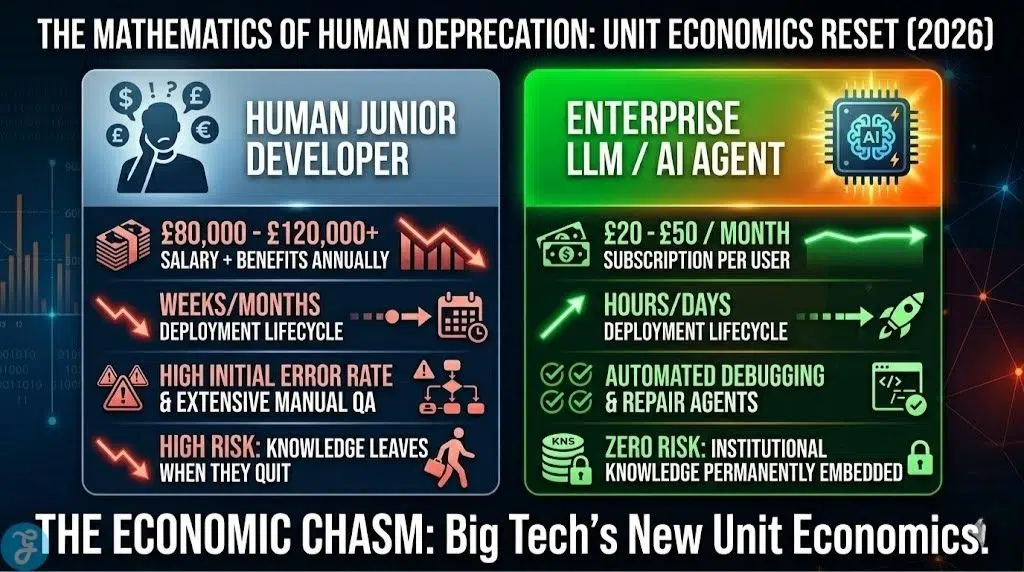
The Mathematics of Human Deprecation
To truly grasp why these jobs are never coming back, we must look at the brutal unit economics driving boardroom decisions. A junior developer writing basic front-end components or simple backend CRUD operations costs a company well over a six-figure salary, plus benefits, office space, and management overhead. A highly tuned enterprise LLM can generate, test, and deploy that same code for fractions of a penny per token.
This is not a slight efficiency gain; it is an economic chasm. Companies are restructuring because the financial incentive to automate the middle tier of their workforce is too massive to ignore.
The table below breaks down the stark reality of the new cost-to-output metrics that executives are using to justify the mass layoffs.
| Operational Metric | Traditional Human Workforce | AI-Augmented Lean Team |
| Code Generation Cost | £80,000 – £120,000+ per developer annually. | £20 – £50 per month per user (Enterprise AI subscriptions). |
| Deployment Speed | Weeks or months for full lifecycle development. | Hours or days via automated CI/CD pipelines and synthetic agents. |
| Error Rate & Debugging | High initial error rate requiring extensive manual QA testing. | Lower syntax error rate; automated debugging agents resolve issues in real-time. |
| Knowledge Retention | High risk; knowledge leaves the organisation when the employee quits. | Zero risk; institutional knowledge is permanently embedded in the fine-tuned corporate model. |
With these metrics staring them in the face, shareholders are demanding leaner operations. You can no longer rely on being a “good coder.” You must adapt to the new market archetypes to remain employed.
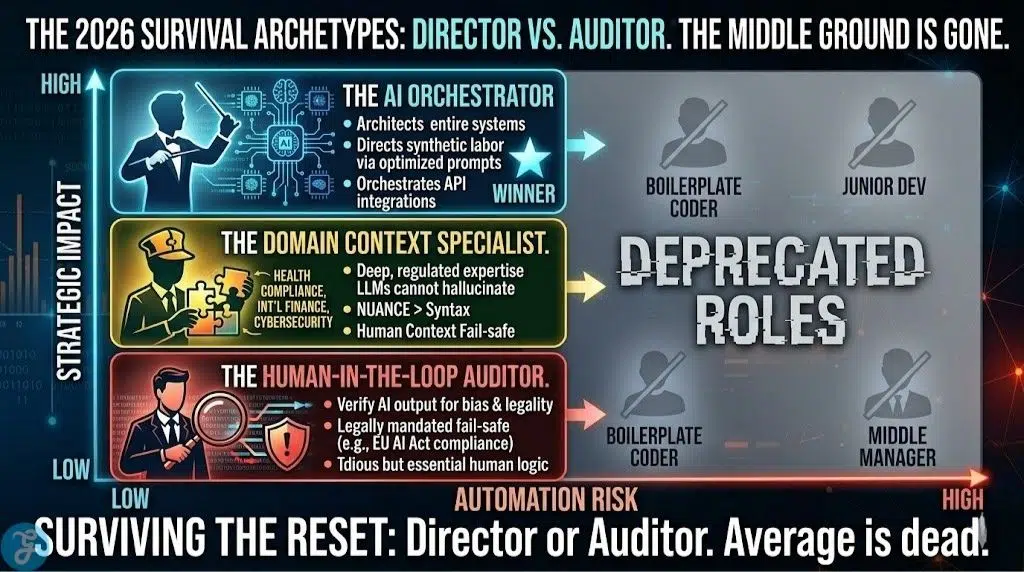
The 2026 Survival Archetypes
As the old roles are automated out of existence, a new set of highly specialised profiles is emerging from the wreckage. To survive the end of the tech worker era, you must aggressively align yourself with one of the following new paradigms.
The AI Orchestrator
This is the evolution of the senior engineer. Instead of writing the microservices themselves, they architect the overarching system and direct the machine learning models to build the constituent parts. They are conductors of synthetic labour.
Best for: Former backend developers and system architects who excel at high-level design, API integrations, and complex prompt engineering.
Why We Chose It: It is currently the only high-growth engineering track that still commands the legacy Silicon Valley salaries.
Things To Consider: You are no longer a creator in the traditional sense; you are an editor and a manager of synthetic agents. The tactile satisfaction of writing raw code is largely gone.
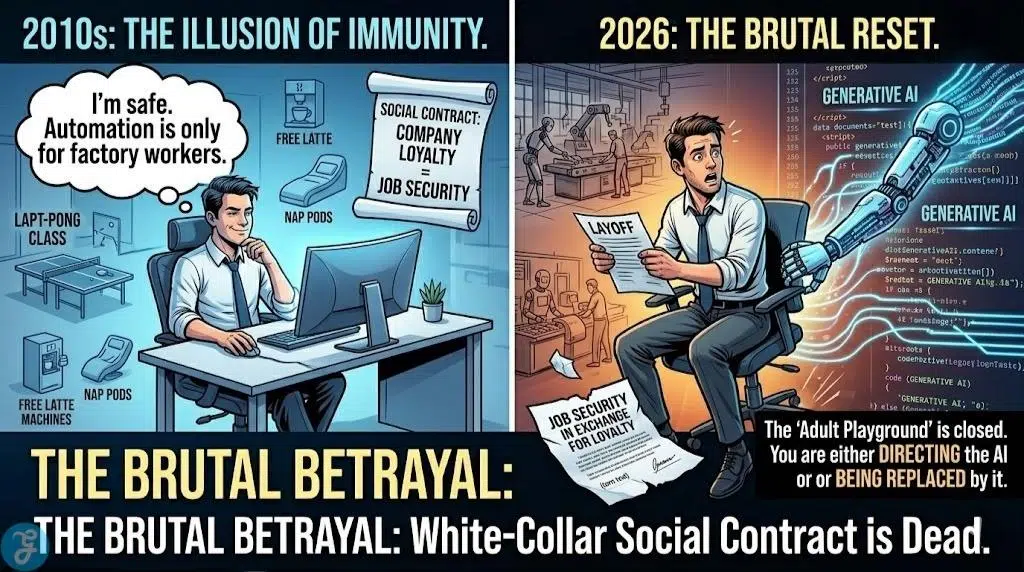
The Domain Context Specialist
Code is now a cheap commodity, but context is incredibly rare and expensive. This role focuses on the deep, nuanced industry knowledge that an LLM cannot hallucinate or scrape from public forums.
Best for: Professionals who possess deep, verified expertise in highly regulated fields such as healthcare, international finance, or cybersecurity compliance.
Why We Chose It: AI models frequently fail at complex regulatory edge cases and nuanced business logic. Human context remains the ultimate fail-safe.
Things To Consider: It requires constant, exhausting upskilling to stay ahead of the models’ expanding capabilities and to maintain your niche authority.
The Human-in-the-Loop Auditor
As AI generates the vast majority of a company’s product, organisations desperately need humans to rigorously verify that the output isn’t biased, illegal, or critically flawed before it reaches the consumer.
Best for: Quality assurance engineers, ethicists, and copy editors who possess an eagle eye for detail, logical fallacies, and structural bias.
Why We Chose It: The impending enforcement of global regulations makes this a legally mandated, indispensable role for any major corporation.
Things To Consider: It is often tedious, high-stress work. You are serving as the final, heavily scrutinised barrier between a corporate algorithm and a massive public relations or legal disaster.
These archetypes highlight a painful but undeniable truth: the comfortable middle ground has completely vanished. You are either directing the AI, auditing the AI, or you are being quietly replaced by it.
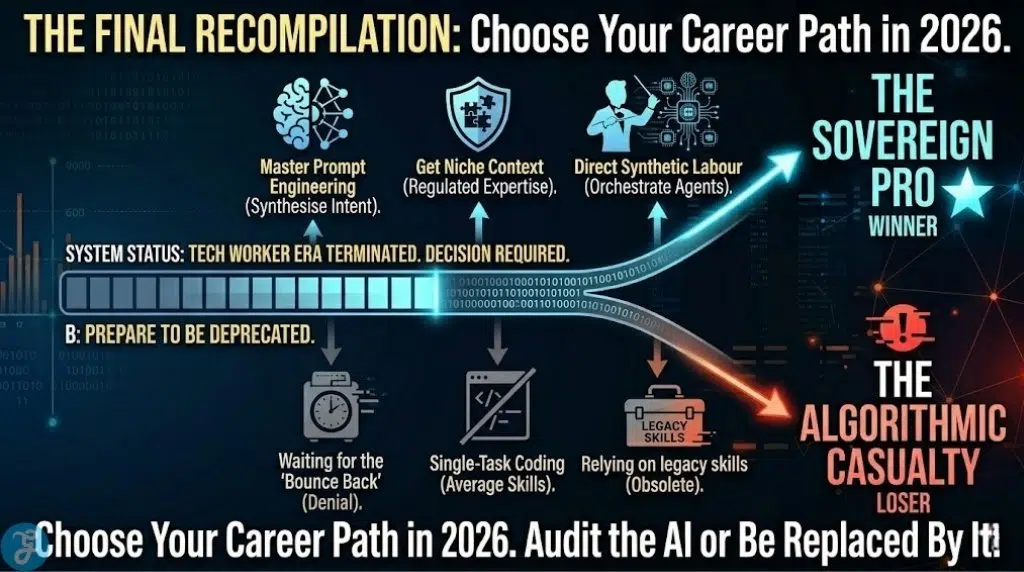
The Final Recompilation
The anger and betrayal currently washing through professional networking sites and blind forums is entirely palpable. We were sold a specific narrative: that if we learned to code, if we mastered the modern frameworks, we would be granted permanent entry into a protected, lucrative class. But technology owes loyalty to no one, not even its creators.
The 45,000 jobs lost are just the leading edge of a much larger, permanent wave of automation. The social contract for white-collar work has been torn up and fed directly into the training data. The tech worker of the 2010s—comfortable, highly paid, and safely tucked away in a sprawling, amenity-rich campus—is officially a relic of the past. The industry does not need our ping-pong skills or our company loyalty anymore. It just needs our output, and it has found a cheaper way to get it.
If you are still waiting for the market to bounce back so you can return to your cosy, single-task ticket crunching, you are waiting for a train that has already been scrapped for parts. The era is over. It is time to recompile your career, or prepare to be permanently deprecated.