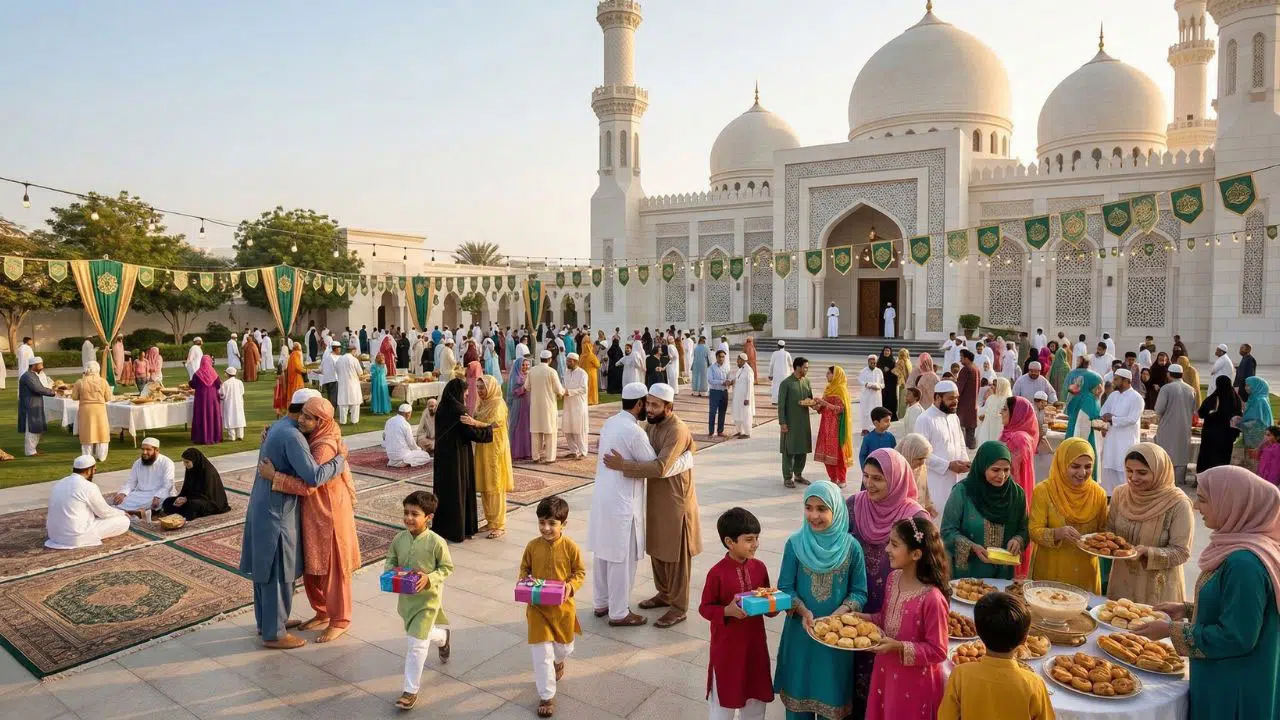
Every year, as the crescent moon rises at the end of Ramadan, more than 1.9 billion Muslims around the world look up at the sky with a mixture of awe, relief, and unbounded joy. That sliver of silver light signals the arrival of Eid al-Fitr — the Festival of Breaking the Fast — one of the two most sacred celebrations in the Islamic calendar.
It is a day that smells of cardamom and rose water, sounds like children laughing in new clothes, and feels like a long, warm embrace after weeks of patient devotion.
Eid al-Fitr does not arrive alone. It comes carried on the shoulders of Ramadan — a month of fasting from dawn to dusk, nightly prayers, charitable giving, and an intensified effort toward spiritual self-renewal. When that month concludes, Eid is the community’s collective exhale: a day of feasting, forgiveness, and profound gratitude. To understand Eid fully, one must first understand what Muslims leave behind when Ramadan ends — not with sadness, but with transformed hearts.
| 1.9B+
Muslims worldwide who celebrate Eid |
1,400+
Years of Eid tradition dating to the Prophet |
2.5%
Of wealth given as Zakat al-Fitr before prayers |
The Origins of Eid al-Fitr
The roots of Eid al-Fitr stretch back to the seventh century CE, to the city of Medina, where the Prophet Muhammad ﷺ established the celebration shortly after the migration from Mecca. According to Islamic tradition, the Prophet arrived in Medina to find the people observing two annual festivals inherited from pre-Islamic times. He declared that God had replaced those days with something better: Eid al-Fitr and Eid al-Adha. From that moment, the celebration became woven into the very fabric of Muslim communal life.
The name itself is layered with meaning. “Eid” derives from the Arabic root that means “to return” — a recurring joy, a celebration that comes back to renew itself each year. “Fitr” comes from “fitar,” to break, and shares its root with “fitrah,” the innate human nature with which Muslims believe every person is born. Eid al-Fitr is therefore a return to one’s truest self — cleansed, grateful, and renewed by the discipline of Ramadan.
| “The month of Ramadan is the one in which the Quran was sent down as guidance for mankind, with clear proofs of guidance and the Criterion. So whoever among you witnesses the month, let him fast it.”
— QURAN 2:185 |
The Night Before: Takbir and Anticipation
The celebration of Eid does not truly begin at sunrise. It begins the night before, when the new moon is sighted — or when the Islamic calendar confirms the close of Ramadan’s 29th or 30th day. Across Muslim neighbourhoods from Cairo to Karachi, from Lagos to London, a sound rises: the takbir. “Allahu Akbar, Allahu Akbar, La ilaha illallah, Allahu Akbar” — God is the Greatest — chanted in mosques, streets, and homes, filling the air with a collective declaration of faith and gratitude.
Children stay up late, giddy with anticipation. Mothers prepare sweets that have been planned for weeks — baklava in Turkey, maamoul in the Levant, sheer khurma in South Asia, kahk in Egypt. The scent of cardamom, saffron, and rose water drifts from kitchen windows. New clothes, pressed and waiting on hangers, promise the fresh beginning that Eid represents. The whole night has the charged, luminous quality of Christmas Eve and New Year’s Eve merged into one — but grounded in something quieter and more profound than either.
Eid Morning: Prayer, Purpose, and Community
Eid morning begins before full daylight. Muslims across the world rise early, bathe, wear their finest or newest clothes, and eat something sweet before heading out — a deliberate act of joy after a month of pre-dawn fasting. Dates are traditional, a small but symbolic bite that says: today, we feast.
Before prayer, every Muslim household that can afford to do so must give Zakat al-Fitr — a charitable donation equivalent to roughly one meal’s cost per family member, given to those in need. It is not optional, and it is intentional: Eid should begin with an act of giving, ensuring that even the poorest members of the community can celebrate with a full stomach and a measure of dignity. This mandatory generosity is one of Eid’s most distinctive features, setting it apart from secular holidays rooted purely in personal enjoyment.
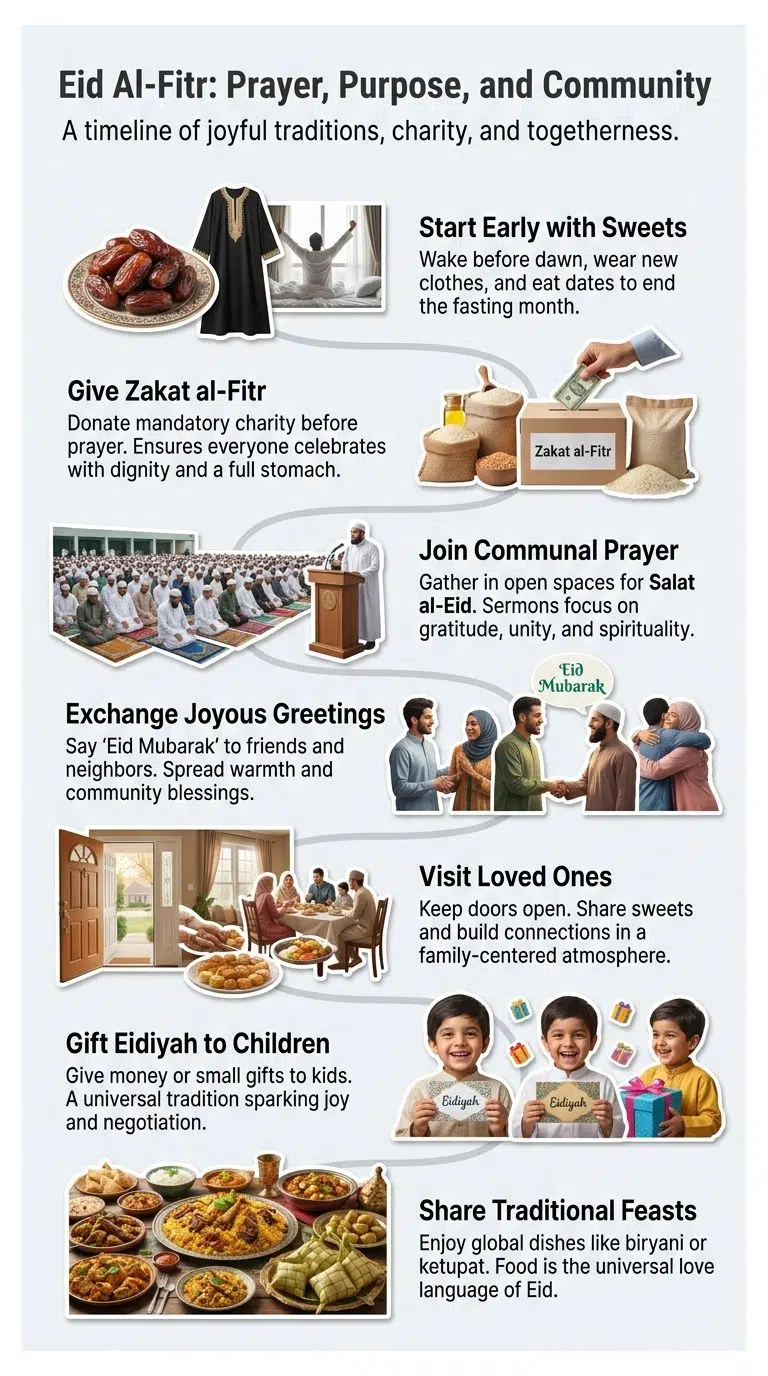
Then comes the Eid prayer — Salat al-Eid — performed in large congregations, ideally in open spaces: parks, fields, and mosque forecourts overflow with worshippers. In countries like Egypt, Indonesia, and Bangladesh, hundreds of thousands gather in a single location. The prayer itself is brief but powerful: two units of prayer (rak’at) followed by a khutbah — a sermon — that typically focuses on gratitude, unity, and the spiritual lessons carried from Ramadan into the year ahead.
| KEY PRACTICES OF EID AL-FITR |
| ❖ Giving Zakat al-Fitr to the poor before the Eid prayer |
| ❖ Performing the communal Eid prayer in congregation |
| ❖ Wearing new or best clothes as an expression of celebration |
| ❖ Eating something sweet (often dates) before heading to prayer |
| ❖ Exchanging greetings of “Eid Mubarak” — Blessed Eid |
| ❖ Visiting family, neighbours, and friends throughout the day |
| ❖ Giving Eidiyah — gifts or money — especially to children |
| ❖ Preparing and sharing traditional festive foods and sweets |
The Culture of Eidiyah and Togetherness
After prayers, the day opens into something more personal and joyful: family. Eid is perhaps the most family-centred occasion in the Islamic world. The day’s rhythm is shaped by visits — to grandparents, to aunts and uncles, to neighbours and old friends. Doors are left symbolically open, and plates of sweets are passed from house to house like currency in an economy built entirely on warmth.
For children, the highlight is eidiyah — small gifts of money pressed into their hands by elders. It is one of the great universal Eid experiences: small fingers curling around coins or crisp banknotes, the counting and recounting, the negotiations with siblings. Across cultures, eidiyah has evolved from a simple gesture into an art form, sometimes involving elaborately decorated envelopes.
Food is the love language of Eid. While the dishes vary enormously by region and heritage, the abundance is constant. In Indonesia and Malaysia, ketupat — diamond-shaped rice cakes wrapped in palm leaves — are central to the feast. In Morocco, bastilla and lamb slow-cooked with prunes fill celebratory tables. South Asian households set out biryani, haleem, and mountains of mithai. Turkish families gather around börek and lamb dishes. The diversity of Eid cuisine is itself a reflection of Islam’s global reach — one faith, a hundred thousand flavours.
Eid Across Cultures: One Celebration, Many Colours
What is perhaps most remarkable about Eid al-Fitr is how seamlessly it absorbs local culture without losing its spiritual core. In West Africa, Eid is marked by vibrant processions, drumming, and dancing that would be unrecognisable to worshippers in Central Asia — yet the prayers, the charity, and the gratitude are identical. In Bosnia, Eid carries a melancholic beauty shaped by history and war; in the Maldives, it arrives on islands where the sea and the sky seem to conspire to make celebration feel inevitable.
In Western cities, Eid has increasingly become an occasion for cultural visibility. Muslim communities in London, New York, Toronto, and Sydney fill parks for public prayers, organise street fairs, and bring Eid greetings into offices, schools, and public life. This visibility matters: for Muslim children growing up as minorities in non-Muslim countries, Eid is an affirmation — a day that says your traditions are beautiful and they belong here too.
The Deeper Meaning: Gratitude as a Way of Being
Beyond the festivities, the food, and the family reunions, Eid al-Fitr carries a message that transcends religious boundaries. At its heart, it is a festival of gratitude — not the passive, polite kind, but an active, embodied gratitude that has been earned through a month of restraint. Fasting teaches the body what abundance feels like only by removing it; Eid restores it with a force multiplied by thirty days of waiting. The sweetness of the first Eid meal is not just sugar — it is relief, celebration, and the particular joy of something valued precisely because it was withheld.
There is also a communal dimension to this gratitude. The requirement to give before you receive — Zakat al-Fitr before the feast — is a structural reminder that personal joy is most complete when it is shared. Eid asks each celebrant to think of the neighbour who might be struggling, the family member who is alone, the stranger who deserves a full plate on this day. It is, in this sense, a festival engineered to produce empathy as well as joy.
| “Eid is the day when Muslims celebrate the completion of their duties, and it is a day of gratitude to God, forgiveness between people, and the renewal of bonds of kinship.”
— ISLAMIC TRADITION |
Eid in the Modern World
In the twenty-first century, Eid al-Fitr has taken on new dimensions shaped by technology and globalisation. WhatsApp and Instagram fill with greetings before sunrise. Families separated by continents share Eid meals over video calls, the phone propped up against the teapot so that a grandmother in Dhaka can watch her grandchildren in Manchester open their eidiyah. Crescent moon sighting has, in many communities, given way to pre-calculated Islamic calendars — a small concession to modernity that nevertheless occasionally sparks spirited debates between traditionalists and pragmatists.
Eid-themed fashion, décor, and greeting cards have become thriving industries. Major retailers in Muslim-majority countries and increasingly in Western markets roll out Eid collections weeks in advance. Governments in the United Arab Emirates, Saudi Arabia, Indonesia, and dozens of other countries declare multi-day public holidays. The New York City school system officially recognises Eid as a school holiday — a decision celebrated as a milestone of cultural recognition when it was first announced.
Yet through all of this — through the commercial packaging, the social media spectacle, the logistics of global celebration — the essence of Eid al-Fitr remains unchanged. It is a morning prayer in a field. It is a grandmother’s hands pressing sweets into a child’s palm. It is the moment when the fast breaks, when the crescent appears, when a community lifts its voice in gratitude and says together: we made it, we are here, and this — all of this — is a gift.