
Eddie Palmieri, the legendary pianist, composer, and bandleader who revolutionized Latin music with his fusion of jazz, salsa, funk, and Afro-Caribbean rhythms, has died at the age of 88. His passing marks the end of a monumental era in Latin jazz, where he stood as one of its most creative and fearless innovators.
Palmieri died on Wednesday, August 6, 2025, at his home in New Jersey after a prolonged illness. His daughter, Gabriela Palmieri, confirmed the news to The New York Times, and his label, Fania Records, later released an official statement mourning the loss of the musical giant.
A Childhood Shaped by Rhythm and Community
Born on December 15, 1936, in New York City’s Spanish Harlem to Puerto Rican parents, Eddie Palmieri grew up surrounded by music and culture. At a time when the borough was a hub for Afro-Caribbean musicians, Palmieri’s early exposure to street rhythms, local bands, and cultural storytelling laid the foundation for his musical journey.
His older brother, Charlie Palmieri, a renowned pianist and bandleader, became his first musical inspiration. Like Charlie, Eddie studied classical piano as a child. However, his early interest in percussion led him to play timbales in his uncle’s orchestra at age 13. That brief stint solidified his rhythmic instincts, even though he would later return to the piano full-time.
Palmieri would often say, “I’m a frustrated percussionist, so I take it out on the piano,” a sentiment that characterized his aggressive and percussive playing style that fused melodic improvisation with rhythmic complexity.
Breaking Barriers: First Latino to Win a Grammy Award
Eddie Palmieri etched his name into music history in 1975, when his album The Sun of Latin Music became the first-ever Latin music album to win a Grammy Award. This milestone shattered long-standing industry barriers for Latino musicians and opened doors for future generations of Latin artists.
Throughout his career, Palmieri would go on to win eight Grammy Awards, with wins for albums like:
- Palo Pa’ Rumba (1984)
- Solito (1985)
- Masterpiece (2000) with Tito Puente
- And others, reflecting a consistent level of excellence across genres and decades
Even as he aged, Palmieri never slowed down. He continued recording music into his 80s and adapted to the times by performing virtual concerts during the COVID-19 pandemic, engaging fans around the world through livestreams.
The Rise of “La Perfecta” and a New Latin Sound
Palmieri’s early professional years saw him working with well-known bands in the 1950s, such as the Eddie Forrester Orchestra, Johnny Seguí, and Tito Rodríguez. But his real breakthrough came in 1961, when he formed La Perfecta, a groundbreaking Latin ensemble that introduced a major innovation in Latin music.
Instead of the typical trumpet-led horn section, Palmieri’s La Perfecta featured trombones — a bold decision that gave the band a deeper, more powerful sound. Collaborating with trombonist Barry Rogers and vocalist Ismael Quintana, La Perfecta quickly rose in popularity, offering a refreshing contrast to traditional Latin dance bands of the era.
The band’s fresh sound was both danceable and musically rich, earning Palmieri comparisons to leading orchestras like those of Tito Puente, Machito, and Tito Rodríguez.
Bold Experimentation: Harlem River Drive and Genre Fusion
Eddie Palmieri wasn’t just content with success — he wanted to push boundaries.
In 1971, he released Harlem River Drive, a politically charged and musically daring album that fused soul, jazz, funk, and Latin rhythms. The album, which featured both Black and Latino musicians, was a powerful cultural statement at a time of racial and economic tensions in New York.
Harlem River Drive became a cult classic, influencing not only Latin musicians but also hip-hop producers and funk artists in later decades. It was one of the earliest efforts in Afro-Caribbean jazz fusion and remains one of Palmieri’s most respected works.
Discography Highlights: Albums That Defined a Movement
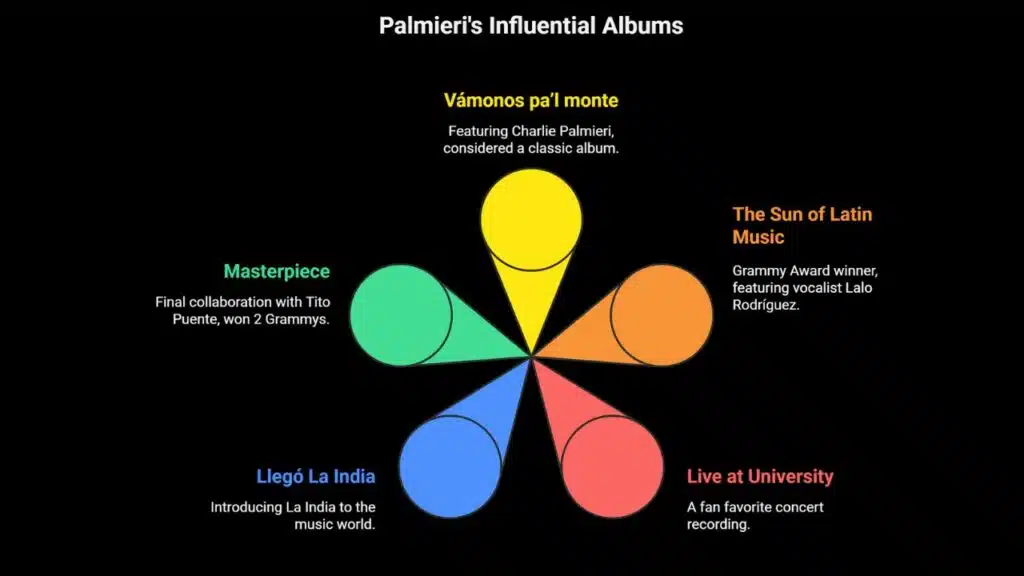
Palmieri’s prolific recording career includes almost 40 albums, many of which are now considered classics in Latin jazz and salsa. Some of his most influential works include:
- Vámonos pa’l monte (1971) — Featuring his brother Charlie Palmieri on organ
- The Sun of Latin Music (1974) — Grammy Award winner, with young vocalist Lalo Rodríguez
- Eddie Palmieri & Friends in Concert: Live at the University of Puerto Rico (1975) — A fan favorite
- Llegó La India vía Eddie Palmieri (1992) — Introducing salsa diva La India to the world
- Masterpiece (2000) — Final collaboration with Tito Puente, awarded 2 Grammys
These albums not only solidified Palmieri’s legacy but also showcased his range — from hardcore salsa to jazz improvisations to socially conscious compositions.
Taking Latin Jazz Global
Palmieri was not just a national treasure — he was a global ambassador for Latin music. Over the years, he performed in Africa, Asia, Australia, Europe, and Latin America, helping to popularize salsa and Latin jazz across continents.
He also collaborated with iconic musicians, including:
- Nicky Marrero (timbales)
- Israel “Cachao” López (bass)
- Alfredo “Chocolate” Armenteros (trumpet)
- Lewis Khan (trombone)
- Bobby Valentín (bass)
He was a key performer in historic ensembles like the Fania All-Stars and Tico All-Stars, legendary collectives that helped define the golden era of salsa.
Honors and Institutional Recognition
Eddie Palmieri’s contributions were widely acknowledged by major institutions:
- In 1988, the Smithsonian Institution recorded two of his live performances for inclusion in the archives of the National Museum of American History.
- In 2002, Yale University awarded him the Chubb Fellowship, typically reserved for global leaders and dignitaries, honoring his impact on community building through music.
- In 2005, he launched the NPR radio show “Caliente”, which reached over 160 stations nationwide, educating audiences on the roots and evolution of Latin jazz.
His work was not just about entertainment — it was about cultural preservation, education, and upliftment.
Reflections from a Humble Genius
Despite his legendary status, Palmieri remained humble and self-critical. In a 2011 interview with The Associated Press, he was asked if there was anything left to accomplish. He responded:
“Learning to play the piano well. Being a piano player is one thing. Being a pianist is another.”
This humility, mixed with his relentless drive, kept him creatively active well into his later years — even as many of his peers and musical heroes passed on.
Final Years and Legacy
In his later years, Palmieri expressed a sense of loneliness, missing many of the “rumberos” — the percussionists and collaborators who had defined his early career. Still, he continued to mentor young musicians, perform where possible, and celebrate the roots of Latin jazz.
His passing leaves a profound void in the world of music, especially in the Latin and jazz communities. But his influence lives on — not just in the recordings he left behind, but in every artist, orchestra, and band he inspired.
The Information is Collected from Yahoo and CNN.