At the heart of South Asia’s latest geopolitical crisis lies the Durand Line dispute, a colonial-era wound that has violently reopened, plunging Pakistan and Afghanistan into an unprecedented state of open conflict. What began as a series of proxy skirmishes and diplomatic stand-offs has rapidly deteriorated by early 2026 into a theatre of war, marked by cross-border airstrikes, massive civilian displacement, and the unravelling of decades of regional security policy.
The patron-client relationship that once defined Islamabad’s approach to Kabul has completely collapsed, leaving behind a volatile vacuum that threatens to destabilize the entire region. This is no longer merely a border skirmish; it is a structural failure of statecraft.
The Colonial Ghost: Tracing the 1893 Boundary
To comprehend the sheer intractability of the current bloodshed, one must first look back at the imperial cartography that originally severed a unified tribal homeland.
The Arbitrary Cartography of Sir Mortimer Durand
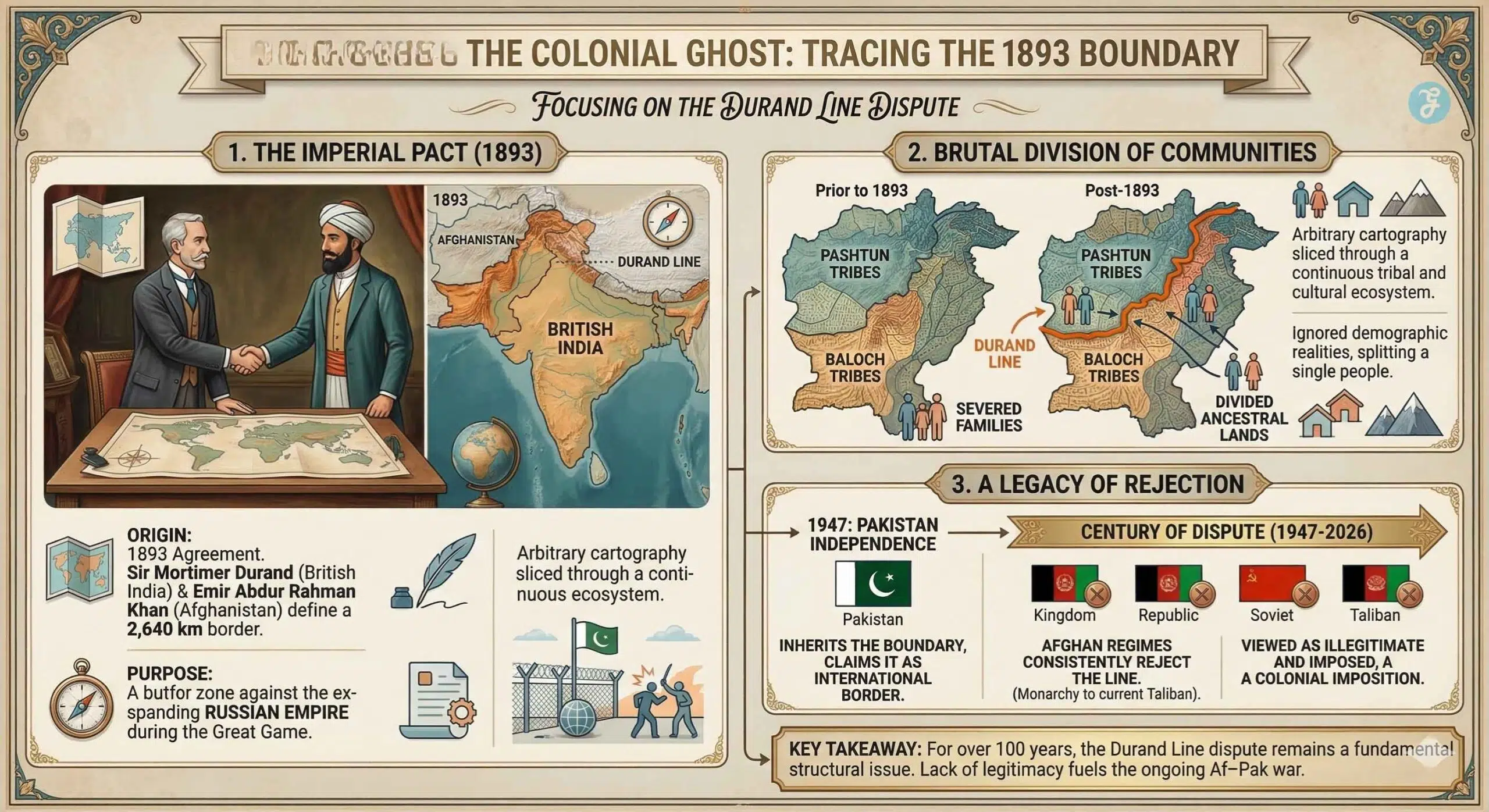
The foundation of this conflict rests not on modern geopolitical strategy, but on a boundary drawn in 1893 by British diplomat Sir Mortimer Durand and Afghan Emir Abdur Rahman Khan. Designed primarily as a buffer zone to protect British India from the expanding Tsarist Russian Empire, the 2,640-kilometre line was a masterpiece of imperial convenience and a disaster of demographic reality. It arbitrarily sliced through the Pashtun and Baloch tribal heartlands, brutally dividing ancient lineages, ancestral lands, and traditional seasonal trade routes.
For over a century, the legal ambiguity of this colonial relic has served as a perpetual point of contention. While Pakistan inherited the border upon its creation in 1947 and demands its international recognition, no Afghan government, from the monarchy to the communists, the Western-backed republic, and now the Taliban, has ever officially recognised the Durand Line.
To Kabul, it remains an illegitimate, imposed frontier. This historical grievance is not merely a talking point; it is the central ideological pillar that justifies the Afghan Taliban’s refusal to subordinate their territorial integrity to Islamabad’s security demands. The line remains a scar on the landscape, a constant reminder of division that continues to fuel ethno-nationalist resentment on both sides of the wire.
The Collapse of Strategic Depth: A Patron-Proxy Reversal
The current crisis forces a harsh re-evaluation of Pakistan’s long-standing foreign policy, exposing the profound irony of cultivating militant assets that have now turned their guns on their former benefactors.
The Blowback of the 2021 Kabul Takeover
For decades, Pakistan’s military and intelligence establishment pursued a doctrine of “strategic depth,” nurturing the Afghan Taliban as a reliable proxy to counter Indian influence in Afghanistan and secure its western flank. When the Taliban marched into Kabul in August 2021, sections of the establishment in Islamabad quietly celebrated what was perceived as a monumental strategic victory. However, that celebration was severely premature. The ensuing years have demonstrated a catastrophic patron-proxy reversal.
The Taliban, now the de facto state power in Afghanistan, has shed its reliance on its former handlers. Instead of acting as a compliant subordinate, Kabul has asserted its independence, demonstrating that it prioritises its ideological brotherhood with the Tehrik-i-Taliban Pakistan (TTP) over any debt of gratitude to Islamabad. This blowback shatters the illusion that state-sponsored militancy can be neatly controlled or perpetually directed outward.
The monster created for external defence has turned inward, proving that using insurgency as an instrument of state policy is an inherently self-destructive endeavour. The strategic depth doctrine has not secured Pakistan; it has instead guaranteed a perpetual two-front security nightmare.
The 2026 Escalation: Operation Ghazab Lil Haq
Moving from the weight of history to the urgency of the present, the recent military manoeuvres represent a terrifying shift in the region’s rules of engagement.
From Shadow War to Open Confrontation
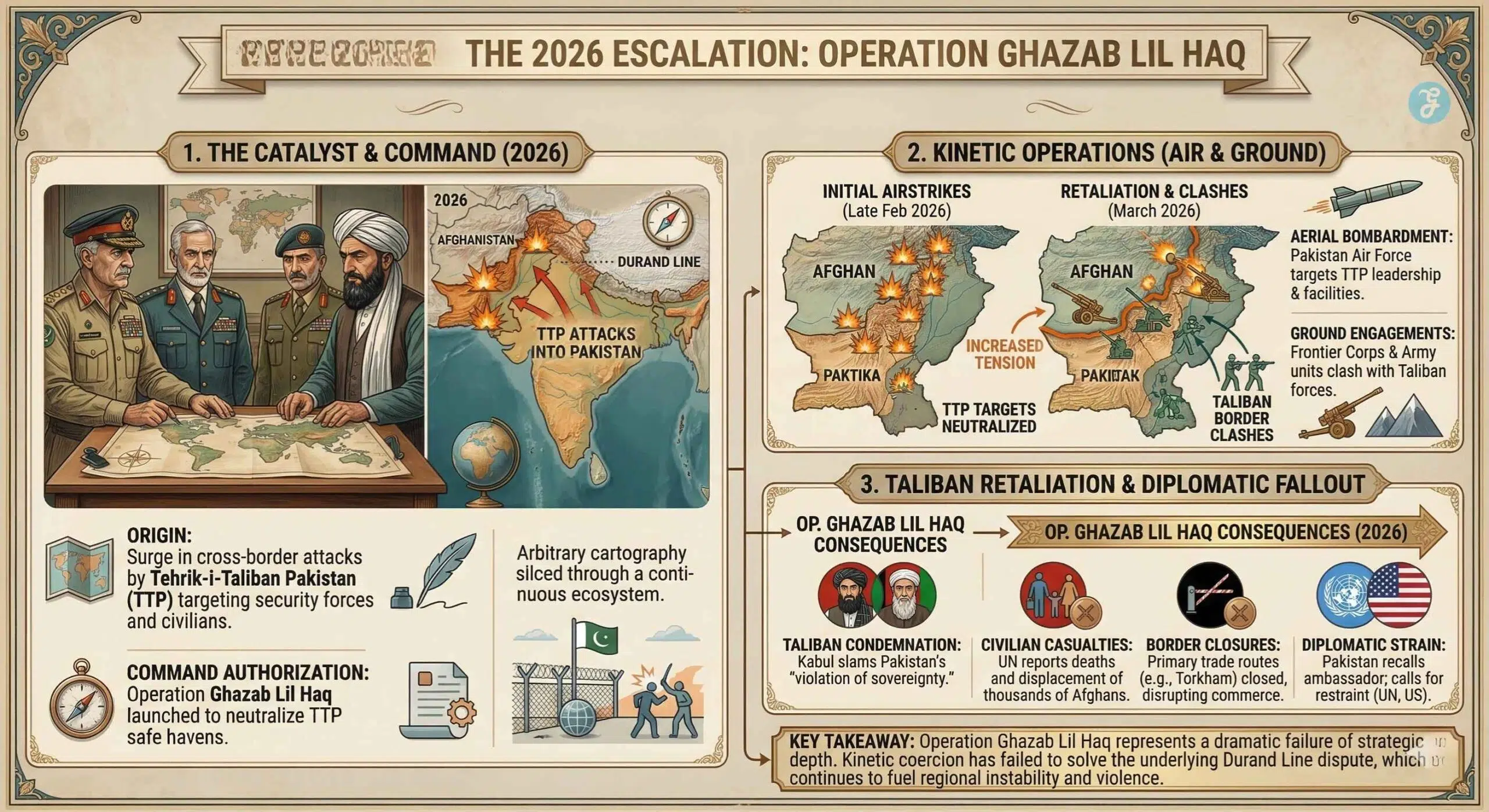
The leap from indirect cost imposition to direct military engagement in early 2026 marks a qualitative and highly dangerous shift in South Asia geopolitics. Following a surge of devastating attacks inside Pakistan by the TTP, including coordinated, high-casualty assaults in Balochistan and urban centres, Islamabad’s patience finally snapped. The launch of Operation Ghazab Lil Haq in late February saw the Pakistan Air Force conduct deep-penetration airstrikes into the Afghan provinces of Nangarhar, Paktika, and Khost.
These were not mere border skirmishes; they were sovereign incursions that the Afghan Taliban immediately condemned as acts of war. The retaliation was swift, with Taliban forces launching heavy artillery assaults on Pakistani military outposts along the frontier. Defence officials in Islamabad have bluntly characterised the situation as an “open war,” a term that signifies the total breakdown of diplomatic backchannels.
To understand the rapidly shifting dynamics on the ground, the following table outlines the immediate military postures and strategic objectives of the primary actors involved in the 2026 escalation.
| Combatant Force | 2026 Tactical Posture | Primary Strategic Objective |
| Pakistan Armed Forces | Offensive airstrikes and intensified border militarisation. | Eliminate TTP safe havens; force Kabul into compliance through kinetic deterrence. |
| Afghan Taliban | Defensive mobilisation and retaliatory artillery strikes. | Defend Afghan sovereignty; maintain ideological independence from Islamabad. |
| Tehrik-i-Taliban Pakistan (TTP) | Escalated asymmetric urban warfare and border ambushes. | Destabilise the Pakistani state; exploit the diplomatic rupture for operational freedom. |
Pashtun Nationalism and the Threat of Fragmentation
Beyond the military hardware and airstrikes, the border conflict is deeply intertwined with a profound cultural and ethnic wound that complicates any attempt at a clean geopolitical resolution.
The Ineffectiveness of the Fenced Frontier
In 2017, Pakistan embarked on a massive, multi-billion-dollar project to fence the entire Durand Line, aiming to physically curb militancy and smuggling. However, attempting to enforce a rigid, militarised barrier through the middle of a continuous ethnic homeland has inadvertently fuelled the very ethno-nationalism it sought to contain. To the Pashtun tribes straddling the border, the fence is a physical manifestation of an unnatural division.
The Afghan Taliban, tapping into this deep-seated resentment, have repeatedly and publicly torn down sections of the fence, viewing it as a hostile act designed to formalise an illegitimate boundary. This resistance highlights a crucial lesson that the Pak-Afghan war refuses to learn: hard borders cannot erase ethnic realities.
The shared Pashto cultural identity, the ancient tribal code of Pashtunwali, and intertwined family lineages override the barbed wire. The more Islamabad attempts to physically seal the frontier without addressing the underlying political grievances of the borderlands, the more it alienates the local populace, turning them into sympathetic hosts for anti-state elements.
The TTP Dilemma: Ideology Over Statecraft
The operational alliance between the Afghan rulers and the Pakistani insurgents remains the primary accelerant of the current violence, baffling policymakers who view the conflict strictly through the lens of state interests.
The Brotherhood of the Insurgency
Pakistan’s persistent demand for Kabul to hand over TTP leadership fundamentally misunderstands the ideological cohesion of these militant networks. The Afghan Taliban and the TTP are not merely allies of convenience; they are bound by a shared history of insurgency, a joint interpretation of strict religious governance, and the sacrifices of a two-decade war.
For the Afghan Taliban to suddenly turn against the TTP and hand them over to the Pakistani military would be viewed internally as a profound betrayal of Pashtunwali, specifically the principle of nanawatai (sanctuary). Furthermore, clamping down on the TTP would severely threaten the Afghan Taliban’s own internal cohesion. It would risk fracturing their ranks and driving disillusioned fighters into the arms of the Islamic State Khorasan Province (ISKP), a rival group that poses a direct existential threat to the Taliban’s grip on power.
Consequently, Kabul’s strategic calculus dictates that sheltering the TTP, even at the cost of enduring Pakistani airstrikes, is preferable to triggering an internal civil war. Ideology and tribal loyalty, in this context, entirely eclipse traditional statecraft.
The ‘Fire of Khorasan’: Transnational Terror Risks for South Asia
As Islamabad and Kabul exhaust their military resources along the frontier, a dangerous power vacuum has emerged, allowing groups like the Islamic State Khorasan Province (ISKP) to rapidly expand.
A Regional Vacuum for Extremism
The breakdown of order along the Durand Line is acting as a massive force multiplier for transnational terrorism, creating a dangerous grey zone where militant networks operate with impunity. While Islamabad and Kabul exhaust their military resources bombarding each other’s outposts, including profound escalations like Afghanistan’s retaliatory strikes on the Nur Khan airbase in Rawalpindi and the Kohat military fort, other actors are exploiting the chaos.
The Islamic State Khorasan Province (ISKP) is aggressively capitalising on the instability to boost its recruitment, explicitly targeting disillusioned fighters who feel the Afghan Taliban are either too accommodating to foreign powers or insufficiently rigorous in their ideology. Security analysts are increasingly warning of the “Fire of Khorasan”, the very real threat that this concentration of radicalisation and sophisticated, black-market weaponry will not remain confined to the Hindu Kush.
If the security apparatus of both nations remains entirely consumed by this border war, the ensuing militant spillover threatens to destabilise the broader Indian subcontinent, potentially pushing terror networks across the Radcliffe Line and into neighbouring states.
Regional Geopolitics: China’s Westward Strategy in Jeopardy
This escalating conflict does not exist in a vacuum; its tremors are shaking the economic architecture of the broader Asian continent, drawing in global superpowers.
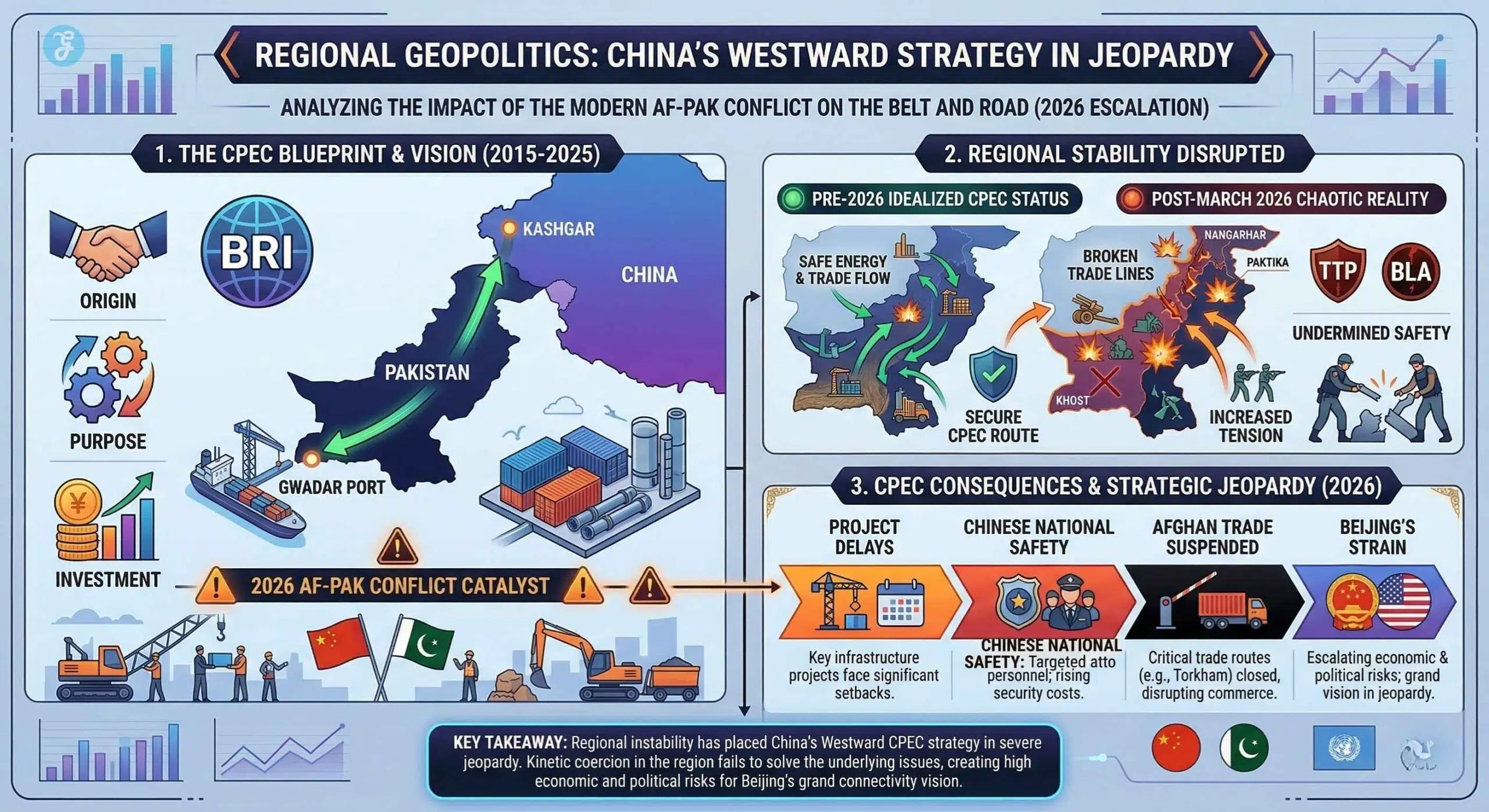
The Belt and Road Hits a Dead End
Beijing’s grand vision of using economic integration to stabilise South and Central Asia is currently failing its ultimate stress test. China has invested billions in the China-Pakistan Economic Corridor (CPEC) and has begun incorporating Afghanistan into this framework, hoping that the promise of infrastructure, trade, and mineral extraction would pacify the region.
However, the “open war” along the Durand Line shatters the premise that economic investment alone can resolve deeply entrenched territorial and ethnic disputes. The escalating violence has severely disrupted cross-border trade, halted infrastructure projects, and put Chinese nationals at extreme risk. For Beijing, the Af-Pak border conflict is a geopolitical nightmare that threatens to turn its westward expansion into a dead end.
It forces the realisation that without fundamental political reconciliation and security guarantees between Islamabad and Kabul, the Belt and Road Initiative cannot traverse the rugged, bleeding terrain of the Hindu Kush.
The Economic Shockwave: Markets and Trade in Freefall
The kinetic warfare has severely disrupted cross-border supply chains, triggering a catastrophic plunge in regional stock indices and exacerbating an already dire food security emergency.
The Cost of Conflict on Fragile Economies
The kinetic warfare has triggered an immediate and devastating economic fallout for two nations already teetering on the brink of financial exhaustion. On 2 March 2026, as news of the escalating airstrikes broke, Pakistan’s KSE-30 Index experienced a catastrophic 7.3% plunge, one of the largest single-day drops on record, wiping out billions in market capitalisation as investor panic set in over the prospect of a prolonged, two-front war.
For Afghanistan, the economic strangulation is even more acute. Following Pakistan’s closure of the primary border crossings, Kabul desperately attempted to rely on alternative import routes via Iran to sustain its domestic needs. However, the closure of the Iranian border in early March completely severed this lifeline, suspending all trade and the export of critical medicines.
The subsequent disruption to supply chains has forced the UN World Food Programme (WFP) to suspend emergency food distributions to approximately 160,000 Afghans, exacerbating an already dire crisis where over 17 million people face emergency levels of acute malnutrition.
Humanitarian Fallout and the Weaponisation of Refugees
Beneath the high-level military manoeuvring and geopolitical theorising lies a devastating, compounding civilian toll that exposes the cruelty of this border dispute.
The Human Cost of Kinetic Diplomacy
The most tragic victims of this failure to learn from history are the civilians caught in the crossfire. As of early 2026, the United Nations reports that hundreds of thousands of Afghans and Pakistanis have been internally displaced due to the cross-border shelling and airstrikes. Civilian infrastructure, including vital healthcare facilities and schools in Nangarhar, Paktika, and Balochistan, has suffered catastrophic damage.
Furthermore, the conflict has seen the disturbing weaponisation of vulnerable populations. In response to the Taliban’s recalcitrance, Pakistan has accelerated the forced repatriation of hundreds of thousands of Afghan refugees, many of whom have lived in Pakistan for decades. This mass deportation is a punitive measure, designed to overwhelm Afghanistan’s already fragile, sanction-hit economy. Using refugees as leverage in a geopolitical standoff is a grim hallmark of hybrid warfare, transforming a political dispute into a spiralling humanitarian disaster that will breed resentment for generations.
The Diplomatic Void: The Fragile March Ceasefire
Despite a temporary, internationally brokered pause in hostilities, the foundational grievances driving the Durand Line dispute remain entirely unaddressed.
Regional Powers Scramble to Contain the Fallout
Recognising the catastrophic trajectory of an unchecked “open war,” a fragile, temporary ceasefire was announced on 19 March 2026. However, this pause in hostilities is less a product of mutual reconciliation and more the result of desperate, behind-the-scenes scrambling by regional heavyweights.
With Western powers largely distracted by conflicts in the Middle East and Eastern Europe, an ad hoc coalition of regional actors has attempted to step into the diplomatic void.
The primary mediators currently attempting to formalise this fragile truce include:
- Saudi Arabia and Qatar: Leveraging their historical ties and religious influence over the Taliban leadership to push for immediate de-escalation and a return to the negotiating table.
- Russia: Offering direct mediation from Moscow, viewing the stabilisation of the region as critical to preventing the northward spread of ISKP militants into Central Asia.
- Iran: Despite its own border tensions and crackdowns on Afghan migrants, Tehran has actively urged both Islamabad and Kabul to resolve their differences through dialogue, fearing a massive influx of new refugees.
While the guns have temporarily quieted, the structural grievances remain entirely unresolved. The success of this ceasefire hinges entirely on whether these international brokers can force a dialogue that addresses the core issue of cross-border militant sanctuaries without violating Kabul’s fierce protection of its sovereignty.
Beyond the Wire: Rethinking Borders in a Fractured Region
Closing this chapter of violence requires moving beyond the current tit-for-tat retaliation to confront the systemic failures that have kept the border bleeding for decades.
The Limits of Kinetic Coercion
The persistent failure of airstrikes, border closures, and proxy manipulation highlights the desperate need for a paradigm shift in how Islamabad and Kabul interact. The lesson that the Pak-Afghan war violently refuses to learn is that kinetic coercion cannot solve an ethno-nationalist and ideological dispute. Every bomb dropped on Afghan soil hardens Kabul’s resolve; every insurgent attack inside Pakistan deepens the militarisation of the state.
Temporary ceasefires and diplomatic pauses are fragile bandages over a gaping wound. Until there is a fundamental restructuring of how both states view the borderlands, moving away from treating them as militant buffer zones and towards integrating them politically and economically, the cycle of violence will continue.
The Durand Line dispute will never be resolved through force; it requires the courageous, unlikely pursuit of localised political reconciliation and a genuine respect for the people whose lives have been divided by the wire. Until that realisation dawns, the border will continue to bleed.
The Final Reckoning: A Frontier Awaiting Reason
The Durand Line dispute proves that colonial boundaries cannot be sustained by artillery fire alone. The 2026 escalation is not a mere skirmish, but the violent unravelling of a flawed security doctrine that prioritised proxy games over human realities. For Islamabad and Kabul, true statecraft demands abandoning kinetic coercion and recognising the intertwined destinies of the border populations.
Until both nations prioritise genuine, localised political reconciliation over the ghosts of imperial cartography, the mountains of the Hindu Kush will remain a theatre of tragedy. The lessons are written in the blood of the displaced; it is time for the warring capitals to finally learn them.