

The lifestyle promise is simple. Work from anywhere, stay flexible, and move when you want. For many people, a digital nomad visa looks like the perfect legal upgrade from short tourist stays. It can be a strong tool for building a global life. But when you start thinking in decades instead of months, the comparison shifts into something deeper: Digital Nomad Vs Citizen is not just about travel freedom. It is about long-term safety, stability, and control over your future when rules, economies, and climate conditions change.
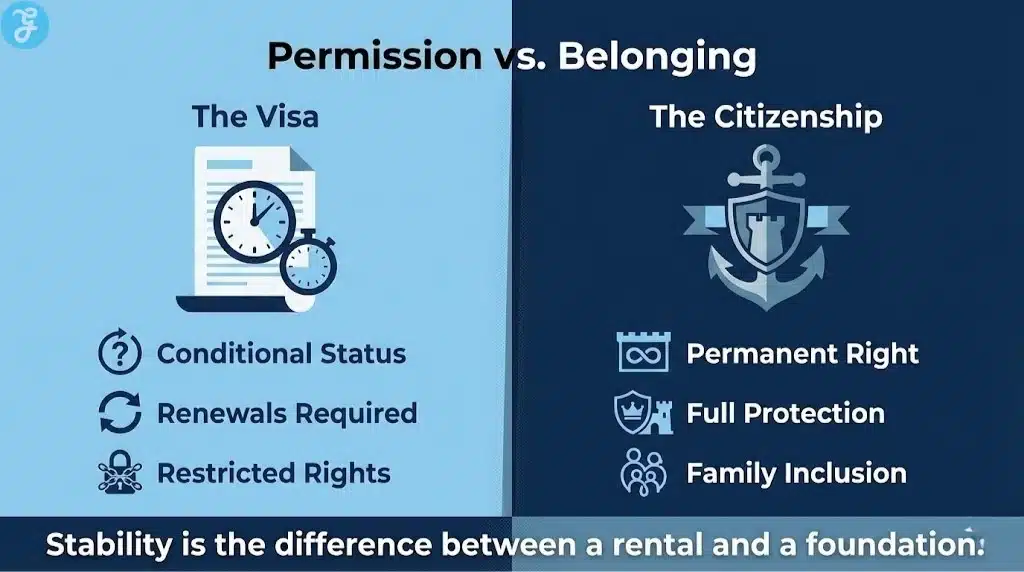
A visa is permission. Citizenship is belonging. They create very different levels of protection when your health changes, when your job ends, when a government updates its policies, or when a crisis makes movement harder. This article breaks down the hidden gaps in visa-based living and explains why long-term safety usually requires more than renewable paperwork.
What “Long-Term Safety” Really Means
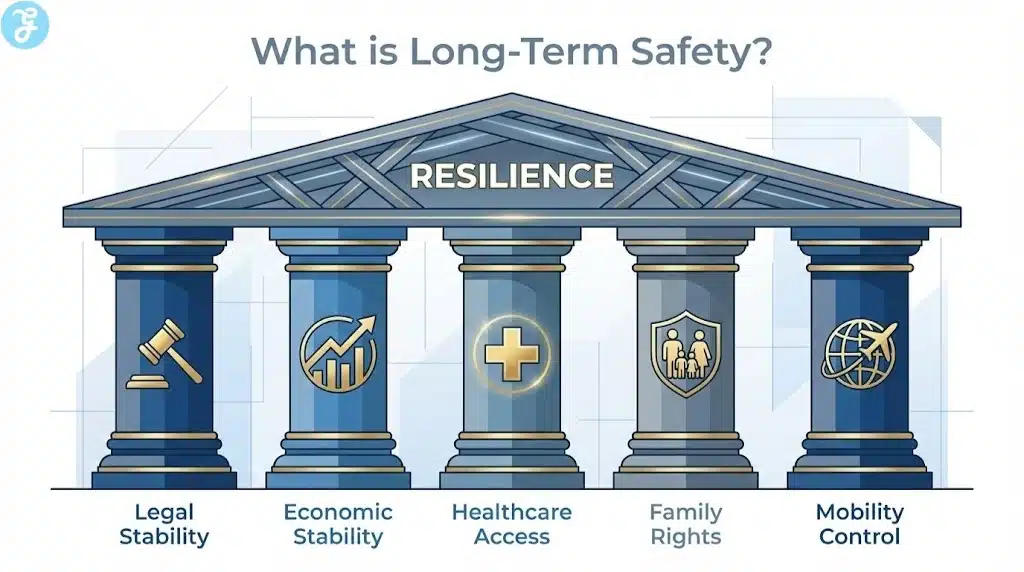
Long-term safety is not only physical security. It is the full set of conditions that help you stay stable when life gets unpredictable.
Think of it as five pillars:
- Legal stability: whether you can stay without sudden disruptions
- Economic stability: whether you can earn, access banking, and handle downturns
- Healthcare stability: whether you can get affordable, continuous care
- Family stability: whether your partner, kids, and parents have secure status
- Mobility stability: whether you can leave and return reliably in emergencies
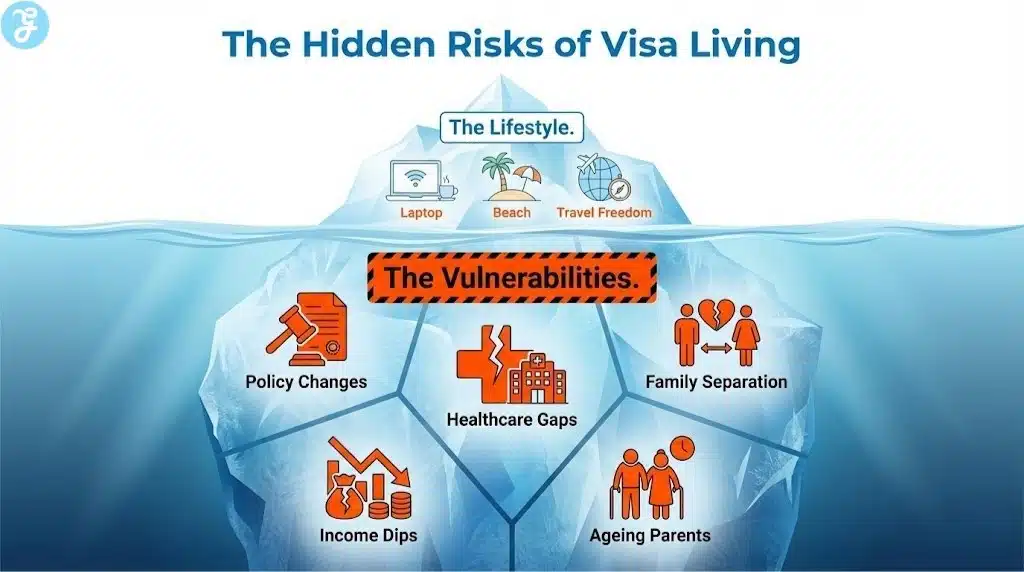
A visa can support parts of this, especially in the short term. Over time, visas often create fragility because you are always “conditional.” That conditional status becomes a pressure point during crises.
Why A Visa Feels Safe Until It Doesn’t
Most nomads do not face immediate problems. They find a country they like, meet the requirements, renew as needed, and keep going. The system works, until a single variable shifts.
Common triggers include:
- Income dips below the visa requirement
- A new government tightens immigration rules
- A landlord dispute forces a move and breaks residency continuity
- A medical event increases your need for local healthcare access
- Currency swings make financial thresholds harder to meet
- A global event changes border entry or processing speed
Visas can feel stable because they often renew smoothly. But stability is not the same as durability. Durability is what holds when the environment becomes hostile or chaotic.
Digital Nomad Visas: What They Are Designed To Do
Digital nomad visas are typically designed for one main purpose: attract foreign income and spending without fully integrating you into the local labor market.
Common features include:
- Proof of remote income from outside the country
- Minimum income thresholds
- Private health insurance requirements
- Restrictions on working for local employers
- Time-limited stays, often 6 to 24 months, sometimes renewable
- Limited access to public benefits
This structure works well for governments because it brings spending without creating long-term obligations. It can work well for you too, but it is not designed to guarantee long-term permanence.
Citizenship: What It Is Designed To Do
Citizenship is built for the opposite goal. It defines membership in a political community.
Citizenship typically grants:
- A permanent right to enter and live in the country
- Strong protection against deportation
- Full work rights without special permits
- Political rights and legal standing that is difficult to revoke
- The ability to sponsor family members under clearer pathways
- Often better access to public services and social systems
Citizenship is not perfect. Some citizens still face discrimination, cost pressure, and climate risk. But the legal foundation is much stronger than a visa.
Digital Nomad Vs Citizen: The Core Difference Is Conditionality
Here is the simplest way to understand Digital Nomad Vs Citizen.
A digital nomad visa often depends on you staying desirable to the system. You must keep meeting thresholds, avoid compliance mistakes, and stay aligned with policy changes. A citizen can lose stability in many ways, but their right to remain is usually not one of them.
Conditionality creates three long-term problems:
- Planning becomes fragile
You cannot plan a decade ahead when your legal right to remain depends on variables you do not fully control.
- Your bargaining power is weaker
When your status is temporary, you often accept worse housing terms, higher deposit demands, and less stable work arrangements.
- Your risk tolerance decreases
You may avoid medical treatment, legal disputes, or business risks because any “complication” could affect renewals.
The Quiet Risk: Policy Changes Are Not Personal
Nomads often assume that if they follow the rules, they will be fine. But immigration policy is not a personal contract. It is a moving framework shaped by politics, budgets, and public opinion.
Policy can change because:
- A country faces unemployment pressure and limits foreigners
- Tax policy shifts toward stricter reporting
- Housing debates trigger restrictions on non-citizen residents
- A geopolitical event changes security priorities
- A new administration wants different migration patterns
Even if you did everything right, a policy shift can create:
- Higher income thresholds
- Shorter renewals
- New documentation requirements
- Mandatory local tax registration
- Limits on bringing dependents
If your entire life structure rests on a visa category, you are exposed to decisions you cannot vote on and cannot easily influence.
Healthcare: The Biggest Long-Term Divider
Healthcare is where many visa-based strategies fail over time. When you are young and healthy, private insurance and out-of-pocket costs can feel manageable. As you age, you want predictable access and continuity.
Continuity Of Care
Long-term healthcare needs are rarely one-time events. Chronic conditions require:
- Regular monitoring
- Medication continuity
- Specialist access
- Long medical histories that follow you
Visa holders may face:
- Insurance exclusions or price jumps
- Coverage gaps during renewals
- Limits on pre-existing conditions depending on policy
- Lack of access to public systems or subsidized care
Citizens and permanent residents often have more predictable access, even if systems are imperfect.
Emergency Scenarios
In emergencies, the questions become blunt:
- Can you stay while recovering?
- Will your visa expire during treatment?
- Can your partner remain to support you?
- Do you risk overstaying if you cannot travel?
A visa strategy is often designed for healthy, mobile people. Long-term safety planning must include the possibility that you become less mobile.
Taxes, Compliance, And The “Invisible” Stress
Many nomads underestimate compliance fatigue. Over time, juggling renewals, insurance proof, bank statements, tax filings, and address rules becomes a recurring mental load.
Common sources of stress include:
- Unclear tax residency status
- Conflicts between “where you live” and “where you earn”
- Banking restrictions for non-residents
- Requests for extra documentation at renewal time
- Fear of making a technical mistake
Citizenship does not remove tax complexity, but it often reduces immigration complexity. And removing one big category of uncertainty can change your life quality dramatically.
Banking And Financial Infrastructure
Long-term life requires stable financial rails.
You need:
- Reliable banking
- Access to credit and mortgages
- Clear reporting rules
- Protection from sudden account closures
Some banks treat temporary visa holders as higher risk. Some require constant re-verification. Some will not offer credit products at all. Even where it works, the system may remain fragile.
Citizens often have easier access to:
- Long-term mortgages
- Business financing
- Stable credit scoring systems
- Investment accounts with fewer restrictions
For many people, wealth-building is a core part of “safety.” Visa-based living can slow that down.
Housing Security And The Long Horizon
Housing is not only about rent. It is about stability, community, and the ability to stay through disruptions.
Visa holders may face:
- Shorter lease offers
- Higher deposits
- Landlords who prefer citizens or long-term residents
- Difficulty buying property, or restrictions on foreign buyers
- Challenges proving long-term address stability
When you are always renewing, it can be hard to build the kind of stable housing foundation that makes you resilient during crises.
Family: Dependents Change Everything
A single, healthy nomad has one set of priorities. A family has another.
Children And Schooling
Kids need continuity. Switching countries frequently can create:
- Curriculum gaps
- Social disruption
- Language barriers
- Uneven quality in international schooling
- High private school costs
Citizenship or long-term residency often increases access to:
- Public schooling
- Subsidies
- Lower tuition categories in some systems
- Clear rights to remain through childhood
Spouses And Partners
Many visa pathways treat dependents as “add-ons,” not equal participants. If your relationship status changes, your household structure can become vulnerable.
Long-term safety requires a plan that works even when life changes.
Aging Parents
If you anticipate future responsibilities for parents, you must evaluate:
- Sponsorship rights
- Healthcare access for older dependents
- Long-term housing feasibility
Visa-only living often struggles here. Citizenship pathways can be slow, but they typically offer clearer family frameworks once achieved.
At around this point, many people realize that Digital Nomad Vs Citizen is not about identity. It is about whether you can protect your family’s timeline without constantly renegotiating your right to exist in a place.
Crisis Scenarios: Where Visa Strategies Get Exposed
A crisis is not always war or disaster. It can be personal, financial, or administrative. But big external shocks do happen, and they expose weak points fast.
Examples of crisis conditions:
- Sudden border restrictions
- Long processing delays for renewals
- Changes to health insurance rules
- Currency controls or banking restrictions
- Housing shortages and political backlash
- Natural disasters and evacuation scenarios
In these moments, citizenship gives you something visas often cannot: a non-negotiable right to return and rebuild inside a system where you are legally “from there.”
Climate Risk: Mobility Is Not Always Enough
Some nomads assume they can always move away from climate extremes. That is partly true, but it assumes:
- You can enter your next country quickly
- You have legal rights there
- Your income and health allow constant movement
- Travel remains easy and affordable
- Housing is available where you land
As climate pressure grows, more regions may experience:
- Heat events that strain power grids
- Flooding that disrupts housing
- Smoke seasons that affect health
- Rising insurance and living costs
Mobility helps, but it is not the same as having a stable base in a resilient system. If you want to create a true safety plan, you need at least one place where your right to stay does not depend on ongoing approvals.
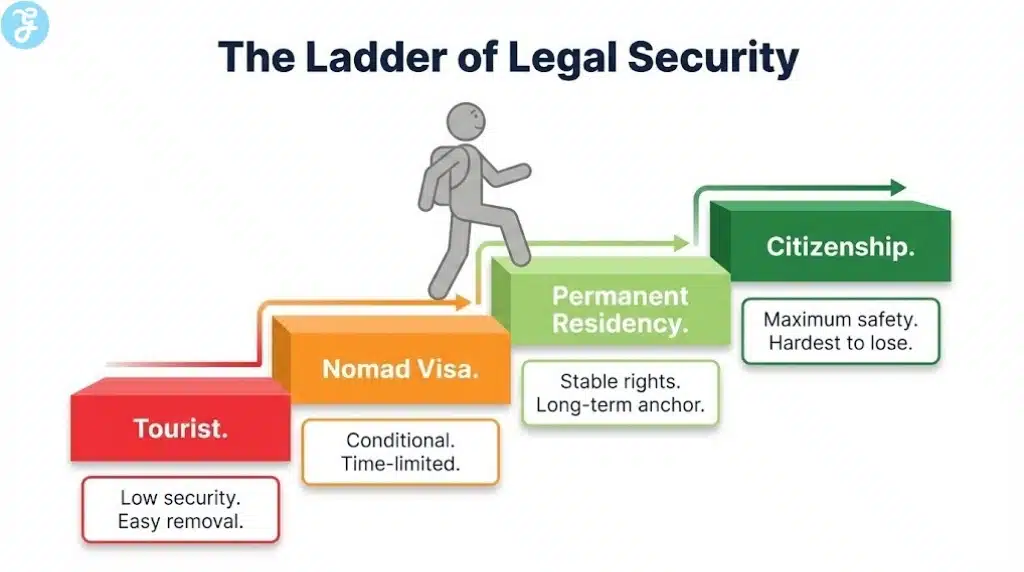
The Ladder Of Security: Tourist, Visa, Residency, Citizenship
Think of legal safety like a ladder.
- Tourist status
Short-term, low security, easy entry but easy removal. - Temporary visa
More time, still conditional, often limited rights. - Permanent residence
High stability, stronger rights, often a long-term anchor. - Citizenship
Highest stability, strongest re-entry rights, hardest to lose.
Many nomads try to live long-term on rung 2. The risk is that rung 2 was never designed to carry the weight of a lifetime.
What Permanent Residency Can Solve Without Citizenship
Some people do not need citizenship to feel safe. Permanent residency can provide:
- Long-term right to live and work
- Greater stability for housing and finance
- Better access to healthcare in many systems
- Stronger family planning options
For a large number of nomads, the best strategy is:
- Use visas to explore
- Choose a base country with strong systems
- Pursue permanent residency
- Consider citizenship later if it aligns with identity and long-term goals
This path can reduce risk while keeping flexibility.
When A Visa Might Be Enough
A visa can be “enough” if your definition of long-term is limited, or if you maintain strong anchors elsewhere.
A visa strategy can work well when:
- You have strong citizenship in a stable country already
- You keep significant savings and a home base
- You are comfortable with regular relocation
- You do not plan to bring dependents
- You are early in your career and using nomad life as a phase
- You have private healthcare coverage that remains affordable
Even here, it helps to plan for an exit strategy if conditions change.
When A Visa Is Not Enough
A visa is usually not enough when:
- You want to buy property or build deep roots
- You want stable schooling for children
- You want predictable healthcare access as you age
- You want to sponsor parents or extended family
- You want long-term economic stability in one system
- You want protection from policy volatility
- You want a reliable place to return during crises
In these cases, you do not have to rush into citizenship. But you should build a pathway toward permanent status.
How To Choose A “Base Country” For Real Safety
If you want long-term safety, you need one primary base that is strong even when you are not.
Evaluate a base country using these criteria:
Institutional Strength
Look for:
- Rule of law
- Predictable courts
- Low corruption
- Effective public administration
Healthcare Capacity
Look for:
- Access and affordability
- Emergency response quality
- Long-term chronic care support
Housing And Infrastructure
Look for:
- Build quality
- Climate resilience standards
- Stable utilities and safe water
Economic Opportunity
Look for:
- Career pathways in your field
- Business environment
- Stable banking and credit access
Pathway Clarity
Look for:
- Transparent residency requirements
- Reasonable timelines
- Stable rules for renewals and permanent status
A base country should not only be attractive. It should be administratively and economically workable for you.
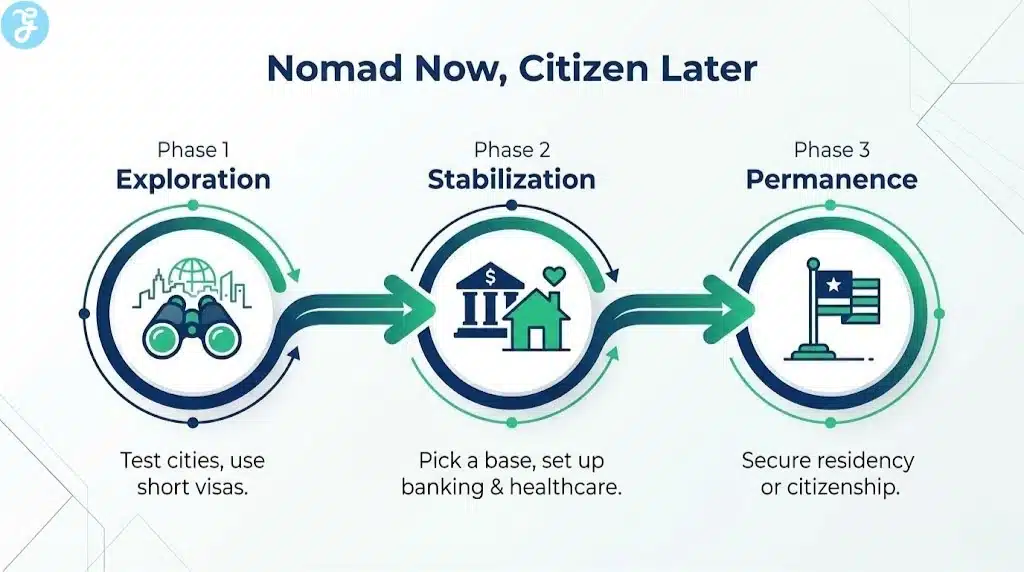
A Practical Strategy: Nomad Now, Citizen Later
Many people do not need to choose one identity forever. You can structure your life like a portfolio.
Phase 1: Exploration
- Use tourist stays and short visas
- Test cities for climate, healthcare access, and cost
- Build a short list based on lived experience
Phase 2: Stabilization
- Choose one base country
- Pursue a legal status that allows long stays
- Set up banking, housing, and consistent healthcare access
Phase 3: Permanence
- Pursue permanent residence
- Build local ties, language competence, and compliance history
- Decide if citizenship aligns with your values and long-term goals
This approach keeps your freedom while increasing your safety over time.
The Second-Passport Question
Some nomads consider a second passport as a shortcut. It can be powerful, but it is not automatically the answer.
A second passport can help if it:
- Gives you stronger re-entry rights into a resilient country
- Expands your ability to live and work across multiple countries
- Supports family planning and long-term mobility
- Reduces the risk that one country’s policy changes trap you
But a second passport can also create complexity:
- Extra tax and reporting obligations in some cases
- Conflicting legal expectations
- Costs that may not match your real needs
The smart approach is to connect the passport decision to a clear life plan, not to fear.
Personal Safety And Belonging
There is also a human layer. Feeling safe is not only legal. It is also social.
Long-term residents can still feel like outsiders, and citizens can still feel displaced. But citizenship often increases:
- Your ability to advocate for yourself
- Your long-term confidence when negotiating housing and work
- Your sense of stability during conflict or uncertainty
This matters more than many people admit. Constant temporary status can create a background anxiety that drains energy over years.
A Clear Checklist To Decide Your Next Move
Use this checklist to locate yourself on the spectrum.
You may be fine with a visa if you can answer yes to most:
- I can relocate quickly with low cost and low stress
- My work is stable and meets income requirements easily
- I have reliable private healthcare coverage long-term
- I do not need public schooling or family sponsorship options
- I have a stable citizenship and a home base elsewhere
- I am comfortable with policy uncertainty
You likely need a residency or citizenship plan if you can answer yes to most:
- I want to anchor in one place for 5 to 10 years
- I want to buy property or build a business locally
- I want stable healthcare access as I age
- I want to raise children with continuity
- I want to reduce legal uncertainty during crises
- I want a guaranteed right to return
This is the practical meaning of Digital Nomad Vs Citizen. One is a lifestyle permission that can be withdrawn. The other is a durable legal home.
A Visa Is Access, Citizenship Is A Safety Net
Digital nomad visas are useful. They can open doors, reduce border stress, and let you build a global life with more legitimacy than constant tourist stays. But they are rarely built for lifetime stability. They are designed to be conditional, renewable, and reversible.
If you want long-term safety, think beyond the next renewal. Build at least one durable anchor through permanent residence, citizenship, or both. Use visas as a bridge, not as your foundation. When the world becomes less predictable, the difference between temporary permission and permanent belonging becomes the difference between improvising under pressure and acting with confidence. That is why, in the long run, Digital Nomad Vs Citizen is a choice about resilience, not just freedom.




























