
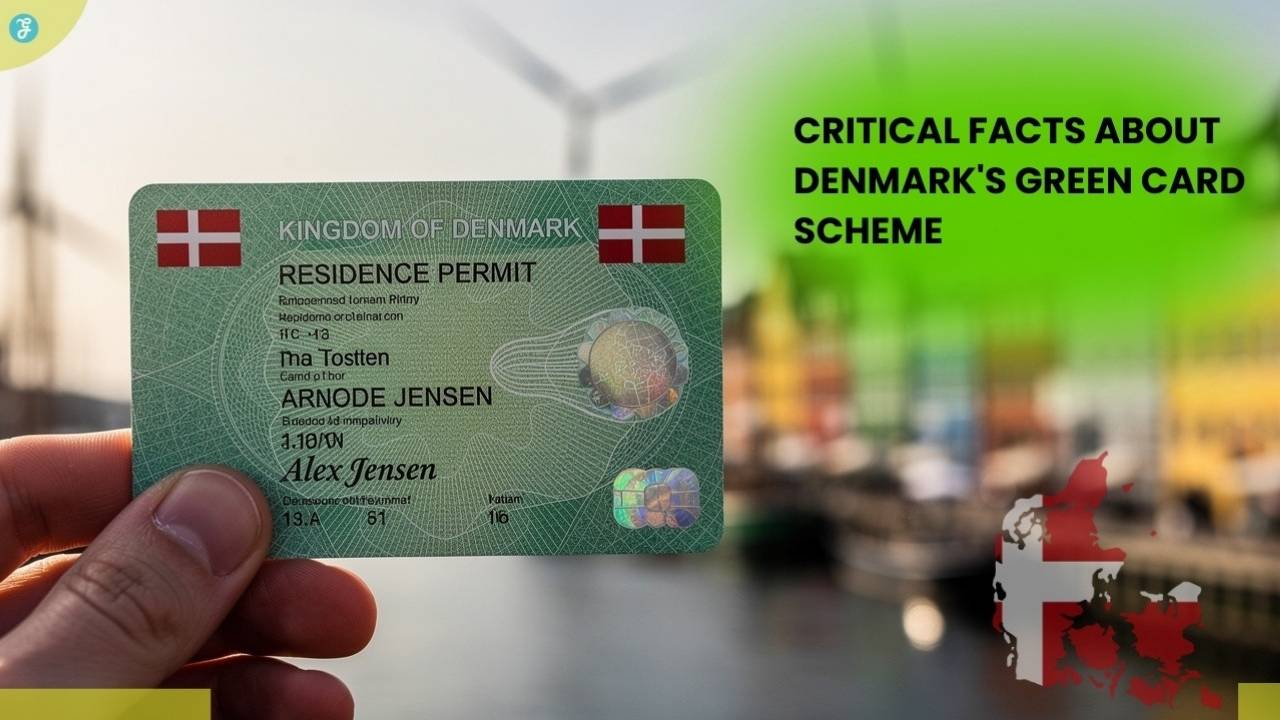
Are you dreaming of packing your bags and moving to Scandinavia? You have probably stumbled across the Denmark Green Card Scheme during your late-night internet research. Years ago, this visa was the absolute golden ticket for skilled professionals who wanted to live and work in Denmark without needing a prior job offer from a local company. It sounded like the perfect setup to start a new life in Europe.
But immigration laws change incredibly fast, and the landscape looks completely different today. People still talk about this specific program on outdated expat forums and shady immigration blogs, which creates a massive amount of confusion for newcomers. If you want to move to Copenhagen or Aarhus, you need the right information before spending your hard-earned money on useless visa application fees. The Denmark Green Card Scheme had a huge impact on the local workforce, bringing thousands of talented people to the Nordic region. However, you need to understand exactly how it worked, why the government decided to shut it down, and what your actual legal options are right now in 2026. This comprehensive guide breaks down seventeen critical facts about the old system while giving you the exact steps you can take today to secure a valid Danish work permit.
Is the Denmark Green Card Scheme Still Active?
1: The Scheme Was Officially Abolished
The single most important thing you need to know today is that the Denmark Green Card Scheme is totally and permanently dead. The Danish parliament repealed the entire program back in June 2016, wiping it from their active immigration options. Since that exact date, the Danish Agency for International Recruitment and Integration has flat-out refused to accept or process any new applications for this specific green card. You will still find a mountain of outdated immigration websites selling bogus services and evaluations for it, but you should never fall for these scams.
While existing green card holders at the time were given a temporary grace period to apply for extensions under transitional rules, that door is now completely locked for any new applicants. Knowing this harsh reality right away saves you time, money, and heartache. It lets you pivot immediately and focus all your energy on valid, active Danish work permits that actually exist and work today.
| Program Detail | Historical Status |
| Official Status | Permanently Closed |
| Abolition Date | June 2016 |
| New Applications | Strictly Prohibited |
| Old Extensions | Phased out entirely |
| Scam Warning | Many fake agency sites still promote it |
Core Requirements and Points System of the Past Scheme
2: The 100-Point Requirement
When the program was actually running, it operated on a strict, transparent, and highly competitive points system. The Danish government designed this to filter out everyone except the absolute best international candidates. To even get your foot in the door, you had to score a minimum of one hundred points on their evaluation scale. These points were pieced together from different categories like your education level, language skills, work experience, age, and European adaptability.
If you scored ninety-nine points, your application went straight into the rejection pile with no chance for an appeal. This objective scoring method made the whole process incredibly transparent but also totally ruthless. It ensured only the most qualified candidates could grab the right to move to Denmark to look for a job. It was a massive hurdle that required months of careful paperwork and documentation.
| Scoring Category | Maximum Allowed Points |
| Minimum Required | 100 Points |
| Education | 80 Points |
| Language Skills | 40 Points |
| Adaptability | 15 Points |
| Age Bonus | 15 Points |
3: Educational Qualifications Mattered Most
Your university degree carried the absolute most weight in your entire application package. You needed at least a recognized bachelor degree just to submit the initial paperwork to the immigration office. A standard bachelor degree handed you thirty points right off the bat. If you held a master degree, you jumped up to sixty points, making the process much easier. Earning a PhD maxed out this entire category and gave you eighty points, practically guaranteeing you would pass the overall test.
The Danish authorities did not just take your word for it when looking at your transcripts. They rigorously checked your foreign degrees against their own strict educational standards to ensure quality. If you had a degree from a developing nation, it had to go through a long assessment to make sure it matched a real Danish university level.
| Degree Level | Points Awarded |
| Bachelor Degree | 30 Points |
| Master Degree | 60 Points |
| PhD Level | 80 Points |
| Unrecognized Degree | 0 Points |
| Verification Process | Mandatory for all applicants |
4: Language Proficiency Was Mandatory
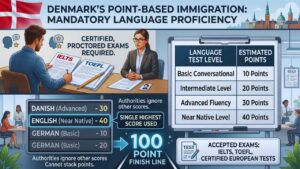
Denmark knew that if you could not communicate with locals, you would never integrate into their society or find a good job. You earned points based on your verified skills in Danish, Swedish, Norwegian, English, or German. Proving your language skills meant you had to sit for certified, proctored exams, like the IELTS or TOEFL for English speakers. A solid IELTS score could grab you twenty to forty points, which was a massive help toward the one hundred point finish line.
You could not stack points for multiple languages to cheat the system, though. The immigration authorities only cared about your single highest language score and ignored the rest. This forced applicants to prove they could comfortably survive in a demanding European workplace environment before arriving.
| Language Test Level | Estimated Points |
| Basic Conversational | 10 Points |
| Intermediate Level | 20 Points |
| Advanced Fluency | 30 Points |
| Near Native Level | 40 Points |
| Accepted Exams | IELTS, TOEFL, Certified European Tests |
5: Bonus Points for Top Universities
The Danish government absolutely loved graduates who came from elite global schools and Ivy League institutions. If you managed to get your degree from a university ranked in the top four hundred worldwide, you bagged ten extra bonus points automatically. Moving up the list, a top two hundred university gave you fifteen bonus points on your application.
Graduating from a top one hundred institution gave you the maximum twenty bonus points available in this specific subcategory. This setup proved that Denmark wanted to suck up the best academic brains on the planet to help build their tech, medical, and green energy sectors. If you went to a highly prestigious school, the government basically rolled out the red carpet to get you into the country.
| Global University Rank | Bonus Points Awarded |
| Top 100 Worldwide | 20 Points |
| Top 200 Worldwide | 15 Points |
| Top 400 Worldwide | 10 Points |
| Unranked University | 0 Points |
| Ranking Source Used | Official government recognized lists |
6: Adaptability and European Experience
Having past life experience in Europe told the Danish government you could probably handle the culture shock of moving to Scandinavia. They happily handed out adaptability points if you had studied for at least one year or worked legally for a full year somewhere in Europe. This included any country inside the European Union, the European Economic Area, or Switzerland.
This simple rule gave international students who were already knocking around Europe a massive head start over folks applying directly from Asia or the Americas. It was their way of ensuring you understood European work ethics, public transport, and social norms. If you already knew how to survive a harsh European winter, the government felt much better about giving you a visa.
| European Experience | Adaptability Points |
| 1 Year EU Study | 10 Points |
| 3 Years EU Study | 15 Points |
| 1 Year EU Work | 10 Points |
| 2 Years EU Work | 15 Points |
| No EU Experience | 0 Points |
7: Financial Independence Was Crucial
Since this green card let you move across the world without a guaranteed job offer, you had to prove you would not go broke immediately. You had to show hard proof that you had enough cash to support yourself and your family for your first full year in the country. The money needed closely matched the standard Danish student grant levels, ensuring a basic standard of living.
We are talking about having several thousand euros sitting comfortably in a liquid savings account before they would even look at your application. You had to provide certified bank statements showing the money had been sitting there for a while. This financial barrier was incredibly tough for applicants from developing nations where average salaries were much lower than in Northern Europe.
| Family Setup | Required Liquid Funds |
| Single Applicant | High |
| Applicant with Spouse | Very High |
| Applicant with Children | Extremely High |
| Proof Required | Certified 30-day bank statements |
| Currency Accepted | Equivalent value in Danish Krone |
Working and Living in Denmark Under the Scheme
8: It Allowed Job Seeking, Not Just Employment
The absolute biggest selling point of the Denmark Green Card Scheme was the sheer freedom it handed you upon arrival. It functioned as a top-tier job-seeking visa rather than a restrictive corporate sponsorship. You got the legal right to rent a local apartment, open a Danish bank account, and physically live in the country while attending job interviews.
When you finally nailed down a job offer, you did not have to go running back to the immigration office for a brand new work permit. The green card already gave you the inherent right to jump right into paid employment the very next day. This made you incredibly attractive to local employers because they did not have to wait months for visa processing to hire you.
| Visa Feature | Green Card Allowance |
| Enter without Job | Allowed |
| Attend Interviews | Allowed |
| Start Work Immediately | Allowed |
| Change Employers | Allowed without notifying government |
| Time Limit to Find Job | Tied to visa expiration date |
9: No Self-Employment Allowed
Even with all that amazing freedom to roam the job market, you absolutely could not be your own boss. Green card holders were completely banned from starting their own local businesses or doing independent freelance contract work. The government designed this visa strictly to feed highly skilled workers directly into existing Danish companies that needed talent.
If you had dreams of building a tech startup in Copenhagen, you had to apply for the totally different Start-Up Denmark visa instead. Breaking this strict employment rule meant instant deportation and the cancellation of your residence permit. They wanted you paying standard income taxes as an employee, not navigating the complicated world of corporate tax deductions.
| Employment Type | Legal Status |
| Corporate Employee | 100 percent Legal |
| Public Sector Worker | 100 percent Legal |
| Freelancer | Strictly Illegal |
| Business Owner | Strictly Illegal |
| Independent Contractor | Strictly Illegal |
10: Family Dependent Benefits
Scandinavia is world-famous for its incredible work-life balance and deep family support systems. If you managed to secure the green card, you could easily bring your spouse and any children under eighteen along for the ride. The absolute best part of this deal was that your spouse received full, unrestricted working rights the minute their feet hit the ground in Denmark.
This dual-income option was a total lifesaver because the daily cost of living in Denmark is notoriously high compared to the rest of the world. Your kids also gained access to the excellent Danish public school system, making the transition much smoother for the whole family unit.
| Family Member | Benefit Granted |
| Legal Spouse | Full residence and immediate work rights |
| Registered Partner | Full residence and immediate work rights |
| Children under 18 | Residence and public school access |
| Extended Family | Not allowed under this scheme |
| Healthcare Access | Full access to public health system |
11: Schengen Area Mobility
Holding a valid Danish residence permit basically unlocks the entire continent of Europe for you. Green card holders could travel freely and easily across the entire Schengen Area without stopping at borders. You could hop on a quick train down to Germany or take a cheap flight to Italy for up to ninety days out of every one hundred and eighty day period.
You never needed to waste time applying for extra tourist visas just to take a weekend vacation. While you could not legally take up a job in those other countries, it made networking, attending industry conferences, and exploring Europe incredibly easy. It was a massive lifestyle perk that drew thousands of applicants to the program.
| Travel Category | Schengen Rule for Cardholders |
| Travel within Schengen | Visa-free |
| Time Limit | 90 days per 180-day window |
| Border Checks | Minimal to none |
| Working in other EU states | Strictly Prohibited |
| Required Documents | Valid Passport and Danish Residence Card |
12: Initial Validity and Extension Rules
When you first won approval, the government usually granted the green card for a period of up to three years. Before that initial time ran out, you could try to submit paperwork to extend it for up to four more years. But getting those extensions approved was incredibly tough and highly stressful for most expats. You had to prove to the government that you had made a specific minimum amount of money during your first few years in the country.
If you could not find a good-paying professional job and failed to hit that strict income target, the agency denied your extension. Once denied, you had only a few weeks to pack up your entire life and leave the country permanently.
| Timeline Factor | Official Rule |
| Initial Visa Length | Up to 3 Years |
| Maximum Extension | Up to 4 Additional Years |
| Extension Condition | Must meet strict income thresholds |
| Failure Consequence | Visa revoked, immediate departure |
| Permanent Residency | Possible after 8 years of legal stay |
Why Was the Denmark Green Card Scheme Abolished?
13: High Rates of Underemployment
The main reason the program crashed and burned so spectacularly was the ugly, undeniable reality of underemployment. Thousands of ambitious people with master degrees and PhDs moved to Denmark but simply could not land proper corporate jobs. The language barrier was way too high, and they did not have a local professional network to get their resumes noticed.
To survive and pay the crazy high rent in the cities, these brilliant engineers and scientists took survival jobs washing dishes, cleaning hotel rooms, or driving taxis at night. This completely defeated the entire purpose of the visa, which was created to fill high-level knowledge gaps in the economy. The government realized they were importing academic talent just to fill minimum wage service roles.
| Intended Outcome | Actual Reality |
| Fill engineering roles | Working in hospitality |
| Boost tech sector | Driving delivery vehicles |
| High income tax revenue | Low income tax revenue |
| Seamless integration | Deep social isolation |
| Knowledge sharing | Wasted academic potential |
14: Political Shifts in Danish Immigration

Right around 2015, the overall political mood in Denmark started to shift heavily toward the right. Lawmakers and voters wanted much tighter borders and strict control over exactly who entered the local labor market. Politicians aggressively argued that letting thousands of people move to Denmark without a guaranteed job was hurting the social welfare system.
They wanted a highly streamlined process where you only get a visa if a Danish company actively proves they want to hire you right now. The open-ended, free-roaming nature of the green card became a very easy political target during election cycles. Eventually, a coalition government gathered enough votes to scrap the entire system in favor of employer-sponsored visas.
| Political Factor | Impact on Immigration |
| Public Sentiment | Demanded stricter borders |
| Government Policy | Shifted to job-first requirements |
| Welfare State Protection | Reduced open-ended visas |
| Employer Focus | Put hiring power back in company hands |
| Final Outcome | Complete abolition of the scheme |
15: The Introduction of Stricter Income Requirements
Right before they killed the program completely, the government desperately tried to fix it with a band-aid solution. They aggressively hiked up the income requirements you needed to hit just to get your visa extension approved. They made it a hard rule that green card holders had to earn the exact equivalent of a standard Danish university graduate’s starting salary.
But because people were still trapped working in low-wage service jobs, they simply could not hit that high financial target. When that strict fix failed to push people into professional roles, the system officially collapsed. The government looked at the depressing data and finally voted to shut the whole thing down for good.
| Income Rule Change | Goal vs Reality |
| Old Extension Rule | Show basic survival income |
| New Extension Rule | Match graduate level salaries |
| Government Goal | Force expats into professional jobs |
| Actual Result | Expats failed to meet targets |
| Final Action | Program deemed unfixable and closed |
Current Alternatives to the Denmark Green Card Scheme
16: The Positive List Scheme (Shortage Occupations)
Since the old scheme is dead, the Positive List is your absolute best friend right now in 2026. This is an official, publicly available government list of specific jobs where Denmark simply does not have enough local workers. They update this crucial list twice a year, on January first and July first, based on current labor market data.
There are two separate lists: one for people with a higher education degree like doctors or IT architects, and one for skilled workers like specialized technicians. If you manage to secure a job offer from a Danish employer for a job sitting right on this list, getting your work and residence permit is a very smooth process. It guarantees the government that you are filling a real, immediate need in their economy.
| Positive List Type | Target Audience | Example Roles (2026) |
| Higher Education List | University Graduates | Software Engineers, Medical Doctors |
| Skilled Work List | Vocationally Trained | Lab Technicians, Specific Trades |
| Update Frequency | Twice Annually | January 1st and July 1st |
| Requirement | Prior Job Offer | Mandatory |
| Visa Duration | Tied to employment contract | Usually 4 years max initially |
17: The Pay Limit and Fast-Track Schemes
If your specific job title is not sitting on the Positive List, you do not need to panic just yet. You can use the highly popular Pay Limit Scheme to get into the country. This route completely ignores your specific job title or degree and looks entirely at the size of your paycheck. As of 2026, if a Danish company offers you a job paying at least DKK 552,000 per year, you easily qualify for the Ordinary Pay Limit Scheme.
There is also a Fast-Track Scheme designed for highly trusted, government-certified Danish companies. This premium option allows those companies to hire you and get you working almost immediately, entirely bypassing the usual long wait times at the immigration office.
| Scheme Name | 2026 Salary Requirement | Key Feature |
| Ordinary Pay Limit | DKK 552,000 yearly | Job title does not matter |
| Supplementary Pay Limit | DKK 446,000 yearly | Requires local job advertisement first |
| Fast-Track Scheme | Matches Pay Limit rules | Start working almost instantly |
| Processing Time | Standard | 1 to 2 months |
| Fast-Track Processing | Expedited | Days to a few weeks |
Final Thoughts
The Denmark Green Card Scheme was a massive, unforgettable chapter in European immigration history. It offered unmatched, incredible freedom for educated professionals to chase the Scandinavian dream without corporate anchors weighing them down. But the harsh reality of local language barriers and a fiercely protective job market ultimately forced the government to shut it down forever. If you want to move to Copenhagen or Aarhus today in 2026, you absolutely have to play by the new rules.
Focus all your networking energy and time on securing a solid, high-paying job offer first. Target the Positive List if you have highly niche skills, or aim for top-tier corporate roles to easily qualify for the Pay Limit Scheme. Getting to Denmark requires way more upfront interviewing and patience now, but the reward of living in one of the safest and happiest countries on earth is absolutely worth the effort.
Frequently Asked Questions (FAQs)
1. What happens if I find an old website offering the Denmark Green Card Scheme?
You must ignore it completely and close the tab. Many scam websites and outdated travel agencies still pretend the program exists just to collect massive evaluation fees from unsuspecting people. The only true, official portal for Danish immigration is Nyidanmark, which is run directly by the government.
2. Can I transition from a student visa to a work visa in Denmark?
Absolutely, this is a very common and successful pathway. If you graduate from a valid Danish university, you are given an establishment card or a dedicated job-seeking period. This gives you plenty of legal time to stay in the country and hunt for a job. Once you secure employment, you simply switch over to a standard work permit.
3. Do I need to know the Danish language for the Pay Limit Scheme?
No, there is absolutely no legal language requirement for the Pay Limit Scheme or the Positive List today. As long as your hiring employer is perfectly happy with your English skills, the government will approve the visa. However, learning Danish is highly recommended if you ever want to make local friends or get promoted to management down the line.
4. Are bonuses included in the Pay Limit Scheme salary calculation?
No, they are totally excluded. When the immigration office calculates if you hit the strict DKK 552,000 mark for 2026, they only look at your guaranteed base salary, employer pension contributions, and paid holiday allowance. Variable bonuses, stock options, or random perks like a company car do not count toward the total.
5. Can citizens of the United States or the United Kingdom move to Denmark without a job offer?
No, they cannot. Ever since Brexit happened, UK citizens face the exact same harsh rules as US citizens and other third-country nationals from around the globe. You absolutely must secure a firm job offer and get an approved work permit before packing your bags and moving to Denmark.
6. What is the Start-Up Denmark Visa?
Since the old green card banned self-employment, the Start-Up Denmark visa is the current legal route for entrepreneurs. You must submit a detailed, innovative business plan to a panel of Danish experts. If they approve your idea, you get a visa to move to Denmark and build your company from the ground up.