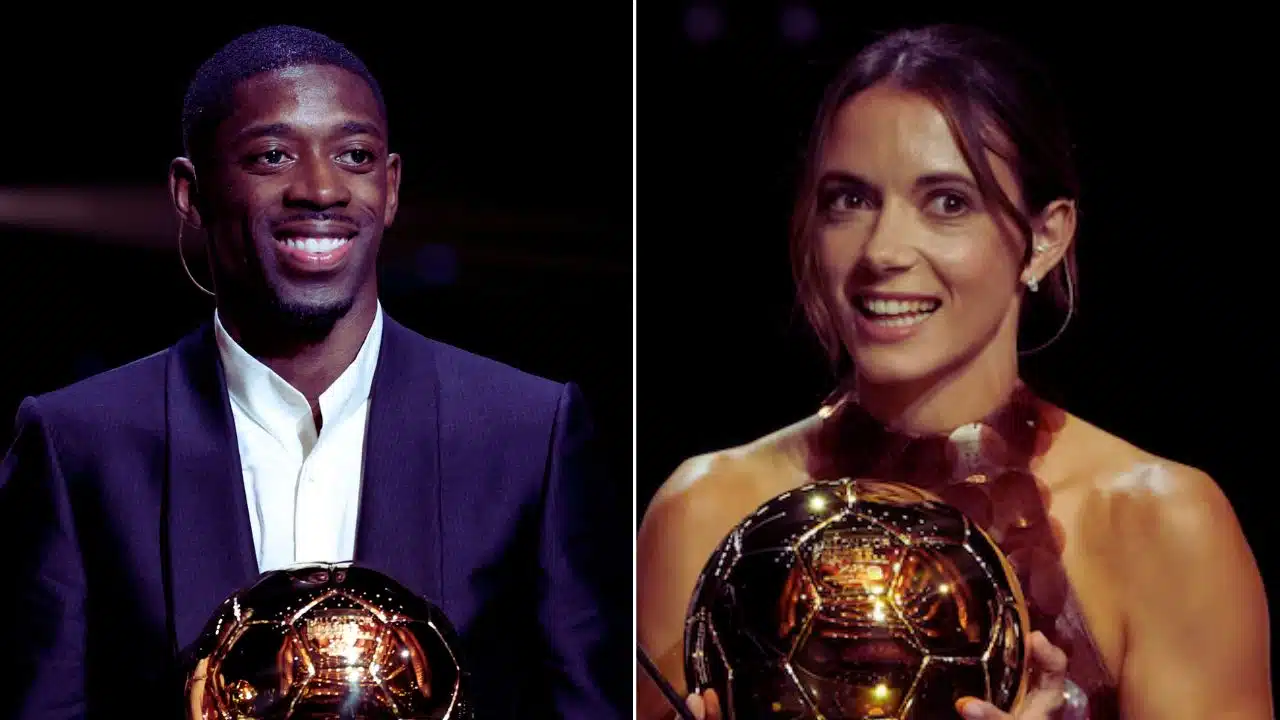
The 69th edition of the Ballon d’Or awards took place on September 22, 2025, at the historic Théâtre du Châtelet in Paris, drawing the attention of the global football community. The annual gala, organized by France Football since 1956, once again recognized the finest players and coaches in the men’s and women’s game. Fans, journalists, coaches, and former football legends filled the theater as the world waited to see who would be crowned the best players of the year.
It turned out to be a special evening for French supporters as Ousmane Dembélé, the Paris Saint-Germain star forward, claimed his first Ballon d’Or. The hometown atmosphere electrified the venue, with chants echoing from balconies as he stepped onto the stage. Meanwhile, Spain’s Aitana Bonmatí further cemented her legacy by winning her third consecutive Ballon d’Or Féminin, confirming her dominance in women’s football.
Dembélé’s Rise to the Pinnacle
For Ousmane Dembélé, the award was the culmination of an extraordinary season. At 28 years old, he became the first Frenchman to win the Ballon d’Or since Karim Benzema in 2022. His performances for Paris Saint-Germain were nothing short of world-class, and he played a decisive role in helping the club achieve a season that will go down in history.
Dembélé scored 35 goals across all competitions, including 21 in Ligue 1 and eight in the Champions League. His ability to combine clinical finishing with creative playmaking made him a nightmare for defenders. In the Champions League, he added six assists to his tally, demonstrating his all-around influence. He was particularly effective in PSG’s knockout rounds, orchestrating attacking moves and playing as both scorer and provider.
A major turning point was the Champions League final in Munich, where PSG dismantled Inter Milan 5-0 to secure their first European crown. Although he didn’t score in that match, Dembélé’s movement, pressing, and vision led directly to two assists and the buildup for another goal. His versatility—capable of operating as a winger or as a central forward under coach Luis Enrique—gave PSG an edge that no opponent could fully contain.
The Ballon d’Or triumph also carried emotional weight. Dembélé collected his award while recovering from a hamstring injury sustained during national team duty earlier in September. His teammates could not attend the ceremony as PSG were simultaneously playing a postponed league fixture against Marseille, which ended in a rare defeat. Nevertheless, Dembélé’s recognition stood as a celebration of not only his own brilliance but also PSG’s breakthrough into European football’s elite.
Beaucoup de joie, de fierté et d’émotion. Un rêve devenu réalité. Merci à tous ceux qui m’ont toujours soutenu tout au long de ce parcours. #ballondor pic.twitter.com/dLTgZXqa6d
— Ousmane Dembélé (@dembouz) September 23, 2025
Bonmatí’s Continued Dominance in Women’s Football
While Dembélé was experiencing his first taste of Ballon d’Or glory, Aitana Bonmatí was adding another chapter to her already illustrious career. At 27, she claimed her third straight Ballon d’Or Féminin, having previously won in 2023 and 2024. This achievement placed her among the all-time greats of women’s football, joining the likes of Ada Hegerberg, Alexia Putellas, and Megan Rapinoe as multiple winners.
Bonmatí’s season with FC Barcelona Femení was filled with silverware. Barcelona dominated domestically, securing another Spanish treble with victories in the Liga F, Copa de la Reina, and the Supercopa de España. Bonmatí was the midfield engine behind the club’s success, dictating tempo, delivering crucial passes, and scoring important goals.
Her year was not without disappointment, however. Barcelona suffered a painful loss in the UEFA Women’s Champions League final against Arsenal, while Bonmatí and the Spanish national team fell short in the Euro 2025 final, losing to England on penalties. Despite these setbacks, her individual consistency stood out. She was ever-present in decisive matches, often rising to the occasion when the stakes were highest.
By capturing the award again, Bonmatí demonstrated that her influence in football is not confined to one season. Her ability to lead on the field and serve as a role model off it has made her an icon for the next generation of women’s players.
Kopa Trophies for Young Talent
The Kopa Trophy, awarded to the best under-21 players in the world, highlighted the next wave of football stars.
-
Lamine Yamal, the 18-year-old Barcelona winger, won the Men’s Kopa Trophy for the second consecutive year. Despite his youth, Yamal has already become a regular starter for both Barcelona and the Spanish national team. His technical flair, speed, and decision-making have marked him as one of the brightest prospects in world football.
-
In the women’s game, Vicky López, another Barcelona prodigy, earned the Women’s Kopa Trophy. Still a teenager, López’s maturity in midfield and creativity have made her a standout performer for both club and country.
Together, Yamal and López underlined Barcelona’s remarkable ability to produce and nurture talent, ensuring the club remains a powerhouse in both men’s and women’s football.
Johan Cruyff Trophies for Coaches
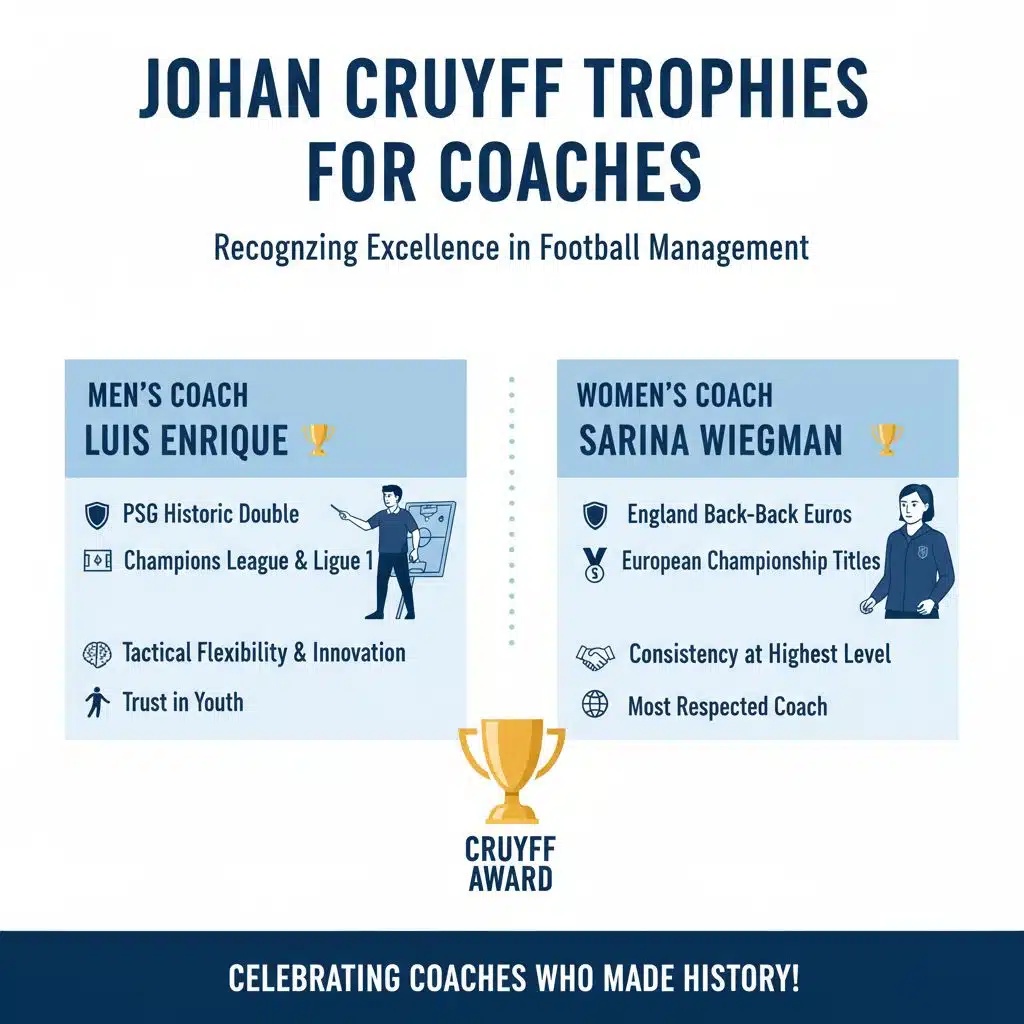
The Johan Cruyff Trophy, recognizing the best coaches, was awarded to two managers who made history with their teams.
-
On the men’s side, Luis Enrique was honored for guiding PSG to their historic Champions League and Ligue 1 double. His tactical flexibility, willingness to trust younger players, and innovative attacking schemes were central to PSG’s breakthrough season.
-
On the women’s side, Sarina Wiegman of England claimed the honor after leading the Lionesses to back-to-back European Championship titles. Her consistency at the highest level of international football has made her one of the most respected coaches in the world.
Other Major Awards
The evening also featured recognition for outstanding goal scorers:
-
The Gerd Müller Trophy for the top men’s striker was awarded to Viktor Gyökeres, who enjoyed a prolific season in front of goal.
-
The women’s version went to Ewa Pajor, whose scoring exploits placed her among the most lethal forwards in Europe.
Meanwhile, Arsenal Women were named Club of the Year for their Champions League triumph and domestic consistency, underlining the growth of English women’s football at the club level.
The Broader Significance
The 2025 Ballon d’Or ceremony highlighted not only the achievements of individual players but also the broader shifts taking place in world football. For PSG, Dembélé’s win symbolized the club’s long pursuit of European glory finally being realized. For Barcelona, Bonmatí’s continued dominance and the emergence of young stars like Yamal and López reinforced the club’s place at the center of global football.
The awards also reflected the growing parity between men’s and women’s football. The prominence given to the Ballon d’Or Féminin and the women’s Kopa Trophy shows how far recognition for women’s achievements has come in the past decade.
The 2025 Ballon d’Or ceremony was a night of milestones. Ousmane Dembélé’s first Ballon d’Or added his name to the list of French legends, while Aitana Bonmatí’s third straight triumph confirmed her as one of the defining players of her generation. With rising stars like Lamine Yamal and Vicky López taking home youth honors, and coaches like Luis Enrique and Sarina Wiegman being celebrated for tactical brilliance, the evening captured the spirit of a sport that continues to evolve, inspire, and captivate audiences across the globe.
The information is collected from ESPN and Yahoo.