Chelsea’s decision to appoint Liam Rosenior on a deal running to 2032 is more than another managerial change. It signals a sharper bet on data-driven football management: build a repeatable performance model, then hire coaches who fit the numbers, the culture, and the multi-club pipeline, right now.
How Chelsea Got Here: From Reset To A Stress Test?
Chelsea’s latest coaching switch did not happen in a vacuum. Since the 2022 takeover, the club has tried to replace a “manager-led empire” with something closer to an “organisation-led operating system.” That matters because the modern elite game is now too complex, too regulated, and too expensive to rely on intuition alone.
Enzo Maresca’s departure on January 1, 2026 ended an 18-month run that delivered trophies and a return to Champions League qualification, but also exposed the tension at the heart of Chelsea’s project: the board wants a coach who fits the structure, not a structure built around the coach. When results dipped, the relationship had less elasticity.
Rosenior’s appointment is the clearest sign yet that Chelsea are prioritising fit and repeatability over star power. His rise at Strasbourg, a club linked to Chelsea’s ownership group, offered Chelsea something unusually valuable in modern football: a live, controlled test environment for a coach’s methods, staff choices, and player-development habits.
| Moment | What Happened | Why It Matters For The “Model” |
| May 2022 | Ownership change begins strategic reset | Club shifts toward a multi-department sporting structure |
| July 2024 | Rosenior takes Strasbourg job | Coach develops within a related ecosystem |
| 2024–25 season | Strasbourg qualify for Europe for first time in 19 years | Proof point for player development + style coherence |
| 2025–26 season (as of Jan 7, 2026) | Chelsea sit 5th on 31 points after 20 matches | Board treats performance as “process + outcome,” not outcome alone |
| Nov 21, 2025 | Premier League explains new financial system for 2026–27 | Spending and squad planning become more rule-bound |
| Jan 6, 2026 | Chelsea appoint Rosenior to 2032 | Long-term contract signals commitment to continuity and metrics-led evaluation |
Why This Pivot Matters Now: The Sport Is Moving From “Boss” To “System”?

For decades, top clubs bought certainty by hiring famous managers and giving them sweeping control. Today, that approach collides with three realities.
First, talent edges are thinner. When everybody has scouting networks, video, and data, advantage comes from decision quality and execution speed rather than one genius voice.
Second, the calendar is brutal. Coaches now manage constant short turnarounds, expanded European formats, and high-intensity pressing norms. That drives injuries, rotation, and performance volatility. A club that depends on one individual’s judgement becomes fragile.
Third, financial regulation is tightening. In England, the Premier League is moving toward a new framework that will replace PSR from the 2026–27 season, including a Squad Cost Ratio that limits on-pitch spending as a share of football-related revenue. When rules harden, “buy your way out” becomes harder, and clubs must win through process.
Rosenior represents a modern archetype: a coach comfortable inside a broader structure, fluent with performance analysis, and aligned with development pathways.
| Pressure Point | What’s Changing | What A Data-Led Club Does Differently |
| Competitive balance | More clubs run elite recruitment | Builds advantages in decision processes and coaching development |
| Schedule density | More matches, less training time | Uses micro-cycles, load monitoring, and targeted tactical work |
| Regulation | Spending tied closer to revenue | Optimises wage structure, squad churn, and amortisation risk |
| Fan scrutiny | Every decision is publicly audited | Communicates a coherent plan and measurable milestones |
The New Coaching Currency: Metrics That Boards Actually Use
“Data-driven” does not mean a coach becomes a slave to spreadsheets. It means the club defines what “good” looks like, then measures whether the work matches the definition.
Modern clubs increasingly evaluate coaches in four buckets:
- Game model health: chance quality created and conceded, territory, rest defence, pressing effectiveness, set-piece efficiency.
- Player development: minutes and improvement curves for young players, resale value protection, role clarity.
- Operational discipline: training-load adherence, injury risk management, staff collaboration, and communication standards.
- Adaptability: how quickly a coach solves recurring problems (for example, chance creation versus low blocks).
Chelsea’s choice suggests they want a coach who can deliver stable “process performance,” even when finishing variance or injuries distort short-term results.
| Coaching KPI | What It Tries To Capture | Why It’s Popular In 2026 |
| Expected goals quality (xG) and expected goals against (xGA) | Sustainable chance creation and prevention | Helps separate performance from finishing luck |
| Expected points (xPts) | Underlying results “should have been” | Boards use it to sanity-check league position |
| PPDA / pressing intensity proxies | Defensive aggression and recoveries | Pressing is now a major identity marker |
| Territory and field tilt | How often a team plays in dangerous zones | Strong link to repeatable attacking volume |
| Set-piece swing | Value from rehearsed situations | Set pieces are rising as a cost-efficient edge |
| Minutes for U23 / pathway utilisation | Development intent vs rhetoric | Aligns coaching with asset strategy |
One underappreciated shift is set-piece optimisation. Data has made the trade-offs obvious: rehearsed routines can produce high-leverage chances without needing long possession sequences. Recent analysis has noted set pieces accounting for a record share of goals and increasing year over year, reinforcing why specialist coaching and analyst support are now standard, not luxury.
Rosenior’s Strasbourg As Proof Of Concept, Not Just A CV Line
Chelsea are not only hiring Rosenior. They are buying a track record of how he works inside a modern club structure.
At Strasbourg, the headline outputs were clear: a European qualification breakthrough and a competitive league position in 2025–26. But Chelsea’s deeper interest is likely in how those outputs were generated.
Strasbourg’s profile under Rosenior suggested a balance modern clubs crave: possession ideas with enough vertical threat to avoid sterile control, plus a willingness to develop younger squads.
As of mid-season 2025–26 (17 league matches), Strasbourg sat 7th in Ligue 1 on 24 points with a positive goal difference. In the UEFA Conference League league phase, they topped their group unbeaten with 16 points (5 wins, 1 draw), scoring 11 and conceding 5. Those are the kinds of “system stability” signals that attract a data-led board.
| Snapshot (As Of Jan 7, 2026) | Chelsea | Strasbourg |
| Domestic position | 5th in Premier League | 7th in Ligue 1 |
| Games played | 20 | 17 |
| Points | 31 | 24 |
| Goals for / against | 33 / 22 | 26 / 21 |
| Recent narrative | Results wobble after board-coach friction | European campaign strengthens credibility |
| Structural link | Multi-department sporting model | Similar development-first environment |
There is also a practical upside Chelsea rarely had in past eras: Rosenior can bring trusted staff and an analysis culture that already matches the ownership group’s methods. That reduces the “translation cost” that often kills coaching transitions.
Multi-Club Ownership: The Pipeline Advantage And The Governance Risk
Chelsea’s ownership-linked relationship with Strasbourg is not a side plot. It is central to this pivot.
In theory, multi-club structures can solve one of football’s biggest inefficiencies: young talent often needs the “right” competitive environment to develop, but loans are messy and selling too early destroys upside. A linked club can provide minutes, tactical continuity, and better information flow.
In practice, multi-club setups face three major risks:
- Competitive integrity scrutiny: regulators and rivals question conflicts of interest.
- Supporter legitimacy: fans of the smaller club fear becoming a feeder team.
- UEFA compliance: European rules restrict common control and influence across clubs in the same competition.
That last point is not hypothetical. UEFA has enforced multi-club ownership rules in recent seasons, and high-profile cases have shown how qualification can be affected when conflicts arise. For Chelsea, the lesson is blunt: if the pipeline is going to exist, governance must be robust enough to survive scrutiny.
| What Multi-Club Can Enable | What Can Go Wrong | What A “Serious” Operator Puts In Place |
| Faster development cycles for young players | Perception of “feeder club” exploitation | Clear sporting autonomy and transparent loan rules |
| Style alignment across teams | Tactical monoculture and blind spots | Allow “principles” without forcing identical systems |
| Better talent identification | Conflicts in European qualification | Compliance walls, ownership structure clarity |
| Shared analytics and performance tools | Data centralisation creates power imbalance | Independent decision rights at each club |
| Market access across leagues | Fan backlash and reputational damage | Communication, investment promises, and accountability |
Rosenior moving from Strasbourg to Chelsea is the best-case version of the pipeline: internal promotion based on observed fit. But it also intensifies the ethical and cultural questions supporters raise, especially if Strasbourg fans believe success is being harvested for Chelsea’s benefit.
Financial Reality: Why Coaching Metrics Matter More Under Tighter Rules?
Chelsea’s spending era has made the club a symbol of modern football’s financial engineering. But the regulatory environment is shifting toward tighter “squad-cost discipline,” which changes how clubs value coaches.
The Premier League’s new system, scheduled to replace PSR from 2026–27, introduces Squad Cost Ratio (SCR), limiting on-pitch spending to 85% of football-related revenue plus net profit or loss from player sales, with controlled headroom. The stated aim is in-season monitoring and alignment with UEFA, creating clearer guardrails for clubs planning across multiple competitions.
At the same time, UEFA’s own financial rules have normalised cost control across Europe. The consequence is straightforward: clubs cannot rely on transfer-market brute force forever. They must reduce waste, improve squad planning, and get more output per pound of wage and fee commitment.
That is where the “data-driven coaching” angle becomes financial as well as tactical. If a coach improves player value, reduces injury downtime, and makes a young squad competitive sooner, that is a balance-sheet advantage, not just a football one.
| Regulation Direction | What It Restricts | Why It Pushes Clubs Toward Better Coaching Processes |
| Premier League SCR (from 2026–27) | On-pitch spending as a share of football revenue | Encourages sustainable squad construction and wage discipline |
| In-season compliance monitoring | Late “accounting fixes” become harder | Clubs need steady decision-making, not end-of-year scrambling |
| UEFA-aligned cost controls | European participation raises compliance complexity | Clubs prefer repeatable models across competitions |
| Market inflation | Fees rise faster than patience | Better coaching reduces the need for constant buying |
What The Numbers Suggest: Chelsea’s Performance Looks “Good,” But Not Yet “Solved”?
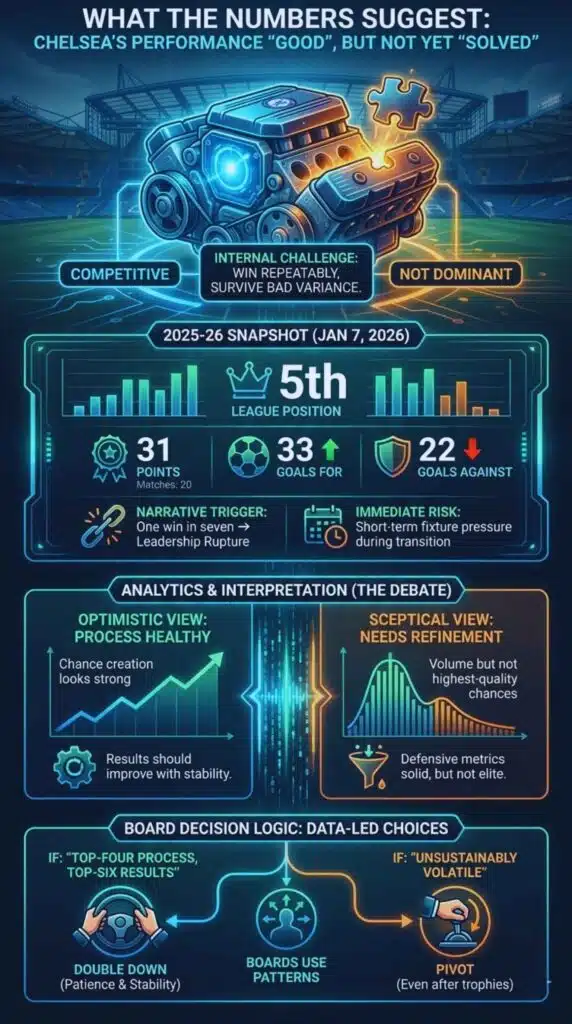
Chelsea’s league position (5th) is respectable, but the underlying story is more nuanced.
As of January 7, 2026, Chelsea have 31 points from 20 matches, scoring 33 and conceding 22. That profile points to a team that is competitive but not dominant. The club’s internal challenge is likely less about “can we win matches” and more about “can we win matches in a repeatable way that survives bad variance.”
Public analytics models also hint at this tension. Depending on provider, Chelsea’s chance creation has looked strong relative to points, while defensive metrics appear solid but not elite. That can be read two ways:
- Optimistic view: the process is healthy, and results should improve with stability.
- Sceptical view: the process creates volume but not the highest-quality chances, and the team still needs refinement.
Either way, these are precisely the kinds of patterns boards now use to justify coaching changes. If the numbers say “top-four level process, top-six results,” a club might double down. If the numbers say “unsustainably volatile,” a club might pivot even after trophies.
| 2025–26 Chelsea Snapshot (As Of Jan 7, 2026) | Value |
| League position | 5th |
| Matches | 20 |
| Points | 31 |
| Goals for | 33 |
| Goals against | 22 |
| Narrative trigger | One win in seven contributed to leadership rupture |
| Immediate risk | Short-term fixture pressure during transition |
Expert Debate: What Data Can Do And What It Cannot?
The best clubs do not ask data to predict the future perfectly. They ask it to reduce error and clarify trade-offs.
Still, there are legitimate counterarguments to a metrics-led coaching era:
- Football is not closed-form: tactics evolve, opponents adapt, and small strategic changes can swing outcomes.
- Models disagree: xG, pressing metrics, and “chance quality” vary by provider and definition.
- Human dynamics matter: a coach who “wins the room” can outperform a theoretically better fit, especially in short bursts.
- Overfitting risk: clubs can hire for a style that worked in one context, then discover the league’s constraints make it less effective.
That is why the most credible approach is hybrid: metrics for structure, experienced judgement for context. Chelsea’s move looks less like “the spreadsheet picked Rosenior” and more like “the club built a coaching profile and hired a candidate who matches it.”
There is also a reputational layer. Surveys and supporter sentiment indicate a sizeable portion of Chelsea’s fan base remains unconvinced by the leadership’s football decision-making. That scepticism raises the stakes: if the club sells itself as a long-term project, it must show long-term coherence quickly.
| Two Credible Views | Strongest Argument | What Would Prove It Right |
| “This is modern best practice” | Stability comes from system fit, not celebrity managers | Clear identity, consistent selection logic, steady results curve |
| “This is optimisation without soul” | Football still turns on leadership aura and dressing-room feel | Rapid buy-in, visible intensity, fewer public fractures |
What Happens Next: The Milestones That Will Define This Pivot
Chelsea’s next phase will be judged less by press conferences and more by measurable signals that the club’s “model” is finally coherent.
Here are the milestones that matter most.
1. Short-cycle results under pressure
Cup fixtures and big-league matches will test whether Rosenior can stabilise performance quickly without abandoning principles.
2. Selection logic and squad clarity
If Chelsea’s strongest lineups and roles stop changing week to week, that will signal governance alignment.
3. Injury and load-management alignment
Recent reporting around internal friction highlights how medical, performance, and coaching departments can collide. A modern club cannot afford that. Clubs that win consistently treat load management as a competitive weapon.
4. Strasbourg relationship optics
Chelsea must show Strasbourg are not merely a supplier. The narrative will matter in France and in UEFA corridors.
5. Recruitment discipline ahead of 2026–27 rules
With the Premier League’s new system looming, decisions made in 2026 will be judged against future compliance, not just immediate gain.
| What To Watch In 2026 | The Signal | Why It Matters |
| Tactical continuity | Same principles, fewer “identity swings” | Shows the club hired for fit, not for novelty |
| Development proof | U23 minutes + visible improvement | Validates pipeline strategy and asset logic |
| Set-piece edge | Goals and xG swing from dead balls | Low-cost margin that data-led clubs target |
| Squad-cost discipline | Wage structure and transfer pattern | Prepares for SCR and UEFA alignment |
| Fan trust trend | Better communication and fewer fractures | Long-term projects fail without legitimacy |
Chelsea Are Betting On A Repeatable Advantage
Chelsea’s coaching pivot is not just about replacing Maresca with Rosenior. It is about institutionalising a belief: the best clubs in 2026 are built like high-performance organisations, not like empires of personality.
If this works, it will look almost boring. Fewer dramatic tactical reinventions. More consistent squad planning. More players improving on schedule. Fewer internal leaks and fewer public contradictions. That “boring” is the point. In a sport where variance is unavoidable, the only sustainable edge is to reduce chaos and improve decision quality.
If it fails, the failure mode is equally clear: long contracts become dead weight, multi-club structures become political liabilities, and “data-driven” turns into a punchline that fans use to describe a club that forgot football is still played by humans.
Either way, Chelsea’s move matters beyond Stamford Bridge. It is a case study in where elite management is heading: away from the myth of the all-powerful manager, and toward a measurable, governed, and repeatable machine.