January often becomes a fresh starting point for crypto research. Traders return after the holiday slowdown, liquidity improves, and new narratives compete for attention. If you want a practical watchlist, the goal is not to predict exact prices. The goal is to track assets with clear use cases, strong liquidity, and measurable activity.
This guide covers the top cryptocurrencies to watch in January 2026 using a simple research lens. You will see what each project does, why it stays relevant, which metrics matter most, and where the risks hide. Each section is built to be scannable so you can revisit it during the month and update your notes.
Why These Are The Top Cryptocurrencies To Watch In January 2026?
A watchlist should feel boring in a good way. It should include assets you can track with real numbers and clear narratives. That usually means strong liquidity, wide exchange availability, and an ecosystem that does not depend on one trending story. It also means choosing a mix of categories so you are not betting on only one theme.
This list includes store-of-value, smart-contract platforms, infrastructure, DeFi, and a higher-risk AI narrative pick. That balance matters in January because market attention can shift quickly. Some weeks are driven by macro headlines and Bitcoin moves. Other weeks are driven by platform competition, stablecoin flows, or DeFi activity.
Selection Criteria
Market Relevance And Liquidity
Liquidity reduces “noise.” A liquid coin usually has tighter spreads, deeper order books, and more reliable signals. It is also easier to compare over time because the price is less likely to be distorted by low-volume spikes.
Utility And Adoption Signals
Coins that power real activity tend to leave visible footprints. You can track fee revenue, active addresses, transaction counts, application usage, and stablecoin settlement. These are imperfect metrics, but they beat guessing.
Ecosystem Health
A strong ecosystem has developers, tools, applications, and community support that continues even in quiet markets. This is why smart-contract networks and infrastructure tokens can remain relevant across cycles.
Catalysts For Q1
January is often full of roadmap updates, new product launches, and investor positioning. Catalysts do not guarantee performance, but they can explain why attention and volume rise.
Risk Filters
Every asset here has real risk. Centralization, token supply, regulatory exposure, security history, and adoption concentration can change how a coin behaves under stress. A strong watchlist always includes red flags.
| What We Evaluate | What It Means | Why It Matters In January 2026 |
| Liquidity | Volume, depth, access | Cleaner signals and easier tracking |
| Adoption | Users, activity, fees | Shows demand beyond marketing |
| Ecosystem | Apps, developers, tools | Supports long-term relevance |
| Catalysts | Upgrades, launches, policy | Explains attention shifts |
| Risk | Security, regulation, supply | Prevents blind spots |
Crypto Market Context For January 2026
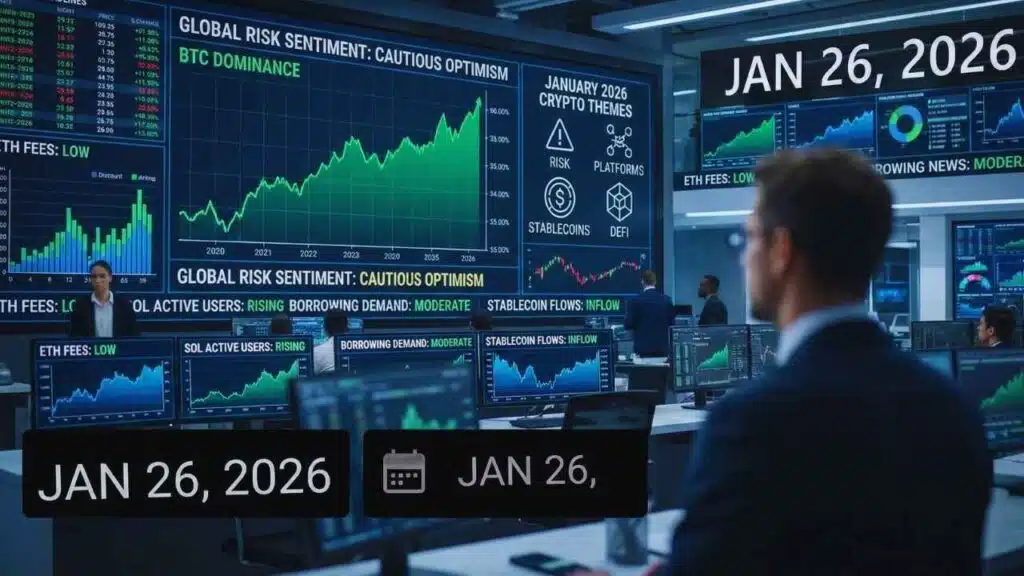
Crypto does not move in a straight line. It reacts to global risk sentiment, interest-rate expectations, regulation headlines, and liquidity flows. January can be especially dynamic because investors reset portfolios, rebalance risk, and chase new narratives.
The most important point is this. Even if you prefer smaller coins, Bitcoin still sets the pace for the whole market. When Bitcoin trends strongly, it often pulls the rest of the market with it. When Bitcoin stalls or drops fast, many altcoins can fall harder because they are more sensitive to risk.
Smart-contract networks also compete more intensely in early-year periods. Users care about low fees, fast confirmation, and strong apps. Developers care about tooling, grants, and active communities. Investors care about whether a network captures value through fees, staking demand, and ecosystem growth.
DeFi remains a useful lens because it shows capital in motion. When borrowing demand rises, it signals confidence and risk appetite. When borrowing demand falls, it often signals caution and deleveraging. Stablecoins matter too because they act like on-chain cash. Rising stablecoin use often suggests growing on-chain commerce and trading.
In January, avoid one common mistake. Do not treat a narrative as proof. A narrative is only a starting point. What matters is whether the numbers confirm it. That is why this guide keeps returning to metrics and checklists.
| Market Theme | What It Means | What To Track Weekly |
| Risk sentiment | Confidence vs fear | Breadth, volatility, rotations |
| Platform competition | Where users build and spend | Active users, fees, dApp growth |
| Stablecoin flows | On-chain cash movement | Supply trends, settlement activity |
| DeFi demand | Leverage and yield appetite | Borrowing, TVL, protocol revenue |
The 10 Cryptocurrencies At A Glance
This section is a quick scan of the top cryptocurrencies to watch in January 2026. The goal is not to rank them as “best.” The goal is to show what category each coin fits and what signal you should track first.
Use this table as your starting dashboard. Then, in each coin section, you will see deeper context, practical metrics, and risks. If you are short on time, focus on the “One Metric To Track” column and update your notes weekly. That single habit often improves decision-making more than reading endless opinions.
Also, keep your watchlist personal. If you do not understand a coin’s purpose, keep it on the watchlist longer before risking money. Understanding is a competitive advantage in crypto because hype moves faster than fundamentals.
| Coin | Category | Why Watch | One Metric To Track | Biggest Risk |
| BTC | Store of value | Market anchor and liquidity leader | Dominance trend | Macro drawdowns |
| ETH | Smart contracts | Settlement base for apps and L2s | Activity and fees | Competition pressure |
| SOL | High-throughput platform | Strong app momentum | Active users | Narrative volatility |
| XRP | Payments narrative | Headline sensitivity and liquidity | Volume stability | Policy headline risk |
| BNB | Ecosystem utility | Exchange and chain usage | Chain activity | Centralization concerns |
| ADA | Smart-contract platform | Long-term ecosystem evolution | dApp growth | Slow adoption pace |
| LINK | Infrastructure | Data layer for DeFi and RWAs | Integrations | Value capture debate |
| AVAX | Platform network | Flexible architecture | App activity | Fragmented adoption |
| AAVE | DeFi lending | Measurable demand signals | Borrowing demand | Liquidation cascades |
| TAO | AI narrative | High attention potential | Participation and liquidity | Complexity and volatility |
1. Bitcoin (BTC)
Bitcoin remains the most important reference asset in crypto. It usually has the deepest liquidity, the widest access, and the largest base of long-term holders. That makes it the first chart many traders watch before they look at any altcoin. Even if you never plan to buy Bitcoin, tracking it helps you understand overall market conditions.
Bitcoin’s role is also psychological. When Bitcoin is stable, investors often explore riskier assets. When Bitcoin becomes unstable, capital often retreats and altcoins can fall faster. This is why Bitcoin frequently acts like the “weather report” for the rest of the market.
What It Is And Why It Matters?
Bitcoin is designed as a scarce digital asset with a capped supply. Many investors treat it as a store-of-value idea within crypto markets. Its simple narrative is part of its strength.
Why Watch In January 2026?
January positioning can be sharp. If risk appetite returns, Bitcoin often leads the first wave. If fear dominates, Bitcoin often becomes the “least bad” crypto asset compared to smaller coins.
Key Metrics To Track
Watch dominance, volatility, and liquidity first. Then watch whether Bitcoin’s moves are supported by broader market strength or are isolated. A strong Bitcoin move with weak altcoins often signals caution.
Main Risks And Red Flags
Bitcoin still faces macro risk. Sudden policy shifts, global risk-off moves, and forced liquidations can hit the price fast. Overheated leverage is also a common trigger for sharp drops.
| BTC Summary | Practical Notes |
| Core thesis | Liquidity anchor and store-of-value narrative |
| Best “signal” metric | Dominance trend and volatility |
| Typical catalysts | Macro news, regulation tone, institutional positioning |
| Key risks | Macro drawdowns, leverage-driven cascades |
2. Ethereum (ETH)
Ethereum remains the most influential smart-contract ecosystem in crypto history. It supports DeFi, NFTs, stablecoin settlement, and a large share of tokenized experiments. Ethereum also matters because many scaling networks settle back to Ethereum, which keeps its role central even as activity spreads.
Ethereum is often judged on whether it captures enough value from its own ecosystem. Fees, scaling, and user experience shape that debate. Still, its network effect is real. Developers, tools, and established DeFi infrastructure keep Ethereum deeply relevant.
What It Is And Why It Matters?
Ethereum is a programmable blockchain that enables smart contracts. It is used for decentralized trading, lending, stablecoin settlement, and many digital asset applications.
Why Watch In January 2026?
In early-year rotations, investors often move from Bitcoin into smart-contract platforms. Ethereum tends to benefit when DeFi heats up and when stablecoin usage expands.
Key Metrics To Track
Track ecosystem activity instead of only price. Watch fee trends, staking participation, and application usage across the broader Ethereum environment. If activity grows while fees stay manageable, it can support long-term adoption.
Main Risks And Red Flags
Ethereum faces platform competition. It also faces value-capture questions if fees shift to other layers. If users move away because of cost or complexity, sentiment can weaken.
| ETH Summary | Practical Notes |
| Core thesis | Settlement layer for smart contracts and DeFi |
| Best “signal” metric | Activity and fee demand over time |
| Typical catalysts | Upgrades, DeFi cycles, stablecoin growth |
| Key risks | Competition, fragmented liquidity, fee pressure |
3. Solana (SOL)
Solana is known for speed, low costs, and strong consumer-style applications. It often attracts trading activity, memecoin activity, and mobile-friendly apps. That creates a powerful engine for attention, but it also creates sharper swings when narratives change.
Solana also matters because it forces competition. When one network grows fast, others respond with upgrades and incentives. That ecosystem rivalry can improve products, which is good for users and builders, but it can create confusing cycles for investors.
What It Is And Why It Matters?Solana is a high-throughput smart-contract platform focused on fast transaction processing. It is often used for on-chain trading, consumer apps, and high-volume activity.
Why Watch In January 2026?
If markets shift into risk-on mode, Solana often benefits because it is liquid and narrative-sensitive. It can also rally when consumer apps and trading activity expand.
Key Metrics To Track
Track daily active users, transaction activity, and fee signals. Also track whether app activity is diversified or concentrated in a single trend. Diversity usually signals stronger fundamentals.
Main Risks And Red Flags
Solana can be volatile because it is tied to fast-moving narratives. If attention shifts away from its core apps, activity can drop quickly. Any reliability concerns can also impact confidence.
| SOL Summary | Practical Notes |
| Core thesis | High-throughput platform with strong app momentum |
| Best “signal” metric | Active users and sustained transaction activity |
| Typical catalysts | App launches, market rotations, trading surges |
| Key risks | Narrative whiplash, confidence shocks, volatility |
4. XRP (XRP)
XRP remains one of the most watched assets in crypto because it has deep liquidity and long-standing attention. It is often associated with payments and settlement narratives, and it can respond sharply to headlines. That makes it useful for a watchlist, even if you are cautious.
XRP’s market behavior often reflects sentiment more than technical upgrades. This is not always a bad thing. If you want to understand how headlines move crypto, XRP can be a clear case study. It also tends to attract retail interest during strong market phases.
What It Is And Why It Matters?
XRP is commonly linked to cross-border payment ideas and liquidity solutions. It has a long history in crypto markets and remains widely traded.
Why Watch In January 2026?
January is a period when narratives reprice fast. XRP can move strongly if market optimism returns or if policy headlines shift. It can also retrace quickly, which makes risk control important.
Key Metrics To Track
Track sustained trading volume, not just spikes. Watch whether liquidity remains strong after rallies. Watch how price reacts to major headlines and whether moves hold.
Main Risks And Red Flags
Headline-driven volatility is the biggest risk. Another risk is chasing late moves after a sharp rally. If you track XRP, focus on discipline and patience.
| XRP Summary | Practical Notes |
| Core thesis | Liquidity-heavy asset with payments narrative |
| Best “signal” metric | Volume stability and follow-through after moves |
| Typical catalysts | Policy headlines, market-wide optimism, product news |
| Key risks | Headline shocks, sharp reversals, crowded trades |
5. BNB (BNB)
BNB is closely tied to a major exchange ecosystem and its on-chain network activity. That connection gives it practical utility in trading, fees, and ecosystem participation. It also makes it sensitive to news around centralized platforms, which can lift or pressure sentiment quickly.
BNB often behaves differently than pure platform coins because it is linked to a broader business ecosystem. When exchange activity rises, it can support interest. When scrutiny increases, it can create caution. For watchlist purposes, that “ecosystem barometer” role is valuable.
What It Is And Why It Matters?
BNB is used across an exchange-centered ecosystem and within on-chain applications. Its utility can include transaction fees, participation incentives, and ecosystem access.
Why Watch In January 2026?
If trading activity rises in January, ecosystem tokens can benefit. BNB also tends to remain on the radar during sideways markets because it is tied to ongoing usage rather than only new narratives.
Key Metrics To Track
Track chain activity, transaction costs, and user engagement patterns. Also track supply-related mechanics if they affect circulation over time.
Main Risks And Red Flags
The biggest risk is spillover from negative headlines around centralized platforms. Centralization perception can also cap long-term narrative strength.
| BNB Summary | Practical Notes |
| Core thesis | Ecosystem utility tied to exchange and chain usage |
| Best “signal” metric | On-chain activity and sustained engagement |
| Typical catalysts | Ecosystem launches, trading surges, product updates |
| Key risks | Headline spillover, centralization concerns |
6. Cardano (ADA)
Cardano remains one of the most recognized platform projects from earlier cycles. Its identity is often tied to research-heavy development and slower, methodical execution. Supporters like the long-term approach. Critics prefer faster product iteration. Both views matter, and that tension shapes how ADA trades.
As a watchlist asset, ADA can help you track sentiment toward “legacy” large-cap altcoins. It often moves with broader altcoin cycles. When markets are risk-on, ADA can catch attention. When markets are risk-off, it can drift.
What It Is And Why It Matters?
Cardano is a smart-contract platform with a strong brand and long-running community support. It aims to support decentralized applications and on-chain activity through structured development.
Why Watch In January 2026?
ADA often becomes active when broader altcoins heat up. It can also see renewed interest when ecosystem updates or application growth picks up.
Key Metrics To Track
Track real usage. Look for growth in applications, user activity, and DeFi participation. Also track whether adoption is steady or only driven by short hype bursts.
Main Risks And Red Flags
Slow ecosystem growth is a key risk. If user numbers remain flat, narratives weaken. Another risk is that attention shifts toward faster-growing ecosystems.
| ADA Summary | Practical Notes |
| Core thesis | Recognized platform with long-term positioning |
| Best “signal” metric | Growth in dApp usage and consistent activity |
| Typical catalysts | Ecosystem milestones, altcoin rotations |
| Key risks | Slow adoption, attention drift, competitive pressure |
7. Chainlink (LINK)
Chainlink is a core infrastructure project because it focuses on data delivery, not a consumer blockchain brand. Many DeFi systems need reliable data feeds for pricing, collateral, and settlement logic. That makes oracle infrastructure essential even when it is not trending.
Infrastructure assets can be overlooked in hype cycles, but they often regain attention when markets mature. If tokenized assets, stablecoin settlement, and complex DeFi products expand, data infrastructure becomes more important, not less.
What It Is And Why It Matters?
Chainlink provides oracle services that connect smart contracts with external data. This supports DeFi, derivatives, lending, and many on-chain applications that rely on accurate inputs.
Why Watch In January 2026?
If the market shifts toward utility and real adoption, infrastructure projects can stand out. LINK can also benefit indirectly when DeFi activity expands across multiple chains.
Key Metrics To Track
Track integrations, real usage, and how widely oracle services are used across protocols. Also track whether token utility is clear and whether demand aligns with network usage.
Main Risks And Red Flags
Value capture is the common debate. Some investors struggle to link infrastructure usage to token demand. Another risk is that the market ignores infrastructure when memes dominate.
| LINK Summary | Practical Notes |
| Core thesis | Oracle and data infrastructure for on-chain finance |
| Best “signal” metric | Integrations and breadth of real usage |
| Typical catalysts | DeFi expansion, tokenized asset growth |
| Key risks | Value-capture debate, narrative neglect |
8. Avalanche (AVAX)
Avalanche is often discussed as a flexible platform network. It aims to support scalable applications and different types of deployments. For investors, the key question is whether that flexibility translates into sustained user growth and strong applications.
AVAX can perform well in rotation periods because it is liquid and widely tracked. It can also respond to ecosystem growth news. For watchlist purposes, the best approach is to focus on measurable activity, not marketing narratives.
What It Is And Why It Matters?
Avalanche is a smart-contract ecosystem designed to support scalable applications. It is often positioned as a platform that can host different types of on-chain products.
Why Watch In January 2026?
Early-year rotation can lift platform coins. Avalanche can benefit if new applications gain traction or if the ecosystem attracts users. January is a good month to measure whether growth is real and sustained.
Key Metrics To Track
Track application activity, user growth, and whether developers keep shipping. Also watch liquidity depth and where most usage comes from.
Main Risks And Red Flags
Fragmented adoption is a risk. If usage is spread thin across too many experiments, it can be hard to build a strong core narrative. Competition from other platforms is also constant.
| AVAX Summary | Practical Notes |
| Core thesis | Flexible platform network aiming for scalable adoption |
| Best “signal” metric | Sustained app activity and user growth |
| Typical catalysts | New apps, ecosystem incentives, rotation cycles |
| Key risks | Fragmented adoption, platform competition |
9. Aave (AAVE)
Aave is one of the clearest “numbers-first” tokens in crypto because lending activity is measurable. Borrowing demand, supplied collateral, protocol fees, and liquidations provide direct signals about user behavior. When DeFi heats up, lending is often one of the first places where demand appears.
Aave is also useful because it highlights how risk works on-chain. Lending creates leverage. Leverage boosts returns in good markets, then amplifies damage in bad markets. If you want to understand DeFi cycles, Aave belongs on your watchlist.
What It Is And Why It Matters?
Aave is a decentralized lending protocol. Users supply assets to earn yield and borrowers take loans against collateral. The protocol’s activity reflects appetite for leverage and yield.
Why Watch In January 2026?
January is a strong month to watch DeFi positioning. If risk appetite improves, borrowing and TVL often rise. If fear grows, borrowing falls and liquidations increase.
Key Metrics To Track
Track supplied assets, borrowed value, protocol fees, and liquidation spikes. Also track which assets dominate collateral because concentration risk matters.
Main Risks And Red Flags
Smart contract risk is always present. Liquidation cascades can happen during fast drawdowns. Another risk is market-wide deleveraging, which can reduce lending demand quickly.
| AAVE Summary | Practical Notes |
| Core thesis | Lending benchmark with measurable demand signals |
| Best “signal” metric | Borrowing demand and protocol revenue trends |
| Typical catalysts | DeFi cycles, stablecoin usage, yield demand |
| Key risks | Liquidations, smart contract risk, deleveraging |
10. Bittensor (TAO)
Bittensor represents a high-volatility corner of crypto where the AI narrative meets network incentives. This is not a simple “payments” or “smart-contract platform” story. It is more complex, which means it can attract strong attention and strong misunderstandings at the same time.
For watchlist purposes, TAO is useful because it shows how emerging narratives can affect liquidity and sentiment. If AI-linked crypto themes heat up, TAO can become a focal point. If the narrative cools, it can drop faster than large caps.
What It Is And Why It Matters?
Bittensor is designed around a network where participants contribute and are rewarded within a machine-learning oriented ecosystem. The project sits within the broader trend of “incentivized networks.”
Why Watch In January 2026?
January narratives often shift quickly, and AI remains a high-attention theme across markets. TAO can move sharply when attention flows into AI-related assets.
Key Metrics To Track
Track network participation, emissions or supply dynamics, and liquidity depth. Also track whether ecosystem activity is growing beyond trading interest.
Main Risks And Red Flags
Complexity is a risk because it increases mispricing and confusion. Volatility is also a major risk because narrative coins can reverse quickly. If you track TAO, treat it as higher risk by default.
| TAO Summary | Practical Notes |
| Core thesis | AI narrative combined with incentive network design |
| Best “signal” metric | Participation trends and liquidity consistency |
| Typical catalysts | AI narrative waves, ecosystem milestones |
| Key risks | Complexity, high volatility, rapid sentiment shifts |
Top Cryptocurrencies To Watch In January 2026: How To Compare Coins Quickly?
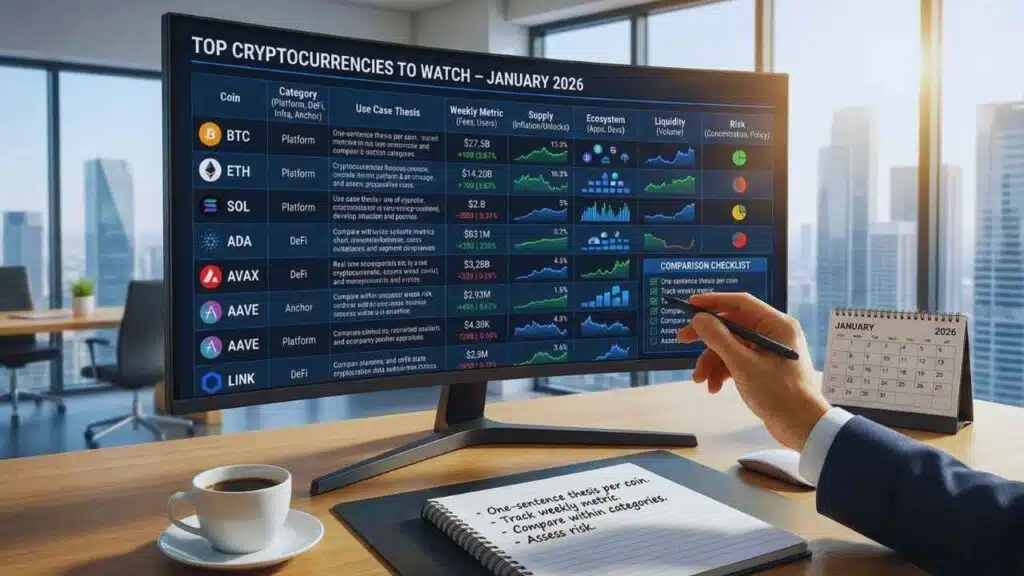
If you want this watchlist to be useful, you need a repeatable way to compare assets. The goal is not to become a full-time analyst. The goal is to track a few consistent indicators that reveal demand, supply pressure, and risk.
Start by writing down what each coin is for in one sentence. If you cannot do that, keep researching before making decisions. Then track one key metric weekly for each coin. That habit reduces emotional trading because your notes keep you grounded.
Also compare coins within the same category. Compare ETH, SOL, ADA, and AVAX as platform networks, not as random tickers. Compare AAVE as a DeFi benchmark. Compare LINK as infrastructure. Compare BTC as the market anchor. This keeps your thinking clean.
Finally, track risk the same way you track opportunity. If a coin relies on a single exchange, a single app, or a single narrative, it usually carries extra fragility. In crypto, fragile systems break first in drawdowns.
| Comparison Checklist | What To Ask | What To Track |
| Use case | What problem is solved | Clear one-sentence thesis |
| Demand | Who needs the token | Fees, activity, users |
| Supply | What increases selling pressure | Inflation, unlocks, emissions |
| Ecosystem | Is growth diversified | Active apps, developer momentum |
| Liquidity | Can you enter and exit safely | Volume, spread behavior |
| Risk | What breaks the thesis | Security, policy, concentration |
Risk Management For Crypto Investors
Crypto rewards discipline more than excitement. Even a perfect watchlist cannot protect you if you take oversized positions, chase momentum late, or ignore security basics. Risk management is not a boring extra. It is the foundation that allows you to stay in the game long enough to learn.
Start with position sizing. Smaller, riskier assets should not be the largest positions. A common approach is to build a core around larger assets and use smaller satellites for higher risk themes. Also set rules for entries and exits. Decide what would make you wrong before you buy.
Security is another must. Many losses come from phishing, fake airdrops, weak passwords, and wallet approvals. Use 2FA, protect seed phrases, and avoid connecting wallets to unknown sites. If you are unsure, wait. Waiting is a skill.
Also be careful with leverage. Leverage can create short-term gains, but it also causes forced liquidations. Most retail investors underestimate how quickly a leveraged position can go to zero in a volatile market.
Finally, track your own behavior. If you notice you only buy after big green candles, you are probably buying at higher risk points. A watchlist should reduce that impulse by giving you a calmer routine.
| Risk Rules | What To Do | Why It Works |
| Size smart | Keep risky coins smaller | Limits damage from shocks |
| Avoid impulse | Use a written plan | Reduces emotional trading |
| Secure assets | Protect wallets and approvals | Prevents avoidable losses |
| Respect volatility | Expect large swings | Keeps expectations realistic |
| Review weekly | Update metrics and notes | Improves consistency |
Final Thoughts
A strong watchlist is built on clarity, not hype. The top cryptocurrencies to watch in January 2026 are the ones you can track with real signals, clear use cases, and measurable adoption. Bitcoin helps you read the market’s “weather.” Ethereum shows the health of smart contracts and DeFi. Solana, XRP, and BNB reveal how liquidity and narratives move large caps. Chainlink and Aave help you track infrastructure and DeFi demand. TAO adds a high-risk AI narrative lens for those who want to monitor emerging themes.
If you use this guide well, you will not treat it as a one-time read. Revisit it weekly, track one metric per coin, and write short notes about what changed. That habit turns the top cryptocurrencies to watch in January 2026 into a practical tool you can use all year.