Many readers hit a wall when they try to move money between banks and crypto, and they fear slow transfers, hidden fees, or getting locked out of accounts. You want to use digital assets to pay bills, invest in real-world assets, or access decentralized finance, but blockchain technology, a crypto wallet, or a cryptocurrency exchange can feel like a foreign language.
Stablecoins had a market cap near $255 billion in early June 2025, as banks and fintech companies joined the space, and transaction volumes rose sharply. This post profiles seven projects that build bridges between traditional finance and blockchain networks, from payment systems to tokenized real-world assets, and it will explain tools like automated market maker and decentralized finance in plain terms.
Keep reading.
Key Takeaways
- Stablecoins reached about $255 billion market cap in early June 2025 as banks and fintechs joined, driving higher transaction volumes and finance-crypto integration.
- Coinbase serves over 100 million users, supports fiat-backed stablecoins and programmable treasuries, and adapts to GENIUS Act and MiCA regulatory rules.
- MakerDAO earns about 80% of revenue from RWAs and holds a $2 billion RWA portfolio, including U.S. Treasury bonds, after 2024–2025 regulatory clarity.
- Stellar, Centrifuge, Quant, XDC, and Algorand connect banks and DeFi via anchors, tokenization, Overledger multi-chain APIs, trade finance, and energy-efficient PoS.
Stellar: The Universal Payment Network
Stellar acts as a universal payment network connecting banks, payment systems, and individuals, using multiple fiat stablecoins. Anchor institutions on Stellar bridge currency silos and the Stellar network, and they make cross-asset transfers faster and cheaper than traditional banks.
That model moves digital assets toward traditional finance, and it ties payment systems to real-world assets through blockchain infrastructure.
The Pendulum bridge links Stellar and a Polkadot network, bringing DeFi capabilities to Stellar stablecoins such as BRZ and TZS. Stellar focuses on serving underbanked people, delivering faster, cheaper cross-border payments across Latin America and Africa.
Regulatory moves in 2025 opened the door for broader bank participation, which boosts regulatory compliance and eases talks with central banks over anti-money laundering rules. Anchors and partners build tools that let financial institutions and payment platforms tap real world assets, while keeping costs low for users.
Centrifuge: Real-World Asset Tokenization
Centrifuge operates as a Polkadot parachain, a piece of blockchain infrastructure, and it tokenizes real-world assets to link decentralized finance and traditional finance. The platform allows businesses to tokenize physical and financial assets, such as real estate, bonds, and commodities.
Projects select token standards, for example ERC20, and sync off-chain records with secure oracles and oracle networks like Chainlink. That process unlocks liquidity, offers fractional ownership, and democratizes access to capital for global investors.
Centrifuge adds layers for regulatory compliance, strong security protocols, and fraud prevention to fit bank needs. It streamlines trading and settlement, lowering costs and speeding cash flows for token holders.
Other projects, like Ondo Finance and Propy, target similar real-world asset work, while oracle systems and hardware wallets, including Tangem devices, secure data and custody. The result expands options for investing in digital assets and nudges financial institutions toward decentralized finance, or DeFi.
Coinbase: Simplifying Access to Cryptocurrencies
Coinbase serves more than 100 million users, and ranks second by global trading volume among cryptocurrency exchanges. The platform acts as a gateway for traditional finance, letting individual and institutional investors reach digital assets, and it advances financial inclusion.
Users trade and hold crypto tokens, access staking, lending, and yield farming, and many move from custody to participation in decentralized finance (defi). Coinbase follows regulatory compliance, and runs regular audits to boost transparency.
Coinbase supports fiat-backed stablecoins, which make up the majority of stablecoin market capitalization, and it powers programmable treasury functions and automated payments with these tokens.
Rising interest from banks and fintechs in stablecoin adoption strengthens Coinbase’s market position across financial systems and with financial institutions. New rules like the GENIUS Act and MiCA affect operations, and the exchange adapts governance and reporting to meet demands from regulators and central banks, and to fight money laundering.
Developers link smart contracts, APIs, noncustodial wallets, and hardware cards from Tangem AG to bridge blockchains, blockchain infrastructure, payment systems, money market funds, private blockchain pilots, decentralised autonomous organisations, and real estate investment experiments.
MakerDAO: Pioneering Decentralized Stablecoins with DAI

MakerDAO runs a decentralized credit platform on Ethereum. It supports DAI, a stablecoin pegged to the U.S. dollar. Users lend and borrow through smart contracts and vaults, using oracle networks for price feeds, without banks or brokers.
Holders of the MKR governance token vote on risk management and on protocol parameters.
About 80% of MakerDAO revenue comes from real-world assets, and the protocol holds a $2 billion RWA portfolio that includes U.S. Treasury bonds. That mix of RWAs bridges traditional finance and decentralized finance, giving financial institutions and crypto exchanges access to collateral-backed loans, and offering central banks a clearer link to digital assets, payment systems, and equities markets.
Regulatory clarity in 2024 and 2025 strengthens MakerDAO market position, and it raises standards for regulatory compliance and anti-money laundering controls. Developers and institutions use smart contracts, wallet tools, and blockchain infrastructure to automate lending, cut marketing and operational expenditure, and expand investments and financial inclusion.
Quant: Enhancing Interoperability Between Blockchains and Finance
Quant’s Overledger OS links multiple blockchains, and it lets developers build interoperable multi-chain applications. The platform connects Ethereum, a smart-contract platform, Solana, a high-throughput chain, and Polygon, a layer-2 network, to legacy payment systems and bank ledgers.
Banks and corporates access the Overledger APIs and SDKs to add blockchain infrastructure to existing financial systems. This setup moves data and value across networks, it helps bridge traditional finance with decentralized finance (defi).
Quant’s tech boosts liquidity and access for tokenized assets, and it brings transparency for stablecoins. Regulated financial institutions use Overledger to manage reserves, and to plug into DeFi protocols while meeting regulatory compliance and anti money laundering rules.
It gives auditors and compliance teams the knowledge to track flows across chains, using smart contracts and DLT logs. Overledger serves as key infrastructure for building cross-chain, regulatory-compliant financial applications used by central banks and large financial institutions.
The project ranks among the top real-world asset platforms by market capitalization, and it helps shift old barter systems to modern digital assets, improving financial inclusion.
XDC Network: Revolutionizing Trade Finance Through Blockchain
XDC Network (XDC) is an enterprise-grade Layer 1 blockchain that bridges traditional finance and decentralized finance (DeFi), with a clear focus on trade finance. The platform tokenizes real-world assets, like trade documents and invoices, and turns paper into digital assets.
This blockchain infrastructure adds security, transparency, and speed to cross-border settlements, and it cuts operational costs and friction. Programmable contracts automate payments and reconciliations, and they link to existing payment systems so settlements clear faster, saving banks and traders time and headaches.
Connectors let XDC plug into existing banking and trade finance systems, helping regulatory compliance and driving institutional adoption. That link ties blockchain technologies to existing financial systems, lowering barriers for traders.
The protocol ranks among the top RWA projects by market capitalization, which reflects strong market interest in tokenized RWAs and digital payments for trade. Central banks and financial institutions can audit records on the ledger, which supports anti-money laundering controls and boosts financial inclusion.
Developers use SDKs and connectors to build integrations fast, and auditors get clear trails for compliance.
Algorand: Bridging Finance with Sustainability and Security
Algorand runs on Pure Proof of Stake, an energy efficient consensus, so the network cuts power use and keeps fees low. Its security and scalability attract central banks and financial institutions, who need regulatory compliance and safe blockchain technology.
Developers deploy smart contracts on the AVM, and they build payment systems and DeFi apps that move digital assets with low transaction costs.
Firms use Algorand to tokenize real-world assets, such as bonds and real estate, often via ASA tokens on public or private chains. The network sits among the top RWA projects by market capitalization, and this track record pulls in banks and enterprises who want to modernize financial systems.
Collaborations with financial institutions help boost financial inclusion, raise liquidity, and lower barriers for traditional finance to enter decentralized finance. Strong security features also help fight money laundering, and they make compliance easier for large players.
Takeaways
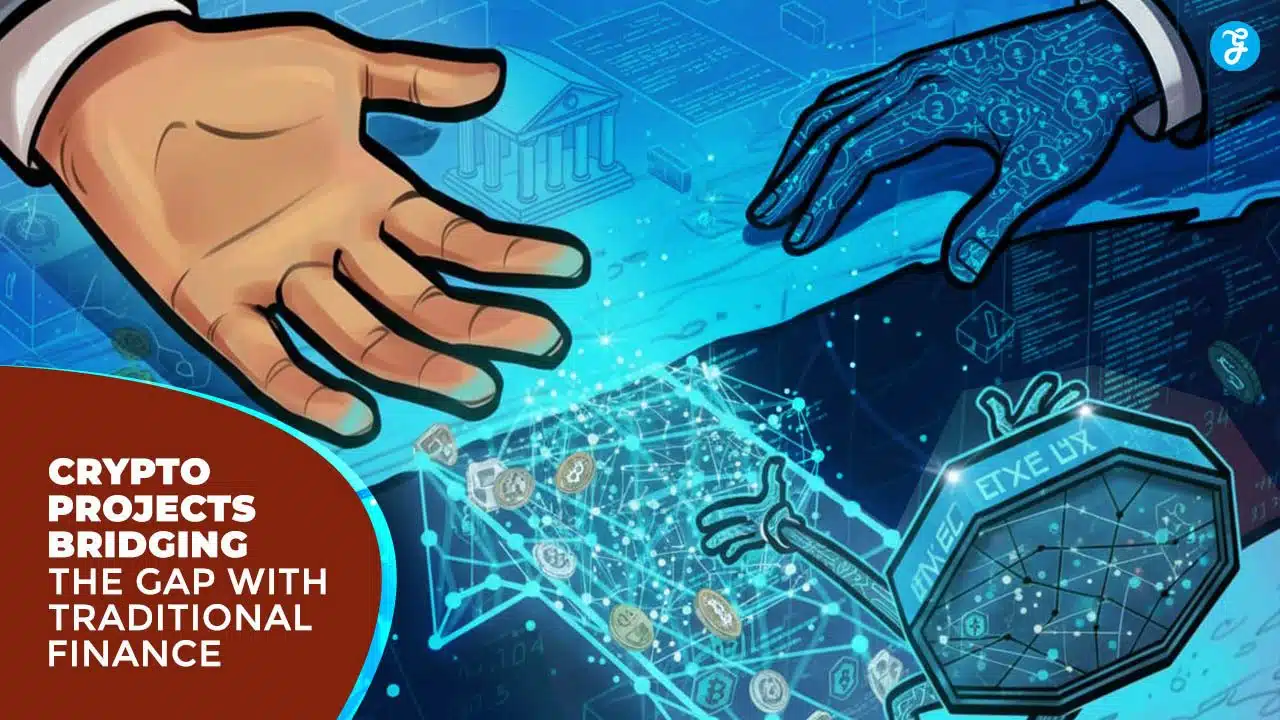
These seven projects bridge digital assets and traditional finance. They act like a digital handshake, using stablecoins, decentralized finance (DeFi), parachain tokenization on Polkadot, and automated market makers to link payment systems with banks.
DAI stablecoin, fiat-pegged tokens, and distributed ledger infrastructure move liquidity from real-world assets into DeFi, while exchanges and wallets give people simple on ramps. Regulatory clarity and bank interest speed adoption, so expect faster, fairer finance that works for more people.
FAQs on Crypto Projects Bridging the Gap with Traditional Finance
1. What do these crypto projects do, to bridge the gap with traditional finance?
They link traditional finance and digital assets. They build connections between banks, payment systems, and decentralized finance (DeFi). They tokenise real-world assets and add fresh blockchain infrastructure, so old ledgers can talk to new ones.
2. How do they help payment systems and people?
They speed up money moves, cut fees, and widen access to accounts and credit. They tie merchants, payment systems, and wallets together, and push financial inclusion, by bringing services to people who lacked them before, like adding a new lane on a crowded highway.
3. Are these projects following rules, and can they stop abuse like money laundering?
Many work with regulators, central banks, and compliance teams. They add tools for tracking flows, to fight money laundering, and to meet regulatory compliance. Still, bugs and gaps exist, so caution and audits matter.
4. Will these projects replace banks and the old system?
No, they will mix with traditional finance, not erase it. They let banks use decentralized finance ideas, and let real-world assets live on blockchains. Think of them as translators, that speed payments, improve audits, and widen access, if regulators and central banks play along.