

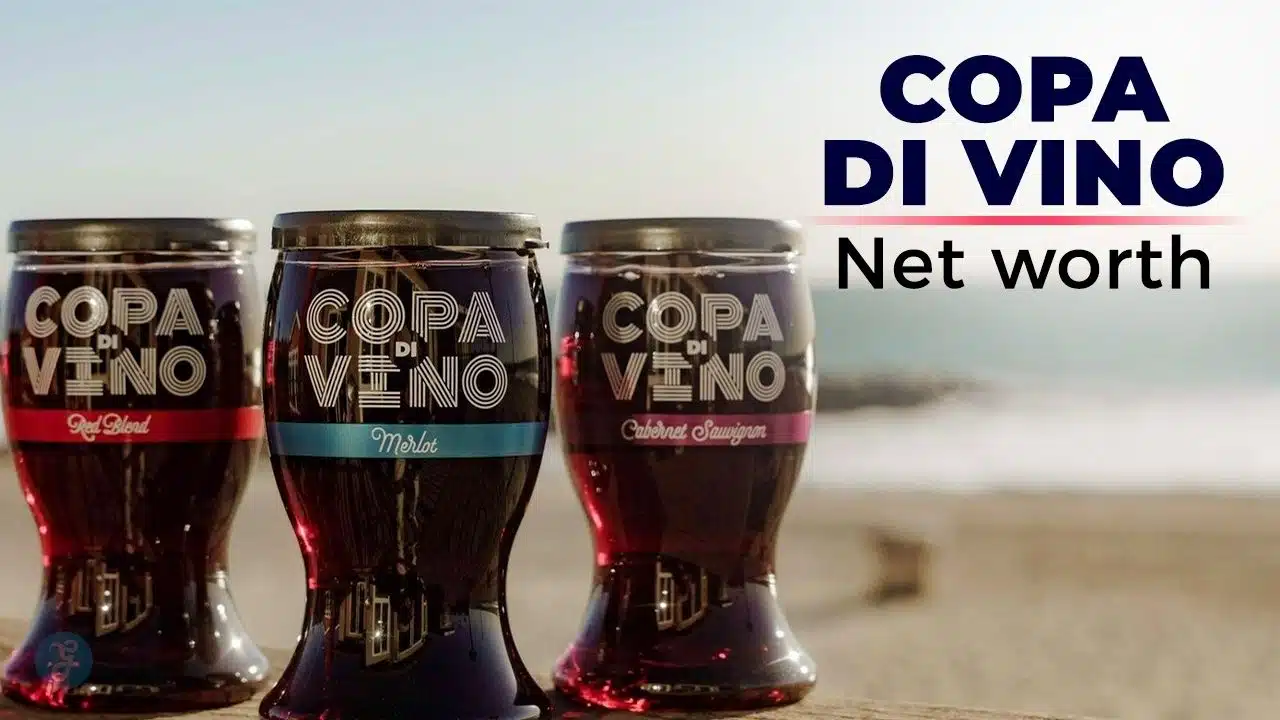
Copa Di Vino net worth has become a kind of shorthand headline for one of television’s most talked-about business stories. A winery owner from a small Oregon town walked into Shark Tank with wine sealed inside plastic glasses, argued with some of the most famous investors on television, refused their money twice, and still turned his idea into a multi-million-dollar brand that later attracted a public beverage company.
Behind that simple headline sits a more nuanced financial story. The company’s value has shifted from early television valuations to later sales milestones and an eventual acquisition. Today, Copa Di Vino net worth is best understood as a range built on revenue, brand strength, and its role inside a larger drinks portfolio.
What Is Copa Di Vino and Why Did It Stand Out?
The single-serve wine idea that started in Oregon
Copa Di Vino began as a practical solution to a simple problem: wine is awkward outside the dining room. Traditional bottles need corkscrews, glassware, and at least a little ceremony. That does not fit easily with concerts, sports events, picnics, or commuters grabbing something on the go.
James Martin, a vintner from The Dalles, Oregon, first encountered single-serve wine packaging while travelling in Europe. The concept was straightforward: pre-filled, sealed portions of wine that could be sold individually, without a bottle. He saw a gap in the United States for the same idea and moved quickly to adapt it.
Copa Di Vino — literally “glass of wine” in Italian-inspired branding — became his answer. The product combined wine and packaging in one unit: a pre-filled plastic glass with a peel-off seal. The consumer did not need to bring anything else.
Patented packaging and the portable wine trend
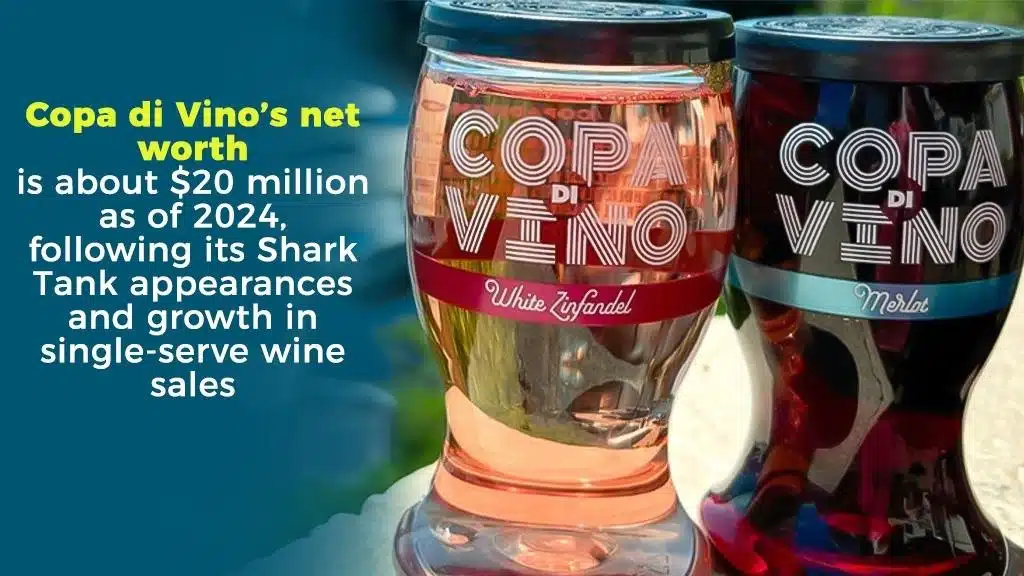
What made Copa Di Vino different was not just the idea, but the execution. The company invested in proprietary technology to fill and seal wine in its custom-designed containers. That packaging know-how became an asset in its own right.
At the same time, the wider drinks industry was moving toward portability and convenience. Canned cocktails, hard seltzers, and ready-to-drink coffees were finding shelf space in supermarkets and convenience stores. Single-serve wine slotted neatly into this broader trend.
Copa Di Vino’s pitch to retailers was simple: a way to sell wine in places where bottles were impractical and to consumers who wanted just one glass, not a full 750-millilitre commitment. That combination of packaging, timing, and changing customer behaviour laid the groundwork for the company’s later valuation story.
Copa Di Vino Net Worth: The Numbers Behind the Hype
Talking about Copa Di Vino net worth means bringing together several different types of numbers: television valuations, private company revenue, third-party estimates, and an eventual acquisition price. None of these on their own tells the whole story. Together, they offer a reasonable range.
Early valuations on Shark Tank
When Copa Di Vino first appeared on Shark Tank, James Martin asked the investors for hundreds of thousands of dollars in return for a minority stake. On one occasion, he sought $600,000 for a slice of equity that implied a multi-million-dollar valuation. On another, he floated an even higher implied value by asking for the same sum in exchange for a much smaller percentage of the business.
The exact fractions differed between appearances, but the message was consistent: Martin believed his company deserved a valuation significantly above what the sharks were willing to offer. He was not just trying to raise cash; he was drawing a line around how much control he would give up.
Those early numbers framed the debate. Television viewers saw a founder apparently holding out for a value in the low single-digit millions, while the sharks, notably Kevin O’Leary and Mark Cuban, argued that the risk and capital needs justified a lower figure or different terms.
Revenue milestones and valuation peaks
After Shark Tank, the important numbers moved from the pitch to the marketplace.
Within a relatively short period, Copa Di Vino scaled from modest early sales to several million dollars in annual revenue. Reports from the time of Martin’s second appearance indicated that the company was on track for around $5 million in sales in a single year — a considerable jump from the first months after launch.
As distribution widened and the concept gained visibility, later updates and business profiles pointed to annual sales climbing toward the $20 million mark at the height of the brand’s standalone growth. In that period, several outlets reported that Copa Di Vino’s valuation had climbed to around $70 million. That figure usually came from combining revenue multiples typical in the beverage sector with the brand’s rapid sales growth and national presence.
It is important to stress that these were not audited numbers released on a stock exchange. They were estimates based on interviews, media coverage, and comparable deals in the drinks industry. Even so, they give a sense of how far the business has moved from early Shark Tank valuations.
Recent estimates of Copa Di Vino net worth
Today, most third-party business sites that track private brands converge on a similar range for Copa Di Vino net worth. Many place the company’s value at roughly $70 million, sometimes describing it as an estimate for recent years. Others suggest that the brand could be worth more, with some commentary stretching the range upwards toward around $90 million, based on continued growth in single-serve alcohol and the strength of the Copa Di Vino name.
These numbers should be treated as informed approximations rather than precise bookkeeping. The company is now part of Splash Beverage Group, and detailed standalone figures for the Copa Di Vino unit are not broken out publicly in a way that allows a simple calculation.
However, the consistency of estimates in the tens of millions, anchored around the $70 million mark, supports a broad conclusion: the Copa Di Vino net worth story is one of a brand that grew far beyond its original televised valuation, even if the exact figure remains an estimate rather than a disclosed, audited number.
How Shark Tank Shaped Copa Di Vino Shark Tank Net Worth
Copa Di Vino’s value cannot be separated from its role in the Shark Tank narrative. Unlike many companies that secure a deal and disappear from public view, James Martin’s business became famous precisely because he refused to compromise with the investors.
Two appearances, two rejected offers
Copa Di Vino appeared on the programme twice, an unusual distinction. In both episodes, Martin sparred with the sharks over valuation and control. Offers were discussed, tempers flared, and deals fell apart on camera.
To some viewers, Martin appeared stubborn or even arrogant. To others, he came across as a founder determined to protect his vision and his equity. Either way, the result was the same: no shark ended up with a stake, and Copa Di Vino walked away without a television-backed investment.
That decision could easily have consigned the brand to a footnote. Instead, it turned Copa Di Vino into one of the show’s most frequently referenced “what happened next” stories.
Publicity over the partnership
The rejected offers did not stop buyers. If anything, the drama drew attention.
National retailers picked up the single-serve wine. Copa Di Vino began appearing on the shelves of chains like Walmart and Target and in convenience outlets such as 7-Eleven. For consumers, the brand was simple to recognise — its clear plastic glass and peel-off foil were distinctive — and easy to try as an impulse purchase.
From a financial point of view, the television exposure functioned as a multi-episode national advertising campaign. Martin kept his equity and captured the upside as sales moved from the low millions into eight-figure territory.
Brand perception and pricing power
The Shark Tank saga also created intangible value. Copa Di Vino became associated with a particular kind of story: the founder who refused the TV investors and won anyway. That narrative, repeated across business blogs and social media, reinforced the idea that the brand was bigger than its size alone might suggest.
When observers today talk about “Copa Di Vino Shark Tank net worth”, they are really pointing to this intersection of storytelling and financial performance. The brand’s worth comes not just from cases shipped but from the way consumers, retailers, and acquirers perceive its resilience and distinctiveness.
The Splash Beverage Group Deal and What It Says About Value
Eventually, the Copa Di Vino story moved from private ownership to corporate portfolio. That turning point offers another reference point for understanding the company’s worth.
Acquisition terms and timing
Copa Di Vino was acquired by Splash Beverage Group in a deal valued at roughly $5.98 million, structured through a mix of cash and stock. At that point, the brand was reported to be generating only a few million dollars in annual revenue as part of a wider family-run operation, following a period of higher sales earlier in its growth curve.
On paper, that figure looks modest compared with earlier estimates of $20 million in sales and a $70 million valuation at peak. But acquisition pricing often reflects the buyer’s expectations, integration costs, and the specific terms of the deal rather than merely applying a simple multiple to prior claims.
In addition, the use of stock as part of the payment means that the real value to James Martin and other stakeholders depends on Splash Beverage Group’s performance over time, not just the headline number.
From family brand to portfolio asset
Inside Splash Beverage Group, Copa Di Vino shifted roles. Instead of carrying the entire weight of its own distribution and marketing strategy, it became a component in a broader line-up that includes energy drinks, other alcoholic beverages, and new product launches.
That portfolio approach changes how analysts think about Copa Di Vino net worth. The brand contributes revenue, intellectual property, and shelf presence, but it also benefits from shared sales teams and cross-promotion. In finance terms, the acquisition value is only one part of the story; the longer-term contribution to Splash’s growth can justify a higher effective valuation for the brand within the group.
This is why more recent estimates still talk about Copa Di Vino net worth in the tens of millions of dollars: they are attempting to capture the value of a recognised single-serve wine brand operating under the umbrella of a public drinks company, not just the cheque written on acquisition day.
James Martin Copa Di Vino Net Worth and Personal Payoff
Any discussion of Copa Di Vino net worth naturally leads to questions about the founder’s own finances. Exact figures for James Martin Copa Di Vino net worth are not public, but some reasonable conclusions can be drawn from the available information.
Equity, liquidity, and paydays
As the originator of the concept and early driving force behind the company, Martin held a substantial share of the equity before the acquisition. While the exact percentage has not been disclosed, he was clearly more than a minority figurehead.
That stake would have given him a significant portion of the proceeds when Copa Di Vino was sold to Splash Beverage Group. Because the deal included stock, his wealth is partly tied to the fortunes of Splash itself. If the group performs well, the value of those shares rises; if it struggles, the real return from the sale shrinks.
On top of that, Martin likely benefited from years of salary, distributions, and related income while Copa Di Vino operated as an independent business. Speaking engagements, consulting, and continued involvement in the wine industry may add additional layers to his personal net worth.
Public estimates of James Martin’s wealth vary, but many put his personal net worth comfortably into seven-figure territory, sometimes more, built primarily on Copa Di Vino and the attention that followed. These figures, like the company-level estimates, remain approximations rather than audited disclosures.
From winery owner to case study entrepreneur
Martin’s on-screen persona — confident, sometimes combative, and unwilling to compromise — polarized viewers. Yet that exact stance has turned him into a case study. Entrepreneurs and commentators now use his story to debate when to walk away from investors, how to value a growing consumer brand, and the trade-offs between capital and control.
That reputational capital has its own kind of value. It keeps Copa Di Vino and its creator in circulation as examples in business schools, podcasts, and online commentary, reinforcing the brand narrative that underpins the Copa Di Vino net worth conversation.
What Drives Copa Di Vino’s Value Today?
With the acquisition complete and the initial television drama long past, what actually sustains Copa Di Vino’s value now? Several factors still matter.
Patents, packaging, and private-label potential
First, there is the packaging technology itself. The ability to safely fill, seal, and distribute wine in single-serve glasses at scale is not trivial. Copa Di Vino invested in machinery, processes, and intellectual property that can be applied not only to its own branded products but potentially to co-packing or private-label deals for other wine producers.
That creates an earnings stream beyond direct retail sales. In valuation terms, it supports a higher multiple because the business is not limited to one label; it owns a format.
Distribution footprint and sales mix
Second, there is distribution. Copa Di Vino has secured placements in major national retailers and convenience channels. Its products can be found in supermarkets, big-box stores, petrol stations, and event venues.
For beverage brands, access to those shelves and refrigerated cases is a critical asset. Retailers generally prefer reliable, proven sellers. Once a product wins its space, it has a good chance of staying there unless performance drops or a rival offers something dramatically better.
In turn, this distribution footprint supports stable revenue and increases the attractiveness of the brand to partners, investors, and acquirers. It also gives Splash Beverage Group a platform for testing related products and extensions within the same category.
Competitive landscape in single-serve alcohol
Single-serve alcohol is more crowded than it was when Copa Di Vino launched. Canned wines, plastic cups from rival brands, and an expanding universe of ready-to-drink cocktails all fight for attention.
Paradoxically, that competition can reinforce Copa Di Vino’s position. The existence of rivals validates the category. A well-known pioneer brand with shelf history and national awareness often fares better in such an environment than a newcomer without recognition.
As long as Copa Di Vino’s products remain price-competitive and the packaging continues to carry a clear identity, the brand is likely to retain a meaningful share of this growing niche. That underpins the higher end of current Copa Di Vino net worth estimates.
Lessons Behind the Copa Di Vino Net Worth Story
The rise of Copa Di Vino offers several broader lessons for founders, investors, and observers trying to interpret business “net worth” headlines.
Using television for leverage, not capital
Many entrepreneurs view programmes like Shark Tank as funding channels. Copa Di Vino treated the show more as a spotlight. By refusing to accept deals that would have significantly diluted his equity or ceded control, James Martin used primetime television as advertising rather than as a source of capital.
That strategy carries risk. A weaker product could have been exposed and quickly forgotten. In this case, however, the combination of a distinctive format, clear consumer demand, and sustained execution after the show turned the initial publicity into long-term sales.
Valuation discipline and founder control
The Copa Di Vino Shark Tank net worth story also illustrates the importance — and cost — of sticking to a valuation. Had Martin agreed to the sharks’ terms, he would have traded a portion of his future upside for immediate security and mentorship.
By drawing a hard line on value and retaining control, he took on more operational strain but ultimately captured a larger share of the outcome when the business scaled and was later acquired. That is not a universal blueprint, but it shows why founders sometimes walk away from offers that look generous to outsiders.
The limits of “net worth” as a headline metric
Finally, the case highlights how slippery net worth numbers can be.
Copa Di Vino net worth figures circulating online range from tens of millions of dollars to even higher estimates, depending on which year, which data points, and which valuation multiple a commentator chooses. Some emphasise peak revenue, others focus on the acquisition price, and still others extrapolate based on the growth of the single-serve market as a whole.
The reality is more nuanced. The brand is valuable, but its precise worth at any given moment depends on underlying sales, margins, contractual obligations, and the performance of its parent company’s stock. For James Martin, too, personal net worth is tied to equity stakes whose value moves with the market.
Treating these numbers as estimates rather than fixed facts leads to a more grounded understanding of what Copa Di Vino has achieved.
Outlook: Can the Brand Keep Pouring Growth?
Looking ahead, Copa Di Vino sits at the intersection of several trends that still favour its model. Consumers continue to seek convenience and portion control in alcohol. Event venues, airlines, and stadiums need formats that reduce waste and speed service. Retailers want products that fit easily into grab-and-go fridges.
If Splash Beverage Group can maintain distribution, refresh packaging and flavours, and keep the brand visible in a crowded ready-to-drink space, Copa Di Vino net worth is likely to remain substantial. There is room for geographic expansion, new wine styles, and collaborations that leverage its distinctive format.
Risks remain. Shifts in alcohol consumption habits, regulatory pressure, and competition from other single-serve options could squeeze margins or erode shelf space. Economic downturns may also push consumers toward cheaper alternatives or different categories altogether.
Even so, Copa Di Vino has already done something most Shark Tank companies never achieve: it turned a televised clash into a durable asset. Whatever precise number one attaches to Copa Di Vino net worth, the underlying story — of a single-serve wine that used visibility, timing, and persistence to outgrow its early sceptics — continues to hold value of its own.
Final Words
Copa Di Vino’s journey shows how resilience, timing, and a bold vision can turn an unconventional idea into a high-value brand. Its growth, despite public setbacks, reflects strong consumer appeal and smart execution. As the single-serve wine market expands, Copa Di Vino remains well-positioned to build on its momentum and strengthen its long-term value.































