Trying to track where your website traffic comes from in 2026 feels a bit like trying to fill a bucket that has holes in the bottom. You fix one leak, and another one springs up. You might have noticed that your sales figures don’t match your ad reports, or that half your visitors seem to be invisible “direct” traffic.
The old way of tracking users with third-party cookies is fading fast. While Google Chrome switched to a “User Choice” model rather than killing cookies entirely, browsers like Safari and Firefox still block them by default. This leaves marketers with a messy, fragmented picture of their audience.
But here is the good news: losing cookies does not mean losing data. In fact, the shift has pushed us toward tools that are actually more accurate and respectful. I’m going to walk you through the exact methods I use to close that data gap, track real conversions, and keep your marketing profitable in 2026.
So, grab a coffee and let’s get your tracking sorted out. It is easier than you think.
What Does “Cookieless” Mean?

“Cookieless” tracking means gathering data on how people interact with your site without relying on third-party tracking scripts that follow them across the web. It is the industry’s answer to a digital world where users want privacy and browsers block unauthorized snooping.
For years, advertisers used these little bits of code to build detailed profiles of user behavior. If you looked at a pair of shoes on one site, a cookie ensured an ad for those shoes followed you to Instagram, Facebook, and the New York Times.
That era is ending. Today, we rely on privacy-safe alternatives that focus on first-party permission. Instead of a third-party script recording everything, we use:
- Universal IDs: Secure, encrypted identifiers like Unified ID 2.0 (UID2) that allow tracking based on a user’s hashed email address, but only with their permission.
- Browser-Based Groups: Technologies like the Privacy Sandbox that group users into anonymous “interest crowds” rather than tracking individuals.
- Direct Signals: Collecting data straight from your own server, bypassing the browser’s restrictions entirely.
Why the Shift to a Cookieless Future Matters
The rules of the game have changed because the players—Big Tech and governments—forced them to. If you are still relying on the old pixel-based tracking methods from 2020, you are likely missing 30% to 50% of your conversion data. This is what we call “signal loss.”
By 2026, privacy is not just a preference; it is the default. Apple’s App Tracking Transparency (ATT) framework means that on iPhones, only about 38% of users globally opt-in to tracking. If you ignore this reality, you are effectively marketing with one eye closed.
Switching to modern tracking isn’t just about compliance; it’s about accuracy. Marketers who pivot to server-side solutions often see their reported conversions jump by 20% or more simply because they are finally seeing the data that ad blockers and privacy filters were hiding.
Key Challenges of Tracking Without Cookies
Tracking traffic today involves navigating a maze of new rules and technical hurdles. Here are the specific roadblocks you need to watch out for.
Loss of Third-Party Data
The biggest pain point is the “addressability gap.” In the past, you could easily target “males aged 25-34 who like hiking.” Now, because third-party cookies are blocked by default on Safari and Firefox—and turned off by many users on Chrome—those easy audience segments are shrinking.
This leads to the dreaded “Dark Traffic” problem. Analytics platforms often dump untracked visitors into the “Direct” bucket. You know you didn’t get 5,000 people typing your full URL into their browser yesterday, but without cookie data, your analytics tool doesn’t know where else to put them.
Privacy Regulations and Compliance
It is not just about technology; it is about the law. In the US alone, we now have a patchwork of state-level privacy laws in over 20 states, including California (CPRA), Virginia (VCDPA), and newer entrants like Indiana and Kentucky enforcing rules in 2026.
Warning: Many of these new laws require you to honor “Universal Opt-Out Mechanisms” like the Global Privacy Control (GPC) signal. If a user’s browser sends this signal, you must legally treat it as a valid request to stop selling or sharing their data, automatically.
Ignoring these signals can lead to steep fines. In Europe, GDPR enforcement remains aggressive, with fines reaching hundreds of millions for mishandling user data. The cost of non-compliance is far higher than the cost of upgrading your tech stack.
Emerging Technologies for Cookieless Tracking

Fortunately, technology has evolved to fill the void. These are the three most powerful tools you should be using right now to replace the old cookie-based methods.
Server-Side Tracking
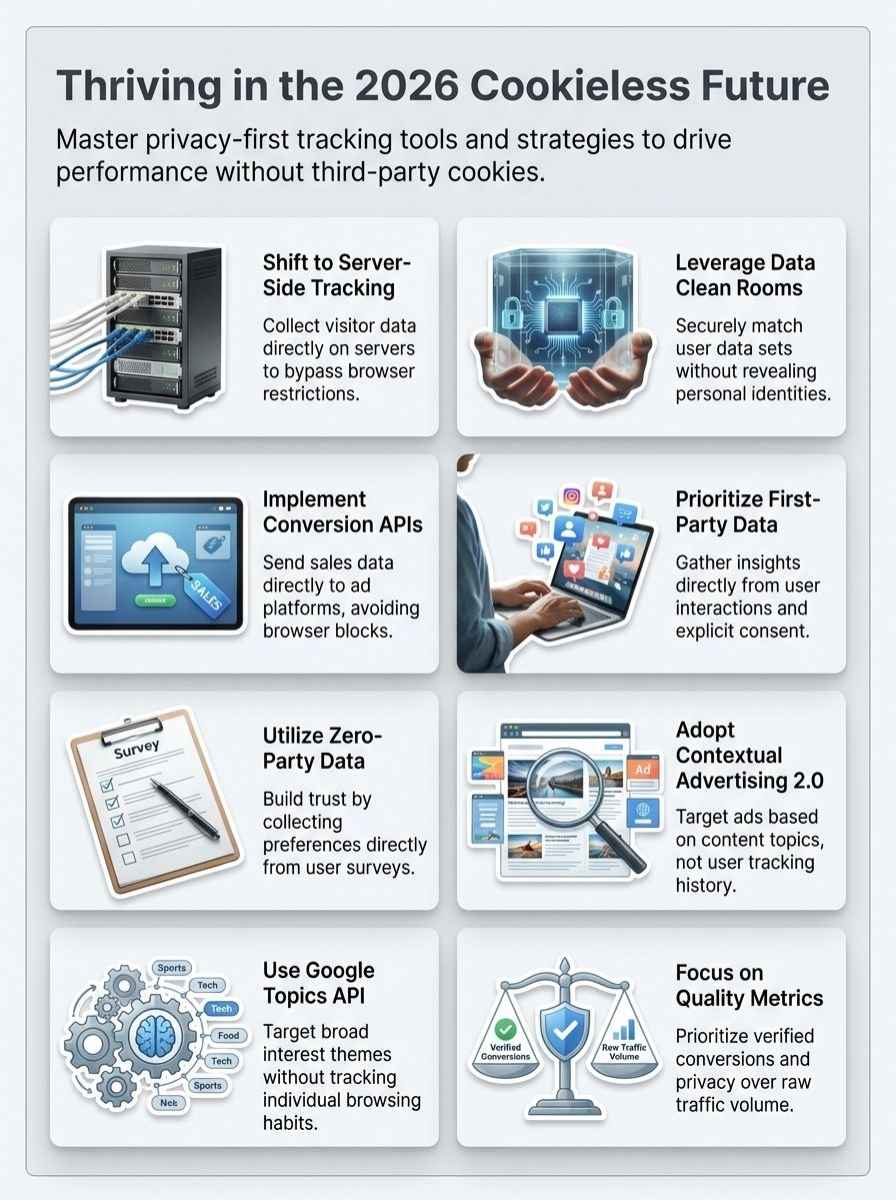
Server-Side Tracking (SST) is the gold standard for 2026. Instead of asking the user’s browser (client-side) to send data to Facebook or Google, your website sends it directly from your own server (server-side). This creates a direct, secure line of communication that ad blockers cannot see or stop.
Why it wins:
- Data Recovery: It recovers 20-40% of conversions lost to ad blockers and browser restrictions.
- Control: You decide exactly what data to share (e.g., you can strip out IP addresses before sending data to Facebook).
- Speed: It removes heavy tracking scripts from your website, making pages load faster for users.
Data Clean Rooms
Think of a Data Clean Room as a Switzerland for your data. It is a neutral, secure software environment where two parties—like a brand and a publisher—can match their user lists without ever actually revealing the raw data to each other.
For example, a retailer can upload their purchase data and a TV network can upload their viewer data to a clean room like Snowflake or AWS Clean Rooms. The system matches the users and tells you, “500 people who saw your ad bought a TV,” but neither side sees the specific names or emails of those people.
Conversion APIs
Conversion APIs (CAPI) are the specific tools that make server-side tracking possible for ad platforms. The most famous is the Meta Conversion API (formerly Facebook CAPI), but TikTok, LinkedIn, and Snap all have their own versions now.
Here is how they compare to the old pixel method:
| Feature | Old Browser Pixel | Conversion API (CAPI) |
|---|---|---|
| Data Source | User’s Browser | Your Website Server |
| Blocked by Ad Blockers? | Yes, frequently | No, rarely |
| Accuracy | Low (misses ~30% of data) | High (99%+ reliable) |
| Privacy Control | Low (Platform scrapes data) | High (You choose what to send) |
Pro Tip: When you set up CAPI, you must “deduplicate” your events. If you run both the Pixel and CAPI at the same time without an Event ID to link them, you will accidentally count every sale twice.
Strategies for Marketers in a Cookieless World
Tools are useless without a strategy. To win in 2026, you need to change how you think about acquiring and keeping customer data.
Leveraging First- and Zero-Party Data
First-party data is information you collect passively, like purchase history or website behavior. Zero-party data is even better: it is data a customer intentionally gives you. This is the holy grail of trust.
To collect this, stop relying on background tracking and start asking questions. Use interactive content tools like Typeform or Octane AI to build:
- Product Quizzes: “What is your skin type?” (They get a recommendation; you get data).
- Preference Centers: Let users choose how often they want to hear from you.
- Post-Purchase Surveys: “Who did you buy this gift for?”
Contextual Advertising 2.0
Contextual advertising has made a massive comeback, but it is much smarter than it used to be. Instead of chasing a specific person, you place ads based on the specific content of the page. It is safe, compliant, and effective.
Modern tools use AI to “read” the video or article content in real-time. For instance, platforms like GumGum or Integral Ad Science (IAS) can analyze a video frame-by-frame to ensure your sneaker ad appears exactly when the video host starts running, ensuring relevance without needing to know who is watching.
Identity Resolution Methods
Identity resolution is the process of stitching together different identifiers—like an email, a phone number, and a loyalty ID—to recognize that they all belong to the same person. In a cookieless world, you need a graph that does not rely on third-party cookies.
Many brands are adopting Unified ID 2.0 (UID2). This open-source framework, pioneered by The Trade Desk, creates a standard, encrypted ID from a user’s email. It allows you to maintain frequency capping (so you don’t show the same ad 50 times) and attribution across the open internet, all while keeping the user’s email private.
Tools and Platforms Supporting Cookieless Tracking
You do not need to build everything from scratch. These platforms have already solved the hard engineering problems for you.
Google Topics API
The Google Topics API is part of the Privacy Sandbox initiative. Instead of tracking your browsing history, Chrome infers a handful of high-level interests—like “Fitness” or “Travel”—based on your last few weeks of browsing. It stores these topics on your device, not on Google’s servers.
When you visit a participating website, the browser shares just three of your topics with the site and its advertisers. This gives marketers enough signal to show relevant ads without exposing your private browsing history.
Location-Based Device Observation
For businesses with physical locations, real-world signals are a powerful alternative to digital cookies. Companies like Foursquare or Placed allow you to attribute digital ad spend to foot traffic.
This works by using privacy-compliant mobile SDKs to observe visits to specific geofenced areas. If someone sees your ad on Tuesday and walks into your store on Wednesday, these tools can connect the dots using aggregated device IDs, giving you a “Cost Per Visit” metric that is often more valuable than a click-through rate.
Best Practices for Adapting to the Cookieless Future

Adapting to this new reality requires a proactive approach. Waiting until your data completely breaks is a recipe for disaster.
Building a Privacy-First Marketing Stack
Start by auditing your current setup. Look at every tag firing on your website and ask: “Is this compliant?” You likely need to upgrade to a Customer Data Platform (CDP) like Segment or Tealium.
A CDP acts as the central brain for your customer data. It collects first-party data from your website, cleans it, ensures you have consent, and then sends it out to your ad platforms server-side. This ensures that if a user opts out, their data is blocked everywhere instantly, keeping you safe from fines.
Training Teams on New Technologies
Your team needs to be fluent in “consent” and “signals,” not just “clicks” and “conversions.” Encourage your analysts to learn SQL, as they will likely need it to query Data Clean Rooms.
Hold regular training sessions on the specific privacy laws in your target regions. A marketing manager running a campaign in California needs to know different rules than one running a campaign in Florida. Ignorance is no longer a valid defense.
Measuring Success in the Cookieless Era
Success in 2026 looks different. We are moving away from “deterministic” tracking (where we know 100% that Person A bought Product B) to “probabilistic” modeling.
This is where Marketing Mix Modeling (MMM) comes in. MMM uses statistical analysis to look at the big picture. It correlates your marketing spend spikes with your revenue spikes over time.
Modern MMM tools like Recast or Rockerbox are faster and more granular than the old models. They can tell you, “When we spent $10,000 on YouTube, our overall sales baseline lifted by 5%,” even if individual clicks weren’t tracked. This “top-down” measurement is the perfect complement to the “bottom-up” tracking of Conversion APIs.
Final Thoughts
The “cookieless” future isn’t about flying blind; it is about flying with better instruments. By shifting to server-side tracking, embracing first-party data, and respecting user privacy, you build a marketing engine that is more resilient and more trusted by your customers.
You don’t need to implement every tool I mentioned overnight. Start with the basics: secure your own data, set up a Conversion API, and audit your compliance. The data you get will be cleaner, and your relationship with your audience will be stronger for it.
As someone who has spent way too many late nights staring at broken tracking pixels, I can tell you that once you get this right, you will sleep much better. The crumbs are gone, but the cake is better than ever.