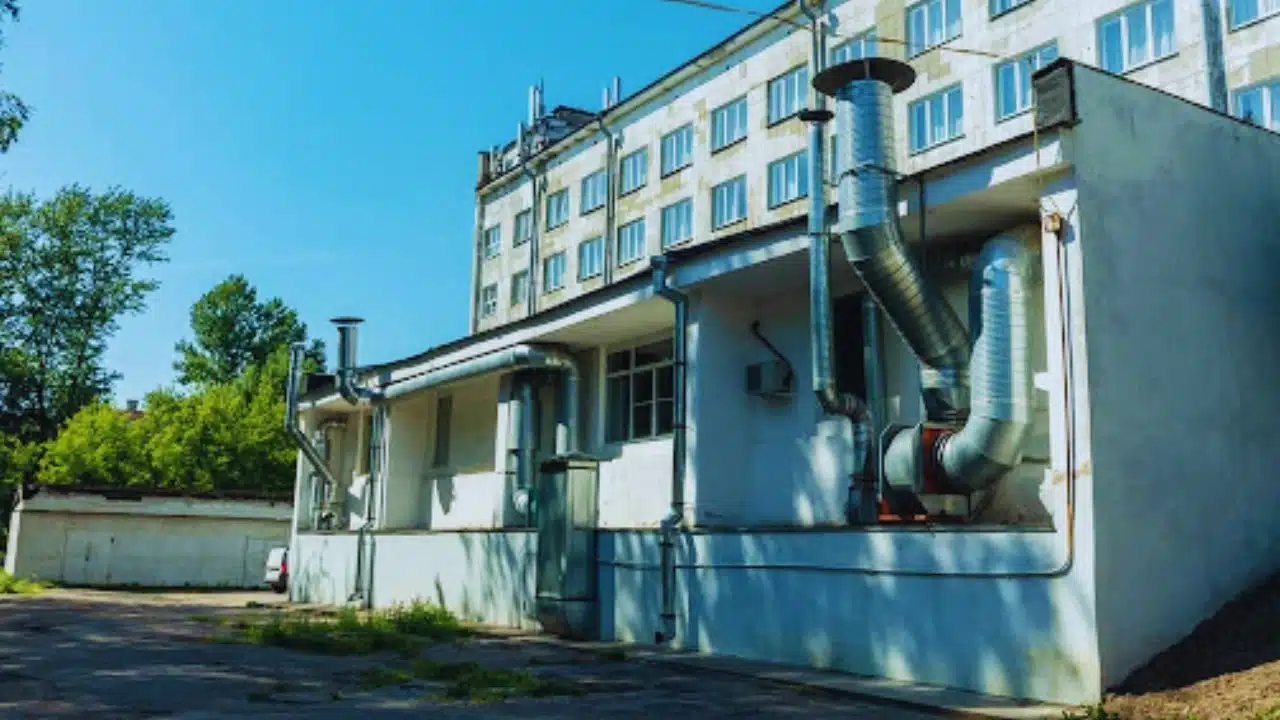
Problems with ventilation capacity are one of the most common mistakes that can be made during system installation. How to choose a fan so that it’s not too weak for your space? Or, on the other hand, how not to overpay for unnecessary power?
For a restaurant of 150 m² with high ceilings (3.5 m), the system should provide air exchange 12-15 times per hour. Thus, a fan with a capacity of about 3000-3500 m³/h is great. For a warehouse of the same size, but with more stringent requirements (for example, high humidity), the ventilation must be more powerful – about 6000 m³/h.
But what exactly is needed in your case? Simply using average values isn’t the best approach. It is important to consider:
- room volume;
- room type (production workshop, warehouse, office, etc.);
- temperature and humidity conditions.
On the Blauberg website, you can find equipment for setting up an industrial ventilation system with the right specifications. For example, their Turbo inline fans for round ducts have a capacity from 220 to 1750 m³/h and can work in both low and high-pressure systems. The Box-I for rectangular ducts is perfect for spaces with higher air exchange needs, offering up to 2970 m³/h with minimal pressure loss.
What other mistakes are common?
Incorrect installation of ductwork
Proper pipe routing is important as well. A frequent mistake is creating unnecessary bends or overly long sections, which leads to increased air resistance and a reduction in system efficiency.
Example: every turn of the duct or its increase by 1 meter can reduce efficiency by 10-15%. If the installer did not take these details into account, the system simply won’t function as it should.
To avoid such problems, it is recommended to use flexible connections for smooth transitions and choose dampers to regulate airflow and minimize excess pressure. It’s also useful to install airflow regulators to balance the system and distribute air evenly.
Poor sound insulation
An ordinary centrifugal fan can produce noise up to 80-90 dB, which is equivalent to the noise at a construction site. For offices or cafes, this level is absolutely unacceptable.
Attention should be paid to models with improved sound insulation. Blauberg’s inWave is an excellent example. It operates in sound-insulated housings, reducing noise levels to 50-60 dB.
Neglecting Maintenance
The process does not end after the system is installed. Ventilation requires regular maintenance. Replacing filters, inspecting fans, checking the operation of temperature sensors – this is what helps avoid breakdowns and extend the lifespan of the equipment. Always remember this.
Thus, proper ventilation is not just a set of ducts and fans, but a well-thought-out system that should work like a clock. That’s why, when choosing and installing equipment, every detail matters – from capacity to sound insulation. And Blauberg is ready to help you select the best solutions for your project, taking into account all the technical specifications and needs.