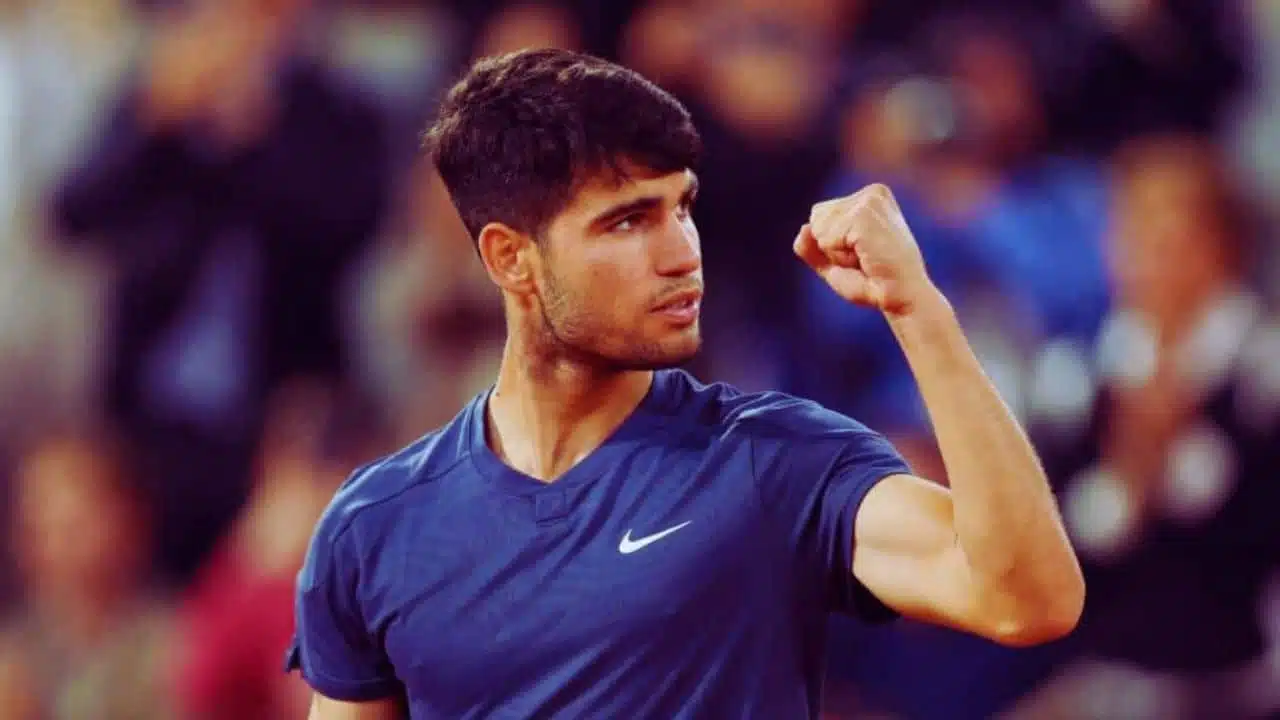
Carlos Alcaraz confirmed his status as the leading force in men’s tennis by beating Jannik Sinner in the 2025 US Open men’s singles final in New York. In front of a packed Arthur Ashe Stadium, Alcaraz produced a commanding display to win 6-2, 3-6, 6-1, 6-4. The match added another gripping chapter to the growing rivalry between the 22-year-old Spaniard and the 24-year-old Italian, who have now met five times in finals this season alone.
This victory secured Alcaraz his second US Open crown—he first won in 2022—and his sixth Grand Slam title overall. With this triumph, he also reclaimed the ATP world No. 1 ranking from Sinner, ending the Italian’s 65-week reign at the top.
The Match: Strong Start, Midway Dip, and Dominant Finish
Alcaraz began with explosive energy, serving powerfully and applying early pressure on Sinner’s return games. His variety of pace and angles quickly unsettled the Italian. By holding serve comfortably and breaking twice, the Spaniard dominated the opening set, conceding only a handful of points on his delivery.
The second set saw momentum shift. Sinner increased his intensity, driving deep groundstrokes into the corners and making inroads on Alcaraz’s serve. The Italian’s improved returning helped him secure a decisive break midway through the set, leveling the contest at one set apiece.
The third set, however, swung heavily back in Alcaraz’s favor. Re-establishing the first-serve accuracy that carried him through the earlier rounds, he immediately broke Sinner’s serve and extended his lead with a combination of net approaches and pinpoint passing shots. Sinner struggled with uncharacteristic errors and appeared less physically sharp, possibly still affected by the abdominal issue that had troubled him in the semi-final. Alcaraz capitalized fully, taking the set 6-1.
The fourth set provided moments of tension, with Sinner saving two championship points through determined resistance. Yet Alcaraz remained composed, breaking serve for a fifth time in the match and maintaining his rhythm until the closing game. He finished with an ace clocked at 131 miles per hour—a fitting demonstration of the serving strength that underpinned his victory.
What Made the Difference
The defining factor of the final was Alcaraz’s serving consistency. In earlier clashes this year, particularly the Wimbledon final, his serve faltered under pressure, allowing Sinner to dictate rallies. In New York, Alcaraz not only protected his delivery but also used it as a weapon, hitting aces at crucial moments and maintaining a high first-serve percentage throughout the match.
Equally important was his ability to absorb Sinner’s power. Where many opponents are overwhelmed by the Italian’s relentless groundstrokes, Alcaraz countered with defensive resilience and tactical variety. By mixing slices, drop shots, and sharp volleys, he disrupted Sinner’s rhythm and kept him constantly guessing.
Historical Milestones
This victory placed Alcaraz in historic company. At just 22 years old, he became the second youngest man in history, after Björn Borg, to collect six Grand Slam titles. He also became one of only a handful of players to win majors on all three surfaces—hard court, clay, and grass—before turning 23.
For Sinner, the defeat was a setback after a remarkable year that included triumphs at the Australian Open and Wimbledon. Despite falling short in New York, he remains firmly established as one of the dominant forces of the men’s game and continues to shape the modern era alongside Alcaraz.
The Security Delay and Trump’s Presence
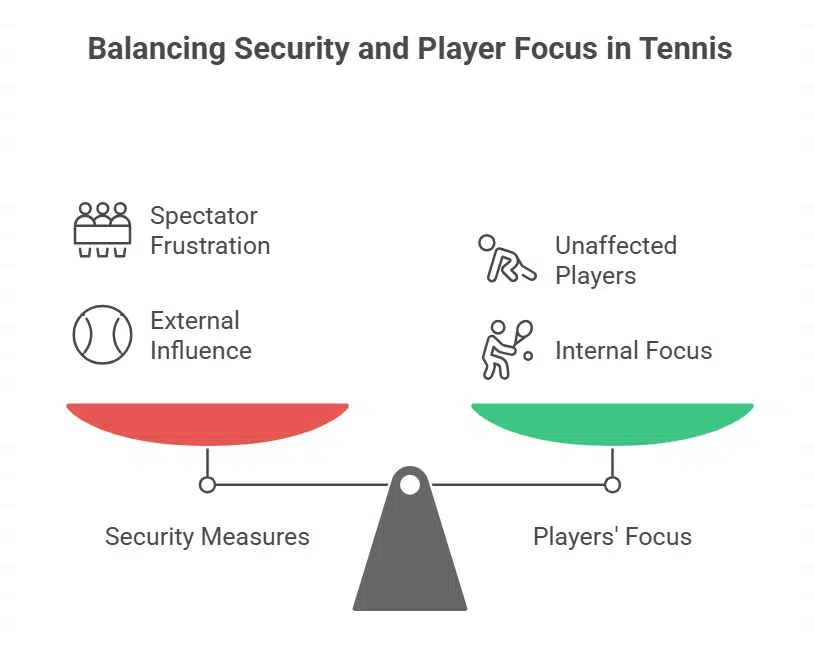
The final was delayed by approximately 30 minutes due to heightened security measures triggered by U.S. President Donald Trump’s attendance. Trump returned to Flushing Meadows for the first time since 2015, prompting airport-style screening procedures and long queues for fans outside Arthur Ashe Stadium. The disruption caused frustration among spectators, with delays extending well into the evening.
While the players warmed up inside the stadium during the delay—Alcaraz performing core stretches and Sinner casually kicking a football with his team—both appeared unaffected once play began. Still, the incident highlighted how external factors, unusual in tennis, can overshadow even a marquee match.
Coaching and Preparation
Alcaraz’s preparation played a key role. Under the guidance of coach Juan Carlos Ferrero, he undertook an intensive training block ahead of the US Open designed specifically to sharpen his serve and refine tactical adjustments against Sinner. Ferrero later emphasized that the plan had worked to perfection, with Alcaraz executing strategies exactly as practiced.
A Rivalry That Transcends Tennis
The Alcaraz-Sinner rivalry is now regarded as the defining contest of this tennis generation. They are the first pair of men in the Open Era to contest finals at three Grand Slam events within the same year. Their head-to-head now stands at 10-5 in Alcaraz’s favor, with each encounter adding fresh significance to their battle for supremacy.
Unlike earlier rivalries dominated by contrasting styles—such as Federer’s elegance against Nadal’s physicality—Alcaraz and Sinner mirror each other in athleticism, baseline aggression, and tactical adaptability. Their duels have already drawn comparisons to classic matchups that shaped previous decades of tennis.
Key Outcomes of the 2025 US Open Final
| Outcome | Impact |
|---|---|
| Alcaraz wins 6th Grand Slam | Becomes 2nd youngest to reach this milestone after Björn Borg |
| US Open title regained | Adds to his 2022 triumph at Flushing Meadows |
| Reclaims world No. 1 ranking | Ends Sinner’s 65-week stay at the top |
| Rivalry milestone | Fifth final meeting of the season, with majors evenly split (2 each in 2025) |
| Trump’s attendance | Caused half-hour delay due to heightened security |
For Alcaraz, the victory cements his dominance at the top of the men’s game and sets him up as the clear favorite heading into the ATP Finals. For Sinner, the loss is a reminder of the narrow margins at the elite level but also proof of his consistency, having reached three Slam finals in a single season.
The rivalry shows no signs of slowing down. With both players still in their early twenties, their careers could extend over another decade, offering the sport a narrative that may come to define an era in the way Federer, Nadal, and Djokovic once did.
The information is collected from ESPN and Yahoo.