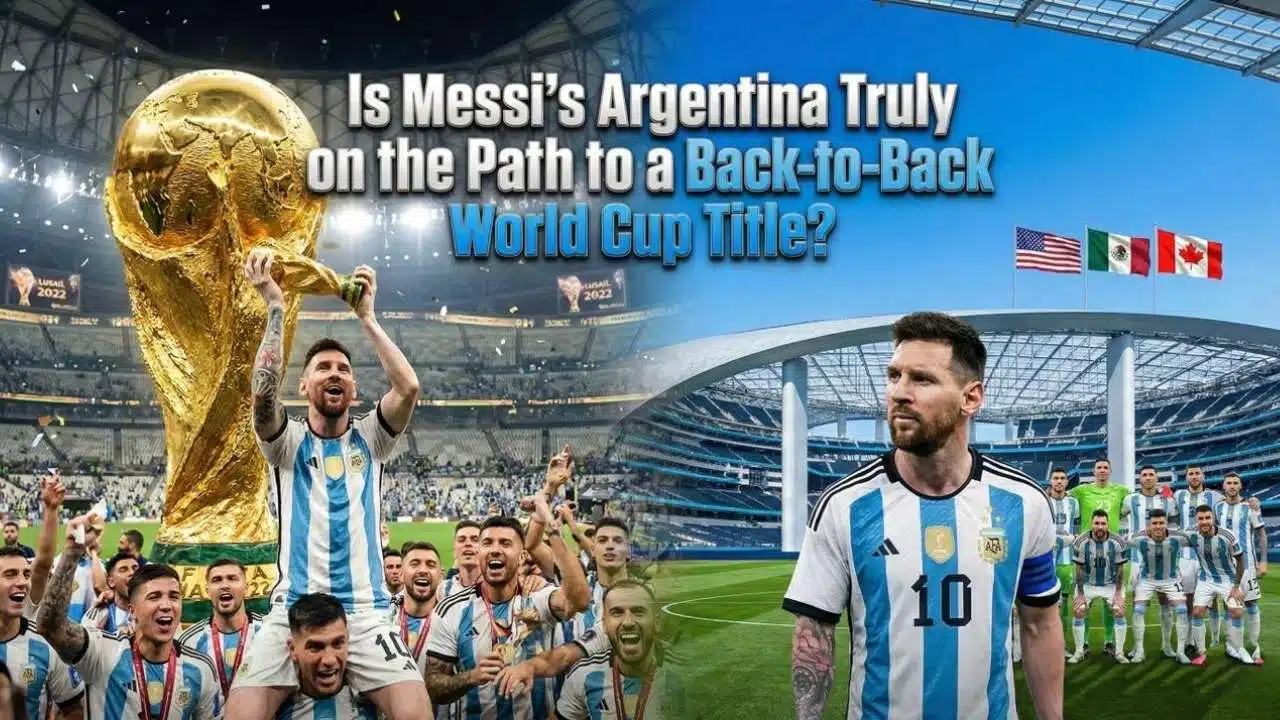
Today marks exactly three years since Lionel Messi hoisted the World Cup trophy in Qatar, culminating the most emotionally charged individual narrative in football history. Yet, as the football world commemorates that anniversary, the focus in Buenos Aires and Miami has already shifted.
At 38 years old, Messi is not merely taking a victory lap in Major League Soccer; he is the centerpiece of a highly calculated project aimed at the unthinkable: defending the title in 2026.
This analysis moves past the emotion of 2022 to examine the cold realities of data, tactical evolution, and the current global landscape to answer if Argentina is truly equipped for a repeat.
The Three-Year Evolution (2022–2025)
The assumption following Qatar 2022 was that Argentina would face an inevitable decline—a “champion’s hangover” common in modern football. History suggested that aging stars fade and hunger dissipates.
Argentina, under manager Lionel Scaloni, has defied this historical trend. In the three years since Lusail:
- They secured another major trophy (Copa América 2024).
- They have maintained the FIFA top ranking almost uninterrupted through late 2025.
- Messi’s transition to Inter Miami has been managed not as a retirement but as a strategic preservation phase for the 2026 World Cup in North America.
The narrative has shifted from “Can they win it for Messi?” to “Can the system sustain Messi long enough to win it again?”
The Tactical Map: How Scaloni Re-Engineered the Machine
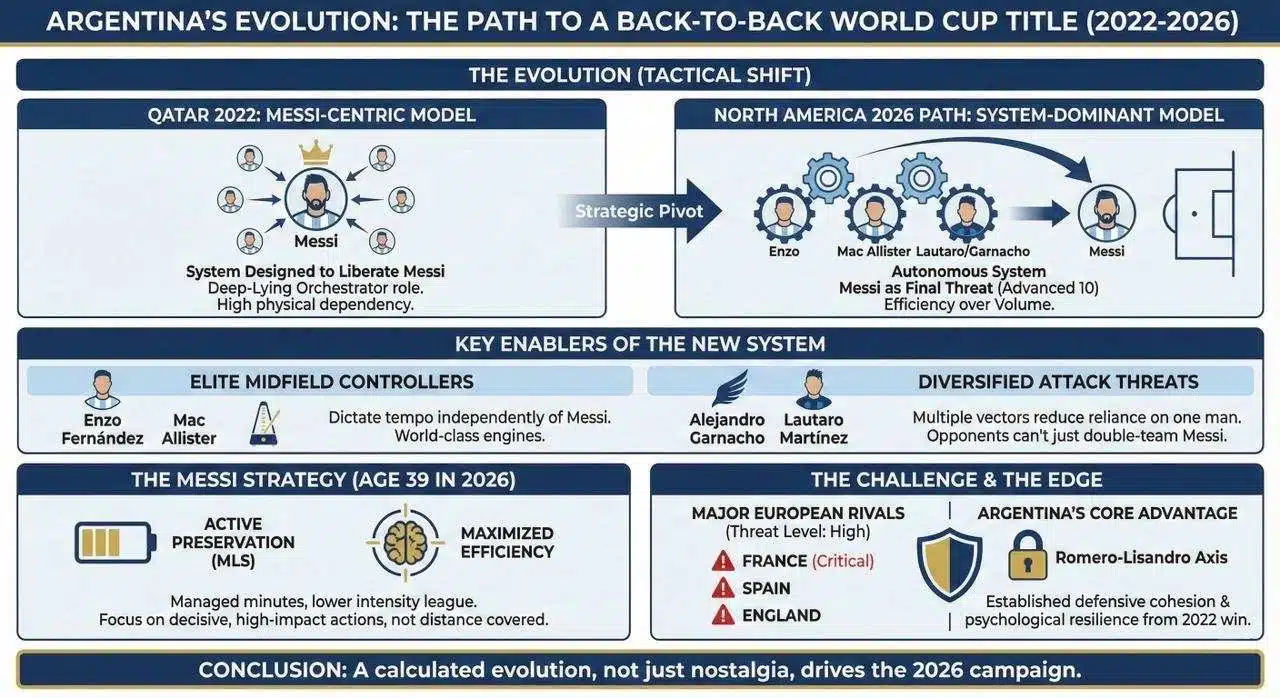
The most critical factor in Argentina’s 2026 prospects is not Messi’s left foot but Lionel Scaloni’s brain. Scaloni recognized that the 2022 blueprint would not work in 2026 with a 39-year-old captain. The team had to evolve from dependency to autonomy.
The Tactical Pivot: 2022 vs. 2025 Setup
The following comparison illustrates the fundamental shift in Argentina’s operational structure over the last three years.
| Feature | The “Lusail Model” (Qatar 2022) | The “North American Model” (Current 2025) |
|---|---|---|
| Primary Philosophy | Messi-Centric: The entire system was designed to liberate Messi. Midfielders were primarily water carriers and pressers to cover his defensive deficits. | System-Dominant: The team functions autonomously. The system is designed to control games without Messi needing to touch the ball constantly. |
| Messi’s Role | Deep-Lying Orchestrator (False 9/10): He dropped very deep into midfield to collect the ball and start attacks, requiring significant physical exertion. | The Final Threat (Advanced 10): He stays much higher up the pitch, operating almost exclusively in the final third. He is now the finisher of moves, not necessarily the starter. |
| The Midfield “Engine” | Functional & Reactive: Enzo Fernández, Mac Allister, and De Paul were emerging talents whose primary job was intensity and ball recovery for Leo. | Elite & Controlling: Enzo and Mac Allister are now established world-class controllers at top European clubs. They dictate tempo independently of Messi. |
| The Attack | Dependent on Messi’s Creation: Julian Álvarez provided the pressing, but creativity came almost solely from #10. | Diversified Threats: The explosive rise of Alejandro Garnacho on the wing and the peak form of Lautaro Martínez mean opponents can no longer afford to triple-team Messi. |
Analysis of the Shift: Scaloni has successfully built a team that doesn’t need Messi to run the engine room. In 2022, if Messi had an off day, Argentina struggled to create. In 2025, the midfield can dominate possession against elite sides, allowing Messi to conserve his energy for 3-4 decisive, high-impact actions per game.
The European Threat Radar (Performance Comparison Dec 2025)
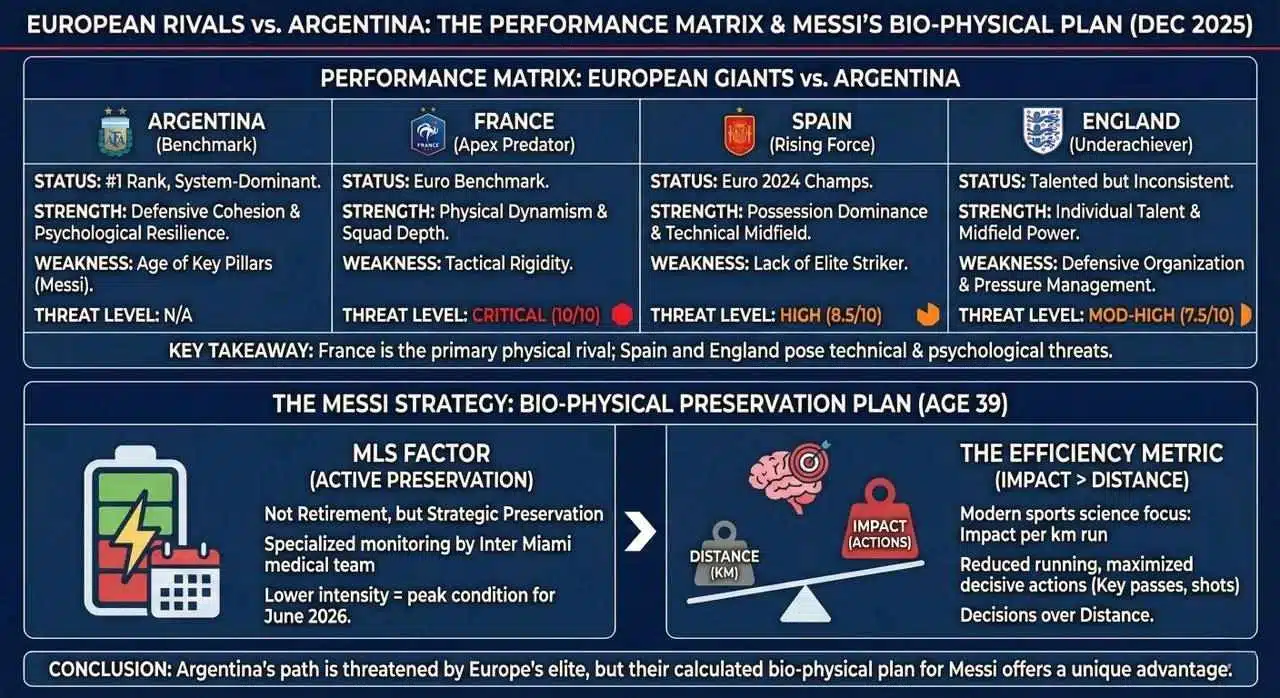
If Argentina is to repeat, they must overcome the European powerhouses. The landscape in Europe has shifted significantly since 2022. While Argentina has remained stable, their main rivals are in various stages of transition.
Below is a comparative analysis of the top European contenders based on performance data leading into the World Cup year.
European Giants Performance Matrix (As of Dec 2025)
| Team | Current Status & Form | Key Strengths (2025) | Major Weaknesses/Question Marks | Threat Level to Argentina |
|---|---|---|---|---|
| France | The Apex Predator. They continue to set the standard in Europe. They have seamlessly transitioned past the Griezmann era, with Kylian Mbappé (now in his prime at 27) leading a terrifyingly athletic squad. | Their physical dynamism and transition speed are unparalleled. Squad depth is absurd; their B-team could likely reach the quarterfinals. | Occasional tactical rigidity against low blocks. The team had an over-reliance on Mbappé’s individual brilliance during tight games. | Critical (10/10) |
| Spain | The Rising Force. The champions of Euro 2024 have continued their ascent. They possess the most technically gifted midfield since their 2010 golden generation, led by Pedri and Gavi. | Total possession dominance. The emergence of Lamine Yamal (now 18 and established) gives them a genuine superstar threat on the wing. | The absence of a world-class, clinical #9 striker continues to be their weakness when facing top-tier defenses such as Argentina’s. | High (8.5/10) |
| England | The Underachievers. Despite having an incredibly talented squad on paper (Bellingham, Foden, and Kane), the team still struggles to control the chaos of major tournament knockout games. | The team possesses immense individual talent and goal-scoring power, particularly from their midfield players. Jude Bellingham is currently arguably the world’s best all-around midfielder. | There were persistent issues with the team’s defensive organization when under pressure. The psychological barrier of “getting over the line” remains a massive hurdle. | Moderate-High (7.5/10) |
| Germany | The Resurgent Power. After years in the wilderness, they have rebuilt a functional, high-pressing unit centered around Jamal Musiala and Florian Wirtz. | High tactical intelligence and pressing intensity. A balanced squad that plays with renewed cohesion. | Lacks defensive star power compared to past generations. They can be vulnerable to rapid counterattacks. | Moderate (7/10) |
Comparative Analysis: France remains the only team that matches Argentina man-for-man in terms of talent and tournament pedigree. Spain has the technical quality to frustrate Argentina but lacks the finishing power. Argentina’s greatest advantage over these European rivals is their established defensive cohesion (the Romero-Lisandro Martínez axis) and superior psychological resilience forged in Qatar.
The Bio-Physical Reality of a 39-Year-Old Legend
The elephant in the room is Messi’s age. Can a 39-year-old physically handle the demands of a 48-team World Cup, which may require an extra knockout game and extensive travel across North America?
The data suggests yes, but only through “extreme load management.”
- The MLS Factor as Strategy, Not Retirement: Messi’s time at Inter Miami has been characterized by playing fewer minutes at lower intensity than in Europe. Inter Miami’s specialized medical team monitors his biometric data intensely. He is essentially in a two-year “active preservation” program designed to have him peak in June 2026.
- The Efficiency Metric: Modern sports science analyzes “impact per kilometer run.” Messi’s distance covered per 90 minutes has dropped significantly since 2022, but his decisive actions (key passes, shots on target, and successful take-ons in the final third) remain elite. Scaloni’s new system (see Core Analysis 1) is designed to maximize this efficiency. He doesn’t need to run; he needs to decide.
Takeaways
On the third anniversary of their greatest triumph, Argentina is not a team living in the past. They are a modernized, evolving unit that has strategically prepared for the final chapter of the Messi era.
They possess the best defense in international football, a midfield that controls games at the highest level, and a tactical setup specifically engineered to accommodate an aging superstar. Furthermore, the 2026 tournament in North America will essentially serve as a home World Cup for Argentina, providing an immense psychological advantage.
While the threat of France is enormous, and the physical toll on a 39-year-old Messi remains the great unknown, the concrete data suggests that Argentina’s bid for a back-to-back title is not a sentimental pipe dream. It is a highly plausible sporting reality.