Investing in cryptocurrency can feel confusing, especially when choosing between Bitcoin and Ethereum. It often seems like comparing two completely different options. Crypto charts can be overwhelming, and while both assets are popular and show growth potential, the risks can be difficult to understand. Many investors are searching for clear guidance on how to choose between them.
One simple fact highlights the contrast. In early 2026, Bitcoin’s price rose by about 16 percent, while Ethereum lost nearly half of its value. For anyone considering Bitcoin vs Ethereum as the better investment in 2025, this is an important comparison to explore.
This guide breaks down the key differences using simple language and real data. By the end, readers will have a clearer understanding of both options and what to consider before making a decision.
Overview of Bitcoin and Ethereum

Bitcoin started as the first digital currency, creating a totally new way to think about money. Ethereum soon followed, changing how people use the blockchain with smart contracts and fresh ideas. Let us look at where they both began.
The origins of Bitcoin
In 2008, a person or group called Satoshi Nakamoto released a whitepaper titled “Bitcoin: A Peer-to-Peer Electronic Cash System.” They wanted to create digital money that worked without banks or governments controlling it. The first block on the blockchain appeared in January 2009, launching Bitcoin as a brand-new digital asset.
Interest grew fast as people liked the idea of decentralization and having extra control over their own money. Over time, Bitcoin gained massive attention from traders and everyday investors alike. Its price started low but saw explosive growth, with a compound annual growth rate of 50 percent from 2017 to 2025.
Today, that growth has turned Bitcoin into a massive financial force. By early 2026, the Bitcoin market capitalization hit roughly $1.78 trillion in the US market. The approval of spot Bitcoin ETFs, like BlackRock’s iShares Bitcoin Trust, brought a flood of institutional money into the space. This strong market performance paved the way for other cryptocurrencies to thrive.
The development of Ethereum
Ethereum launched in 2015 with Vitalik Buterin as its main founder. He wanted to go beyond Bitcoin’s limits and add more options for blockchain technology. Unlike Bitcoin, which mainly acts as digital gold, Ethereum built a system for smart contracts and decentralized apps.
These tools let developers build financial services, games, and marketplaces right on the blockchain. Ethereum has grown fast but definitely faced sharp ups and downs. For example, by March 2025, Ethereum dropped about 50 percent, making it much more volatile than Bitcoin during that same stretch.
Despite the swings, Ethereum drives serious innovation. To understand Ethereum’s massive scale today, consider these quick facts from the US market in 2026:
- Massive Value Locked: Ethereum holds around $72 billion in Total Value Locked within decentralized finance protocols.
- Market Dominance: It secures nearly 60 percent of the entire decentralized finance market.
- Institutional Backing: US regulators approved spot Ethereum ETFs, with funds like BlackRock’s ETHA holding billions in assets.
- Passive Income Potential: Users can earn a 4 to 5 percent annual yield by staking their coins to secure the network.
It compounded at roughly 33 percent yearly between 2017 and 2025. This is not as fast as Bitcoin’s pace, but it still shows incredibly strong growth.
Key Differences Between Bitcoin and Ethereum
Bitcoin and Ethereum stand on completely different ground. Their strengths can be miles apart, almost like comparing apples to oranges in the crypto basket. Understanding these core differences is the secret to building a smart portfolio.
Technological frameworks
Bitcoin runs on a simple yet highly secure blockchain. It relies on a system that keeps the network safe, but it can be slow and use lots of energy for basic transactions. To fix this, developers created the Lightning Network.
The Lightning Network acts as a second layer built on top of Bitcoin. By early 2026, this network reached a capacity of over 5,200 BTC. This upgrade allows for instant, cheap payments without clogging up the main system.
Ethereum takes a different route entirely. It supports complex smart contracts, letting people build full applications right on the chain. To handle millions of users, Ethereum relies heavily on Layer 2 scaling solutions like Arbitrum and Base. These extra layers bundle transactions together, keeping fees low while maintaining Ethereum’s base security.
Use cases and purposes
People use Bitcoin mostly as a store of value and for digital payments. Many call it digital gold because it is scarce, decentralized, and holds its value even during big market swings. In 2025, Bitcoin’s price rose about 16 percent by March, showing stability where others fell apart.
Investors trust its security and see it as a strong hedge against inflation. This trust is why Bitcoin dominance hovered around 60 percent of the total crypto market throughout early 2026.
“A major pro-tip I always share with new investors is to treat Bitcoin as your savings account and Ethereum as your tech investment. Many users on the r/CryptoCurrency subreddit note that mixing up these two use cases is the most common reason people panic sell during a dip.”
Ethereum truly wears many hats. It powers Decentralized Finance (DeFi) protocols, making lending or borrowing money much easier for users worldwide without traditional banks. Program developers flock to Ethereum for its flexibility and speed.
Supply and monetary policy
Bitcoin has a strictly fixed supply of 21 million coins. Nobody can change this rule, not even the original developers or the top miners. This set number is exactly what helps Bitcoin act like digital gold.
It gets rarer over time, just like physical gold in a vault. Every four years, an event called the halving cuts the new Bitcoins released to miners in half. In 2024, the reward dropped to 3.125 BTC per block, making Bitcoin harder to mine and theoretically more valuable.
Ethereum takes a much more flexible path with its supply. It does not have a hard cap on its total coins. Instead, developers and users actively vote on network rules, creating a unique system of decentralized governance. A major network upgrade called EIP-1559 also introduced a feature that burns a small amount of Ethereum with every transaction.
By 2026, over 4.6 million ETH had been permanently burned and removed from circulation. This burn mechanism can actually make Ethereum deflationary when the network gets really busy.
Consensus mechanisms: Proof of Work vs. Proof of Stake
Proof of Work asks powerful computers to solve hard math puzzles. This is how Bitcoin keeps its network safe and fully decentralized. This method eats up loads of energy, but it provides unmatched security.
Ethereum shifted to Proof of Stake in 2022. It lets people lock up, or stake, their coins to help check transactions. This shift makes things run smoothly and wastes almost no power compared to the old way.
Here is a quick breakdown of how these two distinct systems compare today:
| Feature | Bitcoin (Proof of Work) | Ethereum (Proof of Stake) |
|---|---|---|
| Energy Usage | High (Requires heavy computer hardware) | Very Low (Dropped by 99.9 percent after 2022) |
| Security Model | Miners compete to solve puzzles | Validators lock up their own coins |
| User Rewards | Requires expensive mining equipment | Users earn 4-5 percent annual staking yields |
| Primary Benefit | Battle-tested, maximum decentralization | Eco-friendly, allows for passive income |
Historical Performance Comparison
See how Bitcoin and Ethereum have weathered the storm, broken records, and shaped what investors think is possible. Let us take a deeper look at the numbers.
Bitcoin’s historical price trends
Bitcoin has shown incredible growth since 2017, boasting a compound annual growth rate of about 50 percent. By March 2025, its price had risen roughly 16 percent, even as Ethereum’s value dropped by half. This steady climb makes it a favorite for institutional buyers.
In early 2026, Bitcoin saw a massive surge, with prices soaring past the $89,000 mark. The launch of US spot ETFs fueled this fire. In a single week in March 2026, US Bitcoin ETFs saw nearly $1.2 billion in fresh capital inflows, proving that the demand is clearly sustained.
Long-term investors saw their holdings grow more consistently with Bitcoin than with most altcoins. Price swings feel less wild compared to other cryptocurrencies, though big drops and rallies still happen. Over the past decade, nothing in crypto has performed better for patient investors seeking stability.
Ethereum’s historical price trends
Ethereum has been on a wild ride since its launch. Over the last decade, Ethereum’s growth averaged about 33 percent each year. Its price can soar in bull runs but often drops more sharply than Bitcoin during big selloffs.
In early 2025, Ethereum’s price took a heavy hit, falling close to 50 percent. Like someone on a roller coaster without brakes, investors felt every twist and turn. By early 2026, Ethereum traded in the $2,300 to $2,600 range, showing a strong recovery but still trailing Bitcoin’s momentum.
If you prefer excitement and high growth potential over pure stability, Ethereum is hard to ignore. Here are the main factors that usually drive Ethereum’s historic price swings:
- Network Usage: High activity on decentralized apps increases demand for the coin.
- Burn Rate: Busy network days burn more coins, reducing the available supply.
- Wall Street Interest: Inflows into US spot Ethereum ETFs directly impact daily trading volumes.
- Developer Activity: With over 31,000 active developers, new project launches frequently spike investor interest.
Factors Influencing Investment Decisions
Many things can tip the scales for your next crypto pick. Let us figure out what could make or break your investment in 2026 and beyond.
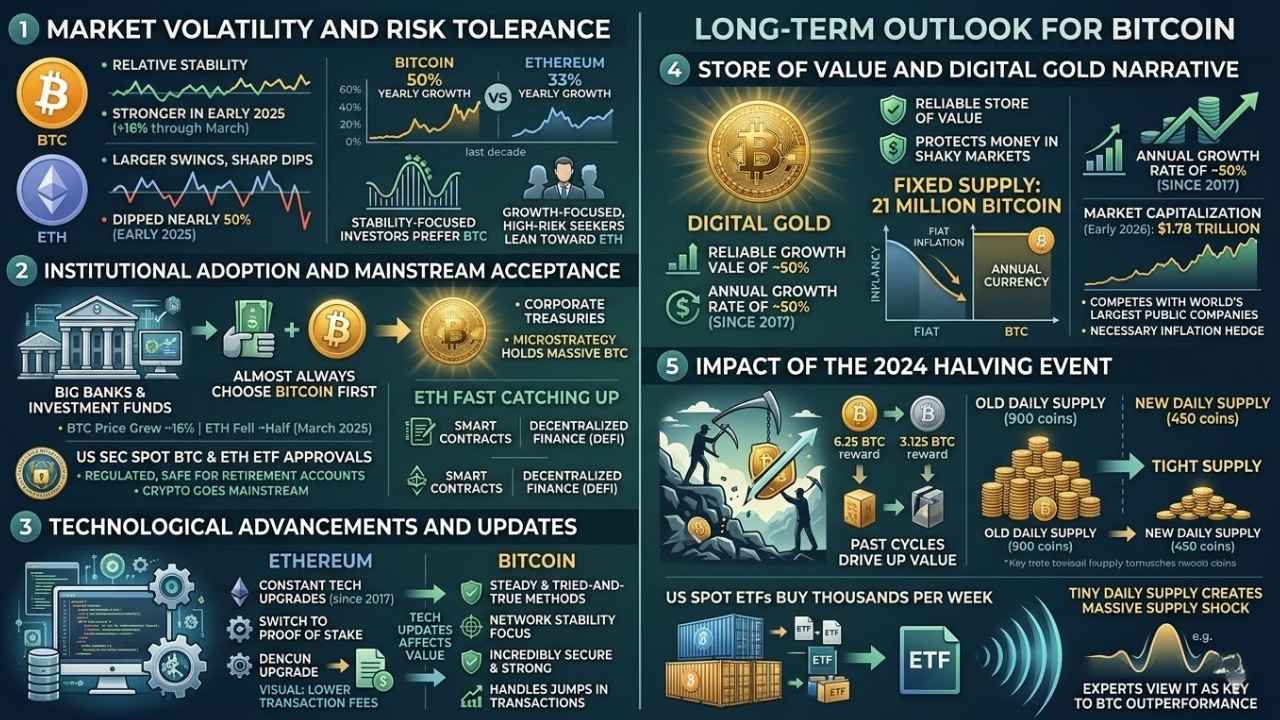
Market volatility and risk tolerance
Bitcoin and Ethereum can act like a roller coaster, making prices jump high one month and tumble the next. When conducting your own market analysis, you will see Bitcoin showed serious strength in early 2025, rising about 16 percent through March. At the same time, Ethereum took a sharp dip, dropping nearly 50 percent.
Ethereum swings harder than Bitcoin during both booms and busts. Over the past decade, Bitcoin outpaced Ethereum with a yearly growth rate of 50 percent, compared to Ethereum’s 33 percent. Investors who lose sleep over price drops will absolutely prefer Bitcoin’s relative stability.
Those chasing faster gains, and willing to stomach bigger losses, often lean toward Ethereum. In any case, both offer ways for investors to control their money outside traditional banking systems.
Institutional adoption and mainstream acceptance
Big banks and investment funds started buying more digital assets in recent years. They almost always choose Bitcoin first, treating it like a mandatory digital asset for their corporate treasuries. Companies like MicroStrategy hold massive amounts of Bitcoin to protect their balance sheets.
In March 2025, Bitcoin’s price rose around 16 percent while Ethereum fell by about half. That performance gap caught the eye of large institutions watching for stability. However, Ethereum is catching up fast in the traditional banking and Financial Technology (FinTech) sectors.
“The approval of spot Bitcoin and Ethereum ETFs by the US Securities and Exchange Commission was a total game-changer. It provided a regulated, safe way for everyday retirement accounts to hold crypto, taking these assets completely mainstream.”
Many big companies use Ethereum’s technology behind the scenes for smart contracts and decentralized finance projects. Still, major players often pick the one with a stronger price track record.
Technological advancements and updates
Ethereum races ahead with constant tech upgrades. Since 2017, Ethereum rolled out major updates, including the massive switch from Proof of Work to Proof of Stake. More recently, the Dencun upgrade significantly lowered the transaction fees on its Layer 2 networks, making the whole system much cheaper to use.
Bitcoin keeps things steady by sticking to tried-and-true methods. Its developers focus heavily on network stability instead of wild new features. Yet, the network stays incredibly secure and strong while handling big jumps in transactions.
Both blockchains keep growing through regular fixes and tweaks. These shifts show exactly how tech upgrades can affect cryptocurrency value fast and hard.
Long-Term Outlook for Bitcoin
Many people see Bitcoin as digital gold because it fiercely holds its value over time. The recent market trends suggest its role is only getting stronger.
Store of value and digital gold narrative
Bitcoin gets called digital gold for a very good reason. Investors treat it like a reliable store of value, using it to protect money during shaky markets. Its fixed supply gives people massive confidence, knowing only 21 million Bitcoin will ever exist.
That hard cap sets it apart from other cryptocurrencies, and especially from traditional fiat currencies that lose purchasing power over time due to inflation. Since 2017, Bitcoin grew at an annual rate of about 50 percent.
Large institutions now actively add Bitcoin to their portfolios as a safe haven asset. With a market capitalization reaching $1.78 trillion in early 2026, it is officially competing with the world’s largest public companies. Many financial advisors now view Bitcoin as a necessary inflation hedge for future generations.
Impact of the 2024 halving event
The 2024 halving event cut Bitcoin’s mining rewards exactly in half. This made new coins enter the market much more slowly, which naturally makes the supply tighter. In 2025, its price showed resilience and grew about 16 percent by March.
Long-term investors obsess over these halving events because past cycles always helped drive up value due to lower inflation. Here is exactly how the math changed during the 2024 event:
- Old Reward: Miners used to receive 6.25 BTC for solving a block.
- New Reward: The reward dropped to 3.125 BTC per block.
- Daily Supply Drop: This reduced the new daily supply of Bitcoin from around 900 coins to just 450 coins.
- Market Impact: With US spot ETFs buying up thousands of coins a week, this tiny daily supply creates a massive supply shock.
That steady supply squeeze attracted serious attention from hedge funds. While no single price prediction is ever guaranteed, many experts see this halving as one key reason Bitcoin consistently outperforms other cryptocurrencies during uncertain markets.
Long-Term Outlook for Ethereum
Ethereum keeps changing and growing fast, drawing fresh developers and projects constantly. With new updates rolling out, the whole blockchain feels faster and ready for tomorrow’s digital needs.
Smart contract growth and decentralized applications (dApps)
Smart contract growth has helped Ethereum permanently grab the spotlight. People use smart contracts to build amazing blockchain tools like decentralized finance, games, and digital art marketplaces. Decentralized apps now let users do things traditional banks usually control, such as getting instant loans or earning interest.
Ethereum dropped about 50 percent in early 2025 while Bitcoin rose by about 16 percent. Yet, developers keep choosing Ethereum for serious innovation. To put this in perspective, Ethereum currently secures around $72 billion in total value locked across these financial apps.
Both Bitcoin and Ethereum protect user money with decentralization, but only Ethereum powers this massive global financial system at scale right now. This clear utility keeps it a hot topic among investors looking for tech growth.
Layer 2 solutions and scalability improvements
Ethereum handles far more transactions than Bitcoin, but as millions of people use it, the main system can easily get jammed and expensive. Layer 2 solutions step in to fix this massive headache by handling transactions off the main blockchain first, then sending them back for permanent record-keeping.
These upgrades cut down fees drastically and boost speed, making Ethereum perfect for daily apps. Here is a quick look at the top Layer 2 networks driving Ethereum’s growth in 2026:
| Layer 2 Network | Primary Benefit | Main Use Case |
|---|---|---|
| Arbitrum | Deep liquidity and massive total value locked | Decentralized trading and lending |
| Base (by Coinbase) | Direct integration with millions of US exchange users | Consumer apps and social finance |
| Optimism | Open-source technology stack | Building custom blockchain networks |
Both digital assets focus heavily on scaling up in 2026. These specific network changes massively boost investment appeal as more people demand fast, affordable trading.
Bitcoin vs Ethereum: Investment Comparison
Picking between Bitcoin and Ethereum is a huge step for any investor. Understanding your personal goals right now will shape which asset suits you best.
Assessing investment goals and timelines
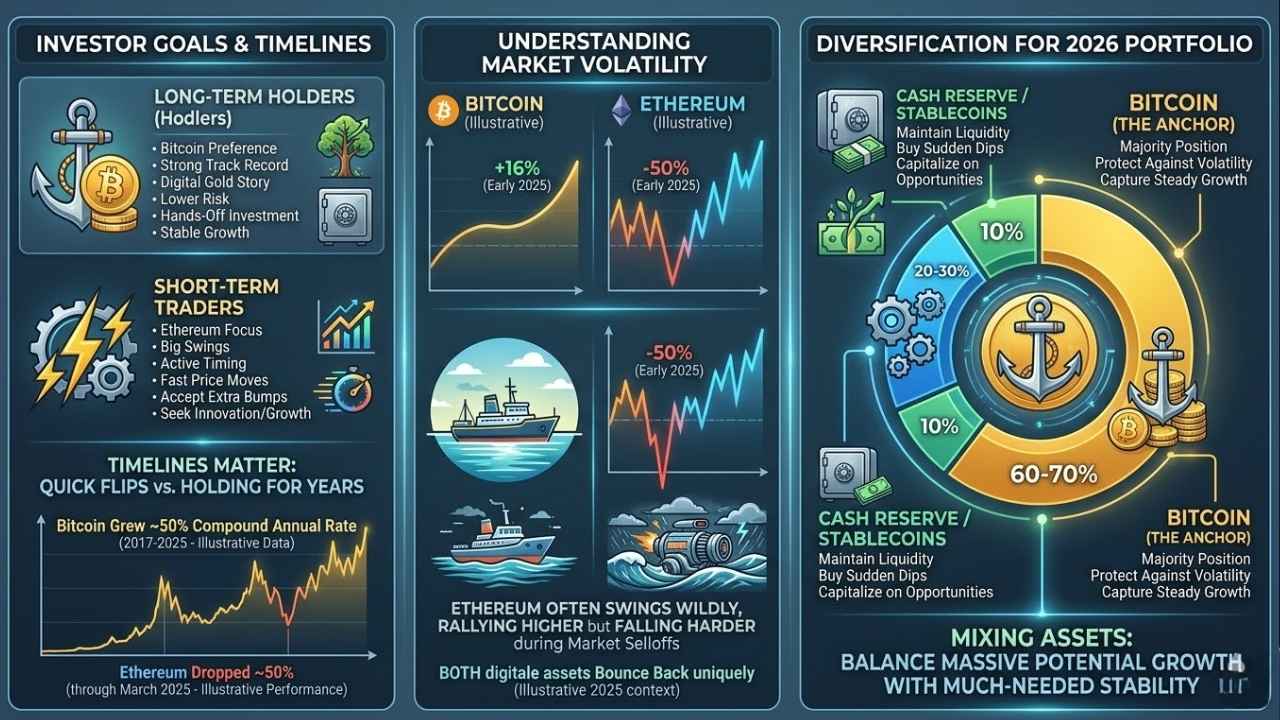
Short-term traders might chase Ethereum for its big swings, adjusting their trading strategies to catch a fast ride on sharp price moves. Ethereum dropped about 50 percent through March 2025, so timing matters heavily with this asset.
Long-term holders almost always choose Bitcoin because of its strong track record and stable growth. It grew at a 50 percent compound annual rate from 2017 to 2025, far outpacing investments in traditional finance. If you want a hands-off investment, Bitcoin is usually the safer bet.
Investors who value lower risk naturally lean into Bitcoin’s digital gold story. Those looking for tech innovation might favor Ethereum, completely accepting the extra bumps along the road. Timelines truly matter, a quick flip carries more risk, while holding on for years could mean catching much brighter days ahead.
Diversifying between Bitcoin and Ethereum
Spreading your investment between Bitcoin and Ethereum is the easiest way to lower your portfolio risk. Both digital assets fell below their all-time highs in 2025, but they both bounced back in unique ways to validate different investment strategies.
For example, Bitcoin’s price went up nearly 16 percent by March 2025, while Ethereum dropped roughly half its value. Ethereum often swings wildly, rallying much higher but also falling harder during market selloffs. Because they act differently, holding both is a brilliant strategy.
Here is a popular way experts suggest splitting a crypto portfolio to balance these investment strategies:
- The Anchor (60-70 percent): Hold the majority in Bitcoin to capture steady growth and protect against extreme downside volatility.
- The Growth Engine (20-30 percent): Allocate a smaller portion to Ethereum to catch the high-upside potential of decentralized finance.
- The Cash Reserve (10 percent): Keep some cash or stablecoins on hand so you can buy more during sudden market dips.
Mixing both digital assets allows investors to perfectly balance massive potential growth with much-needed stability.
Final Thoughts
If you are still wondering about Bitcoin Vs Ethereum: Which Is The Better Investment In 2025?, the answer comes down to your personal goals, risk tolerance, and investment timeline. Bitcoin shines brightly with its long-term growth rate, market stability, and proven digital gold status. Ethereum brings incredible speed and innovation to the table through its powerful smart contracts.
Both have weathered completely wild price swings over the last year. Bitcoin held firm while Ethereum swung lower, but Ethereum still offers massive upside thanks to constant tech upgrades. Picking one is less about finding a perfect answer and more about matching their unique strengths with your financial needs.
Check out trusted sites like CoinMarketCap or major crypto news platforms if you want deeper info on performance trends. Whichever you choose for your portfolio, the most important move is simply starting early with clear eyes and a solid plan in hand.