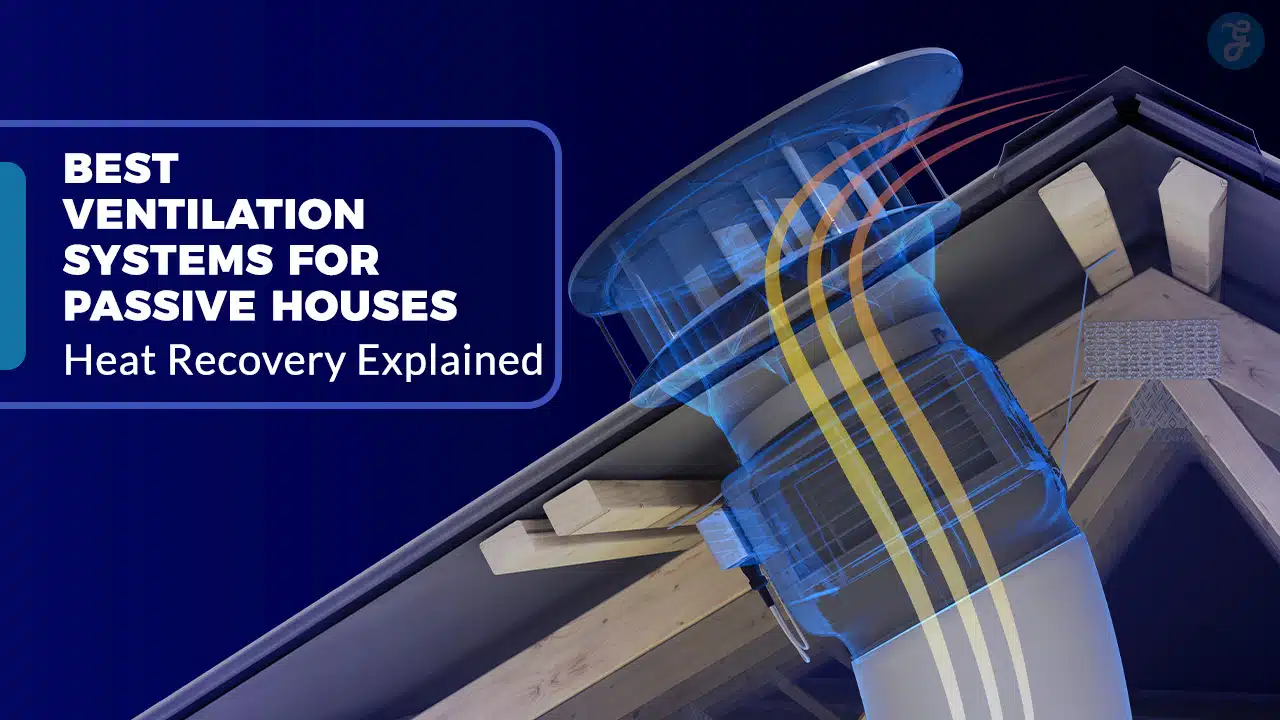
Owners of passive houses face stuffy rooms, high humidity, and stale air. They want fresh air, but hate losing heat.
Ventilation systems in passive houses must recover at least 75% of heat to stay efficient. Our list of 15 top energy recovery ventilators will boost indoor air quality and save warmth.
Keep reading.
Key Takeaways
- Passive houses must limit ventilation losses to 15 kWh/m²·yr. Energy recovery ventilators reclaim 75–95% of heat, cutting losses to 2–7 kWh/m²·yr and meeting the 0.45 Wh/m³ rule set by the Passive House Institute.
- Top systems include Zehnder Novus 300 (93% heat recovery, <25 dB noise), Broan HRV 250 TE (66% at –13 °F, 18 W draw), and Paul Novus 450 (95% recovery, <35 dB).
- Choose ERVs to swap heat and moisture in mixed or humid climates; pick HRVs to preheat air without moisture transfer in cold, dry zones.
- Owners must swap F7 filters every 3 months, clear drain pans monthly, clean heat‐exchange cores yearly, and test fans and controls each season to keep systems efficient.
Why is heat recovery crucial for passive houses?
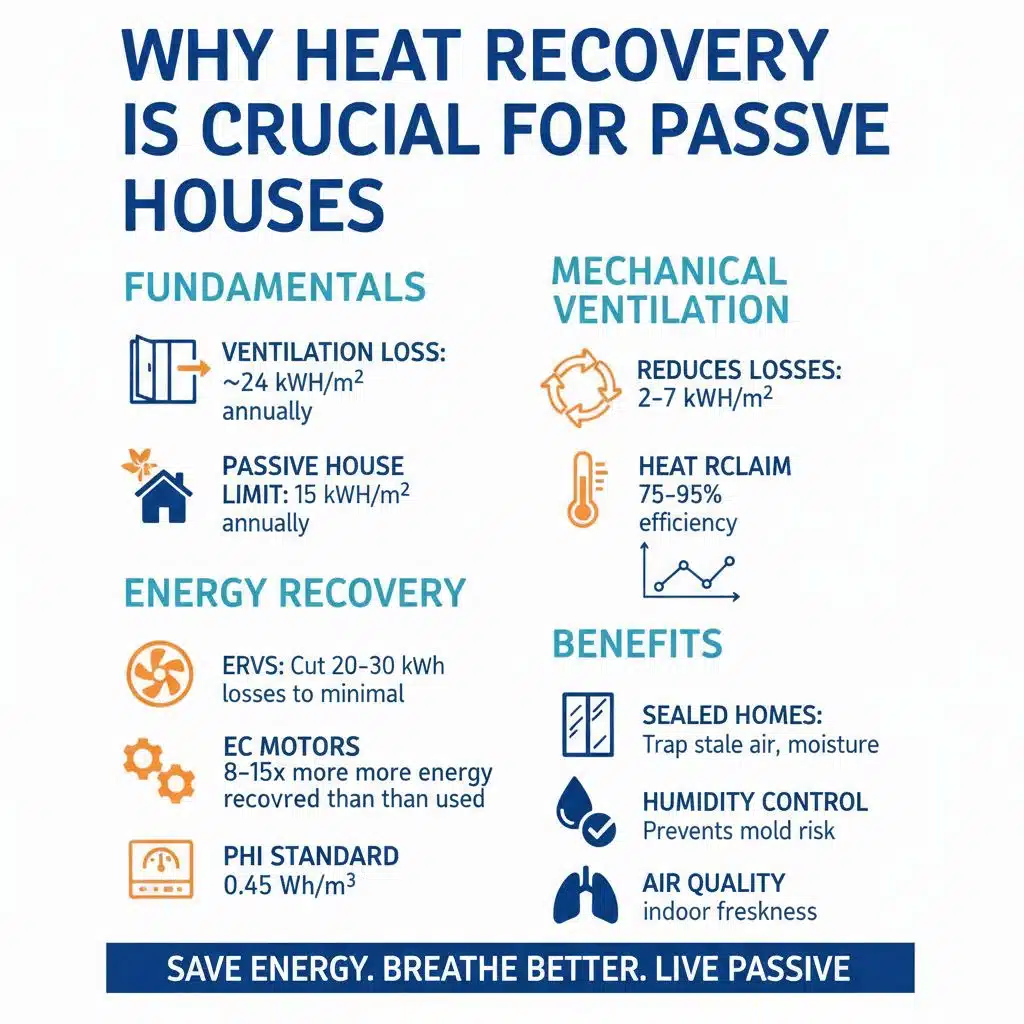
Ventilation without heat recovery wastes about 24 kWh per square meter each year, far above the 15 kWh limit for a passive house. Mechanical ventilation systems use heat exchangers to cut losses to 2–7 kWh per square meter.
They can reclaim 75 to 95 percent of the heat using counterflow heat exchangers. Energy recovery ventilators slice 20–30 kWh losses to just a few units. Their EC motors pump fresh air and recover eight to fifteen times more energy than they use, while meeting the 0.45 Wh per cubic meter rule set by the Passive House Institute.
Tightly sealed walls and windows trap stale air and moisture in a modern home. Smart fans replace stale air and offer humidity control, without dumping winter heat. Fresh supply air moves through air ducts and supports heat transfer.
It follows temperature and moisture limits to warm rooms and cut separate heating needs. This system cuts moisture transfer, curbs mold risk, and boosts indoor air quality.
What are the key features of the Zehnder Novus 300?
The Zehnder Novus 300 achieves 93% heat recovery efficiency. Automatic flow control balances supply and exhaust air. Built silencers in pipes and valves keep noise below 25 dB. Low upkeep design cuts maintenance chores.
This mechanical ventilation system links tight building envelope with fresh air.
Passive House Institute approved its high heat recovery and low energy use. It pairs well with comfort ventilation strategies. Compact form fits retrofit kits. Leading ventilation systems and heat recovery ventilators count on this unit for indoor air quality and energy savings.
How does the RenewAire EV130 improve ventilation?
RenewAire EV130 pushes 50 to 140 CFM through a polymer core. Its low voltage control cuts energy use and noise. The unit pulls stale air out. It brings fresh air in. It traps moisture to curb mold growth.
Its heat recovery design lowers heating loads.
Homeowners tuck this energy recovery ventilator inside a tight building envelope. It ties indoor air quality to humidity control. The EV130 links to heat pumps or dehumidifiers for balanced climate.
Maintenance takes minutes. Varied layouts suit this model.
What makes the Lifebreath 30 ERV suitable for passive homes?
The Lifebreath 30 ERV packs durable aluminum cores into a small frame. Its compact design fits inside tight Passive House layouts. This energy recovery ventilator moves supply and exhaust air, it boosts indoor air quality.
It recovers heat, it cuts heat losses during every air exchange. Continuous mechanical aeration stops mold and stale air.
It shifts moisture, it keeps relative humidity in a healthy range. The ERV function allows moisture transfer, it guards against excess humidity and improves humidity control. A limited lifetime warranty backs each residential ventilation system.
Easy access panels help with filter replacement, they simplify maintenance. The unit blends into the building envelope, it meets strict Passivhaus standards.
Why choose the Broan HRV 250 TE for your ventilation needs?
Broan HRV 250 TE fits mid and large homes in frigid climates and suits small spaces. It recovers 66 percent of heat at minus 13°F. This energy recovery ventilator runs on just 18W of power.
That low draw cuts residential ventilation costs. It swaps stale air out and manages air flow of fresh air in to boost indoor air quality. This mechanical ventilation system links perfectly with airtight passive house walls and tight building envelope.
The unit meets passive house criteria for heat recovery and humidity control. Ventilation fans deliver supply air near room temperature to ban cold drafts. You avoid moisture transfer and humidity swings in well sealed homes.
This model provides lasting comfort no matter how low the temperature falls.
What benefits does the Panasonic Intelli-Balance 100 offer?
Panasonic Intelli-Balance 100 balances fresh air supply with stale air exhaust. This mechanical ventilation system uses a heat-transfer device to reduce space heating demand. Its energy recovery ventilator operates with multi-speed actuator controls to provide precise air exchange, while quiet actuators keep noise minimal in every room.
Technicians install the unit in small homes or large passive-house layouts. Strainer units are easily accessed behind simple panels for quick cleaning. Moisture transfer and humidity control remain stable to improve indoor air quality (IAQ).
The core design integrates smoothly within tight building envelopes and insulation layers in residential ventilation systems.
How does the Build Equinox CERV Smart Ventilation System work?
Build Equinox CERV pulls fresh air in and pushes stale air out with its high-efficiency heat pump. This energy recovery ventilator swaps heat and coolness between supply and exhaust flows to curb energy waste in a passive house.
An ECM fan drives air through MERV 13 filters that catch dust, pollen and moisture. The system offers humidity control and boosts indoor air quality in passive house mechanical ventilation systems.
Its 3.5-inch touchscreen displays real time data on air exchange and moisture levels. IAQ sensors auto-adjust ventilation rates for balanced comfort. You can program modes for heating recovery, cooling recovery or balanced airflow.
It integrates with smart home systems for remote monitoring and links to your building envelope strategy.
What are the advantages of the Ventacity VS1000?
Ventacity VS1000 meets high-capacity ventilation needs in passive house designs. This mechanical ventilation system drives efficient heat recovery across the building envelope. Its high efficiency fans minimize energy use while maintaining strong airflow.
Advanced controls let users set exact airflow rates for balanced air exchange. It fits large residential or commercial passive house projects with ease.
Integration with building management systems puts ventilation on a central dashboard. Technicians run diagnostics on accessible components, cutting maintenance time. Continuous monitoring of indoor air quality spots stale air or moisture transfer issues early.
Compatibility with both HRV and ERV setups lets it serve as an energy recovery ventilator or heat recovery ventilator with built-in humidity control.
What features stand out in the Paul Novus 450?
The Novus 450 uses high-efficiency counterflow heat exchangers. It recovers up to 95% of heat, cutting space heating demand. Automated bypass opens at night, to draw cooler air. Thermally separated components stop thermal bridges, so the building envelope stays efficient.
Low-power motors keep noise under 35 decibels. This energy recovery ventilator suits large homes and multi-unit buildings.
Installers praise its slim cabinet and simple controls. You install it in new builds or retrofits in just a few hours. Filter swaps twice a year meet minimal maintenance needs. Heat exchanger also handles moisture transfer, to balance air humidity.
Homeowners enjoy cleaner indoor air quality and lower energy costs.
Why is the Fantech VHR 200R a reliable option?
Fantech VHR 200R runs on energy-efficient motors, cutting your energy costs. Ventilation system delivers balanced air exchange in mid-sized Passive Houses. High-grade filters boost indoor air quality and trap dust, while heat recovery recycles warmth.
Quiet fans let you sleep without noise. Access to filters and core remains simple, so you can perform maintenance fast. Automated ventilation control fits airtight, high-performance building envelopes and ensures steady moisture transfer and humidity control.
What sets the Swegon GOLD RX apart in ventilation?
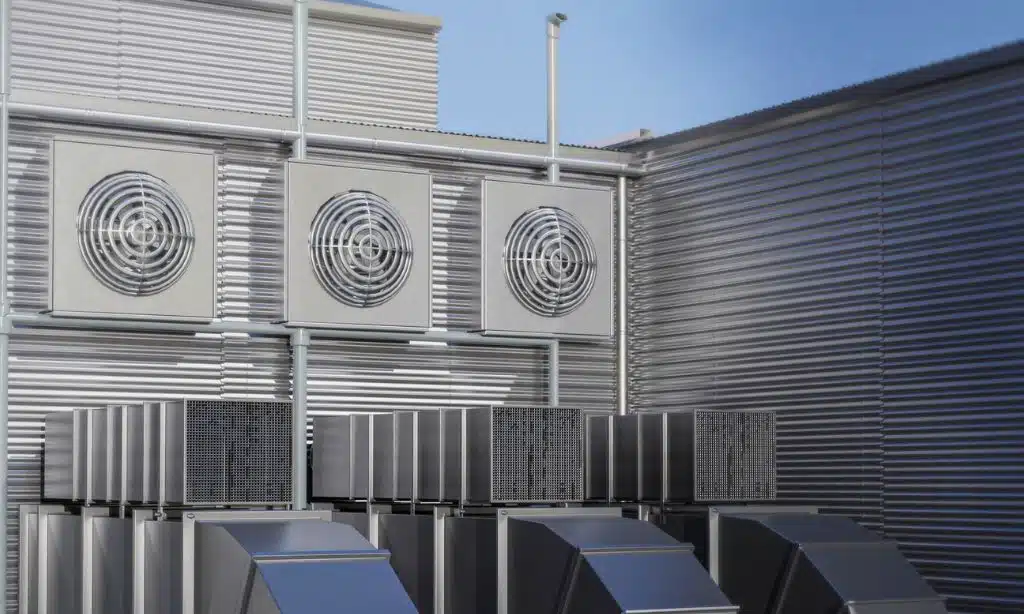
Swegon GOLD RX uses a heat exchanger that captures up to 95 percent of heat from stale air. The rotating wheel also moves moisture, so this energy recovery ventilator keeps humidity control even in frigid zones.
The mechanical ventilation system suits both residential ventilation and small commercial Passive House projects. It fits tight building envelope designs. You slash space heating demand and still meet strict indoor air quality goals.
Advanced controls analyze air exchange trends and spot faults fast. The unit links to an automation system for remote monitoring. Daily diagnostics cut downtime and limit upkeep tasks.
Its rugged core promises long service life. Fans run through silencing tech, so you barely hear them. You get both heat recovery and cooling recovery in one smart package.
How effective is the UltimateAir RecoupAerator 200DX?
The UltimateAir RecoupAerator 200DX delivers maximum heat recovery in a compact housing. It acts as both a mechanical ventilation system and an energy recovery ventilator, pulling fresh air in, pushing stale air out, and reclaiming heat to cut space heating demand.
Advanced filtration removes indoor air pollutants and pollen, boosting indoor air quality inside a passive house envelope. Low power consumption meets strict Passive House standards.
Built-in controls let users tweak air exchange rates to suit their home and climate. It suits small to mid-sized passive house layouts and adapts to various installation configurations.
Technicians access filters and the heat exchange core in seconds, cutting maintenance time. The unit also balances moisture transfer for reliable humidity control in residential ventilation.
What should you know about the Systemair SAVE VTR 200?
Systemair built the SAVE VTR 200 for supply and exhaust ventilation in passive houses. It features high-efficiency heat recovery that cuts energy transfer losses. The unit runs quietly at under 25 dB, so you barely notice it.
It fits modern airtight building envelopes in new homes or retrofits. Maintenance stays simple with front access panels for filter swaps and heat core cleaning.
Advanced controls let you tweak ventilation rates for optimal residential ventilation and humidity control. You get fresh air, less stale air, and moisture transfer without extra energy waste.
The energy recovery ventilator links to smart home hubs for flexible operation. It also matches passive house rules for energy recovery ventilation. No loud hum, just steady, efficient air flows.
Why consider the Brink Renovent Excellent 300?
Brink Renovent Excellent 300 offers high-efficiency heat recovery for passive houses. It matches Passive House Institute standards by recycling up to 95 percent of heat in stale air.
This mechanical ventilation system suits medium-sized homes and apartments. Fans move fresh air through a counterflow heat exchanger to curb space heating demand.
Low energy consumption keeps utility bills in check and meets strict Passive House criteria. Filters slide out for quick replacement, so maintenance stays simple. Automated controls fine-tune humidity control, for balanced air exchange and improved indoor air quality.
A quiet motor hums behind the building envelope, and the unit doubles as an energy recovery ventilator or a heat recovery ventilator to handle moisture transfer.
Benefits of Counterflow Heat Exchangers
Counterflow heat exchangers in ERVs swap heat and moisture between outgoing stale air and incoming fresh air, cut space heating demand, and strengthen the building envelope. Read on to learn more.
How do counterflow heat exchangers improve energy efficiency?
Passive houses rely on careful heat recovery. Exchangers send heat from stale exhaust to fresh supply air. They recover 75 to 95 percent of heat. This design can bring supply air temperature close to the exhaust level, so fresh air feels warm.
Ventilation losses drop from 20–30 kWh per square meter a year down to 2–7 kWh.
Energy recovery ventilators and rotary heat wheels swap heat in cold and warm seasons. Fans with EC motors use little electricity. The exchangers can recover eight to fifteen times the power they use.
Fresh air streams arrive near room temperature, so cold drafts vanish. This mechanical ventilation system boosts indoor air quality and conserves energy.
What maintenance do counterflow heat exchangers require?
Counterflow heat exchangers need regular checks to protect indoor air quality in a passive house. Simple upkeep keeps heat recovery efficient and saves energy.
- Noise dampers keep acoustic load under 25 dB and need visual checks.
- F7 filters at suction points need replacement every three months to block particulate matter and keep moisture transfer clear.
- Thermal break components need inspection each season to avoid thermal bridging in the building envelope.
- Drain pan needs clearing monthly to prevent condensation buildup in the drainage system.
- Heat exchange core surfaces need annual cleaning to preserve heat recovery rates in the energy recovery ventilator.
- Supply and exhaust flows need calibration to avoid stale air mixing during air exchange.
- Humidity sensors in the mechanical ventilation system need testing to maintain proper humidity control.
How to Choose Between HRVs and ERVs
Pick an ERV to balance moisture transfer or an HRV to speed air exchange with its heat exchanger, then keep reading to find your perfect fit.
What are the main differences between HRVs and ERVs?
Here is a clear comparison of HRVs and ERVs for passive houses.
| Feature | HRV | ERV |
|---|---|---|
| Heat recovery | Preheats incoming air in winter without moving moisture | Recovers heat and transfers some moisture between streams |
| Climate fit | Ideal for cold, dry regions | Best for humid or mixed climates |
| Home size | Small homes in cold zones | Large homes or high-humidity areas |
| Humidity control | Minimal impact on indoor moisture | Helps stabilize indoor humidity levels |
| Energy efficiency | Heat only, winter focus | Heat plus moisture, year-round balance |
| Core technology | Counterflow heat exchanger core | Counterflow core with moisture-permeable membrane |
| Maintenance | Filter swap twice yearly | Filter and core clean every six months |
| Cost factors | Lower initial cost | Higher upfront, saves on dehumidification |
Which system is better for different climates?
Cold climates favor balanced ventilation units with heat recovery in small homes; large passive house projects use energy recovery ventilators to balance humidity control, heat recovery, and indoor air quality.
Hot and humid regions find ERVs more economical and efficient, thanks to moisture recovery in their enthalpy wheel cores. Mixed climate zones allow either HRV or ERV under mechanical ventilation system plans, as long as designers use an energy modeling tool to size intake and exhaust flows.
Local codes and Passive House guidelines can add rules that affect system choice. Builders adapt vent placements to match the building envelope and seasonal comfort goals. Proper selection cuts space heating demand in cold months and avoids over-ventilation or stale air in summer.
Installation Considerations for Passive Houses
A tight shell needs a Retrotec pressurization check, a sealed duct run, and a cross-flow core snug in your heat exchanger, so flip the page to learn more.
What are the best practices for installing ventilation systems?
Install ductwork inside the sealed building envelope to boost indoor air quality. Test airtightness with a pressure test at 50 Pascals and aim for 0.6 air changes per hour or less.
Add silencers to pipes and valves to keep acoustic load under 25 decibels. Place air inlets away from parking areas or HVAC vents. Space supply diffusers to prevent stale air pockets in living spaces.
Use the Passive House Planning Package tool to size your energy recovery ventilator for passive house standards.
Mount the mechanical ventilation system close to heated zones to minimize duct runs. Choose duct materials that resist moisture transfer and fit tight to the building envelope. Balance supply and exhaust flows for precise humidity control.
Align window inlets for cross ventilation in outward-facing rooms. Fit windows with U-values at or below 0.85 W per square meter kelvin to keep heat loss low.
How can installation affect system performance?
Botched ductwork leads to air leakage across the building envelope. Thermal bridges form at weak joins, they drive heat loss or heat gain. That cuts the heat recovery rate in energy recovery ventilators.
Misplaced supply vents can blast drafts into rooms. They force stale air into living spaces.
Flimsy pipe insulation in a mechanical ventilation system lets moisture nest and spawns noise. Blocked or faulty drainage traps water inside ventilation systems. That risks mold, harms moisture transfer, and spoils indoor air quality.
Bad links to building controls can spike energy use. Poor window installs with low U-values drag down passive house performance.
Maintenance Tips for Ventilation Systems
Swap the air filter, clear dust from the ducts, and oil the fan motor on your heat-exchange ventilator to keep fresh air flowing—read on to master maintenance.
How often should ventilation systems be serviced?
Passive house systems need care to keep indoor air quality high. Homeowners should check F7 filters in ventilation systems every three months. Clean filters help preserve the building envelope.
Heat exchangers need cleaning twice a year for heat recovery. Acoustic silencers in ducts deserve a yearly inspection. Drainage pipes must stay clear to avoid condensation and water buildup.
Good service flushes stale air and improves air exchange.
Mechanical ventilation system controls need tests each season. Professionals should service energy recovery ventilators at least once a year. Ductwork and airtightness need regular inspections to boost residential ventilation.
Servicing preserves humidity control and helps with stale air removal. Annual checks catch minor issues before they grow.
What are common maintenance tasks for HRVs and ERVs?
Air filters on HRVs and ERVs need frequent checks. Dirty filters choke airflow and harm indoor air quality. Clean or swap them every three months. Heat exchanger cores also demand attention.
Inspect cores and clear dust to maintain heat recovery and control moisture transfer. Drain pans and condensate lines often clog. Flush them to prevent water buildup. Test airflow balance to stop stale air mixing in the building envelope.
Air movers and drives can wear down over time. Scan belts, bearings, and blades for damage. Worn parts cut performance and hike energy use. Silencers hide inside ducts, yet they need cleaning to keep noise low.
System controls and sensors in a mechanical ventilation system need regular checks. Run test sequences to confirm they read right. Ducts often harbor leaks or blockages. Trace each line and seal gaps or clear debris for proper air exchange.
Takeaways
A tight home demands fresh air. Proper heat recovery slashes energy waste. Ventilation devices like ERVs and HRVs swap stale air for filtered, near-room temperature air. They link to the sealed building envelope and ground exchangers for smooth pre-heat.
Smart controls adjust flow to match daily routines. This mix of tools and design yields top indoor air quality, stable humidity control, and cozy rooms.
FAQs on Best Ventilation Systems for Passive Houses
1. What is a passive house ventilation system?
A passive house uses a mechanical ventilation system to swap indoor air with fresh outdoor air. It fights stale air, and it keeps indoor air quality high. It seals the building envelope, then adds controlled air exchange.
2. How does heat recovery work in these ventilation systems?
Heat recovery moves warmth from the outgoing air to the incoming air, like a clever heat handshake. It cuts space heating demand. It helps a low-energy house stay warm with less primary energy.
3. Why choose an energy recovery ventilator for residential ventilation?
An energy recovery ventilator trades heat and moisture between air streams. It gives humidity control and smooth moisture transfer. It reduces energy demands and boosts climate change mitigation efforts.
4. Who is Wolfgang Feist and what did he teach us about passive houses?
Wolfgang Feist is the pioneer of the passive house standard. He set tight rules for window glazing, double glazing, and thermal protection. His work guides energy efficient design and passive solar design around the world.
5. Can these systems handle humidity and latent load?
Yes, they control relative air humidity, and tackle latent load from cooking or showers. They keep wood window frames safe from mold. They help a house breathe easy without damp spots.
6. Do these ventilation systems work with heating and cooling or water heating?
They focus on air exchange and heat recovery but they play well with a heater, an air conditioning system, or solar thermal gear. You still need a top-up to beat extreme cold or heat. They save energy in the process.