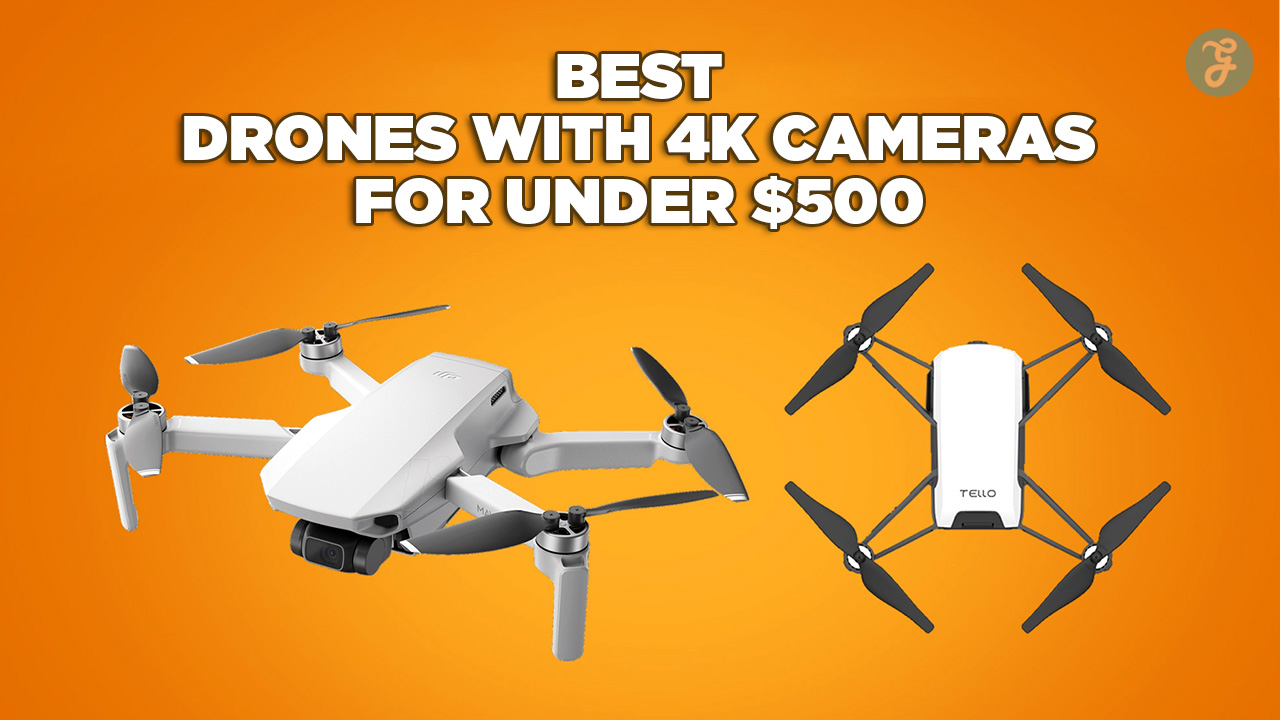
By 2026, the market for affordable aerial photography has undergone a massive shift with the widespread adoption of the Qi2 charging standard and sub-249g airframes. High-quality drones with 4K cameras, which once required a $1,000 investment is now standard in the sub-$500 category. These drones provide professional-grade footage, intelligent tracking, and extended flight times for hobbyists and content creators alike.
Whether you are looking for a palm-sized selfie drone or a robust folding quadcopter for cinematic landscapes, the current crop of budget-friendly drones offers unprecedented value.
How We Selected Our 10 Best Drones with 4K Cameras: Insights
To identify the top performers for 2026, we analyzed the latest flight tests and consumer reliability reports from the first quarter of the year. Our selection process filtered out toys to focus on serious tools that provide stabilized 4K video. We used the following criteria to rank each model:
- Image Stabilization: We prioritized drones with 3-axis mechanical gimbals over electronic image stabilization (EIS) for smoother cinematic results.
- Weight and Regulation: We focused on drones under 249 grams to ensure they bypass the need for FAA registration in most recreational scenarios.
- Intelligent Flight Modes: We selected models that offer autonomous features like ActiveTrack, Return-to-Home, and pre-programmed “QuickShots” for social media.
- Battery Endurance: Every drone on this list provides at least 25 minutes of flight time, with many offering extended battery options.
10 Top-Rated Drones with 4K Cameras Under $500
The move toward silicon-based image processing and lightweight airframes has made high-end features more accessible than ever before. The following drones represent the best technology available in early 2026 for pilots who need 4K resolution without breaking the $500 barrier.
1. DJI Mini 3
The DJI Mini 3 remains a powerhouse for creators due to its unique rotating gimbal that supports true vertical shooting for TikTok and Reels. It features a large 1/1.3-inch sensor that performs exceptionally well in low-light conditions compared to other budget models. With the standard battery, it offers a 38-minute flight time that exceeds many professional-grade quadcopters.
Best for: Social media influencers and vertical content creators
Pros:
- Excellent 4K HDR video quality
- True vertical shooting without cropping
Things to consider: It lacks obstacle avoidance sensors found on more expensive models.
2. DJI Flip
As the newest addition to the 2026 lineup, the DJI Flip introduces palm-launch technology and basic obstacle detection to the entry-level price point. It is designed to be the ultimate travel companion, featuring integrated propeller guards that make it safe for indoor use or crowded spaces. Despite its tiny size, it delivers a stable 4K60 video feed and 48MP high-resolution stills.
Best for: Travelers and beginners who prioritize safety and ease of use
Pros:
- Forward and downward obstacle sensors
- Extremely compact and durable airframe
Things to consider: The shorter flight time of 31 minutes is slightly less than the older Mini 3.
3. Potensic Atom 2
The Potensic Atom 2 has emerged as the strongest non-DJI competitor, offering a refined 3-axis gimbal and 10km transmission range. It includes an upgraded AI-tracking system that rivals the accuracy of more expensive brands for following moving subjects. The build quality feels premium and the software experience has been significantly polished for 2026 users.
Best for: Pilots looking for DJI-level features at a lower price point
Pros:
- Fast OcuSync-style transmission stability
- Precise AI subject tracking and 8K photo mode
Things to consider: The controller is bulkier than some compact DJI alternatives.
4. DJI Mini 4K
This model is the most affordable entry point into the DJI ecosystem, stripping away luxury features to focus on pure 4K video quality. It uses the reliable O2 transmission system which provides a steady HD feed up to 10km away. It is incredibly easy to fly and serves as the perfect “first drone” for anyone learning the ropes of aerial photography.
Best for: Absolute beginners on a strict budget
Pros:
- Most reliable flight software in its class
- Very easy to repair with widely available parts
Things to consider: It uses an older 1/2.3-inch sensor which can struggle in low-light scenes.
5. Skyrover S1
The Skyrover S1 is a 2026 newcomer that has disrupted the market by including a 1/2-inch Sony sensor for under $300. It is one of the few drones in this price bracket to feature a 3-way obstacle avoidance system that covers front, back, and bottom. The folding design is highly portable and the drone handles wind remarkably well for its sub-250g weight.
Best for: Budget-conscious pilots who want advanced safety sensors
Pros:
- Unbeatable value for 3-way obstacle detection
- High-resolution 48MP photo capabilities
Things to consider: The companion app is less intuitive than the DJI Fly or Potensic Pro apps.
6. FIMI Mini 3
FIMI has updated its mini series with the V3, which now supports 4K at 60fps for smoother high-speed action shots. It features an “AI Night Video” mode that uses software processing to reduce noise in evening captures. The drone supports F-Log recording, giving advanced users more flexibility during color grading in post-production.
Best for: Hobbyist videographers who enjoy color grading their footage
Pros:
- High frame rate 4K60 recording
- Advanced night mode for evening flights
Things to consider: The landing gear is a bit short so landing on grass requires a pad.
7. Holy Stone HS720G
The HS720G is a robust, larger-form drone that provides extra stability in breezy coastal conditions. It utilizes a 2-axis gimbal assisted by Electronic Image Stabilization to keep the 4K footage level during aggressive maneuvers. It is often bundled with a high-quality carrying case and multiple batteries, making it a great all-in-one value pack.
Best for: Pilots who fly in moderately windy outdoor environments
Pros:
- Heavy-duty build quality that feels substantial
- Very affordable “Fly More” style bundles
Things to consider: The 2-axis gimbal is not as smooth as 3-axis mechanical alternatives.
8. DJI Neo 2
The DJI Neo 2 is a specialized selfie drone that can be operated entirely through voice commands or palm gestures. While it is less capable for long-distance exploration, its 4K camera is perfect for vlogging and close-range tracking. It is the lightest drone on this list and can be charged via a standard USB-C cable in your car or power bank.
Best for: Vloggers and solo travelers wanting hands-free shots
Pros:
- Hands-free operation via voice and palm gestures
- Extremely lightweight and pocketable
Things to consider: It lacks a mechanical gimbal, relying instead on high-quality digital stabilization.
9. Potensic Atom SE
The Potensic Atom SE is a streamlined quadcopter that prioritizes a minimalist user experience and fast deployment. It offers 4K video with “ShakeVanish” digital stabilization at a price that is hard to beat. It is a highly responsive drone with a “Sport” mode that allows for impressive top speeds for capturing fast-moving vehicles.
Best for: Action-oriented filming on a tight budget
Pros:
- Very fast takeoff and deployment time
- Stable flight performance at high speeds
Things to consider: The lack of a mechanical gimbal means footage is less cinematic than the standard Atom.
10. Ruko F11GIM2
The Ruko F11GIM2 is famous for its massive battery capacity, often shipping with two batteries that provide a combined 56 minutes of flight time. It features a unique 3-axis gimbal design that is protected within the drone’s body, reducing the risk of damage during minor bumps. It is a tall drone that is easy to spot in the sky even at long distances.
Best for: Users who want maximum flight time per session
Pros:
- Longest battery life in the sub-$400 category
- High-visibility LED lights for orientation
Things to consider: The drone is larger and heavier than the Mini models, requiring more storage space.
Quick Overview
The 2026 budget drone market offers a clear split between portable mini drones and feature-heavy larger quadcopters.
Comparison Table
| Drone Model | Max Video | Gimbal Type | Flight Time | Weight |
| DJI Mini 3 | 4K30 HDR | 3-Axis (Rotational) | 38 Mins | < 249g |
| DJI Flip | 4K60 HDR | 3-Axis | 31 Mins | < 249g |
| Potensic Atom 2 | 4K30 HDR | 3-Axis | 32 Mins | < 249g |
| Skyrover S1 | 4K30 | 3-Axis | 30 Mins | < 249g |
| Ruko F11GIM2 | 4K30 | 3-Axis | 28 Mins | 560g |
Our Top 3 Picks
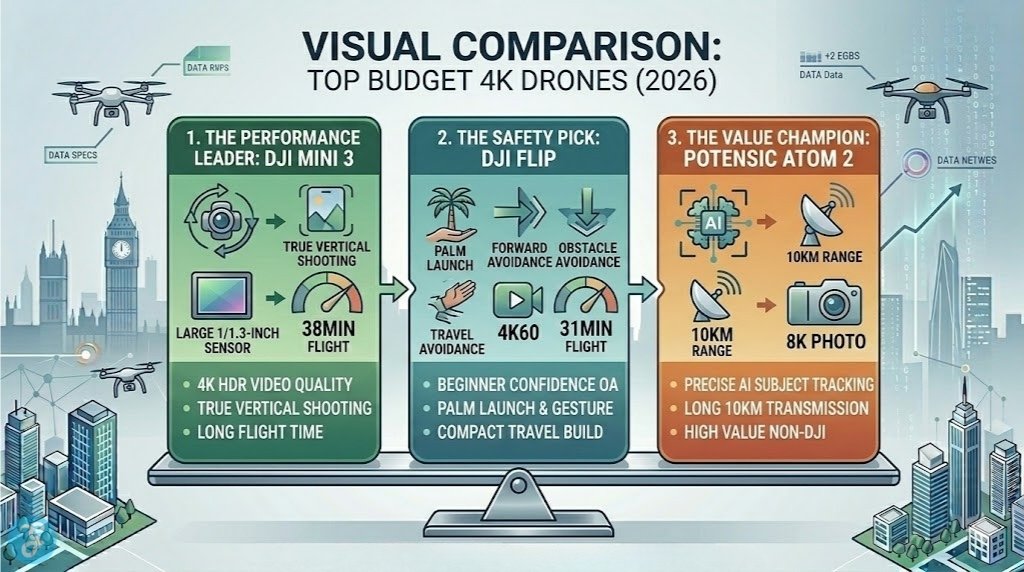
- The Performance Leader: DJI Mini 3. Its superior sensor and vertical shooting make it the most versatile tool for modern content creators.
- The Safety Pick: DJI Flip. The inclusion of obstacle avoidance in a sub-$500 drone is a game-changer for beginner confidence.
- The Value Champion: Potensic Atom 2. It offers the best balance of range, tracking, and image quality for those who want to move away from the DJI ecosystem.
Buyer’s Guide: How to Choose the Right Drones with 4K Cameras
Selecting a drone in 2026 requires understanding the trade-offs between portability and specialized camera features.
The Selection Framework:
- Gimbal vs. EIS: A mechanical gimbal physically moves to keep the camera level, while EIS crops the image to hide shakes. Always choose a gimbal for cinematic results.
- Transmission Technology: Look for drones using OcuSync (DJI) or PixSync (Potensic) rather than standard Wi-Fi to avoid losing video signal behind obstacles.
- Controller Type: Decide if you want a controller with a built-in screen (like the DJI RC) or if you are comfortable plugging in your smartphone for every flight.
Decision Matrix (Table):
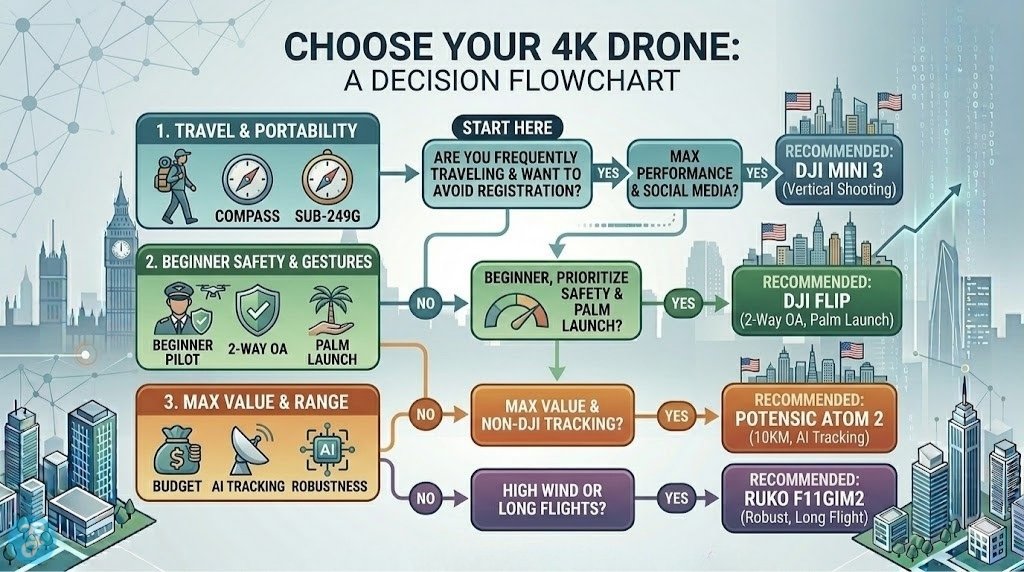
| Choose a Mini Drone (< 249g) If… | Choose a Standard Drone If… |
| You want to avoid FAA registration fees. | You primarily fly in high-wind conditions. |
| You travel frequently and need to save space. | You want a larger, more visible aircraft in the sky. |
| You film mostly for social media. | You need longer flight times with bigger batteries. |
The Final Checklist
- Have you checked the local “No Fly Zones” using an app like B4UFLY?
- Do you have a high-speed V30 microSD card to handle 4K bitrates?
- Does your smartphone meet the minimum OS requirements for the drone’s app?
- Have you practiced flying in a wide-open area before attempting close-proximity shots?
- Are you aware of the battery storage guidelines to prevent swelling during the winter?
Final Thoughts
The selection of Drones with 4K Cameras under $500 has never been more competitive or technologically advanced. By prioritizing stabilization and transmission range over raw megapixel counts, you can find a quadcopter that produces footage indistinguishable from professional rigs. Whether you choose the vertically-gifted DJI Mini 3 or the safety-first DJI Flip, these tools offer a new perspective on the world that was once inaccessible to the average hobbyist.