Have you ever stared at your family tree, wondering if those old stories from Grandma about her roots in Europe could unlock a second passport for you? Many folks feel stuck with just one citizenship, facing limits on travel, work, or even preserving heritage, especially as global mobility gets tougher.
Citizenship by descent, or jus sanguinis, lets you claim ancestral citizenship based on family ties, and it’s much cheaper than citizenship by investment programs. This post breaks down the best programs like Italy’s no generational limit option and Ireland’s grandparent rule, plus eligibility criteria, application process, and benefits like EU freedom of movement.
Ready to explore your options?
What Is Citizenship by Descent?
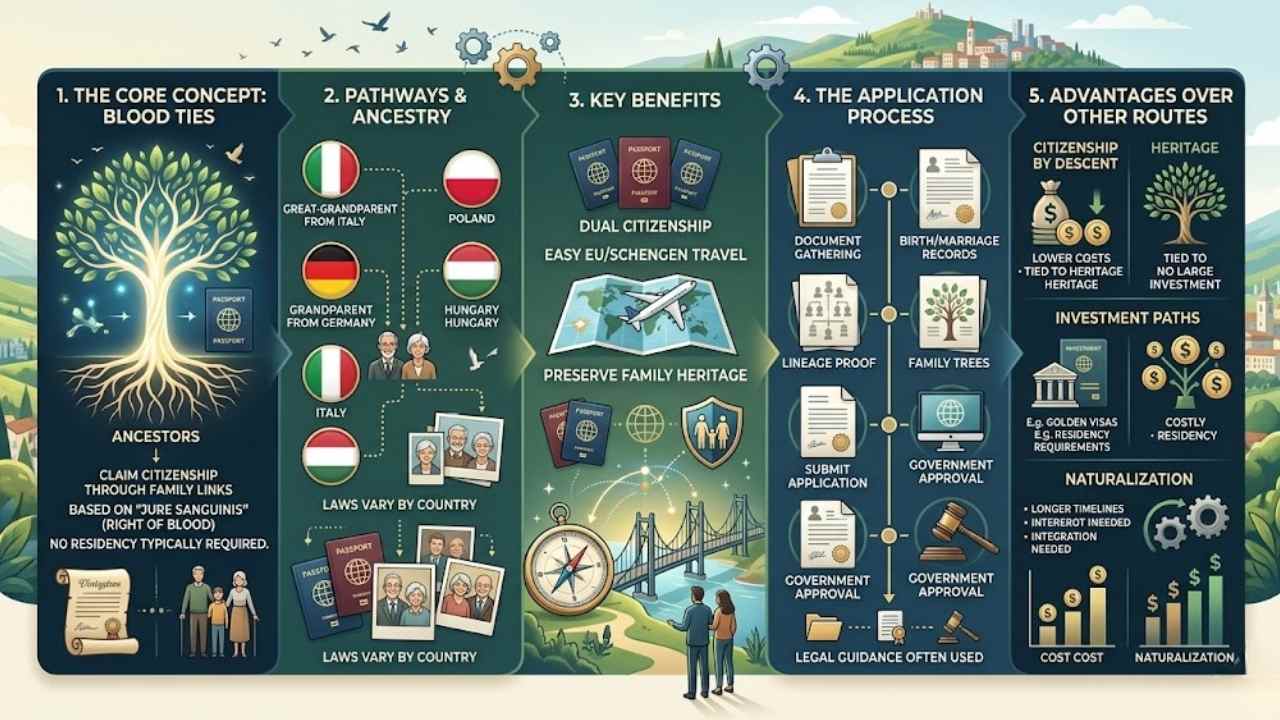
Citizenship by descent lets you claim a passport from another country through family links. This path, also called citizenship by ancestry or jure sanguinis, bases your right on blood ties to ancestors from that nation.
Folks chase it for dual citizenship perks, like easy travel in the European Union or Schengen Area. Picture your great-grandpa from Italy; his roots could unlock Italian citizenship for you, no residency requirements needed.
Programs vary by place, say Germany or Poland, but they all hinge on proving those ancestral connections. Experts like Henley & Partners or Global Citizen Solutions often guide the way, especially for Americans eyeing Europe.
You prove eligibility with birth records and family trees, dodging investment routes like residence by investment. This setup beats costly citizenship by naturalization or marriage paths, keeping things tied to heritage.
Take Hungary’s simplified process since 2011; it shows how laws evolve to ease claims. Immigration lawyers help gather docs, from vital stats to lineage proofs, making the citizenship application process smoother.
Costs stay low compared to big bucks programs, and you preserve family stories along the way.
How Does Citizenship by Descent Work?
People gain citizenship by descent, or CBA, through family links to a country. This path skips big investments or long stays. You prove your ties with birth records and other papers.
Countries like Italy, Ireland, and Germany offer this option. They base it on ancestry, not jus soli or birthright citizenship. Folks in the United States of America often chase these for EU perks.
Imagine digging through old family stories, like a treasure hunt for passports. Eligibility hinges on generational limits and documentation requirements. Some spots, such as France or Spain, add language proficiency tests.
Others, like the United Kingdom or Canada, focus on direct lines. Processing times vary, from months to years. Experts from Global Law Experts or Greenback Expat Tax Services help with U.S. tax angles.
Mike Wallace, a pro in this field, notes the value for dual setups. Programs in Romania, Austria, or Bulgaria follow similar ancestry rules. Unlike citizenship by marriage or investment, this ties to bloodlines.
Think of it as claiming a family heirloom, passed down quietly. Henley Passport Index ranks these passports high for travel ease. Australia has its own twists, but Europe leads for Americans.
Ancestry drives the whole process, demanding proof across generations. You interact a lot with government offices, more than in residency paths. Picture chatting with officials, sharing tales of great-grandparents from Poland or Hungary.
Portugal’s grandparent rule opens doors without huge costs. This beats pricey citizenship by investment schemes. Immigrants eye this for 2026 and beyond, as laws shift. University of Chicago’s Booth School of Business studies show economic upsides.
No need for deep pockets, just solid family proof. Folks preserve heritage while gaining freedom of movement.
Citizenship through ancestry connects you to roots you never knew you had, says an expert from Global Law Experts.
Eligibility Requirements for Citizenship by Descent
Eligibility kicks in when you prove direct family links to a country. Think of it like unlocking a family treasure chest, full of passports waiting for the right key. Citizenship by descent hinges on those ancestral ties, not cash or long stays.
You need to show birth records or marriage papers from your kin. Rules differ by nation, so dig into your tree. For Italy, no limit on generations applies. Ireland looks at grandparents.
Germany expanded options after 2024 changes. Poland focuses on post-1900 roots. Hungary simplified steps since 2011. Portugal uses the grandparent rule too. Gather vital records, like certificates of birth, to back your claim.
Officials check these ties closely.
Proving ancestry demands solid proof, often across many years. Imagine piecing together a puzzle from old family stories and dusty files. Programs vary, but all require clear links to citizens of that land.
Europeans offer paths that lead to EU perks, like free movement. Americans flock to these for that edge. Costs stay low compared to buying in. No big investments needed, just family history.
Consult experts if gaps appear in your docs. They help authenticate items, such as passports or naturalization forms. Stay persistent; laws shift, but options endure into 2026 and beyond.
The Best Citizenship-by-Descent Programs
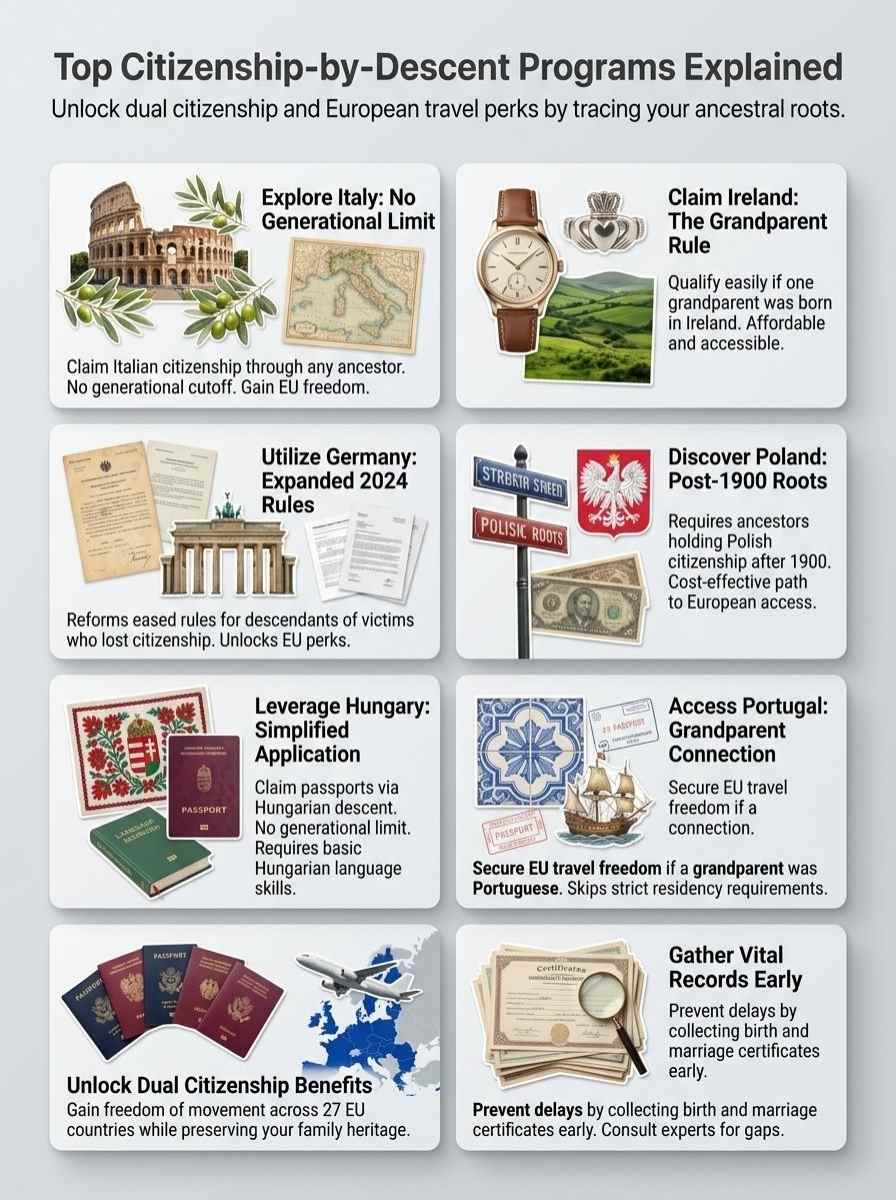
Imagine tracing your roots back to Europe and snagging a second passport, like finding buried treasure in your grandma’s attic. These standout options open doors to new lives abroad, so keep reading to see which one fits your family story.
Italy: No Generational Limit
Italy offers one of the top citizenship by descent programs in Europe, perfect for Americans with deep ancestral ties. You claim citizenship through any Italian ancestor, with no limit on generations.
This stands out because it relies on family connections, not money or long stays. Picture tracing your lineage back to a great-great-grandparent from Sicily; that link could open doors to an EU passport.
Folks love this route for its low cost compared to investment options. Plus, it grants freedom to live, work, and travel across the European Union. Proving those ties takes effort, like gathering birth records and marriage papers, but many succeed.
Think about your family tree branching far back. Italy’s rules let you follow it without cutoff points, unlike some nations that stop at grandparents. This process, based on bloodlines, beats pricey paths to a second passport.
You interact with officials, submit authenticated docs, and wait for approval. Success preserves your heritage and boosts mobility. Eligibility hinges on solid proof of ancestry, so dig into records early.
Many call it a smart, affordable way to gain dual citizenship in 2026 or later.
Ireland: Grandparent Rule
Ireland offers a strong citizenship by descent program through its grandparent rule. You qualify if one of your grandparents was born on the island. This path taps into ancestral ties, just like other European options.
Folks love it for the low cost compared to investment routes. Picture reclaiming your family’s old roots, like finding a lost family heirloom. It beats pricey programs hands down.
Applicants prove ties with birth records and family trees. The process involves some government steps, similar to residency apps. EU perks come along, like free movement across borders.
Many Americans chase this for dual passports. Laws stay steady, making it viable into 2026. Dig into your lineage, and you might score that second citizenship.
Germany: Expanded After 2024 Reform
Germany opened up its citizenship by descent rules in 2024. This reform helps more people claim ties through ancestors. Folks with German roots now face fewer hurdles. Picture your great-grandparent fleeing Europe long ago; that link could unlock a passport for you today.
Officials expanded eligibility for those whose family lost citizenship under old laws. You prove ancestry with birth records and family trees. Costs stay low compared to investment paths.
Many Americans jump on this European option for dual status.
This program shines with EU travel perks. Move freely across borders without visas. It preserves your heritage, like holding a piece of family history in your hand. Gather docs early to avoid snags.
Laws can shift, but Germany keeps it straightforward for qualified applicants. Chat with an expert if your case feels tricky. You might find the process smoother than you think.
Poland: Post-1900 Ancestry
Poland offers a strong citizenship by descent program for folks with roots after 1900. You qualify if your ancestors held Polish citizenship during that time, often tied to the nation’s independence in 1918.
This path stays cost-effective compared to investment options, and it opens doors to EU freedom of movement. Imagine tracing your great-grandpa’s old papers from Warsaw; it feels like discovering a family treasure chest.
Many Americans pursue this, proving ties through birth records and naturalization docs.
Applicants face some government hoops, similar to other European setups. Gather those vital records early, like passports or marriage certificates, to show clear ancestral links. Laws here focus on blood ties without residency demands, making it a smart choice for dual citizenship in 2026.
Hey, if your grandma fled during tough times, this could preserve that heritage while snagging a second passport. Costs beat out fancy investment programs by a mile, keeping things simple and tied to family history.
Hungary: Simplified Process Since 2011
Hungary simplified its citizenship by descent program in 2011, making it easier for folks with Hungarian roots to claim their passport. You qualify if you prove descent from a Hungarian citizen, even from way back.
This path skips big investments or long stays, focusing instead on family links, like your grandparents or beyond. Picture digging up old birth certificates from Budapest, it’s like piecing together a family puzzle that unlocks EU perks.
Many Americans chase this option because it’s cheap compared to buying citizenship elsewhere. The process involves gathering docs and maybe learning basic Hungarian phrases, but hey, that’s part of the fun in reconnecting with heritage.
Officials handle applications through consulates, keeping things straightforward despite some paperwork hurdles. Dual citizenship? Hungary allows it, so you keep your U.S. status while gaining freedom to roam Europe.
Portugal: Grandparent Rule
Portugal offers a strong citizenship by descent program through its grandparent rule. You qualify if your grandparent was a Portuguese citizen. This path taps into ancestral ties, much like finding a hidden family treasure in your attic.
Folks with Portuguese roots often chase this for EU perks. It beats pricey investment options hands down, since it skips residency needs.
Picture tracing your family tree back to Lisbon or Porto. Proving those links means digging up birth records and other papers. Many Americans love this route for its low cost and dual citizenship perks.
Laws can shift, so check current rules. This setup preserves heritage while opening doors to European travel freedom.
Benefits of Citizenship by Descent
Imagine, you snag a second passport through your grandma’s old stories, and suddenly doors swing open wide. Yeah, it feels like hitting the jackpot in the family lottery, doesn’t it?
Access to Dual Citizenship
Many folks chase dual citizenship through descent programs, and it opens doors you might not expect. Picture holding passports from the U.S. and Italy, all thanks to your great-grandpa’s roots.
These setups let you snag that second citizenship based on family ties, not big bucks or long stays. Europeans programs shine here, often tossing in EU travel perks as a sweet bonus.
You prove ancestry, gather papers, and boom, dual status is yours without ditching your original one. Costs stay low compared to investment routes, making it a smart play for passport hunters.
Think about Ireland’s grandparent rule or Portugal’s setup; they welcome dual holders with open arms. No need for fancy investments, just solid proof of those ancestral links. People love this path because it preserves heritage while adding real freedom.
Chat with others who’ve done it, and you’ll hear stories of easier moves abroad. Dual citizenship via descent feels like finding buried treasure in your family tree, simple and rewarding.
Freedom of Movement in the EU and Other Regions
Freedom of movement stands out as a top perk for those snagging European citizenship through descent. Imagine hopping on a train from Paris to Berlin without a single border hassle, that’s the EU magic at work.
European programs, like the ones in Italy or Ireland, hand you this right as an extra boost. You live, work, or study across 27 countries, no visas needed. It’s like unlocking a giant playground for your career and adventures.
Americans love these options because they open doors to new lives abroad, all tied to your family roots.
Other regions offer their own twists on this freedom too. Think about how Portuguese citizenship lets you roam the Schengen Area with ease. Or picture settling in Germany post-2024 reforms, where expanded rules make it simpler to claim your spot.
These paths beat pricey investment routes hands down, keeping costs low while linking you to heritage. Proving those ancestral ties might take effort, but the payoff? Seamless travel and a second home base that feels just right.
Preserving Family Heritage
Citizenship by descent lets you claim a passport from your ancestors’ homeland. It builds on familial ties, not cash or long stays. Imagine, you connect with your great-grandparents’ roots in Italy or Ireland.
This path honors those old stories your family shares at reunions. People chase it to keep heritage alive, like passing down a cherished heirloom.
You prove ancestry with birth records and photos. Laws focus on these bonds, granting citizenship through bloodlines. Folks feel a rush, like finding a lost family treasure. It ties you to places your kin left long ago.
This option stays strong for second passports into 2026 and beyond.
Common Challenges in the Application Process
Picture digging through old family papers only to find gaps in vital records, or wrestling with laws that shift like sand, proving those grandparent links across oceans—it’s like chasing a family ghost, but hang in there, read on for tips to conquer these hurdles.
Documentation Gaps
You dig through old family boxes, hunting for that birth certificate from your great-grandpa’s village in Italy. Missing papers hit like a brick wall in citizenship by descent applications.
These gaps often stem from lost records over generations, especially in programs like Poland’s post-1900 ancestry rules or Hungary’s simplified process since 2011. Proving ancestral ties demands solid proof, and without it, your claim stalls fast.
Think of it as piecing together a puzzle with half the pieces gone; frustrating, sure, but not impossible if you hunt archives or hire help.
Folks chase European passports for that sweet EU freedom of movement, yet paperwork holes trip them up big time. Citizenship by descent stays cheaper than investment routes, based purely on family links, but you face heavy government checks to fill those voids.
Imagine chatting with a distant cousin who unearths a forgotten marriage license; that anecdote saves the day for many. Stay patient, gather what you can, and watch how ancestral connections unlock doors despite the hurdles.
Proving Ancestral Ties Across Generations
Proving ancestral ties across generations hits many people like a brick wall in citizenship by descent applications. You need solid proof of family links to a country, often through birth certificates, marriage records, or death notices from way back.
Eligibility varies by nation, and it depends on showing those direct ancestry connections. Take Italy’s program, for instance, it has no generational limit, so you dig deep into family history without cutoff dates.
Ireland uses a grandparent rule, meaning you link to a grandparent born there. Germany expanded options after its 2024 reform, easing paths for distant descendants. Poland focuses on post-1900 ancestry, while Hungary simplified things since 2011.
Portugal also follows a grandparent rule. These setups demand you connect the dots across time, like piecing together a family puzzle that’s missing a few edges.
Folks often struggle with faded records or name changes that break the chain. Imagine your great-grandma’s maiden name got lost in translation during immigration, now you chase shadows to fix it.
Citizenship by descent stays a smart choice for a second passport into 2026 and beyond, but it calls for real detective work. You gather evidence to show those ancestral bonds, no investment or residency needed.
This path beats costly citizenship by investment programs hands down. European options add EU freedom of movement as a sweet bonus. Stay patient, like waiting for buried treasure to surface, because proving ties takes time and grit.
Changing Citizenship Laws
Citizenship laws shift over time, and that can trip you up in your application. Take Germany, for example, they expanded their program after the 2024 reform, opening doors for more folks with ancestry ties.
You might think you qualify based on old rules, but a quick change flips the script. Picture digging through family records, only to find the law evolved last year. Stay on top of updates, folks, because citizenship by descent remains a solid choice for a second passport into 2026 and beyond.
These programs demand as much government back-and-forth as residency or investment paths, so prepare for that hustle.
Laws vary by country, and proving ties gets tricky when rules bend. Ireland sticks to the grandparent rule, steady as a rock, but others like Poland focus on post-1900 ancestry with their own twists.
You face eligibility hurdles if a nation’s policy tightens or loosens without notice. Imagine chatting with your grandma about her roots, then bam, the law demands extra proof. European programs often sweeten the deal with EU movement freedom, yet changing regs mean you juggle facts from different eras.
Ancestry-based citizenship beats investment routes in cost, no doubt, but watch those legal waves to ride them right.
How to Apply for Citizenship by Descent
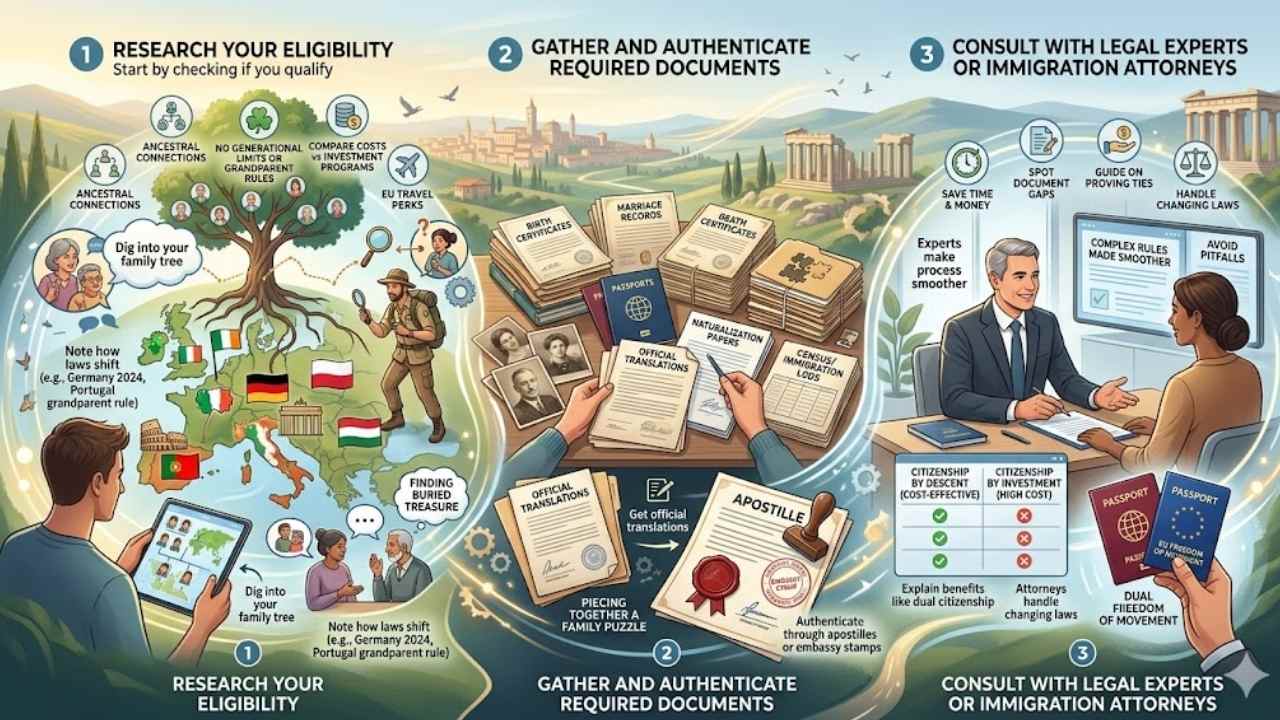
Dreaming of that second passport from your family tree, huh, like finding buried treasure in grandma’s attic? Start by digging into your roots with birth certificates and marriage records, then chat with a lawyer who knows the ropes on consular applications to make the process smooth as butter.
Step 1: Research Your Eligibility
You want to claim citizenship through your family roots. Start by checking if you qualify for these programs.
- Dig into your family tree to spot ties to countries like Italy, Ireland, or Germany, where citizenship by descent lets you gain a passport based on ancestral connections, often without generational limits or with grandparent rules.
- Look at how eligibility varies by nation, such as Poland’s focus on post-1900 ancestry or Hungary’s simplified process since 2011, and keep in mind these paths stay open for folks seeking a second passport even in 2026 and beyond.
- Compare costs, since citizenship by descent beats investment programs on price, relying on family links instead of cash or long stays, making it a smart, cheap way to snag dual status.
- Check out popular European options for Americans, which add EU travel perks, like free movement across regions, and think of it as unlocking a door your ancestors left ajar.
- Gather basic facts on proving ties, as this process demands similar government chats as residency apps, but hey, it’s all about those bloodlines granting you rights.
- Chat with relatives for stories or old papers that show your lineage, turning detective in a fun hunt that preserves your heritage while eyeing benefits like better job options abroad.
- Use online tools or ancestry sites to trace back generations, because eligibility hinges on solid proof of familial bonds to specific lands, and a little humor helps when you hit a dead end, like “Grandpa, where’d you hide the birth certificate?”
- Note how laws shift, such as Germany’s 2024 reforms expanding access, or Portugal’s grandparent rule, so stay current to avoid surprises in your quest for that extra citizenship.
- Imagine you’re an explorer mapping out your past to claim a future perk, and since it’s cost-effective compared to other routes, it feels like finding buried treasure without digging too deep.
Step 2: Gather and Authenticate Required Documents
Gathering the right documents forms the backbone of your citizenship by descent journey. Authenticating them proves your ancestral ties and keeps things smooth with government officials.
- Start by collecting birth certificates, marriage records, and death certificates from your family line, as citizenship by descent hinges on ancestral connections rather than investments or residency needs. These papers show your link to countries like Italy or Ireland, where programs focus on family heritage. Picture digging through old family albums, like a treasure hunt, to find that one faded certificate from your great-grandparent’s era.
- Hunt for passports or naturalization papers from your ancestors, especially if they tie back to post-1900 ancestry in places like Poland. You prove eligibility by linking these to specific rules, such as Germany’s expanded options after the 2024 reform. Imagine chatting with relatives over coffee, sharing stories that turn dusty docs into living proof of your roots.
- Include census records or immigration logs to bridge any gaps across generations, since eligibility varies by country and depends on solid ancestry evidence. For programs like Hungary’s simplified process since 2011, these help show unbroken ties. Think of it as piecing together a family puzzle, where each record adds a vital edge.
- Get official translations for non-English documents, as many European programs, popular among Americans, demand clear proof for EU freedom of movement perks. This step involves more government interface than some residency paths, but it stays cost-effective compared to investment programs. Envision a lightbulb moment when that translated paper unlocks your dual citizenship dream.
- Authenticate all items through apostilles or embassy stamps to verify their legitimacy, crucial for applications in nations like Portugal with grandparent rules. Citizenship by descent remains viable into 2026 and beyond for those seeking a second passport via family bonds. It’s like giving your papers a seal of approval, turning potential roadblocks into open doors.
- Double-check for completeness to avoid documentation gaps, a common hurdle in proving ties over generations. Programs in Europe often grant that extra benefit of regional mobility, making the effort worthwhile. Feel the empathy here, we’ve all faced that frustrating missing link in family history searches.
Step 3: Consult with Legal Experts or Immigration Attorneys
You face complex rules in citizenship by descent applications. Experts make the process smoother and help avoid pitfalls.
- Legal experts know the ins and outs of eligibility requirements for citizenship by descent programs, which vary and depend on proving ancestry to specific countries like Italy or Ireland, often requiring a similar or greater degree of government interface compared to residency or citizenship by investment applications.
- Immigration attorneys spot documentation gaps early, saving you time and money since citizenship by descent is a cost-effective path to citizenship compared to other routes, and way cheaper than citizenship by investment programs.
- Pros guide you on proving ancestral ties across generations, a common challenge in applications for programs like Germany’s expanded rules after 2024 reform or Poland’s post-1900 ancestry focus.
- They explain benefits like access to dual citizenship and freedom of movement in the EU, tying into why European citizenship by descent programs are popular among Americans seeking a second passport in 2026 and beyond.
- Attorneys handle changing citizenship laws, like Hungary’s simplified process since 2011 or Portugal’s grandparent rule, based on principles granting citizenship through ancestral connections rather than investment or residency requirements.
- Experts offer advice on preserving family heritage, turning what could feel like a headache into a rewarding journey, much like piecing together a family puzzle with professional backup.
- They assist in authenticating documents for programs without generational limits, such as Italy’s, ensuring your application stands strong against scrutiny from government officials.
- Consultants compare options, highlighting how citizenship by descent remains a viable choice for immigrants, often with more government interaction but less cost than other paths to a passport.
Final Thoughts
You’ve explored citizenship by descent, from its basics to top programs like Italy’s no-limit rule and Ireland’s grandparent tie. These paths offer a simple, low-cost way to gain a second passport without hefty investments.
Claiming this status boosts your travel freedom, especially in the EU, and keeps family stories alive for generations. Check online forums or hire an immigration lawyer for extra help on your application.
Go ahead, dig into your roots, and unlock that global door waiting for you.
Frequently Asked Questions (FAQs) on Citizenship by Descent Programs
1. What exactly is citizenship by descent, and why should I care?
Citizenship by descent means you can claim nationality from your ancestors, like grandparents or parents from another country. It’s like finding a golden ticket in your family tree, opening doors to new passports and travel perks. Imagine jetting off to Europe without visa hassles; that’s the kind of freedom these programs offer.
2. Which countries have the top citizenship-by-descent programs?
Italy and Ireland top the list for their straightforward ancestry rules. Poland and Germany follow close behind, with programs that dig deep into family history.
3. How do I know if I qualify for these ancestry-based citizenship programs?
Check your family records for direct links to citizens from qualifying nations, like birth certificates or marriage papers. You might need to prove unbroken lineage, but don’t sweat it; many folks discover eligibility through simple genealogy searches. Talk to an expert if things get tangled, as rules vary by country.
4. What benefits come with getting citizenship through descent?
You gain dual nationality, stronger passports for easier global travel, and sometimes even work rights abroad. It’s a smart move for families eyeing better education or healthcare options.