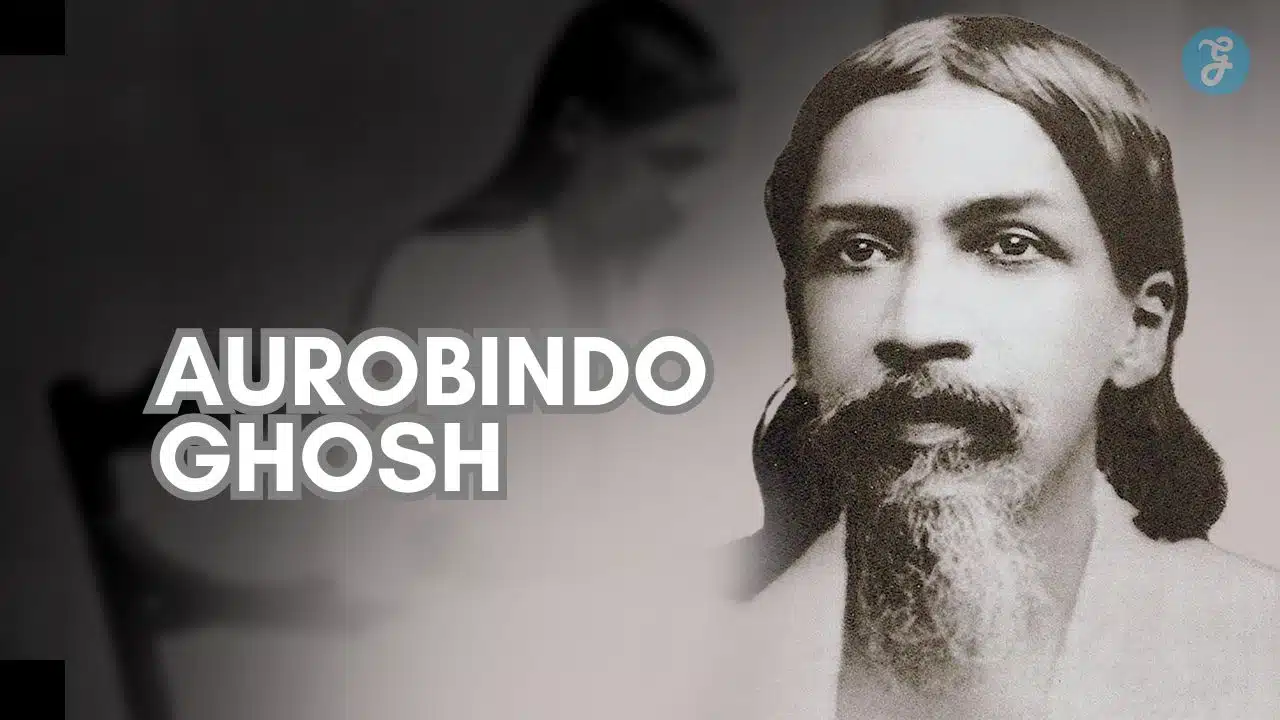
When most of us hear the word “freedom,” we think of flags, elections, and national borders. For Aurobindo Ghosh (Sri Aurobindo), freedom was much more than that. He fought as a radical leader in India’s freedom struggle. Later he withdrew from active politics and became a yogi, philosopher, and spiritual guide in Pondicherry. His life moved from political revolution to inner revolution.
In this article, we will explore how Aurobindo Ghosh redefined freedom and spirituality:
- Freedom is not only about ending foreign rule.
- Real freedom also means inner liberation and growth of consciousness.
- Spirituality is not an escape from life. It is deep engagement with life and society.
Early Life and Political Awakening: The Making of a Revolutionary
Aurobindo Ghosh was born in Calcutta on 15 August 1872 into a Bengali family. At the age of seven, he was sent to England for his education. He studied at St. Paul’s School in London and later at King’s College, Cambridge.
In England he:
- Mastered classical languages like Greek and Latin.
- Excelled in English literature and European history.
- Passed the Indian Civil Service (ICS) written exam but chose not to complete the riding test, effectively avoiding a British government job.
He returned to India in 1893 and worked in the Baroda State service. He served in the administration and later taught at Baroda College, where he became vice-principal. During these years, he quietly joined secret groups that aimed at India’s complete independence, years before it became a mainstream demand.
Quick Facts – Early Life and Career
| Aspect | Details |
| Birth | 15 August 1872, Calcutta (now Kolkata) |
| Early Education | St. Paul’s School, London |
| Higher Education | King’s College, Cambridge |
| Return to India | 1893, joined Baroda State service |
| Roles in Baroda | Civil servant, teacher, later vice-principal at Baroda College |
| Early Political Activity | Secret societies, writings in Indu Prakash and nationalist circles |
The Fire of Nationalism: Aurobindo’s Role in India’s Freedom Movement
By the early 1900s, Aurobindo Ghosh had become one of the most radical voices in the Indian national movement. He wrote powerful articles in the newspaper Bande Mataram, which he edited in Calcutta. These writings openly opposed British rule and called for complete independence, not just reforms.
He supported:
- Swadeshi—use of Indian goods instead of British products.
- Boycott—refusal to cooperate with colonial institutions.
- Passive resistance and active revolution—a mix of methods to challenge the Raj.
His speeches and writings helped turn the freedom struggle from a moderate petition-based movement into a bold demand for Swaraj (self-rule).
Aurobindo Ghosh in the Freedom Struggle
| Area of Impact | Contribution |
| Journalism | Editor of Bande Mataram, inspiring radical nationalism |
| Ideology | Early demand for complete independence (Purna Swaraj) |
| Methods Supported | Swadeshi, boycott, passive resistance, revolutionary groups |
| Influence | Inspired young revolutionaries and shifted the tone of the freedom movement |
Alipore Jail and the Turning Point Towards Spirituality
In 1908, Aurobindo was arrested in connection with the famous Alipore Bomb Case, a major state trial against revolutionaries in Bengal. He spent about a year in jail under very harsh conditions.
During this imprisonment:
- He went through long periods of solitude and meditation.
- He reported having profound spiritual experiences.
- He felt the presence of the Divine even in the courtroom and prison.
After he was acquitted in 1909, he came out a changed man. He still supported India’s freedom, but his focus began to shift. In his famous Uttarpara Speech, he spoke not only of political liberty but also of God, spirituality, and a higher destiny for India.
Alipore Jail as a Turning Point
| Element | Details |
| Year | 1908–1909 |
| Case | Alipore Bomb Case |
| Main Charge | Waging war against the British Government (high treason) |
| Jail Experience | Solitary confinement, intense inner change, deep spiritual experiences |
| Outcome | Acquittal and release in 1909 |
| Effect on Life | Shift from pure political activity to spiritual mission |
Redefining Freedom: From Political Independence to Inner Liberation
After Alipore and especially after moving to Pondicherry in 1910, Aurobindo’s idea of freedom widened. He began to see freedom not only as an external condition but as a state of inner consciousness.
Beyond the Nation-State: Freedom as Evolution of Consciousness
In Pondicherry, which was then a French territory, Aurobindo withdrew from direct politics. Here he focused on yoga, philosophy, and writing. He developed a vision in which human evolution is not only physical or social but also spiritual.
According to his later writings, especially The Life Divine, human beings are part of an ongoing evolution of consciousness, moving from ignorance to greater knowledge, harmony, and unity.
For him:
- Political freedom is important but not enough.
- Real freedom means liberation from fear, ego, and inner bondage.
- Evolution of consciousness leads to a life where the divine can be expressed on earth.
Outer vs Inner Freedom
| Type of Freedom | Description |
| Political Freedom | End of foreign rule, rights, self-government |
| Economic Freedom | Fair opportunities, livelihoods, freedom from poverty |
| Psychological Freedom | Freedom from fear, guilt, rigid beliefs |
| Spiritual / Inner Freedom | Realisation of the inner Self, connection with the Divine, inner peace |
| Aurobindo’s Ideal | Harmonising all these levels through evolution of consciousness |
Individual vs Collective Freedom in Sri Aurobindo’s Thought
Sri Aurobindo did not see individual freedom and collective freedom as separate. For him, they were deeply linked:
- A society cannot be truly free if its people are inwardly chained by hatred, ignorance, or selfishness.
- A person is not fully free if they live in an unjust, oppressive, or deeply divided society.
He believed that each person has a psychological and spiritual journey, and this inner growth slowly reshapes social and political life as well. His later works even speak of a possible future humanity with a higher consciousness, which he sometimes called the supramental or supermind.
Individual and Collective Freedom in Aurobindo’s Vision
| Level | What Freedom Means | How It Connects |
| Individual | Self-knowledge, inner peace, mastery over impulses | Inner change influences society |
| Family/Group | Relationships based on respect, love, and cooperation | Reflects inner maturity of members |
| Nation | Justice, rights, cultural self-expression, responsible leadership | Needs evolved individuals |
| Humanity | Unity beyond race, religion, and nationality | Culmination of collective evolution |
Comparing Conventional Political Freedom with Aurobindo’s Vision
We can compare conventional political ideas of freedom with Aurobindo’s deeper vision in a simple way.
Political Freedom vs Aurobindo’s Larger Freedom
| Aspect | Conventional View | Aurobindo’s Expanded View |
| Main Focus | Laws, rights, elections, sovereignty | Evolution of consciousness and inner transformation |
| Goal | Independence from foreign or unjust rule | Manifestation of the divine in life and society |
| Method | Political action, protest, institutions | Combination of outer action and inner spiritual practice |
| View of the Individual | Citizen with rights and duties | Soul in evolution, growing into a higher truth |
| End State | Free nation-state | Free inner being and harmonious world community |
For Sri Aurobindo, freedom and spirituality were two sides of the same process—the growth of the human being towards a higher, more conscious life.
The Spiritual Turn: How Sri Aurobindo Reimagined Spirituality
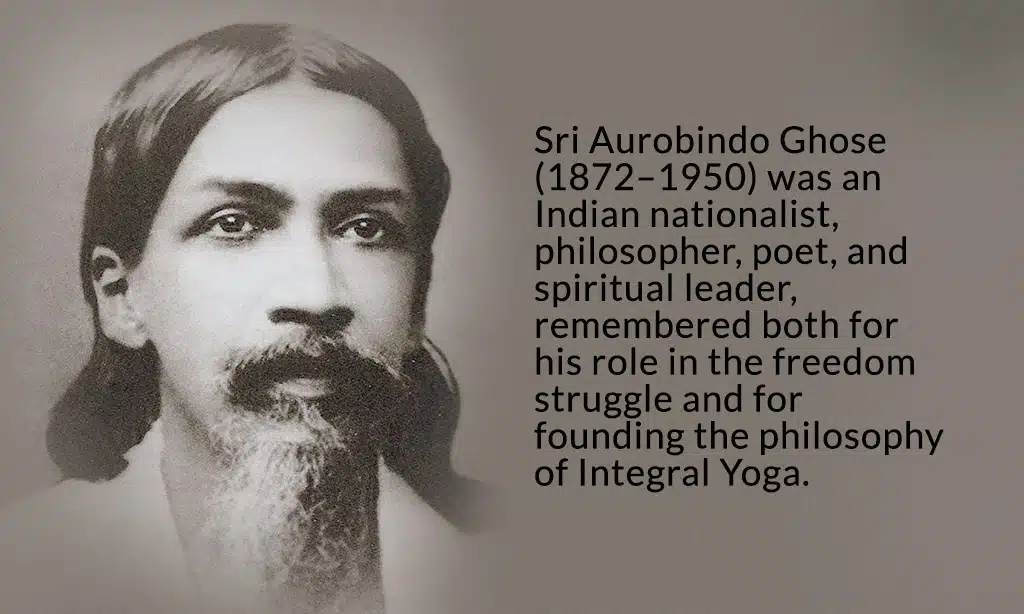
Traditional spirituality in India often emphasized renunciation—leaving family, work, and society to pursue God in an ashram, forest, or monastery. Sri Aurobindo respected this path, but he felt it was not the only way.
He proposed a new ideal: not escape from life but transformation of life.
- The world is not an illusion to be rejected.
- The world is a field where the divine can be expressed.
- Work, relationships, and daily life can all become part of sadhana (spiritual practice).
This was a major shift in the understanding of spirituality.
Old Ideal vs Sri Aurobindo’s Ideal of Spirituality
| Feature | Traditional Renunciation | Sri Aurobindo’s Transformative Spirituality |
| Place of Practice | Ashram, forest, cave, monastery | Everywhere: home, work, society |
| Attitude to World | Often seen as illusion or distraction | Seen as a field for divine manifestation |
| Main Focus | Personal liberation (moksha) | Personal liberation plus transformation of earth-life |
| Role of Action | Often reduced or abandoned | Action becomes a means of spiritual growth (Karma Yoga + Integral Yoga) |
| Ideal Outcome | Freedom from cycle of birth and death | Divine life within the world |
Integral Yoga: A Path that Unites Freedom and Spirituality
To express this new vision, Sri Aurobindo developed a spiritual path called Integral Yoga (Purna Yoga). It is “integral” because it seeks to join all parts of the being—body, life-energy, mind, and soul—with the Divine.
Key ideas of Integral Yoga:
- All life is yoga—every experience can help our growth.
- The aim is not only inner peace but also complete transformation of nature.
- It is not limited to one fixed technique; it is a flexible, inner process guided by aspiration, rejection of lower impulses, and surrender to the Divine.
The goal is a state where the divine consciousness is present and active in ordinary life, leading to real freedom from ignorance and suffering.
Core Elements of Integral Yoga
| Element | Description |
| Aim | Union with the Divine and transformation of the whole being |
| Scope | Physical, vital (energy), mental, psychic (soul), spiritual levels |
| Key Movements | Aspiration, rejection of lower nature, surrender to higher consciousness |
| Practice Style | No fixed ritual; emphasis on inner sincerity and constant remembrance |
| Outcome | Inner freedom, spiritual realisation, and gradual change of life conditions |
The Divine Life on Earth: Spirituality as Collective Evolution
In his major work, The Life Divine, Sri Aurobindo argued that evolution is not finished with the human mind. It can proceed further towards a spiritualized mind and beyond, into a supramental consciousness that sees unity in all.
For him:
- The destiny of the earth is not endless conflict.
- The true aim is a “divine life”—a life where truth, harmony, and unity can rule.
- Spirituality must, over time, change not only individuals but also culture, politics, education, and economics.
So spirituality becomes a force for collective evolution, not just personal salvation.
The Divine Life Concept
| Aspect | Explanation |
| Basis | Evolution of consciousness |
| Human Being’s Role | Bridge between animal past and spiritual future |
| Future Stage | Supramental or truth-consciousness |
| Social Impact | Greater unity, justice, and cooperation among humans |
| Link to Freedom | True freedom is living in this higher consciousness while in the world |
Freedom and Spirituality in Practice: Lessons for Today’s India
Today we live in a world of constant distraction—social media, breaking news, and endless tasks. Sri Aurobindo’s call for inner discipline and self-mastery feels very relevant.
His approach suggests:
- Spend some time daily in silence or meditation.
- Watch your thoughts and emotions instead of reacting blindly.
- Replace fear and anger with confidence and goodwill.
These simple steps move us towards the inner freedom he spoke about.
Practical Steps for Inner Freedom
| Practice | Simple Description |
| Quiet Time | Sit in silence for 10–15 minutes daily |
| Thought Observation | Notice thoughts as they arise, without judgment. |
| Emotional Awareness | Recognise anger, fear, jealousy, and let them pass without acting blindly |
| Positive Aspiration | Keep a clear inner wish for growth, peace, and truth |
| Service & Work | Do daily work with care and sincerity, not only for personal gain |
Spiritual Nationalism vs Toxic Nationalism
Sri Aurobindo sometimes spoke of spiritual nationalism. This idea is very different from narrow or aggressive nationalism.
- Toxic nationalism puts one group or nation above all others and often breeds hatred.
- Spiritual nationalism, in his sense, respects the soul of the nation—its culture, values, and dharma—while also recognizing the unity of all humanity.
He believed India has a special role in sharing spiritual knowledge and experimenting with higher forms of life, but always within a global vision.
Two Kinds of Nationalism
| Feature | Toxic/Narrow Nationalism | Spiritual Nationalism (Sri Aurobindo’s View) |
| Attitude to Others | Distrust, hostility, sense of superiority | Respect for all nations, sense of shared human destiny |
| Basis | Race, religion, ethnicity, power politics | Culture, dharma, spiritual mission |
| Use of Religion | Often divisive and political | Used for inner growth, unity, and higher values |
| Long-Term Vision | Domination or survival | Harmony of nations in a spiritually evolved world |
Freedom, Youth and the Future of India
Sri Aurobindo spoke to young people even during his political days. Today, his message can still inspire students and young professionals:
- Do not see a career only as a way to earn money.
- See work as a way to serve society and grow inwardly.
- Use science, technology, and innovation in a way that helps human evolution, not just profit.
He dreamed of an India that would combine:
- Spiritual depth
- Intellectual clarity
- Practical efficiency
In simple terms: an India that is modern, wise, and compassionate at the same time.
How Youth Can Apply Sri Aurobindo’s Ideas
| Area of Life | Possible Actions Inspired by Sri Aurobindo |
| Education | Study both science and humanities; explore Indian and world thought |
| Career | Choose work that supports society; act with integrity |
| Lifestyle | Balance technology use with time for reflection and nature |
| Relationships | Build respect and empathy across religions, languages, cultures |
| Civic Life | Support democratic values, justice, and inclusive development |
How Aurobindo Ghosh Inspires Modern Spiritual Seekers
Though his philosophy is vast, we can pick a few simple principles that modern seekers can use in daily life.
| Principle | Meaning in Simple Words |
| Aspiration | A steady inner call for truth, peace, and growth |
| Faith | Trust that the Divine or higher power is working in life |
| Sincerity | Being honest with oneself; no double life |
| Patience | Accepting that deep change takes time |
| Perseverance | Continuing practice even when results are not visible |
| Self-Offering | Offering one’s work and life to something higher than the ego |
| Harmony | Seeking balance between body, mind, emotions, and soul |
These principles help unite freedom and spirituality:
- They free us from impulses and confusion.
- They bring us closer to our deeper self.
Balancing Career, Family, and Inner Life: Aurobindo’s Way
Many people feel a split between work, family, and spiritual life. Sri Aurobindo’s teaching suggests that we do not need to run away. Instead, we can bring a deeper consciousness into all parts of life.
Some practical ideas:
- Treat work as a field for practice—stay calm, fair, and focused even under pressure.
- In family life, practice listening, forgiveness, and empathy.
- Keep a small daily routine of prayer, reading, or meditation, even if only for 10–20 minutes.
He did not give rigid rules. He stressed the inner attitude much more than the outer form.
Integrating Spirituality with Daily Life
| Area | How to Integrate Sri Aurobindo’s Approach |
| Work | Do tasks carefully, without ego, as an offering to the Divine |
| Family | See each member as a soul in evolution; respond with patience and compassion |
| Health | Respect the body with good habits; see it as a temple for higher consciousness |
| Leisure | Choose activities that relax and uplift, not dull the mind |
| Daily Practice | Short meditation, reading of inspiring texts, short moments of inner quiet |
Are We Ready for Aurobindo’s Larger Freedom?
Sri Aurobindo’s journey from Aurobindo Ghosh, the revolutionary, to Sri Aurobindo, the yogi, shows a powerful truth. Freedom is not only a political slogan; it is a deep inner need of the human soul.
He redefined freedom and spirituality in several ways:
- Freedom is not just the end of foreign rule but the growth of consciousness.
- Spirituality is not escape from life but the transformation of life.
- True liberation joins inner peace with outer action for a better world.
In a time when we still struggle with violence, division, and anxiety, his ideas invite us to ask:
Can we build societies where outer freedom and inner freedom grow together?
If we take even a few steps towards inner discipline, wider compassion, and higher aspiration, we begin to live the vision of how Aurobindo Ghosh redefined freedom and spirituality—not as a theory, but as a living path.