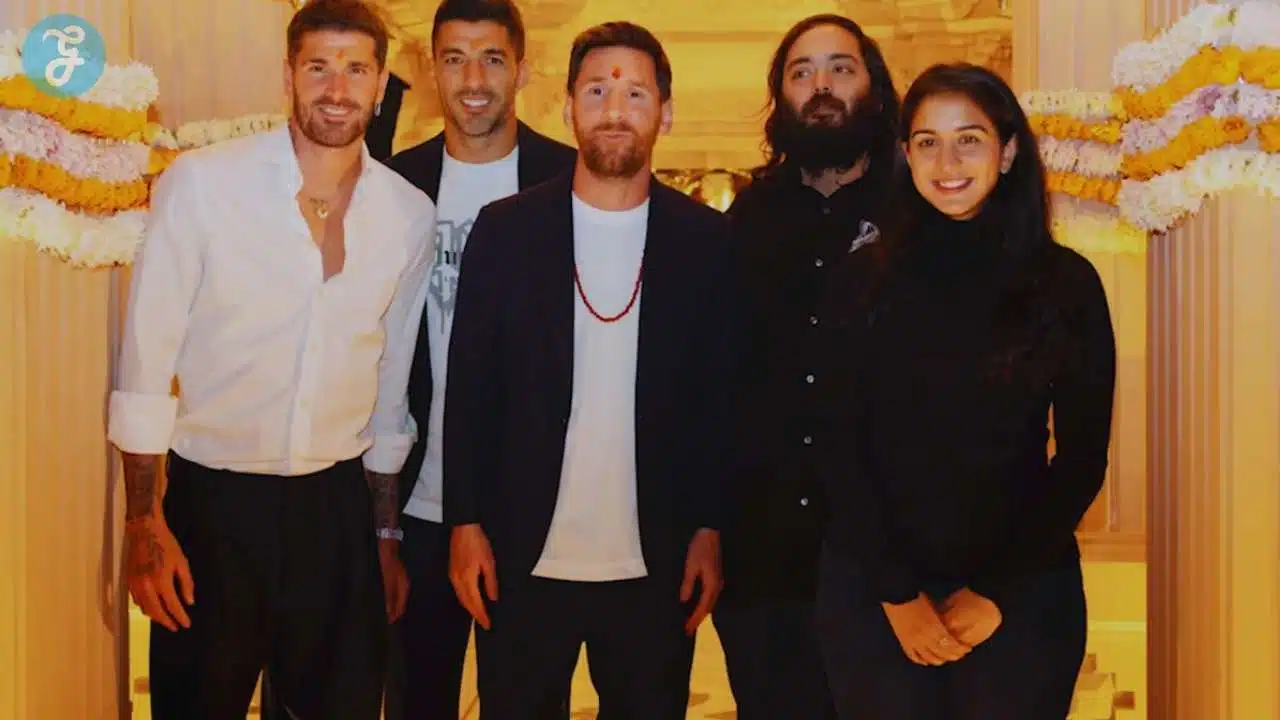
Anant Ambani gifts Messi Richard Mille watch—media reports say Lionel Messi received a rare Richard Mille timepiece during a Jamnagar visit linked to Vantara, with the watch’s value widely quoted at about ₹10.91 crore; the visit is widely reported, while the exact gift details remain publicly unverified.
What happened: Messi’s Jamnagar stop and the Vantara visit?
Lionel Messi’s short India itinerary in December 2025 included a high-security visit to Jamnagar, Gujarat, where he was hosted for a stop connected to Vantara, a large animal rescue, rehabilitation, and care initiative that has drawn national and international attention.
The “who” and “where” are clear Messi, one of the world’s most recognized footballers, traveled to Jamnagar and was received by Anant Ambani, who has been associated with Vantara’s public-facing outreach and high-profile visitors. The “what” is also straightforward at the base level—Messi visited or was scheduled to visit a major animal welfare facility and toured parts of the campus as cameras and social media coverage followed the movement.
The “when” is anchored to mid-December 2025, when multiple outlets and social channels reported Messi’s movement from a New Delhi stop to Jamnagar. The public narrative placed this as part of a tightly managed schedule featuring controlled access, security presence, and short, staged moments for photographs and brief interactions.
The “why” for Jamnagar is also relatively easy to understand. Vantara has become a showcase destination—an initiative built on scale, curated public messaging, and a strong emphasis on welfare infrastructure. Celebrity visits, even brief ones, amplify its profile and reinforce the impression of global relevance. For a star like Messi, such a stop offers a non-sporting headline that aligns with philanthropy and public interest, while also fitting the pattern of celebrity itineraries that blend appearances, private meetings, and curated tours.
Fast facts: what’s solid vs. what’s still a claim
| Topic | What is broadly reported | What is still not clearly verified in public |
| Messi in Jamnagar | Arrival and planned/actual Vantara stop | The precise sequence of private interactions |
| Host | Anant Ambani linked to hosting | Whether any formal “gift ceremony” occurred |
| Viral claim | A luxury watch was gifted | Exact model, rarity count, and confirmed valuation |
The reported gift: Richard Mille RM 003-V2 and what we can responsibly say?
The viral center of this story is the claim that Anant Ambani presented Messi with a Richard Mille watch—often described online as the RM 003-V2 Tourbillon Dual Time Zone (sometimes labeled an “Asia Edition” or “Asia Boutique” variant). In the luxury watch world, Richard Mille sits in a category where seven-figure valuations are plausible on the secondary market, especially for rare tourbillon models and limited configurations.
However, a newsroom-standard approach requires separating three layers that often get blended in viral coverage:
1. The existence of a watch gift
Social posts and entertainment-style write-ups commonly state that a watch was gifted. Yet, without a clear, attributable statement from Messi’s side or the hosts—or a verified photo/video that unmistakably captures the exchange—this element remains best described as “reported” rather than “confirmed.”
2. The model identification (RM 003-V2)
The RM 003 family is real and known for a tourbillon paired with a second time zone function, along with additional indicators often seen in performance-oriented haute horology. Still, publicly identifying a specific reference from quick videos and compressed images is difficult. Watch references can look similar across variants, and straps, lighting, and camera angles frequently mislead casual identification. If the model is indeed RM 003-V2, it fits the kind of rare, technically complex piece that could generate exactly this kind of online reaction.
3. The “12 pieces” and the ₹10.91 crore figure
Some listings and collector chatter describe an “Asia Boutique” limited run—often repeated as “12 pieces.” That figure may reflect a specific boutique allocation or a limited edition claim, but it is not always backed by easily accessible primary documentation.
The ₹10.91 crore valuation is also not a fixed “price tag” in the way consumer goods are priced. Ultra-rare watches trade like assets: condition, originality, service history, provenance (who owned it), and timing all influence price. One figure can spread rapidly simply because it is dramatic and memorable.
How luxury-watch valuation works (and why viral numbers fluctuate)?
When a high-end watch story goes viral, it often combines retail pricing logic (a single number) with collectibles pricing reality (a range). For rare Richard Mille pieces, the market typically behaves like this:
- Availability drives the headline. If a watch is genuinely scarce, the “asking price” becomes a talking point even before any verified sale occurs.
- Provenance can add a premium. If a watch is publicly linked to a global star, perceived value can increase—though that premium depends on documentation.
- Currency conversion adds noise. INR-to-USD swings can subtly inflate or deflate a headline number depending on the day and the rate used.
- Listing price is not sale price. Many viral figures come from listings, estimates, or “worth up to” statements rather than completed transactions.
Watch profile: what people say the RM 003-V2 represents
If the watch is indeed an RM 003-V2-style tourbillon dual time zone, it aligns with three characteristics that define Richard Mille’s most talked-about pieces:
- Complex mechanics: Tourbillon movements are difficult to build and service; dual time zone functionality adds another layer of complexity.
- Distinctive design language: Richard Mille watches are often instantly recognizable because of tonneau-shaped cases, skeletonized layouts, and technical aesthetics.
- Status signaling: The brand is often worn by elite athletes and celebrities, and it has built a long-running association with high-performance sports culture.
This is why the story resonates Messi is the kind of figure for whom such a watch seems “on brand” in the public imagination—even if the specific claim still needs stronger public verification.
The price debate: is ₹10.91 crore plausible, and what does it translate to globally?
A quoted value of ₹10.91 crore (₹109.1 million) is striking, but not automatically impossible in the context of ultra-rare Richard Mille pieces—especially tourbillons tied to limited runs. Still, it should be treated as a reported estimate, not a confirmed invoice.
Rough conversion context (for reader clarity)
Rather than locking to a single exact USD number (because rates change daily), it helps to show a reasonable conversion band.
| INR figure (reported) | Approx. USD at ₹88/$ | Approx. USD at ₹90/$ | Approx. USD at ₹92/$ |
| ₹10.91 crore | ~$1.24M | ~$1.21M | ~$1.19M |
This table shows why two articles can report the “same” watch value but quote different USD numbers: the conversion rate alone shifts the headline.
Why “Messi + rare watch” spreads faster than most celebrity stories?
This story did not go viral only because of the Ambani name or India’s interest in Messi. It spread because it sits at the intersection of three online ecosystems that amplify each other:
1. Football fandom
Messi content travels instantly, and fans treat even off-field moments as major events.
2. Luxury culture
Big-ticket gifts, rare collectibles, and billionaire-adjacent narratives attract clicks because they feel exclusive and aspirational.
3. Watch communities
The watch world is unusually detail-driven. A single photo can trigger long threads about reference numbers, authenticity cues, case materials, and market value. Even the possibility of a rare RM reference becomes a debate.
This combination makes the story “sticky.” Even if the watch detail is not fully verified publicly, the discussion continues because people can argue about the model and the price.
Comparison snapshot: why Rolex gets mentioned in the same breath?
A separate but related reason for the buzz is that Messi has often been photographed wearing or associated with rare Rolex references in popular coverage. Rolex, unlike most ultra-high-end independent brands, is widely recognizable to mainstream audiences. That familiarity makes readers more receptive to any luxury-watch story attached to Messi—even if the brand in the headline is Richard Mille.
| Brand | Why mainstream readers recognize it | Why collectors still obsess |
| Rolex | Global brand awareness and iconic models | Scarcity, allocations, resale premiums |
| Richard Mille | Celebrity-athlete visibility and bold design | Extreme pricing, limited production, technical identity |
Why this matters: celebrity gifting, verification standards, and what to watch next?
Beyond the luxury headline, this story is a case study in how modern news and viral culture collide.
1) The line between “reported” and “confirmed” is getting blurrier
In the social-first environment, a single claim can become “truth” through repetition—especially if it involves a massive number (₹10.91 crore) and famous names (Lionel Messi, Ambani). Readers often see multiple posts repeating the same details and assume independent confirmation exists, when it may simply be replication.
A fact-based approach doesn’t dismiss the claim—but it labels it correctly:
- Confirmed: The Jamnagar visit and the Vantara link are widely covered.
- Reported/Unverified publicly: The exact watch reference, the “12 pieces” claim, and the valuation.
2) Vantara’s rising profile makes it a magnet for global attention
High-profile visits reinforce Vantara as more than a local project. It becomes a global-content moment: a celebrity arrives, tours a carefully designed facility, and leaves behind headlines that merge philanthropy, spectacle, and influence. This is a familiar pattern in large-scale initiatives seeking international recognition.
3) What would actually verify the watch claim?
If stronger confirmation emerges, it will likely come through one of these routes:
| Verification path | What it would look like | Why it’s credible |
| Verified visual evidence | Clear photos/video of the exchange, not just a group shot | Shows the event directly |
| Official statement | A quote or post from Messi’s verified channels or representatives; or the hosts | Attributable and accountable |
| Provenance documentation | Auction-style paperwork or third-party verification later | Harder to fake; supports valuation |
4) What comes next?
In the near term, the story will likely move in one of two directions:
- It gets clarified: More definitive visuals or statements settle the debate and lock the model and valuation into a more reliable narrative.
- It remains a viral legend: The visit stays true, while the watch details remain contested and recycled in social media.
Either way, the episode shows how celebrity access, luxury collectibles, and high-profile hosting can generate global attention quickly—sometimes faster than the verification process can keep up.