The “Analogue January” trend is a critical psychological pivot for Gen Z, signaling a collective rejection of the “always-on” digital economy. By swapping dopamine-loop algorithms for tactile reality, this generation is not just detoxing; they are reclaiming cognitive autonomy from the Attention Economy’s grip.
The Analogue January Movement
-
Cognitive Reclamation: A radical shift from passive algorithmic consumption to intentional, presence-based living.
-
Mental Health Sovereignty: Direct intervention against “Digital Burnout” and the chronic anxiety associated with the 2025 AI-information explosion.
-
The Attention Recession: A measurable decline in social media engagement that threatens the traditional ad-revenue models of Silicon Valley.
-
The “Authenticity” Premium: A surge in the market value of physical goods—vinyl, print books, and film—as status symbols of a “well-lived” life.
-
Legislative Momentum: The trend is fueling a global push for “Right to Disconnect” laws to protect workers and students from digital tethering.
The transition into 2026 has been marked by a profound cultural silence. While “Dry January” was once the cornerstone of New Year’s resolutions, it has been eclipsed by Analogue January. This movement, spearheaded by Gen Z, involves a thirty-day commitment to replacing smartphones with “dumbphones,” digital feeds with physical books, and virtual chats with face-to-face encounters. This is not a mere nostalgic whim; it is a sophisticated, generation-wide response to a decade of digital saturation. For the first time, the generation that grew up with the iPhone is collectively asking: At what cost did this convenience come?
The catalyst for this shift was the “Digital Breaking Point” of late 2025. Following a year where Generative AI saturated every corner of the internet with synthetic content, the “uncanny valley” of the web became too much to bear. When every image, comment, and article felt potentially artificial, the value of the “unplugged” and the “tangible” skyrocketed. Gen Z is no longer seeking more information; they are seeking more reality.
The Neuroscience of the “Dopamine Reset”
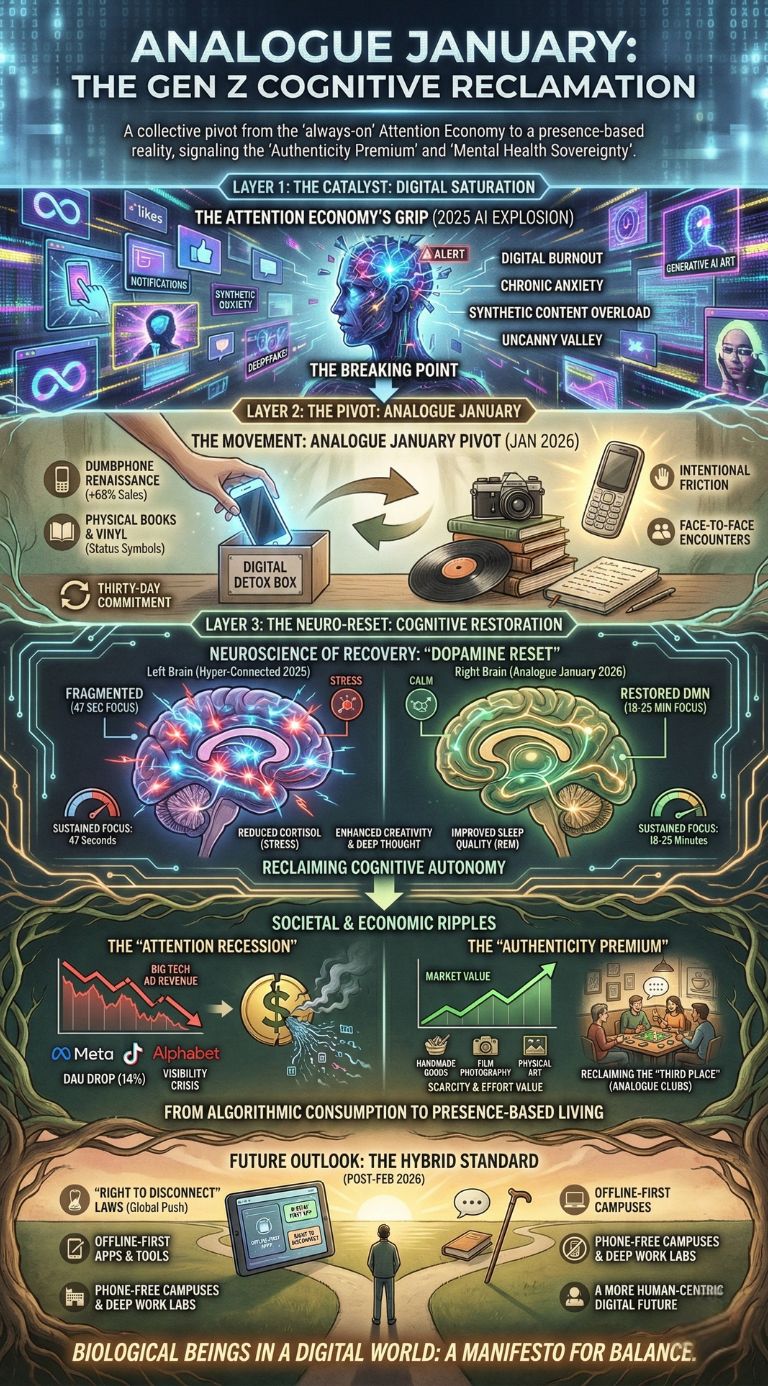
The primary driver behind Analogue January is the urgent need for neurological recovery. By 2026, the term “Cognitive Fragmentation” has moved from academic journals to mainstream conversation. This refers to the erosion of the human attention span, which, according to recent neurological studies, dropped to an average of 47 seconds on a single task for frequent social media users in 2025.
Analogue January acts as a “hard reset” for the brain’s reward system. By removing the intermittent variable rewards—the “likes,” “notifications,” and “infinite scrolls”—participants are forcing their brains to recalibrate. This process, often uncomfortable during the first week, eventually leads to the restoration of the “Default Mode Network” (DMN), the part of the brain responsible for creativity, self-reflection, and deep thought.
| Cognitive Metric | Hyper-Connected State (2025 Average) | Analogue January State (Observed) |
| Sustained Focus Duration | 47 Seconds | 18–25 Minutes |
| Cortisol (Stress) Levels | Chronic elevation (high-alert) | Significant decline (baseline rest) |
| Information Processing | Shallow/Scanning (Skimming) | Deep/Linear (Comprehension) |
| Sleep Quality (REM) | Fragmented by Blue Light | Enhanced (90% report improvement) |
| Neuroplasticity Signal | Reactionary (Fear-based) | Proactive (Logic-based) |
The “Dumbphone” Renaissance and the New Hardware Market
The movement has birthed a massive secondary market for “minimalist” hardware. In the first week of January 2026, sales of “dumbphones”—devices limited to calling, texting, and perhaps a basic map—surged by 68% globally. Companies like The Light Phone and Punkt, which were once niche players, have entered the mainstream, with major manufacturers like Nokia releasing “Analogue Editions” of classic 2000s-era handsets.
This shift is more than an aesthetic choice; it is about “intentional friction.” Gen Z users are intentionally making it harder to access the internet to ensure that their digital usage is purposeful rather than compulsive. This has led to a revival in dedicated devices: point-and-shoot cameras, MP3 players, and paper planners have replaced the “all-in-one” smartphone.
| Device Category | 2025 Growth Rate | 2026 Projected Market Impact |
| Basic Feature Phones | +12% | +68% (YoY Jan 2026) |
| Film Photography/Cameras | +24% | +45% (Estimated) |
| Physical Paper Journals | +18% | +52% (Supply chain shortages) |
| E-Ink Tablets (Non-Web) | +30% | +55% (Demand spike) |
The “Attention Recession”: A Crisis for Big Tech
The economic implications of Analogue January are staggering. For the past decade, the business models of Meta, TikTok, and Alphabet have relied on “Time on Site.” As millions of users—specifically the high-value 18–24 demographic—opt out for a month, the data-harvesting machine has ground to a halt. Analysts at major financial institutions have termed this the “Attention Recession.”
If this 30-day experiment evolves into a permanent lifestyle change (Digital Minimalism), the advertising industry faces a “visibility crisis.” In 2025, Gen Z’s purchasing power was largely influenced by social commerce; in early 2026, we see a return to “Word of Mouth” and “Local Discovery.” This shift threatens the projected $750 billion social ad-market, forcing a pivot toward more ethical, less intrusive marketing strategies.
| Platform Metric | Pre-Analogue January (Q4 2025) | During Analogue January (Q1 2026) |
| Daily Active Users (DAU) | Peak Highs | 14% Average Drop in Gen Z |
| Ad Click-Through Rate | 2.1% | 0.8% (In participating regions) |
| Average Session Length | 52 Minutes | 12 Minutes |
| User Acquisition Cost | Stable | Rising by 35% |
Reclaiming the “Third Place”: Social Infrastructure in 2026
A critical sub-theme of this movement is the reclamation of physical space. For years, the “Third Place”—social environments between home and work—had been digitized. People sat in cafes, but they were on their laptops; they went to concerts, but they watched through their phone screens. Analogue January is reviving the “Phone-Free Zone.”
In major cities like New York, London, and Tokyo, a new wave of “Analogue Clubs” has emerged. These are venues where phones are checked at the door in exchange for board games, physical books, and conversation prompts. This movement is a direct attempt to combat the “Loneliness Epidemic” that reached a fever pitch in 2025. By removing the digital intermediary, Gen Z is rediscovering the nuance of human body language and the depth of uninterrupted conversation.
| Social Interaction Type | Digital Equivalent (URL) | Analogue Experience (IRL) |
| Community Building | Discord Servers / FB Groups | Neighborhood Co-ops / Clubs |
| Dating/Romance | Algorithmic Swiping (Apps) | “Slow Dating” / Blind Meets |
| Content Sharing | TikTok Trends / Reels | Zines / Vinyl Swap Meets |
| Knowledge Transfer | YouTube Tutorials | In-person Workshops/Mentoring |
Expert Perspectives: A Necessary Correction or a Temporary Fad?
The debate among sociologists is fierce. Dr. Julian Aris, a behavioral economist, argues that Analogue January is the “Great Correction.” He suggests that “just as we realized in the 20th century that unlimited sugar and tobacco were harmful, the 21st century is realizing that unlimited connectivity is a public health crisis.”
However, tech-optimists like Sarah Jenkins of the “Future Forward Institute” remain skeptical. She argues that “Analogue January” is a form of “digital asceticism” that is only accessible to those with the privilege of time. “For the gig worker, the freelancer, or the marginalized student, being offline is a luxury they cannot afford,” Jenkins notes. This highlights a potential “Digital Class Divide” where the elite can afford to be “ghosts” while the working class remains tethered to the machine for survival.
The “Authenticity Premium”: Why Physical Matters
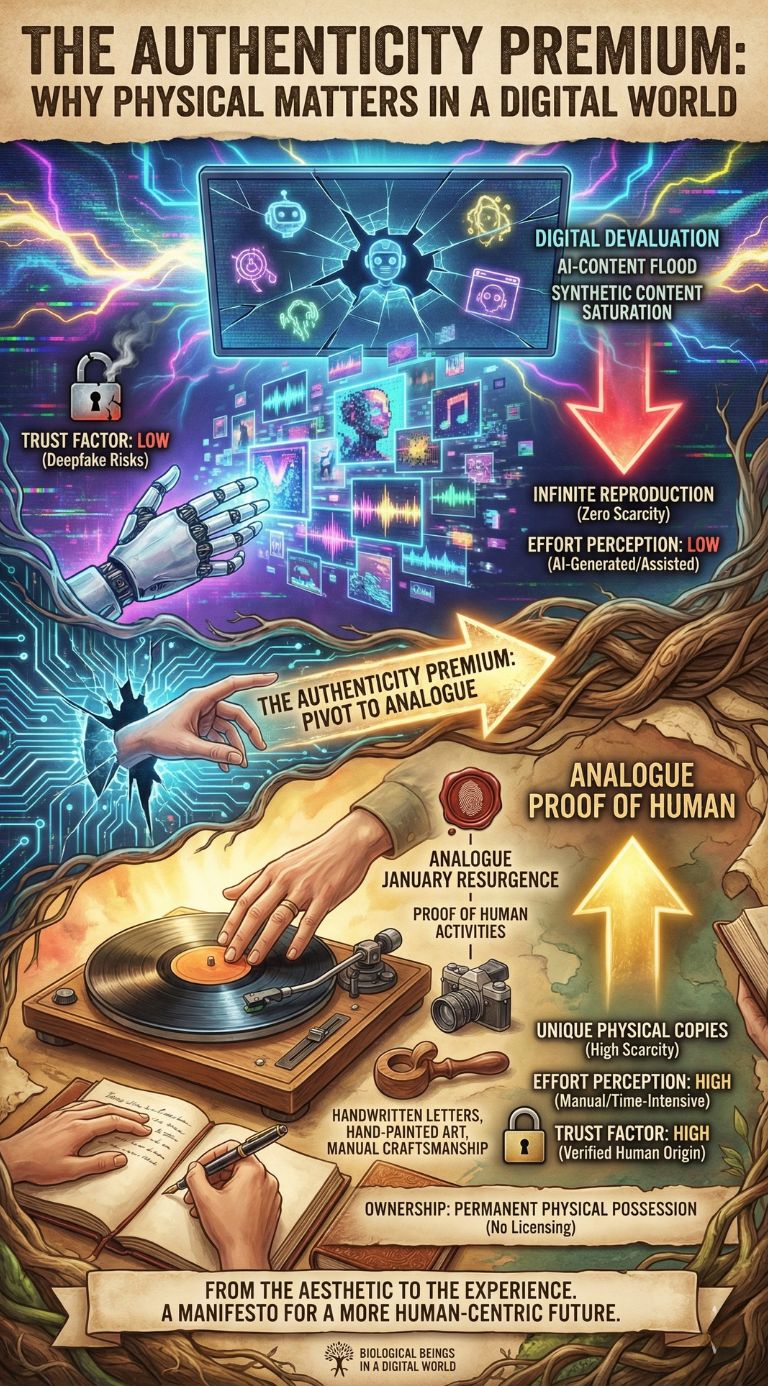
The 2025 AI-content flood created a “Devaluation of the Digital.” When an AI can generate a perfect image or a soulful-sounding song in seconds, the human effort behind a physical object becomes its primary value. Analogue January has intensified this “Authenticity Premium.”
We are seeing a resurgence in “Proof of Human” activities. This includes handwritten letters, hand-painted art, and manual craftsmanship. In the 2026 economy, “Human-Made” is becoming a more powerful label than “Organic” was in the early 2000s. The trend is moving away from “The Aesthetic” (which can be faked) to “The Experience” (which must be felt).
| Value Driver | Digital Content (Pre-2026) | Analogue Content (2026 Trend) |
| Scarcity | Zero (Infinite reproduction) | High (Unique physical copies) |
| Effort Perception | Low (AI-generated/Assisted) | High (Manual/Time-intensive) |
| Ownership | Licensing/Subscription | Permanent Physical Possession |
| Trust Factor | Low (Deepfake risks) | High (Verified Human Origin) |
Future Outlook: What Happens on February 1st?
The true test of Analogue January lies in the “Re-entry Phase.” Historical data from smaller detox movements suggest that 40% of participants do not return to their previous levels of phone usage. By February 2026, we expect to see a “Hybrid Lifestyle” emerge as the new standard for the conscious consumer.
Upcoming Milestones to Watch:
-
The “Right to Disconnect” Legislation: Several US states are expected to follow the UK and France in passing laws that protect employees from being forced to respond to digital communications outside of work hours.
-
The Rise of “Offline-First” Apps: Software developers are beginning to create apps that function entirely offline, syncing only once a week to minimize “check-in” compulsions.
-
Educational Shifts: We expect more universities to introduce “Phone-Free Campuses” or “Deep Work Labs” to help students regain the cognitive stamina required for high-level research.
Analogue January is not a death knell for technology, but a manifesto for a more human-centric digital future. It is a declaration that while we may live in a digital world, we remain biological beings with a fundamental need for silence, boredom, and real-world connection.