
Ever had an idea so vivid in your mind you could almost see it? A knight charging on a dragon, a futuristic city humming with flying cars, or a simple, heartwarming scene of a family picnic at sunset. For decades, bringing these visions to life required expensive equipment, specialized skills, and a whole lot of time.
But what if you could create a video just by describing it?
This isn’t a far-off science fiction concept anymore. It’s the reality of text to video AI, a groundbreaking technology that is rapidly changing the landscape of digital content. By simply typing a descriptive sentence—a “prompt”—anyone can now generate stunning, high-quality video clips in minutes.
This isn’t just a novelty; it’s a revolution for creators, marketers, filmmakers, and businesses everywhere. Let’s dive into how this technology works and why it’s set to become an indispensable tool in your creative arsenal.
The Magic Behind the Curtain: What is text to video AI?
AI text to video generator is a form of generative artificial intelligence. It uses complex deep learning models, trained on vast datasets of videos and their corresponding text descriptions, to understand the relationship between words and visual elements.
When you provide a prompt like, “A golden retriever puppy chasing a red ball across a sunny green lawn,” the AI deconstructs it. It identifies the key subjects (puppy, ball), their attributes (golden, red), the environment (sunny, green lawn), and the action (chasing). It then synthesizes millions of data points to construct a brand-new video that visually represents that description, complete with realistic motion, lighting, and texture.
The result is a powerful creative engine that moves beyond simple stock footage, allowing for the creation of truly unique and bespoke visual content.
Why is Everyone Talking About Text-to-Video? The Benefits are Huge.
The buzz around this technology isn’t just hype. The practical benefits are transforming workflows and unlocking new creative possibilities.
1. Unprecedented Speed and Efficiency
Imagine the traditional video production timeline: storyboarding, location scouting, casting, shooting, and extensive post-production editing. This process can take weeks or even months. With text to video AI, you can generate a concept, iterate on it, and have a finished clip in the time it takes to drink a cup of coffee. This speed allows marketers to create timely social media content, filmmakers to pre-visualize complex scenes, and businesses to produce a high volume of videos without the traditional bottleneck.
2. Drastic Cost Reduction
High-quality video production is notoriously expensive. Costs for actors, equipment rentals, location fees, and a professional crew can run into the thousands, or even millions, of dollars. AI video generation eliminates many of these overheads. For brands and entrepreneurs, this means creating professional-grade product showcases or branded content at a fraction of the cost, leveling the playing field and making high-impact video accessible to everyone.
3. Boundless Creative Freedom
Your imagination is the only limit. Want to see a fashionable woman strolling through a neon-lit Tokyo street? A majestic whale breaching in a cosmic ocean? An astronaut planting a flag on a candy-striped Mars? These fantastical or highly specific scenes, which would be impossible or prohibitively expensive to film traditionally, can be brought to life with a simple text prompt. This empowers creators to explore surreal, abstract, or historically impossible concepts with ease.
4. Consistency and Scalability:
For agencies and marketing teams, maintaining a consistent brand aesthetic across a campaign is crucial. AI can be instructed to generate videos in a specific style—be it cinematic, anime, photorealistic, or vintage—ensuring that all your content feels cohesive. Furthermore, you can generate dozens of variations for A/B testing or for different platforms, scaling your video output without sacrificing quality.
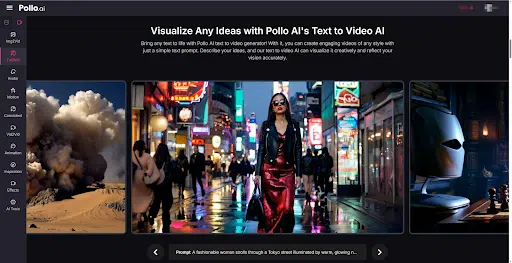
As the technology has boomed, so has the number of tools available. We’re seeing powerful models like Google’s Veo, Kling AI, Runway, and Luma AI pushing the boundaries of what’s possible. However, jumping between different platforms, each with its own interface and credit system, can be confusing and inefficient.
This is where a unified platform can make all the difference. Imagine having access to the best video generation models all in one place. That’s the idea behind Pollo AI, an all-in-one AI text to video generator that integrates many of the top-tier models into a single, user-friendly interface. Instead of committing to just one AI’s “style,” you can experiment with Kling AI for its realistic physics, Veo for its cinematic quality, or Pollo’s own flagship model, all from one dashboard. This flexibility allows you to choose the perfect tool for your specific vision without the hassle of managing multiple accounts.
Pollo AI also demonstrates the next step in this technology’s evolution: creating a complete audiovisual experience. Its generator can create and seamlessly sync audio—from ambient sounds to musical scores—directly from your text prompt, enhancing the mood and making the final video far more immersive.
Who is This For? A Tool for Every Creator
text to video AI isn’t just for tech enthusiasts. It has practical, game-changing applications for a wide range of professionals:
- Brands & Entrepreneurs: Lower production costs by over 60% by generating unique visuals for products and services without expensive shoots.
- Marketers & Agencies: Speed up bulk video creation by up to 75%, allowing for rapid promotion and campaign deployment at scale.
- Filmmakers: Visualize imaginative concepts in minutes, cutting down pre-production time and expenses by around 80% by storyboarding with actual moving images.
- Social Media Influencers: Boost engagement by delivering a steady stream of polished, eye-catching videos that stand out in crowded feeds.
The Future is Visual, and It Starts with a Word
We are at the dawn of a new era in content creation. Just as desktop publishing democratized graphic design and blogging platforms gave everyone a voice, text to video AI is democratizing video production. It’s breaking down the barriers of cost, time, and technical skill, empowering a new generation of storytellers.
The ability to translate a simple thought into a moving, breathing world is no longer a dream. It’s a tool waiting for you to use it. Whether you’re building a brand, telling a story, or just want to bring a flicker of an idea to life, the power is now, quite literally, at your fingertips.
So, what story will you tell first?