Do you ever feel like your business lags behind in a fast-paced digital world? Many folks juggle outdated tools, wasting time on repetitive tasks that drain energy and profits. Imagine you’re a small shop owner buried in paperwork, or a team lead chasing endless customer queries without a break.
It’s like trying to run a marathon with weights on your ankles, right? This frustration hits hard in software development and the IT industry, where keeping up with digital transformation feels impossible.
AI steps in to change that game. One key fact shows AI could add $15.7 trillion to the global economy by 2030. That’s huge. In this post, we’ll break down AI-augmented digital services, from machine learning in healthcare to generative AI in content creation.
You’ll see how tools like large language models and natural language processing boost efficiency, spark predictive analytics, and even blend with augmented reality for smarter workflows.
Think of it as your roadmap to harnessing AI agents and digital workers, tackling ethical concerns along the way.
Prepare for the journey.
What Are AI-Augmented Digital Services?
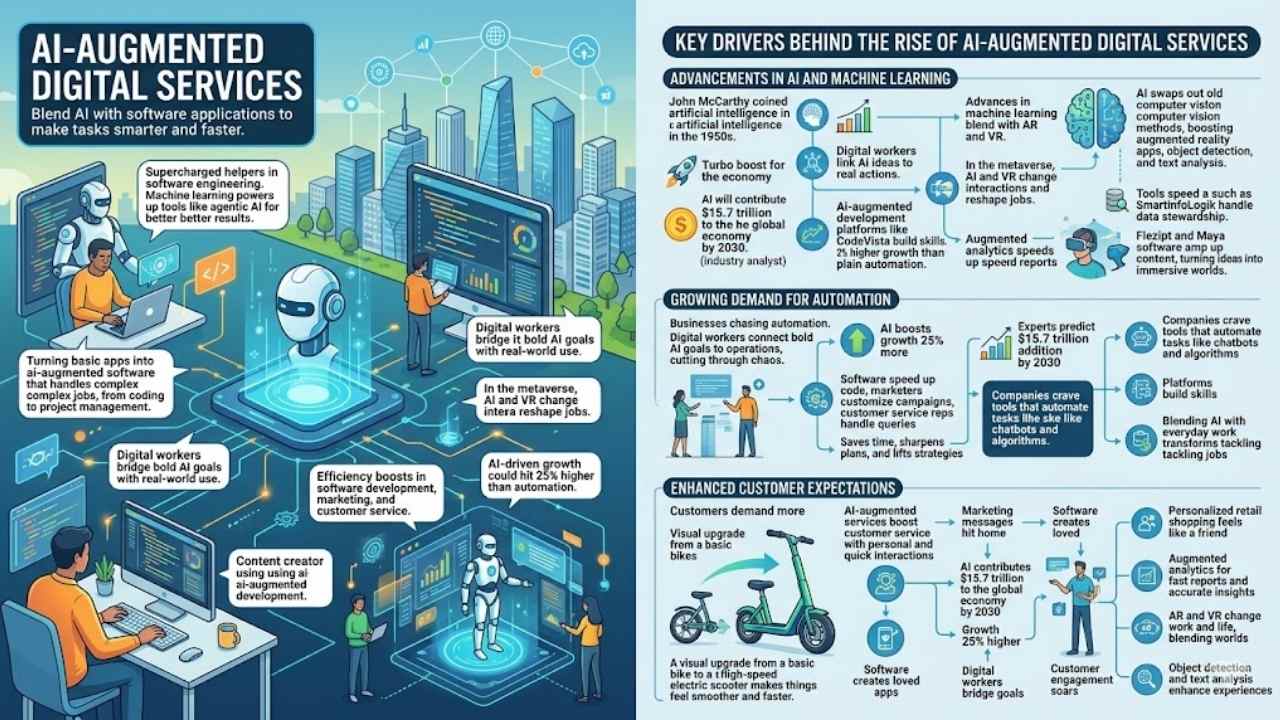
AI-augmented digital services blend artificial intelligence with everyday software applications to make tasks smarter and faster. Think of them as supercharged helpers in software engineering, where machine learning powers up tools like agentic AI for better results.
These services turn basic apps into ai-augmented software that handles complex jobs, from coding to project management. Digital workers emerge as that key bridge, linking bold AI goals with real-world use in companies.
They boost efficiency in sectors like software development, marketing, and customer service. AI-driven growth could hit 25% higher than automation alone, experts say. Picture a content creator using ai-augmented development to craft stories quicker, or a business tapping IvyAgents for smooth operations.
All this saves time, sharpens plans, and lifts strategies.
AI is projected to contribute $15.7 trillion to the global economy by 2030, notes industry analyst Tom Mainelli.
Organizations build stronger AI skills through ai-augmented development platforms. These tools enhance proficiency and spark new capabilities. In consumer technology, they mix with voice recognition and intelligent document processing for seamless experiences.
Data privacy stays crucial, as does handling ML models wisely. Sorab Ghaswalla points out how such services transform workflows. AI-augmented workforce changes how teams operate, blending with blockchain for secure setups.
Nvidia drives much of this tech, pushing boundaries in emotional computing and more. Businesses gain from augmented analytics, getting quick, spot-on reports.
Key Drivers Behind the Rise of AI-Augmented Digital Services
You see, rapid progress in AI, sparked by pioneers like John McCarthy, powers these smart services forward. Add in the surge for automation, like tools in ai-augmented software development, and folks crave faster, sharper experiences every day.
Advancements in AI and Machine Learning
AI powers big changes in how we work and live. John McCarthy coined the term artificial intelligence back in the 1950s, and now it drives massive growth. Think of it like a turbo boost for the economy; experts project AI will add $15.7 trillion to the global picture by 2030.
Digital workers step in as that key link, turning bold AI ideas into real actions inside companies. They bridge the gap, you know, making sure dreams become daily operations. AI-augmented development platforms, like CodeVista, build skills and smarts within teams.
These tools enhance proficiency in artificial intelligence, pushing organizations forward. Plus, AI-driven growth hits about 25% higher than what plain automation delivers. Software development thrives here, along with marketing and customer service as top sectors that gain the most.
Advances keep rolling in machine learning too, blending with tech like AR and VR for wild transformations. AI swaps out old computer vision methods with sharper ones, boosting augmented reality apps.
Picture object detection and text analysis weaving right into those experiences, making them smarter. Augmented analytics, fueled by AI, speeds up reports and nails accuracy for businesses.
Tools such as SmartInfoLogik handle data stewardship, keeping everything clean and useful. In the metaverse, AI teams up with VR to change how you interact with digital stuff, even reshaping jobs and daily life.
Contech firms use this mix to save time and sharpen strategies. Flezipt and Maya software amp up content creation, turning ideas into immersive worlds. All about content? AI makes it personal and powerful, like a smart sidekick that never tires.
Growing Demand for Automation
Businesses chase automation like kids after ice cream on a hot day, and for good reason. Digital workers step in as that vital link, connecting bold AI goals to real-world operations in companies everywhere.
They cut through the chaos, making things run smoother. Imagine: AI boosts growth by about 25% more than plain old automation does. That extra edge draws everyone in, from small shops to big corporations.
Software development teams speed up their code, marketers customize campaigns that hit home, and customer service reps handle queries like pros. All this saves time, sharpens plans, and lifts strategies to new heights.
Folks demand more automation because AI promises a massive payoff. Experts predict it adds $15.7 trillion to the world economy by 2030. You see, companies crave tools that automate tasks, like chatbots in service or algorithms in marketing.
These setups build skills inside teams, pushing efficiency sky-high. Imagine blending AI with everyday work; it transforms how we tackle jobs, one smart step at a time.
Enhanced Customer Expectations
Customers today demand more from digital services, and AI steps in to meet those needs. Think of it like upgrading from a basic bike to a high-speed electric scooter; everything feels smoother and faster.
AI-augmented digital services boost customer service, making interactions personal and quick. They help in marketing too, crafting messages that hit home. Software development gets a lift, creating apps that users love right away.
AI contributes $15.7 trillion to the global economy by 2030, showing how it raises the bar for what people expect. Digital workers bridge AI goals with real operations, keeping businesses on track.
Growth from AI hits 25% higher than from automation alone, fueling these rising demands. People want efficiency, and AI delivers it in spades. Augmented analytics speeds up reports, giving accurate insights fast.
In retail, personalized shopping feels like a friend picking out your favorites. Customer engagement soars, thanks to smart tools. AI-augmented solutions save time and sharpen strategies, matching what folks now crave.
AR and VR, powered by AI, change how we work and live, blending digital worlds seamlessly. Object detection and text analysis make these experiences pop.
Applications of AI-Augmented Digital Services
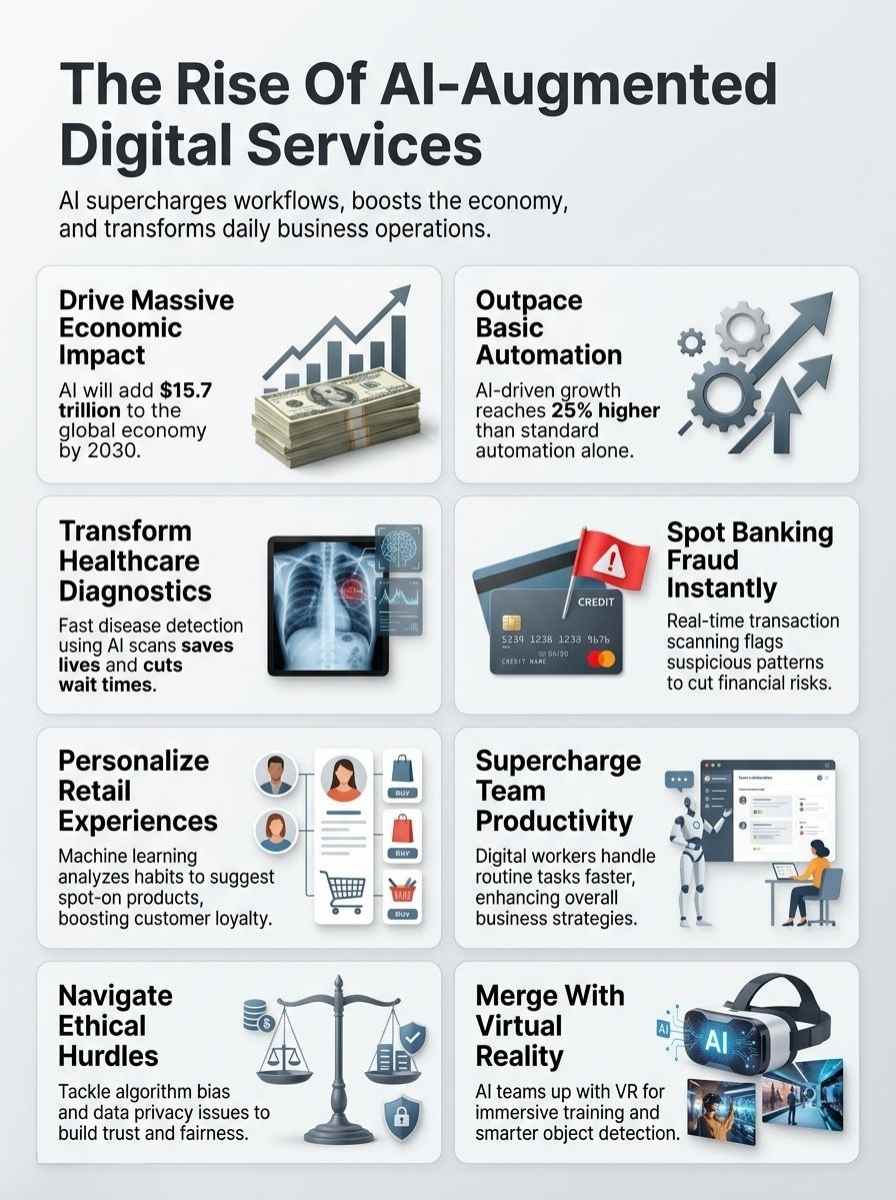
Applications of AI-Augmented Digital Services: Imagine AI stepping in like a super-smart sidekick, transforming everyday tasks in fields from health checkups with speedy scans to shopping sprees personalized just for you, and hey, keep scrolling to uncover how these clever systems spark real change in banking fraud hunts and classroom smarts.
Healthcare: AI in Diagnostics and Patient Care
AI changes healthcare fast. Doctors use it for quick diagnoses, spotting diseases in scans like X-rays or MRIs. Imagine a tool that flags cancer early, saving lives with speed. Patients get better care through chatbots that answer questions anytime, easing worries.
AI boosts efficiency here, cutting wait times and raising productivity for teams. It helps make smart choices, like predicting outbreaks from data patterns. Think of it as a trusty sidekick, always ready with facts.
Organizations save time, plan strategies well, and see growth jump 25% over plain automation. Software in diagnostics runs smoother, blending with tools like augmented reality for virtual check-ups.
Fraud detection ideas from banking apply too, catching odd health patterns to prevent errors. Retail’s personal touch shows up in customized treatment plans, fitting each patient’s needs.
Education platforms inspire smart apps that teach about conditions in fun ways. AI adds $15.7 trillion to the economy by 2030, with healthcare grabbing a big slice. Digital workers bridge gaps, turning AI dreams into real clinic wins.
They build skills inside teams, using machine learning for sharp reports. Augmented analytics speeds up patient insights, accurate and fast. AR and VR mix with AI, letting doctors practice surgeries in safe spaces, transforming how care happens daily.
Banking: Fraud Detection and Risk Management
Banks spot fraud faster with AI tools. These systems scan transactions in real time, flagging odd patterns like a sudden big purchase from across the world. Imagine you’re sipping coffee, and bam, your bank texts you about a shady charge before you even notice.
Machine learning algorithms learn from past scams, getting smarter each day. This cuts risks and saves money for everyone involved. AI-driven growth in banking hits about 25% higher than old-school automation alone, pushing the sector to that massive $15.7 trillion boost to the global economy by 2030.
Risk managers love how AI crunches data for better calls. It predicts loan defaults by analyzing credit histories and market trends, almost like a crystal ball for finance folks. Teams use augmented analytics for quick, spot-on reports, ditching slow manual checks.
Businesses save time this way, sharpening their strategies and dodging costly slip-ups. Software like neural networks powers these setups, blending with customer service to keep things smooth and secure.
Retail: Personalized Shopping Experiences
AI powers personalized shopping in retail, folks. Visualize it, you stroll into an online store, and the system knows your style before you do. It suggests outfits that match your past buys, like a friend who gets you.
Retailers use machine learning to analyze your clicks and purchases. This creates spot-on recommendations. Such tech falls under AI-augmented digital services, boosting customer engagement.
Marketing teams love it, as it drives sales through personalized ads. Customer service improves too, with chatbots that recall your preferences.
These services save time for businesses, no doubt. They enhance strategies by predicting trends from data. Imagine AR glasses letting you try on virtual clothes at home. AI replaces old vision tech with smart object detection.
It even scans text for product details. VR setups, fused with AI, change how you shop and interact. Retail sees big gains here, part of that projected $15.7 trillion AI boost by 2030.
Growth jumps 25% higher than plain automation. Organizations build skills via AI platforms, making shopping feel personal and fun.
Education: Smart Learning Platforms
Smart learning platforms change how students learn. These tools use AI to make lessons personal and fun. Teachers see kids struggle less with tough topics. Digital workers act as that key link, turning big AI ideas into real classroom wins.
AI boosts growth by about 25% more than just automation alone. Picture a student acing math, thanks to quick tips from an AI tutor. Organizations build skills fast with AI-augmented development platforms.
They enhance proficiency in no time.
AI in education saves time and sharpens plans. Projections show AI adding $15.7 trillion to the global economy by 2030. Software development joins marketing and customer service as top areas that gain from these services, and education fits right in.
Augmented analytics, powered by AI, speeds up accurate reports for teachers. Students engage more with interactive setups. AR and VR mix with AI to transform interactions, like virtual field trips that feel real.
Businesses, including schools, improve strategies through these tools.
Benefits of AI-Augmented Digital Services
Imagine AI as your tireless sidekick, speeding up tasks in banking with quick fraud alerts that save time and money. Plus, it sharpens choices in retail through smart recommendation engines, making shoppers feel seen and boosting their loyalty in fun, unexpected ways.
Increased Efficiency and Productivity
AI-augmented digital services boost efficiency in ways that feel like a turbo charge for your daily grind. Digital workers act as that vital link, turning big AI dreams into real-world actions in companies.
They save time and sharpen strategic planning, making business strategies stronger in general. Imagine: software development, marketing, and customer service sectors thrive with these tools, handling tasks faster than ever.
AI-driven growth hits about 25% higher marks than plain automation does. Organizations build better AI skills through augmented development platforms, ramping up proficiency and capabilities inside teams.
These services cut through the noise, delivering augmented analytics for quicker, more spot-on reports. Businesses see productivity soar as AI solutions streamline operations, like a well-oiled machine humming along.
In software fields, teams code smarter; marketers target audiences with precision; customer service reps solve issues on the fly. It’s like giving your workforce superpowers, all while enhancing decision processes that drive real results.
Improved Decision-Making Processes
AI boosts choices in business. Think of it like a smart coach whispering tips during a big game. Digital workers connect bold AI goals to real daily tasks in companies. They make operations smoother and smarter.
Augmented analytics, powered by AI, delivers quick, spot-on reports. This speeds up how firms spot trends and act on them. Businesses save time with these tools. They plan strategies better too.
AI-augmented platforms build stronger skills inside teams. Staff gain sharper insights for tough calls.
Imagine juggling options without dropping the ball. AI-driven growth hits 25% more than just using machines alone. It enhances total plans in sectors like software development and marketing.
Firms use these setups to refine customer service decisions. Leaders feel the edge, turning data into wins. Empathy kicks in here, folks, as AI eases the stress of big choices. It transforms guesswork into solid plays.
Enhanced Customer Engagement
Companies use AI-augmented digital services to connect better with customers. Imagine a retail store that suggests products just for you, like a helpful friend who knows your tastes.
These services shine in customer service, where AI handles queries fast and personal. Marketing teams craft campaigns that feel custom-made, boosting loyalty. Firms save time with these tools and plan smarter strategies.
Customer service stands out as a top sector that gains from this tech, along with software development and marketing. AI adds $15.7 trillion to the global economy by 2030, much from better engagement.
Folks love the personal touch AI brings, like chatbots that chat like real people. Businesses see growth spike 25% higher with AI than with just automation. Digital workers bridge AI dreams to real work, making interactions smooth.
Think of augmented analytics giving quick reports that help firms respond to customer needs on the spot. These solutions enhance business strategies, keeping customers hooked. AR and VR, mixed with AI, change how people interact with content, making experiences fun and immersive.
Challenges in Implementing AI-Augmented Digital Services
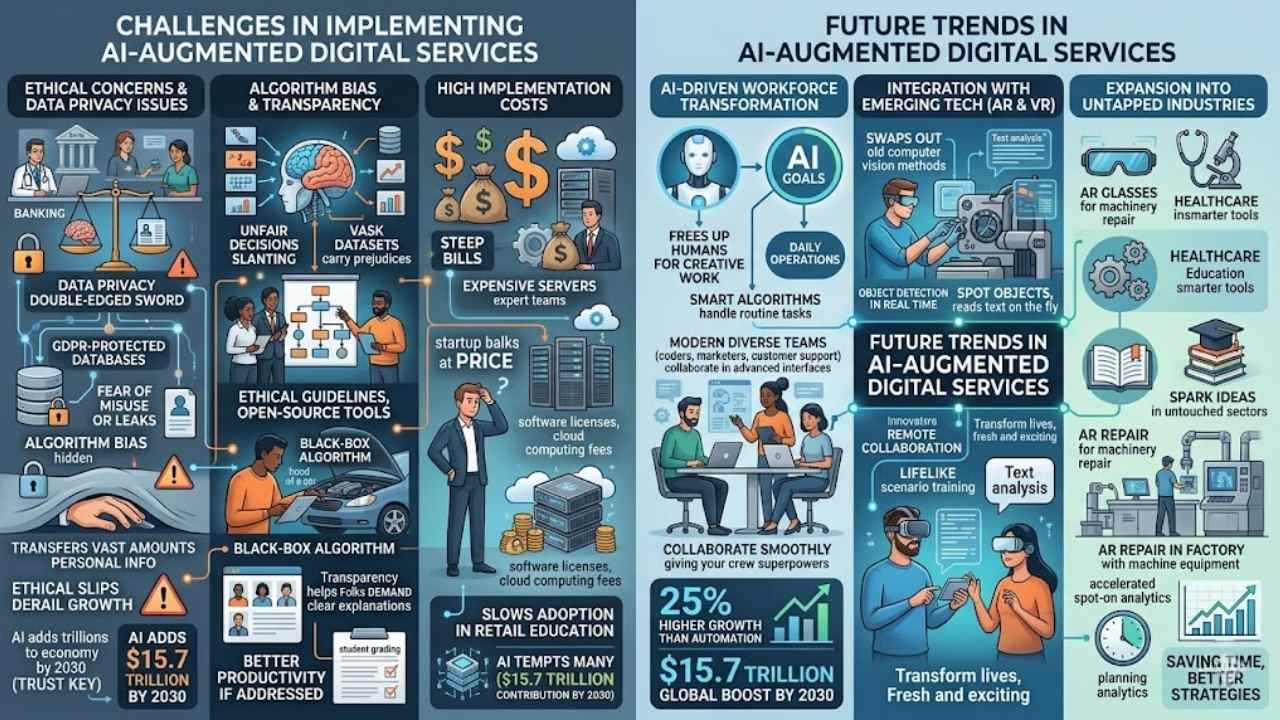
You face real hurdles when you roll out AI in digital services, from ethical puzzles that twist your brain like a pretzel, to data privacy scares that hit close to home, think about hackers eyeing personal info in systems like GDPR-protected databases.
Biases sneak into machine learning models, say neural networks trained on skewed datasets, leading to unfair outcomes that nobody wants. Transparency stays tough, as folks demand to peek inside black-box algorithms without spilling trade secrets.
Costs pile up fast, with pricey cloud servers and expert teams draining budgets before you blink. Imagine juggling all that while keeping customers happy, it’s a wild ride. Curious how to beat these odds? Keep reading for the full scoop.
Ethical Concerns and Data Privacy Issues
AI-augmented digital services bring big benefits, like saving time and boosting strategies, as fact nine points out. But they also spark worries about right and wrong. Think of it like a double-edged sword, folks.
Companies use these tools to amp up efficiency, yet they handle tons of personal info. Data privacy sits at the heart of this mess. People fear leaks or misuse, especially in sectors like banking and healthcare from the outline.
Augmented analytics, driven by AI, gives faster reports, fact eight notes, but what if that speed hides unfair biases? We see algorithm bias crop up, making decisions slant against certain groups.
It’s like playing favorites without meaning to. Organizations must tackle these issues head-on to build trust. Imagine your info floating around without safeguards, scary stuff. Facts show AI adds trillions to the economy by 2030, yet ethical slips could derail that growth.
Digital workers bridge AI dreams to real work, fact one says, but they need strong privacy rules to avoid pitfalls.
Costs run high for setup, adding to the headaches. Bias in algorithms demands clear fixes, no shortcuts. Customer service gains from AI, fact five highlights, but privacy breaches hurt engagement fast.
We empathize with your concerns here, readers, it’s a tough balance. Picture a world where AI in AR and VR transforms lives, fact ten describes, yet without ethics, it turns sour. Expansion into new industries calls for careful steps.
Fraud detection in banking shines, but data mishaps erode confidence. Let’s chat about it, ethical AI isn’t just nice, it’s essential for fair play.
Algorithm Bias and Transparency
AI systems sometimes make unfair decisions, like favoring one group over another in hiring tools. This happens because data fed into them carries old prejudices from the real world.
You see, developers train these models on vast datasets, and if those sets skew toward certain biases, the AI spits out skewed results. Think of it as a chef using salty ingredients, the whole dish ends up too salty, no matter how fancy the recipe.
Organizations fight this by auditing algorithms regularly, promoting diverse teams to spot issues early. Transparency helps too, folks demand clear explanations of how AI reaches conclusions, much like peeking under the hood of a car to understand its engine.
Yet, building trust takes effort, especially when AI powers fraud detection in banking or diagnostics in healthcare. Users worry about hidden biases affecting lives, say in loan approvals or medical advice.
Picture a student using a smart learning platform that unfairly grades based on background, that stings. Companies counter this with open-source tools and ethical guidelines, making sure AI stays fair.
As AI grows, adding $15.7 trillion to the global economy by 2030, addressing bias boosts that impact, leading to better productivity in sectors like software development and customer service.
High Implementation Costs
Companies face steep bills when they roll out AI-augmented digital services. You pour cash into fancy hardware, expert teams, and tons of data storage. These setups demand big upfront investments, and small businesses often feel the pinch most.
Costs can soar for training models or integrating systems, leaving leaders scratching their heads over budgets. Yet, AI-augmented solutions help businesses save time, improve strategic planning, and enhance business strategies, as fact nine points out.
Imagine a startup eyeing AI for better customer service, only to balk at the price tag. They juggle expenses like software licenses and cloud computing fees, which add up fast. Larger firms might absorb these hits, but everyone weighs the dollars against gains.
AI is projected to contribute $15.7 trillion to the global economy by 2030, per fact two, so the payoff tempts many. Still, high costs slow adoption in sectors like retail or education, where every penny counts.
Future Trends in AI-Augmented Digital Services
Picture AI reshaping jobs, where smart algorithms handle routine tasks and free up humans for creative work, like a reliable sidekick in the office. As virtual reality merges with these services, expect immersive training sessions that feel real, pulling industries like manufacturing into a bold new era, and leaving you eager to explore more.
AI-Driven Workforce Transformation
AI shapes the workforce in exciting ways, folks. Digital workers step up as that key link, connecting bold AI goals to real daily operations in companies. They boost efficiency, and get this, AI-driven growth hits about 25% higher than what plain automation delivers.
Picture software coders, marketers, and customer support teams thriving with these tools. AI-augmented platforms build skills and ramp up smarts across the board.
Businesses save time with these solutions, sharpening plans and lifting strategies to new heights. AI pushes the global economy toward a whopping $15.7 trillion boost by 2030. Sectors like software development, marketing, and customer service lead the charge, transforming how teams collaborate.
It’s like giving your crew superpowers, making work smoother and smarter every day.
Integration with Emerging Technologies like AR and VR
AI teams up with augmented reality and virtual reality to change the game. It swaps out old computer vision methods for smarter ones in AR setups. Imagine, you slip on VR glasses, and AI spots objects around you in real time.
It even reads text on the fly, making apps more useful. Folks, this combo shifts how you handle digital stuff at work or home. AR and VR, fueled by AI, turn everyday tasks into something fresh and exciting.
Businesses gain from this mix too. They weave AI’s object detection into AR tools for better results. You see it in how teams collaborate across distances, feeling like they’re in the same room.
This tech duo transforms lives, one virtual step at a time. Imagine training sessions that pop with lifelike scenarios, thanks to these advances.
Expansion into Untapped Industries
AI expands into fresh fields like augmented reality and virtual reality. These areas see big changes from smart tech. Picture workers using AR glasses to fix machines faster, thanks to AI spotting issues in real time.
Fact is, AI swaps out old computer vision methods for sharper ones in AR apps. It adds object detection and text checks too. This mix boosts how folks interact with digital stuff, work, and even live their days.
Businesses jump in to save time and plan better strategies.
Growth hits new spots beyond software, marketing, and customer service. Think education or healthcare getting smarter tools. AI-driven analytics speed up reports and make them spot-on.
Projections show AI adding $15.7 trillion to the world economy by 2030. That’s 25% more growth than just automation brings. Digital workers fill gaps in firms, building AI skills fast.
They transform whole teams and spark ideas in untouched sectors.
Final Thoughts
We’ve explored how AI boosts digital services across healthcare, banking, retail, and education, driving efficiency and smart decisions. These tools prove simple to adopt, saving time and sparking better strategies for any business.
Picture AI as your trusty sidekick, transforming daily tasks and adding up to $15.7 trillion to the global economy by 2030. Check out resources like AI platforms for developers or reports on augmented analytics to dive deeper.
Go ahead, embrace this tech wave, and watch your world change for the better.
FAQs
1. What exactly are AI-augmented digital services, and why should I care?
AI-augmented digital services blend smart tech like machine learning with everyday online tools, making them faster and more helpful. Think of it as giving your apps a brain boost, so they predict what you need before you ask. This rise in clever integration turns routine tasks into smooth experiences, saving you time and hassle.
2. How has the rise of AI changed digital services for regular folks?
The rise of AI has supercharged digital services, automating boring jobs and personalizing interactions. It’s like having a sidekick that learns your habits and serves up just what you want.
3. What benefits come with using AI-augmented digital services in business?
These services boost efficiency by analyzing data in real time, helping companies spot trends and improve customer chats. They cut costs too, like a money-saving wizard waving its wand. Plus, they enhance security, keeping hackers at bay with sharp vigilance.
4. Are there challenges in the rise of AI-augmented digital services?
Yes, privacy worries pop up since these systems handle tons of personal info. It’s a bit like inviting a nosy neighbor into your home; you gain convenience but risk exposure.