
You sit down to find the right keywords for your website, but it feels like searching for a needle in a haystack. Hours slip by, and you still wonder if you have picked words people actually use on Google. Too much guesswork makes it tough to boost your SEO rankings and reach the right audience. Here is something wild: AI tools are changing keyword research faster than most can keep up.
Machines now spot patterns across loads of data that humans miss, saving time and catching search terms hiding in plain sight. In fact, recent data shows AI tools can speed up keyword discovery by nearly 70%.
Prompt engineering with AI can solve some of the biggest keyword challenges in modern content creation. Clear tips, simple examples, and proven strategies demonstrate how these intelligent tools support content strategy, align with user intent, and improve search rankings.
So, grab a cup of coffee and explore the process step by step. Everything needed to understand and apply these techniques effectively is outlined below.
What Is AI-Assisted Keyword Research?

AI-assisted keyword research uses advanced tools and machine learning to find search terms for Search Engine Optimization. These AI tools can scan huge datasets in seconds, much faster than any person could.
They spot hidden patterns, cluster related keywords together, and highlight fresh SEO opportunities. Google’s AI Mode is shaking up search so fast that even seasoned marketers need to adapt quickly.
Unlike old-school methods that rely on keyword volume alone, AI digs deeper using natural language processing. It tracks user intent, predicts trends, and discovers long-tail keywords you might never think of by hand.
Models like GPT-4o and Claude 3.5 Sonnet are leading this charge. While GPT-4o excels at analyzing data and spreadsheets rapidly, Claude 3.5 Sonnet is often praised by SEOs for its ability to understand complex logic and nuance without “hallucinating” as much.
The content process powered by AI often outpaces what humans manage solo. To really get the most from these systems, prompt engineering becomes a must-have skill for today’s digital marketing teams aiming for ranking improvement and data-driven strategies.
Understanding Prompt Engineering for SEO
Prompt engineering shapes how AI tools find and suggest keywords, making or breaking your search results. Simple tweaks in how you ask questions can lead to very different keyword lists, sometimes like flipping a light switch in a dark room.
Definition and Role of Prompts in AI
Prompts guide AI tools by telling them what to do and how to answer. These short instructions shape the way AI like ChatGPT, Bard, or Gemini delivers keyword suggestions for search engine optimization.
A well-made prompt can help uncover hidden keyword clusters from massive datasets, which a human might miss even after hours of keyword analysis. Some SEO experts have found that using five advanced prompts gives higher quality results than standard queries.
The secret sauce comes in the details you give. I always recommend using a specific framework like COCO (Context, Objective, Constraints, Output) to get the best results.
- Context: “Act as an SEO expert for a vegan bakery in Austin, Texas.”
- Objective: “Find 20 low-competition keywords related to gluten-free wedding cakes.”
- Constraints: “Exclude any branded keywords from competitors.”
- Output: “Present the data in a table with columns for Keyword, Search Intent, and Estimated Difficulty.”
Simple changes in prompt wording can push an AI tool to generate better long-tail keywords or focus on user intent for digital marketing campaigns. In today’s world where Google Search is rapidly changing due to AI Mode, prompts play a bigger role in making sure that keyword research stays effective and future-proof.
How Prompts Influence Keyword Research Outcomes
Changing your prompt can shift the whole outcome of AI-assisted keyword research. A clear, focused prompt helps AI tools like ChatGPT or Bard spot SEO opportunities and dig up useful long-tail keywords that fit real user intent.
For example, if you ask an AI to “find keywords for dog food buyers in Texas,” it will search thousands of data points and suggest niche terms tied to local language and trends.
A vague or generic prompt gives weaker results, missing details about audience targeting or content strategy. Using strong prompt development techniques pulls better insights from machine learning models, smoothing out bumps in traditional keyword analysis where volume data often falls short.
So much so that a good prompt can even help AI cluster related topics no human would spot at first glance. This boosts ranking improvement by sharpening search engine optimization efforts without extra manual effort.
Benefits of Using AI for Keyword Research
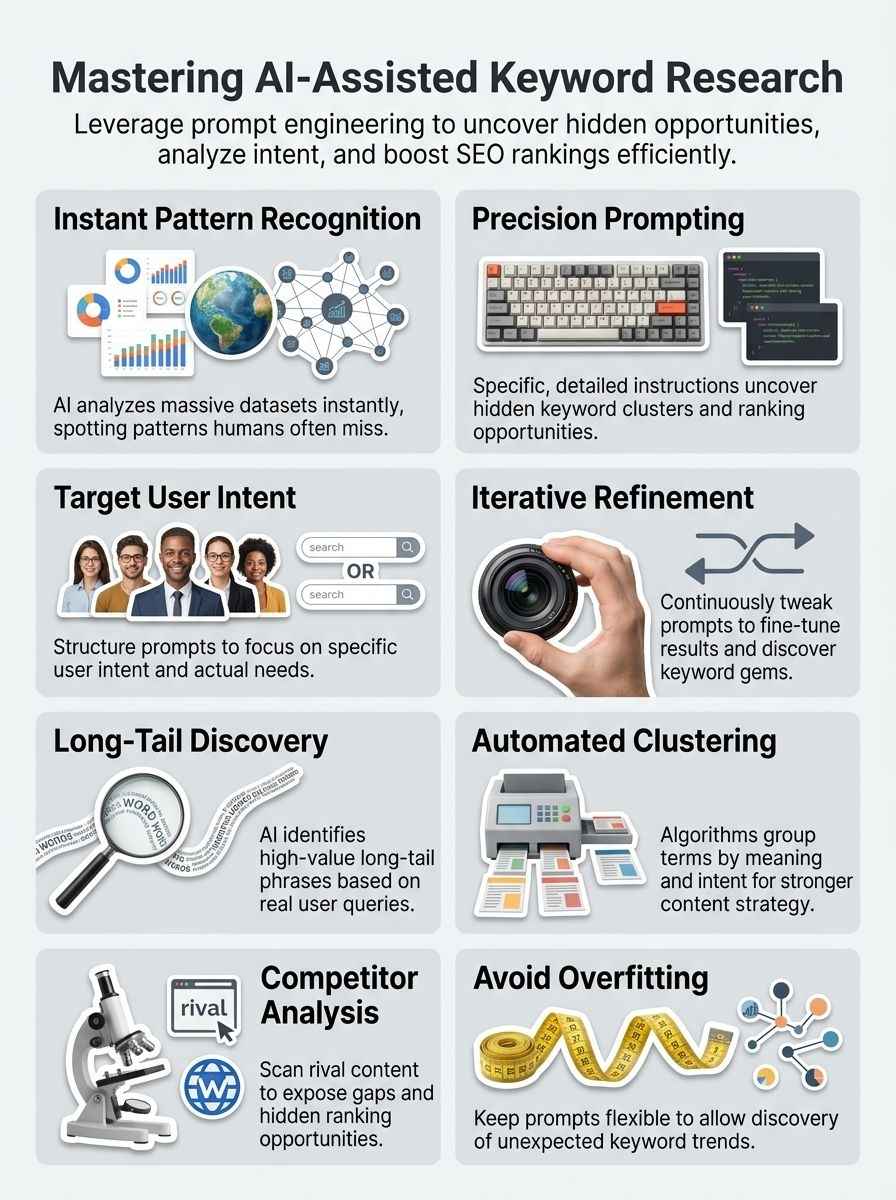
AI tools make keyword research faster and smarter, saving time for other tasks. You might even spot keywords you never thought to target before.
Reducing Manual Effort
AI-assisted keyword research takes the weight off your shoulders. Instead of slogging through endless spreadsheets, you can let machine learning spot patterns across massive datasets in seconds.
AI-powered SEO tools quickly cluster keywords and uncover hidden opportunities that normal searches might miss, making digital marketing tasks smoother. Tools like Answer Socrates can instantly scrape “People Also Ask” questions, saving you hours of manual Googling.
Say goodbye to hours spent juggling data by hand or sorting endless lists for ranking improvement. As early as 2024, these tools have started to outperform human capabilities at pinpointing trends and predicting user intent with accuracy no one imagined before.
With prompt development fueling smarter search engine optimization, content strategy becomes more focused while your hands are free for more creative work.
Improving Keyword Accuracy
AI tools now scan massive datasets in the blink of an eye, picking up keyword patterns that most people would miss. This sharp pattern spotting means your list gets smarter, with keywords grouped by topic and intent.
For example, Google Search is changing fast as AI Mode transforms results and SEO experts scramble to keep up. In traditional search engine optimization, marketers rely on keyword volume to guide their choices.
There is no perfect match for this metric in today’s AI search processes. Instead, prompt engineering becomes vital for better keyword accuracy. Clear prompts help machines understand user intent in detail.
As a result, you find hidden opportunities and optimize content strategy based on true audience needs instead of guesswork or old habits from standard SEO tools.
“A 2025 study found that long-tail keywords generally convert at a rate of 36%, compared to significantly lower rates for broad head terms. This accuracy drives real revenue, not just traffic.”
With five tried-and-tested prompt techniques out there, digital marketing teams can target long-tail terms and niche topics faster than ever before. This puts you one step ahead in ranking improvement without breaking a sweat.
Generating Long-Tail Keywords
AI finds hidden gems in keyword research by spotting long-tail keywords missed by most people. These longer search phrases often bring in highly targeted traffic, since they match what real users type into Google.
For example, instead of “digital marketing,” a long-tail keyword might be “best digital marketing tools for small businesses 2024.” AI processes huge datasets and uncovers patterns that help create these smart combinations.
Using prompt engineering with machine learning, SEO experts can tell AI to look for keywords based on user intent or semantic search trends. In fact, the latest stats show machines catch clusters humans miss.
Keyword clustering powered by artificial intelligence lets teams aim content at precise topics that fit audience needs. With good prompts, an SEO specialist will see more ranking improvement and spot emerging terms fast.
Effective Prompt Engineering Techniques for SEO
Crafting smart prompts helps you target search intent, refine your keyword list, and spark fresh ideas. Stick around to discover clever ways to do it.
Structuring Prompts for User Intent
Nailing user intent is key for AI-assisted keyword research. Good prompt structure makes AI tools work smarter and boosts your Search Engine Optimization results.
- Use clear language in prompts to focus on the kind of answers you want. For example, type “List keywords users search before buying shoes online” instead of just “keywords for shoes.”
- Call out user needs by including phrases like “to find solutions,” “to compare prices,” or “to learn about.” This helps AI spot search intent faster.
- Add context, such as industry or audience type, so outputs match real searchers. Say “for small business owners” or “for college students” right in your prompt.
- Referencing data-driven marketing goals can help refine results; for instance, target phrases that raise conversion rates or improve SEO rankings.
- Keep each prompt focused on a single objective to avoid muddying results; ask about one product, service, or niche at a time.
- For long-tail keyword generation, be specific in your request; an example is: “Suggest questions people might ask about AI-powered competitor keyword analysis.”
- If you need semantic search suggestions, direct the tool using words like “related terms,” “synonyms,” or “concept clusters.”
- Encourage the AI to reflect different user mindsets by stating things such as “from a buyer’s perspective” or “from someone comparing features.”
- Include performance indicators when possible; adding phrases like “high traffic” or “low competition” steers the AI toward valuable keywords.
- Test small prompt changes and check how they shift keyword suggestions since even tiny tweaks can flip the whole outcome for content strategy and ranking improvement.
AI models are great with lots of data but need sharp instructions from humans to hit the mark every time with prompt development and SEO tools.
Iterative Prompting for Keyword Refinement
AI-assisted keyword research thrives on fresh ideas and precise targeting. Iterative prompting helps fine-tune results, making your content stand out in Search Engine Optimization.
One powerful method is “Chain of Thought” prompting. This involves asking the AI to explain its reasoning before giving you the final list. For instance, ask, “First, identify the top three pain points for this audience. Then, generate keywords that address each pain point.”
- Start with a broad AI prompt using your main topic, such as “Generate top keywords for digital marketing trends 2024.” This draws from massive datasets, uncovering potential clusters that might stay hidden to humans.
- Review the first set of keywords for accuracy, search intent, and relevance. Many AI tools will include long-tail phrases with high value, spotting opportunities traditional SEO may miss.
- Tweak the prompt for better focus; add user intent or specify audience type. For example, try “Suggest long-tail keywords for small business owners interested in digital marketing.”
- Evaluate the refined list using SEO metrics from your favorite tools. Unlike old-school keyword volume data, today’s AI can predict trends even if no hard numbers exist yet.
- Adjust prompts based on fresh industry facts or seasonal trends. For instance, update inputs around Google’s latest Search changes; these shifts since 2023 have flipped content strategy upside down.
- Test at least five advanced prompt versions to get high-quality results. Marketers find these tested prompts deliver more useful keyword suggestions than manual brainstorming.
- Watch out for overfitting by asking AI too-specific requests like “Give ten keywords only about red shoes size 8 in Texas” as this limits discovery and narrows your ranking options.
- Analyze what real competitors rank for by crafting prompts like “List competitor keywords driving organic traffic in digital marketing niche,” leveraging machine learning power for smarter audience targeting.
- Keep iterating until you spot gaps or untapped search phrases perfect for content creation. Each round uncovers new patterns thanks to Natural Language Processing and semantic search tech that evolves fast.
Iterative prompting pulls out SEO gold nuggets buried deep in vast data mines, giving you an edge before others catch up with the future of keyword optimization.
Examples of Good vs. Bad Prompts
Not all prompts are born equal. Some light up the path, others lead straight to dead ends or, worse, SEO black holes. Compare these examples before sending your next request to an AI tool for SEO keyword research.
| Prompt Type | Prompt Example | Result | Why It Works (or Fails) |
|---|---|---|---|
| Good | List 20 long-tail keywords about electric bikes that parents might search in 2024. Focus on questions or problems parents have. Output as a table with searcher intent. | Detailed, relevant long-tail keywords. Each includes user intent, matching real parent queries. | Targets a specific audience (parents), gives year context (2024), and asks for user intent. Makes keyword clustering easier. AI uncovers patterns humans could miss. |
| Bad | Give keywords for bikes. | Very broad, short keywords. Lacks context. Misses user intent. No segmentation. | Vague prompt confuses the AI. No audience, no timeframe, no problem focus. Results are too generic for advanced SEO. |
| Good | Show top 15 keywords your competitor, Rad Power Bikes, ranks for in 2024, sorted by traffic potential. Group by topic clusters. | Actionable competitor data. Clear organization by topic. Strong for SEO action plans. | Names a competitor, requests sorting, and asks for clustering. Helps spot hidden keyword groupings and trends, which AI handles swiftly. |
| Bad | What are popular keywords? | Unfocused keyword list. No industry, no competitor, no cluster insight. | Prompts like this fail to tap into AI’s strengths. No data points, user intent, or focus areas are given, so results have low SEO value. |
| Good | Generate keyword clusters for “home solar panels” in the US. Show at least 10 clusters with intent (informational, commercial, navigational, transactional), and give example search queries for each. | Comprehensive clusters. Shows searcher intent for each. Includes real questions users search. Makes mapping content easy. | Specifies a market (US), product, and expects user intent. Forces the AI to surface hidden clusters. Matches modern SEO where intent is king. |
| Bad | Find keywords for solar panels. | Broad, basic keyword ideas. Lacks segmentation, clustering, or intent. | No specificity, so AI can’t showcase pattern recognition. Misses out on what makes keyword research with AI outperform humans. |
Using AI Tools for Keyword Clustering
AI tools sort keywords into groups faster than people ever could. Algorithms run through huge datasets, spot patterns, and uncover keyword clusters that would stay hidden with manual research.
Traditional SEO relies on search volume, but AI doesn’t need it to find connections. These tools use natural language processing to group terms by meaning or user intent, pulling in ideas for a stronger content strategy.
Specialized tools like Keyword Insights and Surfer SEO have made this automatic. You can upload a list of 1,000 raw keywords, and they will group them based on live SERP data, telling you exactly which terms can be targeted on a single page versus which ones need their own articles.
Google Search keeps changing as AI mode shapes fresh ways to look at data and rank websites. Digital marketers now have sidekicks like machine learning models that can handle complex keyword analysis without breaking a sweat.
For example, they chunk out long-tail phrases from thousands of searches and highlight new ranking possibilities fast. This helps teams focus efforts where they matter most for search engine optimization success.
AI-Powered Competitor Keyword Analysis

AI can spot hidden keyword gems your competitors miss, sometimes faster than you can say “Search Engine Optimization.” With machine learning at its core, AI tools parse massive datasets.
They track which keywords lift rivals’ rankings and why those terms work. Type in a prompt with the right angle, like “show me competitor long-tail keywords for digital marketing,” and get a list that might have escaped old-school research.
You can also use tools like Perplexity AI for this. Unlike standard ChatGPT, Perplexity has live web access. You can ask it, “Analyze the sitemap of [Competitor Website] and list their top 10 blog categories.” This gives you an instant blueprint of their content strategy.
No more poring over endless spreadsheets. AI understands user intent and clusters search phrases with speed humans cannot match. This means smarter choices for content strategy, even if there is no exact equivalent to keyword volume as in classic SEO.
Want to predict trends or uncover fresh opportunities? Rely on these new methods shaping Search Engine Optimization since 2023, as Google’s search mode continues shifting under everyone’s feet.
Common Mistakes in Prompt Engineering for SEO
Simple errors in prompt writing can trip you up, so don’t skip this section. Your next breakthrough tip might be waiting!
Overfitting Prompts to Specific Results
Overfitting prompts can trip up even the sharpest digital marketers. AI tools, like those using Natural Language Processing, may start giving answers that stick too closely to an exact result instead of showing new ideas.
For example, if you craft a prompt asking for “top keyword opportunities in Digital Marketing,” but give it so many details, it will serve back only what matches your request word-for-word without finding hidden keyword clusters or long-tail variations.
AI-assisted keyword research needs room for creativity and pattern detection. Limiting the prompt narrows search engine optimization possibilities and blocks the tool from highlighting trends it spots across big datasets.
Many advanced SEO prompts found success because they allowed space for machine learning algorithms to uncover fresh ranking opportunities that might slip past human eyes or old-school tools as early as 2024.
A rigid approach weakens content strategy rather than improving keyword accuracy or audience targeting.
Ignoring Search Intent in Outputs
Ignoring user intent can throw keyword optimization off track fast. AI tools are great at finding patterns in huge datasets, but they sometimes miss the mark on why someone starts a search.
That means your SEO content might grab traffic for the wrong reasons or attract visitors who bounce quickly. For example, an AI prompt could suggest “how to make pancakes” as a target phrase when users really want quick pancake hacks or gluten-free options.
Another major risk is AI Hallucination regarding search volume. Never ask ChatGPT for “search volume numbers” directly, as it often invents them. Always verify volume data with a dedicated tool like SEMrush or Ahrefs.
Missing this point wastes time and hurts rankings instead of helping. Google’s new semantic search methods keep pushing SEO toward better audience targeting based on search intent, not just keywords or phrases with high volume scores.
Relying only on raw data numbers can lead to bland outputs that ignore what actual readers need right now. Smart prompt development focuses hard on matching real questions from real people; that is where ranking improvement lives today.
How to Build a Prompt Workflow for SEO Success
Building a prompt workflow for SEO with AI can feel like herding cats, but it pays off. You only need to follow clear steps and keep your eyes peeled for good data.
- Start with clear goals for your keyword optimization. Think of what you want the AI to help you do, like boosting rankings or finding low-hanging fruit in search engine optimization.
- Select an advanced AI tool that fits your SEO needs, such as ChatGPT, Jasper, or SEMrush’s AI features. Each brings strengths in natural language processing and user intent analysis.
- Craft prompts that speak directly to user intent and content strategy goals. For example: “List 20 long-tail keywords about digital marketing trends for small businesses in 2024.”
- Use prompt engineering techniques like rephrasing and clarifying examples to improve keyword accuracy and generate useful outputs. Try asking the AI for questions users might type into Google about machine learning or SEO tools.
- Test each prompt by running it through your chosen AI model; check if the output matches search engine optimization objectives, such as targeting audience segments or semantic search topics.
- Refine prompts based on feedback from the results. Don’t just settle on your first try! High-performing SEOs often tweak their request until they strike gold.
- Analyze discovered keywords using clustering features inside leading AI tools; cluster related terms so you get smarter ideas for content creation and topic selection.
- Run a competitor keyword analysis using fresh prompts focused on top-ranking domains; ask the tool: “Show me hidden opportunities from top five competitors’ content strategies.”
- Watch out for common mistakes, like overfitting prompts to one answer or skipping past crucial audience targeting information. The devil truly is in the details here!
- Track changes in SEO rankings after applying new keywords from your workflow; use real-world data to tune future prompt development efforts so results get better each month.
- Repeat and improve this process as AI gets smarter. Google Search keeps changing fast since 2023, so staying sharp is key if you want that coveted ranking improvement!
Final Thoughts
AI-assisted keyword research using strong prompt engineering can change how you build your SEO strategy. With simple prompts and smart adjustments, you can boost keyword accuracy, find hidden trends, and save hours on manual searches.
Have you tried asking an AI for long-tail keywords or checked out what words your top competitors rank for? These easy methods put more power in your hands while making search engine optimization faster and smarter.
Using the right AI tools does not need to be hard; it just takes a little practice with prompts to help your content shine in search results. Need more tips or want deeper insight? You are only one good question away from turning your traffic numbers around. So give these strategies a whirl and watch those rankings climb!