

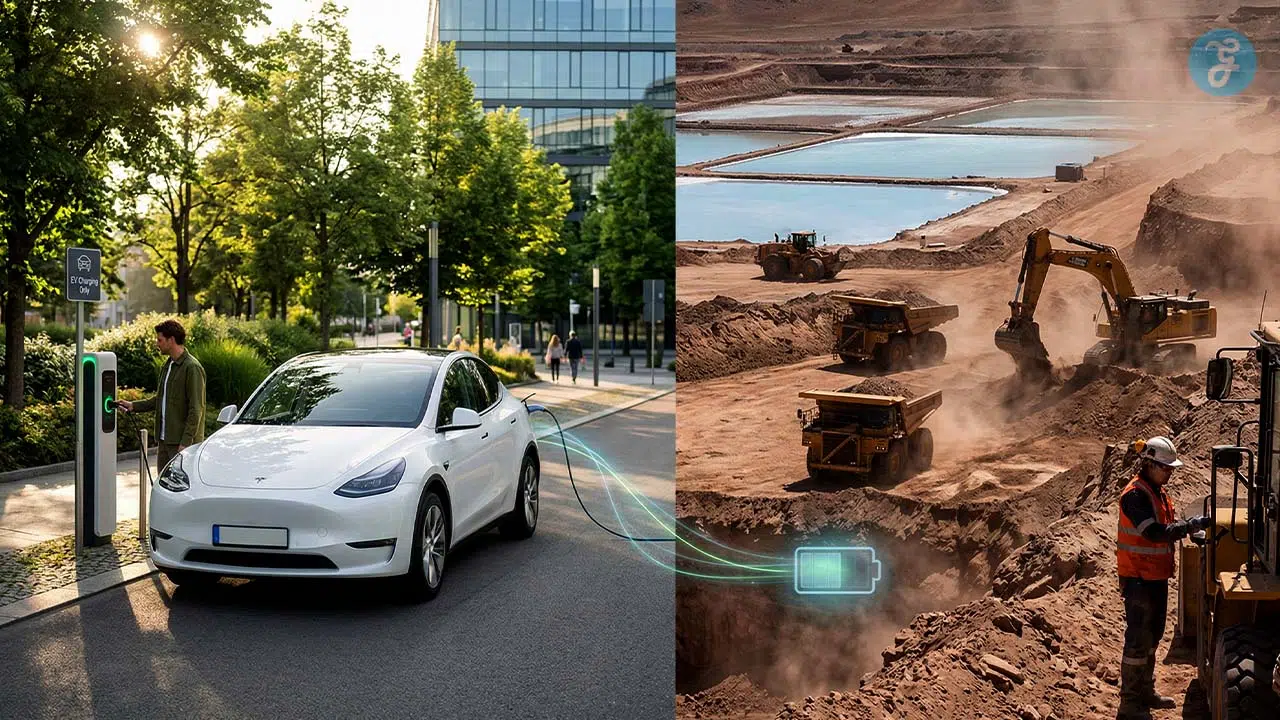
Electric vehicles are often promoted as a solution to fossil fuels and climate change. However, questions remain about whether EVs truly reduce emissions or simply shift the environmental burden to battery production and the mining of lithium, cobalt, and nickel.
Choosing between EVs and gasoline cars is like comparing a new bike to an old car—both serve a purpose, but one may leave a smaller environmental footprint.
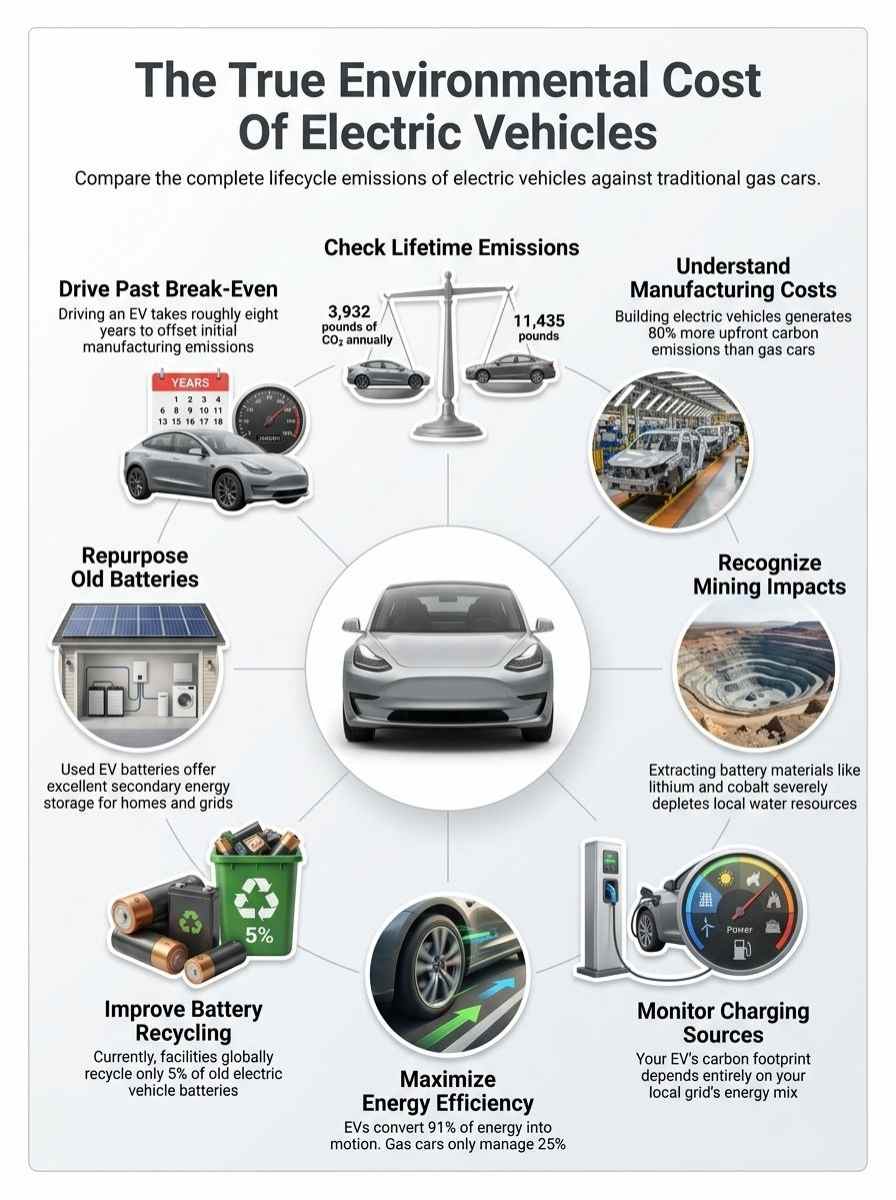
According to the U.S. Department of Energy, electric vehicles generate around 3,932 pounds of CO2 equivalent annually, while gasoline vehicles produce about 11,435 pounds. This highlights a significant difference, but it does not tell the full story.
This article explores the Environmental Cost of Electric Vehicles, analyzing lifecycle emissions from manufacturing to disposal. It also compares EVs with gasoline cars using data from the International Council on Clean Transportation.
Key topics include renewable energy integration, battery recycling challenges, and emerging innovations shaping a more sustainable future.
The Environmental Impact of Electric Vehicles
Electric cars promise cleaner air, but their full story hides some dirty secrets in the making and powering. Think about greenhouse gas emissions from mining lithium for batteries, or how coal-fired plants charge them up—it’s like trading tailpipe smoke for factory fumes, right?
Emissions Across an EV’s Lifecycle
EVs promise a cleaner ride, but their carbon footprint spans the whole journey from factory to scrapyard. Factories crank out lithium-ion batteries, and that process pumps out greenhouse gas emissions through mining lithium, cobalt, and nickel.
A 2021 study shows that 46% of an EV’s carbon emissions come straight from production. Imagine, like building a house where the blueprint alone dirties the air more than living in it for years.
Argonne National Laboratory studies confirm that even with battery manufacturing tossed in, EVs release fewer total greenhouse gases over their lifetimes than gas-powered cars. People often overlook how resource extraction for these batteries scars the earth, from the Democratic Republic of Congo’s cobalt mines to Chile’s lithium fields.
Manufacturing an EV creates about 80% more emissions than making a comparable internal combustion engine vehicle, yet the payoff hits over time.
Over their lifetimes, EVs produce fewer carbon emissions compared to gasoline-powered cars under most conditions, notes an expert from Argonne National Laboratory.
Most emissions for current EVs kick in after they roll off the lot, tied to the electricity that charges them. Coal-fired power plants can spike CO2 emissions during charging, while renewable sources like hydropower in Norway keep things greener.
Think of it as fueling up with dirty or clean energy, it makes all the difference in the carbon pollution tally. The analysis factors in an average of 173,000 miles driven per vehicle.
Manufacturing and end-of-life disposal add up to around 29% of an EV’s emissions, with battery recycling posing real challenges. Automakers push for better energy efficiency, but the grid’s mix decides much of the environmental impact.
Insights from the ICCT highlight how plug-in hybrid electric vehicles bridge the gap, blending gas and electric to cut total greenhouse gases.
Gas-Powered Vehicles vs. Electric Vehicles
Let’s compare gas-powered vehicles and electric vehicles side by side, folks, to see how they stack up on the environmental front.
| Aspect | Gas-Powered Vehicles | Electric Vehicles |
|---|---|---|
| Lifetime CO2 Emissions per Mile | Gasoline cars average over 350 grams of CO2 per mile driven over their lifetimes. They may drop to around 225 grams by 2050. | Electric vehicles often produce lower lifetime emissions, especially with clean energy sources. Pair them with renewables, and they shine even brighter. |
| Annual CO2 Equivalent Emissions | Gasoline vehicles emit 11,435 lbs. of CO2 equivalent each year. That’s like a heavy footprint stomping through the air. | Typical hybrids, a step toward electric, release 6,258 lbs. of CO2 equivalent annually. Full electrics can cut that further, imagine ditching the gas guzzler for good. |
| Production Process Emissions | A 2021 study shows 26% of internal combustion engine vehicle carbon emissions come from production. Manufacturing and end-of-life disposal add about 9% more. | Electric vehicle battery production ramps up upfront emissions, but operations stay cleaner. Think of it as paying now for a fresher tomorrow. |
| Fuel Efficiency Assumptions | The analysis assumes gasoline car fuel efficiency of 30.7 miles per gallon. It keeps chugging along, burning fuel all the way. | Electric vehicles boast higher energy efficiency. They zip by without tailpipe smoke, turning electricity into motion like a smart wizard. |
| Household Energy Use for Charging | Gas vehicles rely on pumps, no home energy tie-in here. They guzzle at the station, straightforward but dirty. | In 2020, charging electric vehicles used less electricity in a typical U.S. household than water heating and air conditioning, per the U.S. Energy Information Administration. It’s like sneaking in a charge without breaking the bank. |
| Grid Integration Tools | Gas vehicles stand alone, no grid tricks up their sleeve. They idle without giving back. | Vehicle-to-Grid technology lets electric vehicles return energy to the grid during peak times and charge when demand dips low. Picture your car as a helpful battery buddy. |
Battery Production and Its Environmental Toll
Imagine, you’re excited about your new Tesla Model 3, but did you know the lithium-ion batteries inside come from massive mining operations in places like the Lithium Triangle in Argentina and Bolivia, where digging for lithium, cobalt, and nickel scars the earth and guzzles water? Yeah, those manufacturing emissions in China add up too, pumping out more carbon than you might think, so stick around to see how this hidden side stacks up against the green promise of EVs.
Manufacturing Emissions of EV Batteries
People often praise electric vehicles for their clean drive, but battery production packs a big carbon punch. Factories churn out lithium-ion batteries for EVs like the Tesla Model 3, and that process releases tons of CO2.
Studies show manufacturing an 80 kWh battery creates between 2.5 and 16 metric tons of CO2. The Argonne National Laboratory’s GREET Model pegs it at about 12 metric tons for a typical EV battery.
Over half of an EV’s total emissions come from this stage alone. China and other East Asian countries report the highest numbers due to their energy mixes. In contrast, U.S. and European studies show the lowest emissions.
A single electric car production emits around 4 tonnes of CO2.
Over half of EV emissions stem from battery production alone, notes a comprehensive review of studies from the early 2010s to now.
EVs need at least 8 years of use to offset their initial 0.5 tonnes of yearly emissions and break even with gas cars. Researchers have tracked these impacts across countries, energy sources, and timeframes.
This data highlights the hidden costs in the push for insights into future mobility.
Mining Impacts for Lithium, Cobalt, and Nickel
Electric vehicles rely on batteries packed with lithium, cobalt, and nickel. These materials come from mines that hit the environment hard. Take lithium extraction, for instance. Producers use about 2 million tonnes of water for every tonne of lithium.
That amount makes roughly 100 car batteries. In Chile, this process gulps down 65% of the region’s water resources. Imagine a thirsty giant draining a lake, leaving locals high and dry.
Protests erupted in 2016 at the Ganzizhou Rongda Lithium mine in Tagong, Tibet. Folks there raged against toxic pollution harming their land and water. Over in Yichun city, China, authorities halted lithium production.
Investigations uncovered serious water contamination. Even in Nevada, USA, crowds protested the Lithium Americas Project. They feared massive groundwater depletion. India faces its own bind.
The country lacks enough lithium reserves. It imports most from China, adding to global strain.
Nickel and cobalt mining brings more trouble. Operations wreck land and sea life in shocking ways. In Cuba, evidence shows over 570 hectares of land stripped bare, lifeless. Picture a barren wasteland where nothing grows, like a bad sci-fi movie scene.
The Philippines took bold action. Officials shut down 23 mines tied to nickel and cobalt. These sites caused huge environmental harm. Such stories highlight the dark side of chasing materials for EVs.
Battery tech advances, like those from the Federal Consortium for Advanced Batteries, aim to ease these pains. Yet the toll on nature stacks up. Miners dig deep, but at what cost to our planet? Thea Riofrancos often points out these hidden impacts in her work.
The Carbon Footprint of EV Electricity and Charging
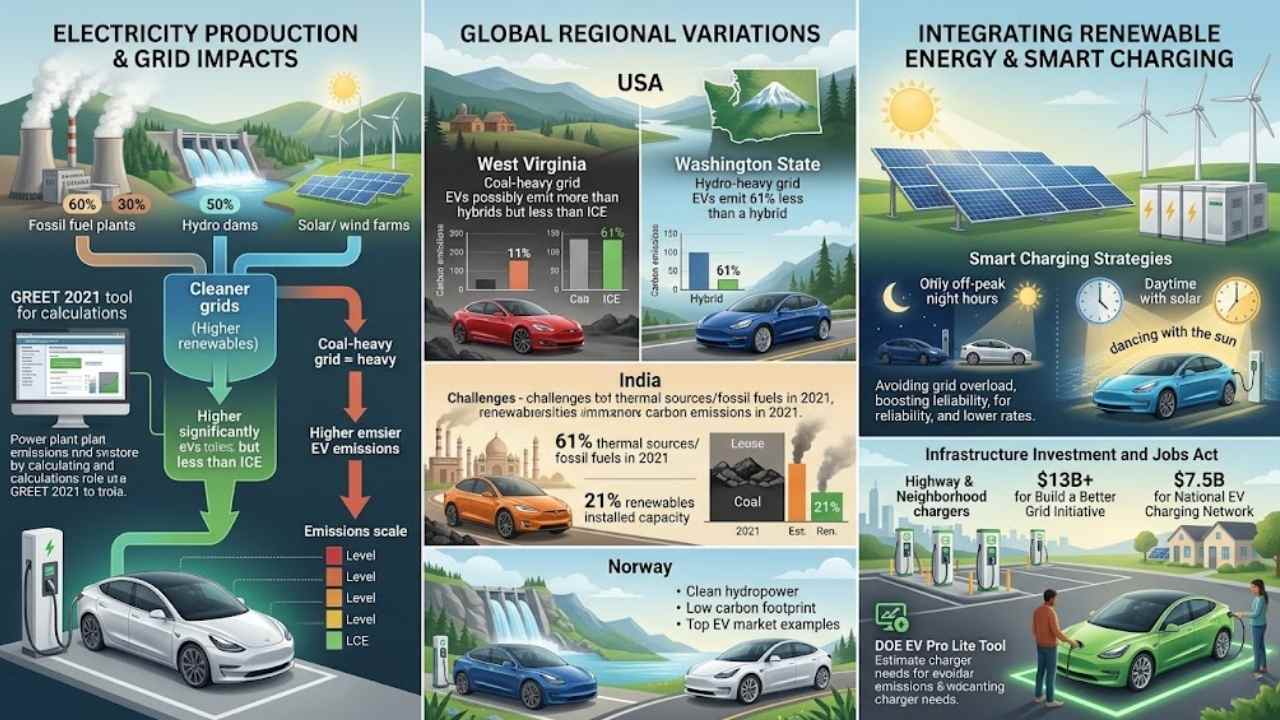
You know, when you plug in your electric vehicle, that juice comes from somewhere, and power plant emissions play a big role in the total carbon story. Think about New England, where cleaner grids cut those emissions way down, or check out tools like GREET 2021 that crunch the numbers on electricity production for charging—it’s eye-opening stuff that might change how you see your next plug-in.
Electricity Production for EV Charging
Electricity powers electric vehicles, but its source matters a lot. Carbon emissions from charging EVs change based on where you live and how power gets made. Take the U.S., for instance; in 2020, charging these cars used less electricity in a typical household than water heating or air conditioning, says the U.S. Energy Information Administration.
Yet, in coal-heavy West Virginia, EVs might release more emissions than hybrids, though still less than cars with internal combustion engines. Contrast that with hydroelectric-heavy Washington State, where an EV emits 61 percent less carbon than a hybrid.
Power plant emissions play a big role here, folks.
India faces its own challenges with EV charging. As of 2021, 61 percent of the country’s electricity came from thermal sources, mostly fossil fuels like coal. Those sources made up 60 percent of India’s emissions that year.
Right now, only 21 percent of installed capacity uses renewables. Norway sets a better example as a top market for EVs; its hydropower reliance keeps the carbon footprint low for charging.
Think about it like this: your EV’s green glow depends on the grid’s mix, so cleaner sources make all the difference.
Integrating Renewable Energy with EV Charging
Renewables grow in the energy mix. Daytime charging gets easier for electric vehicles (EVs). They tap into solar power and storage systems. Picture your EV sipping clean energy like a cool drink on a hot day.
Charging strategies stop grid overload. They boost reliability too. EVs plug in overnight during off-peak hours. Rates drop low then. Research shows the grid handles more EV demand in years ahead.
The Department of Energy’s Build a Better Grid Initiative steps up. It comes from the Infrastructure Investment and Jobs Act. This plan pours over $13 billion into grid strength and efficiency over the next decade.
Government pushes under the same act invest $7.5 billion. They build a national network of EV chargers on highways and in neighborhoods. The Joint Office of Energy and Transportation tracks charger growth.
It gives fresh data on spots. Owners use the DOE’s EV Pro Lite Tool. This estimates charger needs in areas as EV use rises. You avoid blackouts with smart timing. It feels like dancing with the sun, keeping power steady and green.
Disposal and Recycling of EV Batteries
Old EV batteries pile up like forgotten treasures, but companies like Redwood Materials and Ascend Elements step in to recycle them, turning waste into new resources. Imagine giving those power packs a second life through places like the ReCell Center, where they store energy for homes or grids, cutting down on fresh mining needs.
Challenges in Recycling EV Batteries
Electric vehicles promise a greener ride, but their batteries pose real recycling hurdles. Folks, imagine tossing out a smartphone every few years without a good plan; that’s kinda like what happens with EV batteries today.
Current tech falls short, folks, as only 5% of global batteries get recycled. This low rate means we miss chances to cut emissions by reusing materials instead of mining fresh ones.
Companies like Redwood Materials and Ascend Elements step up, pushing better methods, yet the industry lags. The ReCell Center from the U.S. Department of Energy offers key resources, along with the National Blueprint for Lithium Batteries, to boost development and recycling efforts.
We face big gaps in handling used batteries, and that hits the environment hard. Volkswagen and Renault have set up recycling plants, a solid start, but widespread adoption drags. A smart action plan calls for advancing tech in recycling and reuse, plus safe disposal for old units.
Think of it as giving batteries a second life, like repurposing an old bike for parts. Recommendations push sustainable mining and responsible sourcing for lithium, cobalt, and nickel, with Russia supplying 20% of the world’s nickel.
Manufacturers need to share clear data on carbon footprints at every stage, and shifting to low-carbon hydrogen and biofuels in processing helps decarbonize the chain.
Reusing EV Batteries in Second-Life Applications
Nissan powers automated guided vehicles in its factories with used EV batteries. This smart move gives those batteries a second life. It delays disposal and cuts environmental harm.
Reuse offers cheap energy storage for factories or power grids. Picture old batteries keeping lights on without hitting landfills too soon.
Battery packs pass strict tests and feature safety shut-offs for crashes or shorts. The DOE’s Alternative Fuel Data Center shares details on these standards. Their ReCell Center pushes research into repurposing.
Stats from Recurrent show EV battery failure rates under 0.5% since 2016. Plus, 97.5% of EVs run on original packs, boosting reuse chances.
Comparing EVs and Gas Cars for Environmental Impact
Electric cars cut tailpipe emissions to zero, but their full story involves mining and power sources that add up over time. Experts like Georg Bieker use tools such as the GREET model to show how a Honda Clarity stacks up against a Toyota Camry in total carbon output, making you rethink that quick drive.
Lifetime Emissions of EVs versus Gas Cars
Let’s compare lifetime emissions of EVs and gas cars, folks, using solid data to see the big picture.
| Aspect | Details |
|---|---|
| Annual CO2 from Plug-in Hybrids | Plug-in hybrids release 5,772 pounds of CO2 equivalent each year, adding up over time like a slow leak in your tire. |
| Per-Mile CO2 from Battery EVs | Fully battery-electric vehicles put out about 200 grams of CO2 per mile, less than a gas guzzler’s daily grind. |
| Manufacturing and Disposal for Plug-in Hybrids | Plug-in hybrid EV emissions from making and scrapping hit around 17 percent, a chunk you can’t ignore in the full story. |
| Efficiency with Shorter Lifespan | Consider EVs lasting 90,000 miles versus 180,000 for others; they still beat hybrids by 15 percent and crush gasoline cars in efficiency, no contest. |
| U.S. Department of Energy Report on EVs | The U.S. Department of Energy states EVs produce 3,932 pounds of CO2 equivalent yearly, a lighter load than you might think. |
| Gasoline Car Projections to 2050 | Projections show gasoline car emissions dropping from over 350 grams per mile to around 225 grams by 2050, but that’s no quick fix. |
| Battery EV Projections to 2050 | Battery EV emissions could fall to about 125 grams, or down to 50 grams by 2050 if renewable energy prices plunge, imagine that shift. |
| MIT Study Comparison | MIT’s “Insights Into Future Mobility” breaks down emissions across vehicle types, from sedans to SUVs, highlighting EVs’ edge in lifecycle analysis. |
Energy Efficiency of Electric Vehicles
Electric vehicles pack a punch in energy efficiency, making them a smart choice for daily drives.
| Aspect | Details |
|---|---|
| Efficiency in Energy Conversion | EVs convert 87% to 91% of battery energy straight to movement. Gas vehicles manage only 16% to 25%. Imagine wasting less fuel, like sipping coffee instead of spilling it everywhere. |
| Range for Everyday Trips | Most EV models offer ranges over 200 miles on a full charge. All new models hit at least 100 miles. The National Household Travel Survey from 2022 shows over 73% of passenger trips span 10 miles or less. Plus, 98% fall under 75 miles. Short commutes fit EVs like a glove. |
| Impact of Cold Weather | Cold temps and heating cut EV range by about 40% on average. Plan ahead, folks, bundle up or preheat that cabin to keep things smooth. |
| Charging Options | Charge most EVs with a standard 120 Volt Level 1 outlet at home. Need speed? Go for a dedicated 240 Volt Level 2 outlet. These tools make topping up as easy as plugging in your phone, fitting right into your routine. |
Innovations and Policies for Reducing EV Environmental Costs
Experts like Sergey Paltsev point out fresh battery designs, such as solid-state options, that slash mining needs and boost efficiency. Programs from the National Electric Mobility Mission Plan drive cleaner nickel extraction methods, making EVs kinder to the planet—want to see how these changes stack up against old ways?
Developments in Battery Technology
Battery tech keeps getting better, folks. Think about those electric vehicle batteries. Their replacement failure rate averaged just 2.5% from 2011 to 2023. That peaked at 7.5% back in 2011, but now it drops to as low as 0.1% for newer models.
It’s like watching a kid learn to ride a bike, wobbly at first, then zooming ahead smoothly. The U.S. Department of Energy’s ReCell Center pushes this progress, offering tools for smarter battery development.
Their National Blueprint for Lithium Batteries guides recycling too, making sure we reuse what we can.
Companies jump in with fresh ideas. Volkswagen and Renault set up battery recycling plants, turning old packs into new life. India’s national electric mobility mission plan fuels growth there, with projections hitting $100 billion for the EV industry by decade’s end.
Lithium prices in India shot up 70% since January 2022, so EV costs might rise 8% next year from raw material hikes. The Department of Energy’s Build a Better Grid Initiative pours over $13 billion into grid upgrades, tying into better charging for these advancing batteries.
Sergey Paltsev, an expert, often chats about this on NPR, using models like GREET 2 2021 to measure emissions drops.
Practices for Eco-Friendly Mining
Eco-friendly mining can cut the harm from digging up materials for EV batteries. You, as a reader, play a part by supporting companies that choose better ways.
- Companies promote sustainable mining practices to protect land and water, like those recommended for lithium batteries, which help avoid disasters such as the 570 hectares of dead land in Cuba from nickel and cobalt digs.
- Workers ensure responsible sourcing of raw materials, a key step that slashes the environmental cost of EVs, and think about how protests in Nevada against the Lithium Americas Project spotlight groundwater risks we must dodge.
- Teams decarbonize the supply chain by switching to low-carbon hydrogen and biofuels for lithium processing, a smart move that fights pollution, much like halting production in Yichun city, China, after probes uncovered water contamination.
- Governments shut down harmful operations, for example, the Philippines closed 23 mines tied to nickel and cobalt due to their bad impact on nature, showing how quick action saves ecosystems.
- Communities push back against toxic sites, such as the 2016 protests in Tagong, Tibet, over the Ganzizhou Ronga Lithium mine’s pollution that wrecked local rivers and sparked real outrage.
Weighing the Pros and Cons of Electric Vehicles
Electric cars cut tailpipe emissions to zero, like a breath of fresh air on busy streets, but their battery production digs deep into the earth for materials, stirring up dust and worries about mining scars.
Think about those hidden disposal headaches too, where old batteries pile up like forgotten toys, yet they promise cleaner drives if we push for better recycling paths—curious to learn more?
Comparing Emissions from Tailpipes
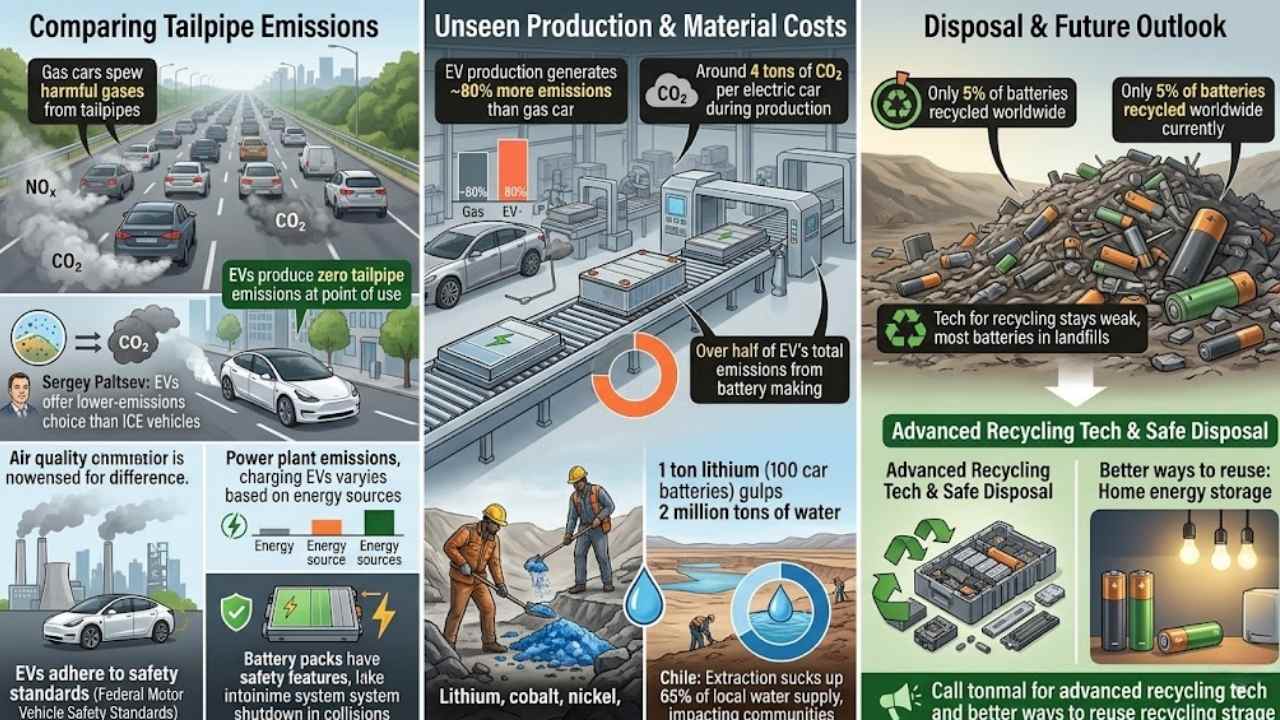
Gas cars spew harmful gases right from their tailpipes, polluting the air we all breathe. Think about that cloud of exhaust on a busy highway; it adds up fast. Electric vehicles, on the flip side, produce zero tailpipe emissions. They run clean at the point of use, which feels like a breath of fresh air in crowded cities. Sergey Paltsev, Deputy Director of the MIT Joint Program on the Science and Policy of Global Change, points out that EVs offer a lower-emissions choice than internal combustion engine vehicles. He shared this insight in a November 2019 report from the MIT Energy Initiative. Andrew Moseman from the MIT Climate Portal Writing Team highlighted these details too.
Power plant emissions do play a role, though, and they vary based on energy sources for charging EVs. The U.S. Department of Energy’s Alternative Fuels Data Center, accessed on October 13, 2022, explains this clearly. Lakshmi R B noted in a January 11, 2023, article on Global Commons that EVs adhere to Federal Motor Vehicle Safety Standards, just like gas vehicles. Battery packs include safety features that shut down the system during collisions or short circuits. All electric vehicles must meet these rules. This setup keeps things safe while cutting those direct exhaust fumes.
Unseen Costs of Production and Disposal
Electric vehicles hide big costs in their making and end-of-life stages, folks. Factories pump out about 80% more emissions for an EV than for a gas car. They release around 4 tons of CO2 per electric car during production.
Over half of an EV’s total emissions come from battery making alone. Miners extract lithium, cobalt, and nickel, which drains resources. One ton of lithium, enough for 100 car batteries, gulps down 2 million tons of water.
In Chile, this process sucks up 65% of the local water supply. It hits communities hard, like a thief in the night stealing vital resources.
Disposal adds another layer of trouble. Only 5% of batteries get recycled worldwide right now. Tech for recycling stays weak, leaving most batteries in landfills or waste piles. We need better ways to reuse them, say in home energy storage.
Imagine old batteries powering your lights instead of rotting away. A smart plan pushes for advanced recycling tech and safe disposal methods. This cuts the hidden harm EVs bring.
Final Thoughts
We’ve covered the full picture of electric vehicles, from battery mining’s heavy toll to their lower lifetime emissions compared to gas cars. You can make a real difference by choosing EVs that use recycled materials or charging with solar power, simple steps that cut your carbon footprint fast.
Think about it, switching helps fight climate change and saves money on fuel over time, a win-win for the planet and your wallet. Check out reports from the EPA or Union of Concerned Scientists for more facts on green driving.
Go ahead, drive the change toward a cleaner future, like that time I swapped my old sedan for an EV and felt the fresh air difference right away.
Frequently Asked Questions (FAQs) on the Environmental Cost of Electric Vehicles
You know, digging up rare metals for those batteries can scar the earth like a bad tattoo that won’t fade. It pollutes water and air in mining spots, and hey, that’s no small potatoes when we talk about the full picture.
2. Do electric vehicles cut down on pollution over their whole life?
Electric vehicles often have a bigger carbon footprint at first from factory emissions. But they clean up their act on the road, beating gas guzzlers in the long haul if you charge with green energy.
3. How does recycling electric vehicle parts help the planet?
Recycling batteries keeps toxic stuff out of landfills, turning old junk into new treasures. It’s like giving Mother Nature a high-five, reducing the need for fresh mining that harms habitats. Plus, it saves energy, making the whole deal more eco-friendly.
4. Are electric vehicles truly greener than regular cars?
Sure, they zap fewer emissions while driving. But factor in the power grid’s dirt, and it’s not always a slam dunk.






















