
Dreaming to Move to Canada As a Skilled Worker? Navigating immigration rules and paperwork can feel overwhelming, like finding your way through a foggy forest. Many skilled professionals face this challenge while seeking better jobs, safer communities, and a higher quality of life.
The Federal Skilled Worker Program (FSWP), launched in 1967, remains Canada’s leading pathway for attracting global talent. This guide explains key steps, including Express Entry, eligibility criteria such as work experience and language proficiency, the points system, and Provincial Nominee Programs.
From assessing eligibility to submitting a permanent residence application, understanding each stage is essential to successfully Move to Canada As a Skilled Worker.
Canada’s Skilled Worker Immigration Programs
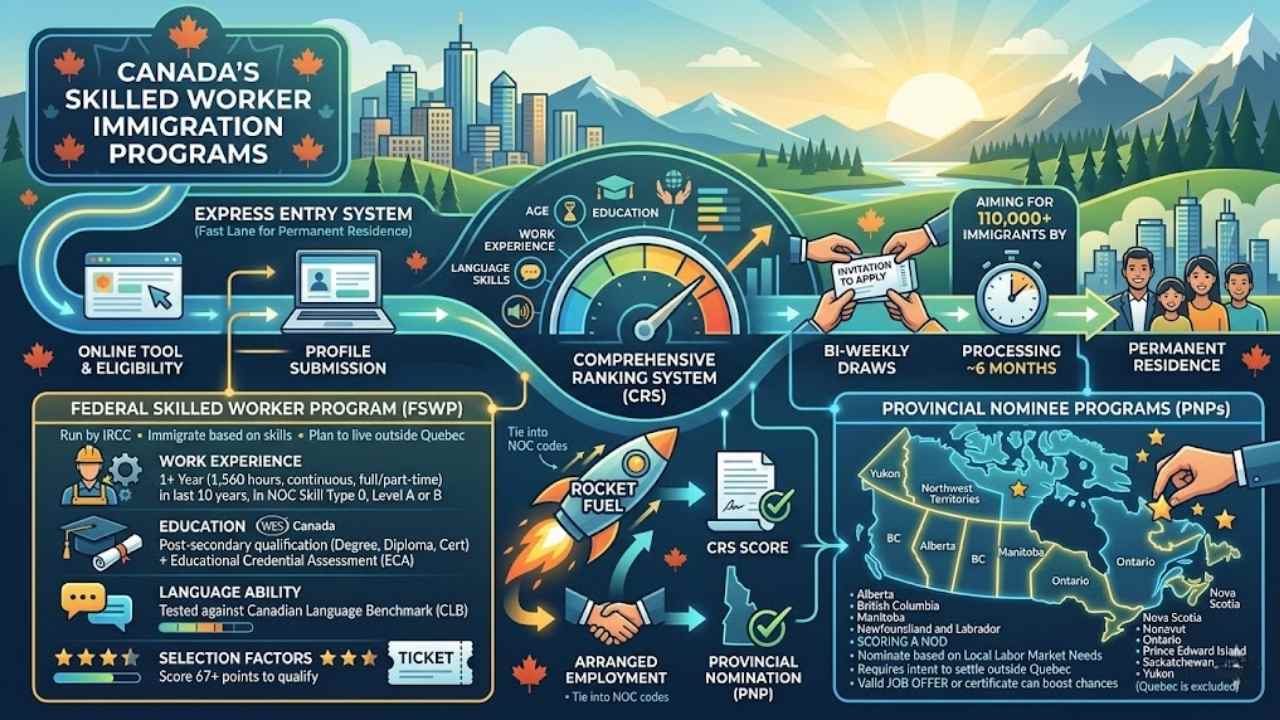
Canada opens its doors wide for folks like you, with skills that match their needs, through paths like the Express Entry setup, which acts like a fast lane for permanent residence.
Imagine scoring a spot via the Comprehensive Ranking System, or snagging a nod from a Provincial Nominee Program, it all starts with checking how your job fits the National Occupational Classification codes, and hey, that could be your ticket to a fresh start up north.
Federal Skilled Worker Program (FSWP)
People often dream of starting fresh in a new country. The Federal Skilled Worker Program, or FSWP, lets selected individuals immigrate based on their work experience and skills. Immigration, Refugees and Citizenship Canada runs this program.
You need at least one year of full-time, or equivalent part-time, skilled work experience. That means 1,560 hours of continuous full-time or equivalent paid work within the last 10 years.
Your work must fall under the National Occupational Classification, NOC, in Skill Type 0, Level A, or Level B. Applicants also require a post-secondary education qualification, like a certificate, diploma, or degree.
Plus, you must plan to live outside Quebec.
Skilled workers bring valuable talents that strengthen our economy, says an official from Immigration, Refugees and Citizenship Canada.
A permanent job offer can waive some work experience rules. Score at least 67 points on the selection factors to qualify. Think of it like earning a ticket to a better life, with your skills as the golden key.
Educational Credential Assessment, ECA, verifies your qualifications. Language ability matters too, tested against Canadian Language Benchmark levels. Provincial Nominee Programs can boost your chances if you fit specific needs in places like Ontario or Alberta.
Express Entry System
Canada launched the Express Entry system on January 1, 2015, as the main intake method for skilled worker applications. This online tool manages three key programs: the Federal Skilled Worker Program (FSWP), the Federal Skilled Trades Program, and the Canadian Experience Class.
Skilled immigrants submit profiles through the Express Entry application system, and they get Comprehensive Ranking System (CRS) scores based on factors like age, education, work experience, and language skills.
Draws happen every two weeks or so, picking top scorers for an Invitation to Apply. Imagine it like a talent show, where you showcase your skills, and the highest scorers win a spot on stage.
The system ties into the National Occupational Classification (NOC) to match jobs with your background.
Candidates with strong profiles often move via the FSWP through Express Entry, leading the pack in success rates. The government aims to bring in over 110,000 immigrants this way by 2024, under the Immigration Levels Plan.
Processing for permanent residence takes about six months, a quick turnaround compared to old methods. You might need an Educational Credential Assessment (ECA) from groups like World Education Services – Canada to prove your schooling.
Tie in arranged employment or a Provincial Nominee Program (PNP) boost, and your CRS score jumps. It’s like adding rocket fuel to your application, helping you zoom past the competition.
Eligible folks include those in the Atlantic Immigration Pilot or Rural and Northern Immigration Pilot.
Provincial Nominee Programs (PNPs)
Provinces like Alberta, British Columbia, Manitoba, New Brunswick, Newfoundland and Labrador, Northwest Territories, Nova Scotia, Nunavut, Ontario, Prince Edward Island, Saskatchewan, and Yukon run these programs.
They nominate folks for permanent residence based on local labor market needs. Think of it as provinces picking talent, like scouts at a talent show, to fill job gaps. You need to show you plan to live outside Quebec, since that province handles its own quebec immigration system.
Some spots ask for a valid job offer or a certificate of qualification to boost your chances.
Eligibility varies by place, so check details for each territory. Work experience from Quebec counts if you prove your intent to settle elsewhere. Programs tie into the Immigration and Refugee Protection Act, often linking with Employment and Social Development Canada for things like labour market impact assessment.
Imagine chatting with a friend about moving to Manitoba or Yukon; they might need specific skills, and you adapt your pitch. Permanent residents get nominated this way, fitting right into spots like Nova Scotia or New Brunswick.
Eligibility Criteria for Skilled Workers
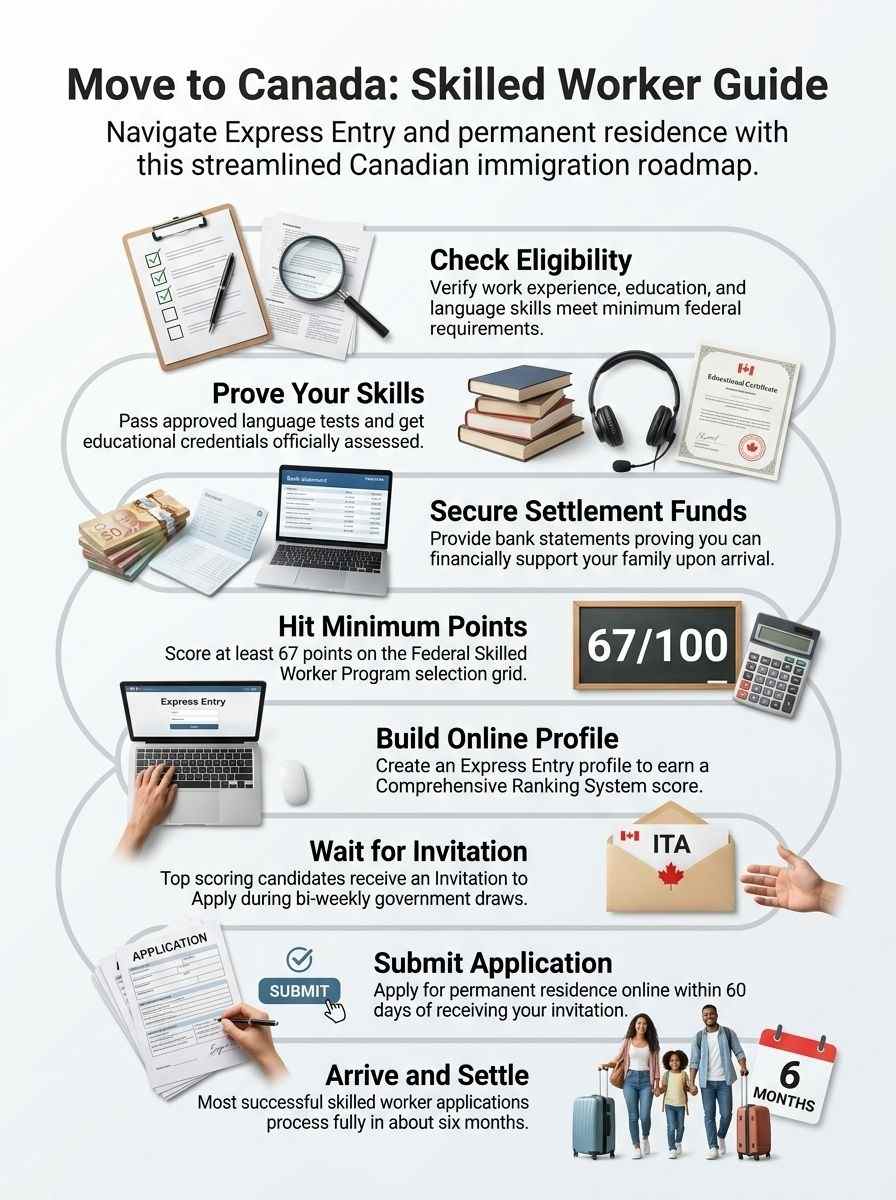
Dreaming of a fresh start in Canada, eh? You need solid work experience, strong scores on tests like the Canadian Language Benchmarks for English or Niveaux de compétence linguistique canadiens for French, plus education checked by groups such as the Comparative Education Service or International Qualifications Assessment Service, and enough money saved up to prove you can settle in.
Work Experience Requirements
You need at least one year of paid work to qualify for Canada’s skilled worker programs, like the Federal Skilled Worker Program. That means 1,560 hours in a row, full-time or part-time, over the last 10 years.
Pick jobs in skilled spots under NOC TEER 0, 1, 2, or 3. Go for full-time gigs at 30 hours a week, or mix in part-time to hit the total. Folks in the Federal Skilled Trades Program face a higher bar.
They must show two years of work, or 3,120 hours, in the last five years. Nail 30 hours a week for 24 months at one job, or rack up part-time hours without topping 30 a week. Student jobs skip the count here.
A permanent job offer can wave off these rules, like in some Provincial Nominee Programs. Think of it as stacking bricks for your future home; each hour builds your case stronger.
Tie this to paths like the Self-Employed Persons Program or Start-Up Visa Program for entrepreneurs. Grab a work permit first if you aim for experience in Canada, maybe through International Experience Canada.
Check CICIC’s Directory of Occupational Profiles to match your skills. Bodies like the Medical Council of Canada or Pharmacy Examining Board of Canada verify fields. Use services such as the International Credential Assessment Service of Canada for proof.
Permanent resident visa awaits if you play your cards right. Sites like CanadaVisa guide you along.
Language Proficiency (CLB/NCLC Levels)
Language skills open doors in Canada’s immigration process, like a key that fits just right.
| Aspect | Details |
|---|---|
| Minimum Proficiency | Candidates show at least CLB 7 in English or French. This level fits NCLC 7 too, for French speakers. |
| Abilities Covered | CLB 7 or NCLC 7 applies to reading, writing, listening, and speaking. All four count equally. |
| Test Validation | Validate language test scores for Express Entry. Skip this, and your profile stalls. |
| Points in FSWP | Language skills add up to 28 points in the FSWP selection grid. Strong scores boost your chances, like extra fuel in a race. |
| Programs Affected | These rules cover FSWP and Federal Skilled Trades Program applicants. No shortcuts here. |
| Role in CRS | Language proficiency drives Express Entry CRS scoring. It shapes your rank, plain and simple. |
| Last Update | Officials updated minimum language requirements on June 2, 2021. Check recent changes to stay sharp. |
| Bilingual Bonus | English and French skills both factor into scoring. Mix them, and watch points climb, like stacking blocks higher. |
Educational Credentials
You must hold a post-secondary certificate, diploma, or degree to qualify for the Federal Skilled Worker Program. This rule stands firm for applicants. Foreign credentials demand an Educational Credential Assessment report from services like the International Credential Evaluation Service.
Canadian credentials, or those from recognized foreign spots, fit the bill too. Think of it like proving your school’s stamp of approval; without it, your application hits a wall. Education scores you up to 25 points on the FSWP selection grid, a big boost in your favor.
These needs apply to both the Federal Skilled Worker Program and the Federal Skilled Trades Program. IRCC outlines the full education assessment process for you. Credentials come only from recognized institutions, no shortcuts here.
For trades, check the Canadian Information Centre for International Credentials, especially for federally regulated ones. Bodies like the Canadian Architectural Certification Board handle specific fields, while programs such as the Agri-Food Immigration Pilot or Live-in Caregiver Program might tie into credential checks too.
Get this right, and you’re one step closer to that Canadian dream.
Proof of Funds
Canada demands proof of settlement funds from skilled workers without a valid job offer or arranged employment. These funds support you and your dependents right after you arrive. IRCC sets the minimum amounts each year, and they vary by family size.
For example, a single person needs one sum, while a family of four requires much more to cover basics like rent and food. Show your cash through bank statements or official letters; they verify everything.
This step counts as a core part of eligibility in the Federal Skilled Worker Program. Skip it if you hold a permanent job offer from a Canadian employer.
Plan to settle outside Quebec, or these rules shift. Applicants gather documents like financial records to prove their funds stay ready and unborrowed. Think of it as your safety net, easing that big move across the border.
IRCC checks these details closely in Express Entry profiles. Get this right, and you avoid delays in your invitation to apply. Dependents include spouses and kids, so count everyone coming along.
Points-Based Selection System
Canada picks skilled workers like choosing players for a top hockey team, scoring you on key strengths to see if you make the cut. Picture racking up points for your years on the job, school smarts, and even how well you speak English or French, all adding up to snag that golden ticket north.
Scoring Factors (Age, Education, Work Experience, etc.)
You know, scoring factors in Canada’s points system feel like pieces of a puzzle that fit together to boost your chances.
| Factor | Details | Max Points |
|---|---|---|
| Age | Points peak for folks in their prime working years, like a sweet spot in life. | Up to 12 points |
| Education | Your degrees count big time, think of them as keys unlocking doors. | Up to 25 points |
| Language Skills | Strong English or French skills shine here, measured by CLB or NCLC levels, like fuel for your profile. | Up to 28 points |
| Work Experience | Years on the job add up fast, picture them stacking like building blocks. | Up to 15 points |
| Arranged Employment | A solid job setup in Canada gives you an edge, almost like a head start in a race. | Up to 10 points |
| Adaptability | Things like past time in Canada or family ties help, they act as bonus glue holding it all together. | Up to 10 points |
| Canadian Job Offer | This one packs a punch under the Comprehensive Ranking System (CRS), boosting your score in Express Entry draws. | 50 to 200 points |
| CRS Total | Scores draw from all these factors, plus more, for those key Express Entry rounds. | Varies by draw |
Minimum Points Required
Canada sets a clear bar for skilled workers eyeing the Federal Skilled Worker Program. You need at least 67 points out of 100 to qualify, plain and simple. IRCC runs this show, and they calculate your score using the FSWP selection grid.
Score below that magic number, and you’re out of luck for the FSWP. This threshold stands as a longstanding rule for eligibility, last updated on March 9, 2026. Think of it like a gatekeeper, making sure only top candidates slip through to Express Entry.
Folks often sweat over these points, but the system keeps things fair and objective. IRCC sets these minimums, and yes, they can shift over time. Meet that 67-point mark, and you gain a shot at applying via Express Entry.
Fall short, and the door slams shut on your FSWP dreams. This grid assesses candidates without bias, like a referee calling a clean game.
Steps to Apply for Immigration
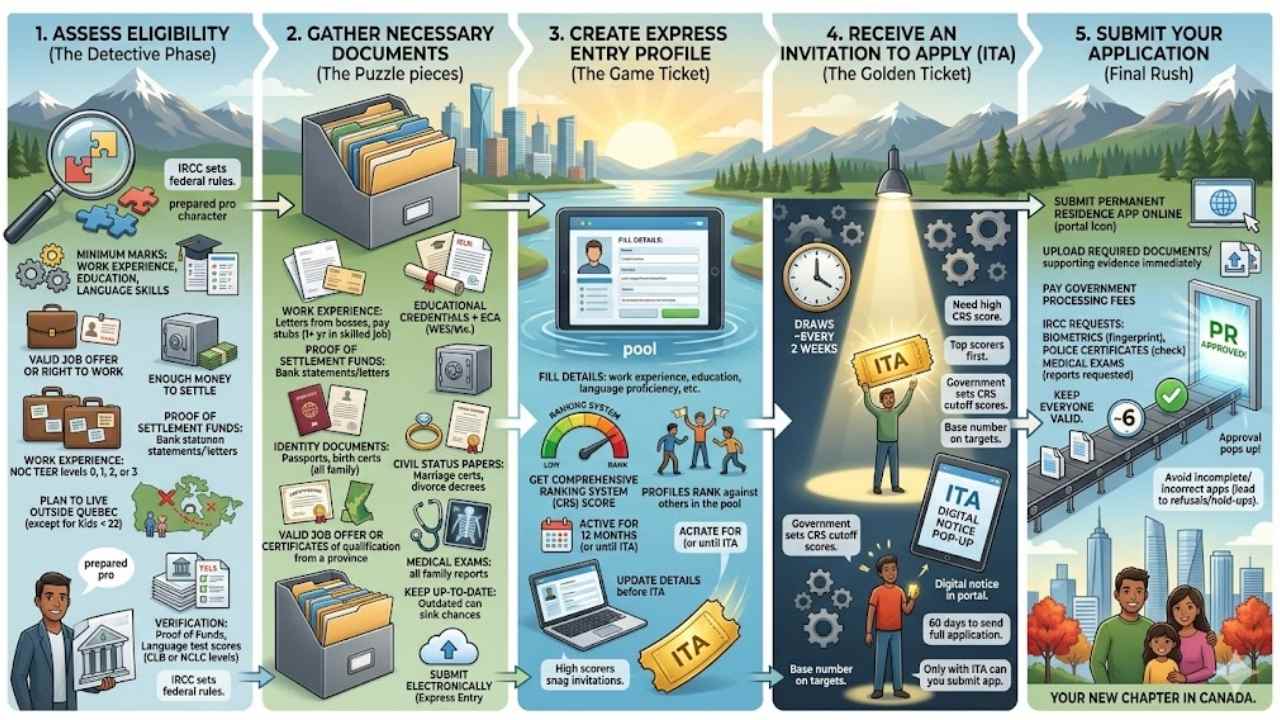
Ready to chase that Canadian dream, like packing your bags for a fresh start? Jump in by checking if you qualify, then grab your papers and build your profile in the Express Entry pool, where invites come like golden tickets to a new life.
Assess Your Eligibility
Start by checking if you meet the basics for Canada’s skilled worker programs. Candidates must hit minimum marks in work experience, education, and language skills. IRCC sets these rules for federal options like Express Entry.
Think of it like a puzzle; all pieces need to fit. You need a valid job offer, the right to work in Canada, or enough money to settle. Work experience counts only if it falls under NOC TEER levels 0, 1, 2, or 3.
Plan to live outside Quebec, folks, that’s key. If you bring kids, they must be under 22 to join your application. Only then can you build an Express Entry profile.
Verification comes next, and it’s thorough. Officials check all your supporting papers to confirm eligibility. Picture yourself as a detective, gathering clues like proof of funds or language test scores at CLB or NCLC levels.
Miss one detail, and the door stays shut. Stay sharp, double-check everything against IRCC guidelines. This step weeds out the unprepared, but hey, you’ve got this if you prepare like a pro.
Gather Necessary Documents
You need the right papers to show Canada you’re a good fit. Gather them early to avoid delays, like collecting puzzle pieces for a clear picture.
- Collect proof of your work experience, such as letters from bosses or pay stubs, to show at least one year in a skilled job.
- Get your educational credentials ready, and if they’re from outside Canada, obtain an Educational Credential Assessment (ECA) from a group like World Education Services.
- Prepare language test results from approved tests, like IELTS or CELPIP, to prove you meet Canadian Language Benchmark (CLB) levels.
- Show proof of settlement funds if you need it, with bank statements or letters that confirm you can support yourself and family.
- Include identity documents for you and all family members, things like passports or birth certificates, to verify who everyone is.
- Add civil status papers for family, such as marriage certificates or divorce decrees, so officials see your full household setup.
- Provide a valid job offer if you have one, or certificates of qualification from a province, to boost your points in the system.
- Gather police certificates from countries you’ve lived in, when the government asks, to confirm a clean record.
- Schedule medical exams for everyone applying, and submit reports as requested, proving good health for life in Canada.
- Keep all supporting documents up-to-date and valid, because outdated ones can sink your chances.
- Submit everything electronically through the Express Entry portal, scanning items clearly for easy review.
Create an Express Entry Profile
Eligible candidates create an online profile in the Express Entry system, it’s like your ticket to the big game. Fill it with details on work experience, education, language proficiency, and other key info.
You get a Comprehensive Ranking System score, or CRS score, based on that profile data. Think of it as your spot in line, profiles rank against others in the pool. High scorers snag invitations to apply for permanent residence.
Profiles stay active for up to 12 months, or until you grab an Invitation to Apply, known as an ITA.
Only folks who meet program requirements submit a profile, no shortcuts here. Update yours with fresh details before that ITA arrives, keep things current. Imagine tweaking your resume mid-job hunt, it boosts your chances.
Stay sharp, as the system invites the top candidates from the bunch.
Receive an Invitation to Apply (ITA)
Express Entry draws happen about every two weeks, and they issue ITAs to top scorers. You need a high CRS score to stand out, like being the fastest runner in a crowded race. Candidates with the highest CRS scores get these invites first.
The government sets CRS cutoff scores for each draw, so check them often. They base the number of ITAs on draw details and yearly targets. Imagine your profile sits in the pool, and suddenly, an electronic notice pops up in the Express Entry portal.
That ITA arrives digitally, right through the system.
This invite lets you move forward, as only folks with ITAs can submit a permanent residence application. You have 60 days to send in a full application after getting one. Officials require that step to proceed to the next stage.
Think of it as your golden ticket, opening doors to new chances in Canada. Stay alert for those draws, and keep boosting your score to snag an ITA.
Submit Your Application
You’ve got your Invitation to Apply, so now jump into action. Submit applications for permanent residence online through the Express Entry portal. Upload all required documents and supporting evidence right away.
Pay government processing fees at submission time, folks, no delays there. IRCC requests biometrics, police certificates, and medical exams during processing. Keep everything valid throughout, like a well-oiled machine running smooth.
Most successful candidates see processing wrap up in about six months. Avoid incomplete or incorrect applications; they lead to refusals or hold-ups, and nobody wants that headache.
Final decisions come electronically via the IRCC portal, so check it often. Imagine the thrill when approval pops up, your new chapter in Canada kicking off with a bang.
Benefits of Skilled Worker Immigration to Canada
Moving to Canada as a skilled worker changes your life for the better. You step into a world of opportunities that feel like hitting the jackpot.
- Access top-notch health care right away, because Canada offers world-class medical services that keep you and your family healthy without breaking the bank.
- Grab economic opportunities that boost your career, with jobs that match your skills and help you build a solid future in a thriving economy.
- Bring your dependent children up to age 22 along for the ride, so your whole family settles in together and starts fresh in a supportive place.
- Enjoy excellent education options for you and your kids, since Canada provides world-class schools and universities that open doors to bright futures.
- Benefit from the Express Entry system that streamlines your application process, making your move quicker and less stressful than you might expect.
- Feel the fairness of the objective points system, which ensures transparent candidate selection and gives you a real shot based on your merits.
- Join Canada’s push to welcome over 110,000 new immigrants through Express Entry by 2024, putting you in a wave of skilled workers building the nation’s future.
- Experience efficient processing for FSWP candidates, with most applications done in about six months, so you start your new life sooner.
- Score extra points with a Canadian job offer, adding up to 15 points plus 50 to 200 CRS points, which ramps up your chances and leads to better job stability.
- Know that most successful skilled worker candidates come through the FSWP, proving it’s a reliable path that delivers real results for folks like you.
Common Challenges and Tips for Success
Applicants often trip up on work experience rules, like how student jobs fail to count for the Federal Skilled Trades Program’s basics. For example, you pour years into a role, only to learn it misses the NOC TEER 0, 1, 2, or 3 mark, and boom, your application stalls.
Hey, don’t sweat it, double-check your job history against those categories early on. Language tests throw curveballs too, since you need at least CLB 7 or NCLC 7 in listening, speaking, reading, and writing.
One applicant I heard about bombed the speaking part, felt like chatting with a brick wall, but practiced with friends and nailed a retake. Grab those scores, folks, they open doors.
Proof of funds? That’s mandatory without a solid job offer, so stash that cash proof ready. Intend to live outside Quebec for federal paths, or your file might bounce back. Trades folks, head to the Canadian Information Centre for International Credentials for those regulated assessment steps, it clears the fog.
Outdated documents kill dreams fast, causing delays or flat-out refusals, so keep everything fresh and valid. Imagine submitting papers from last year, only for officials to say, nope, try again, what a headache.
Update them pronto, and you’ll sail smoother. Requirements shift often, with the last tweak on March 9, 2026, so stay sharp on official sites. One tip, join online forums where folks share war stories, like the guy who forgot his fund proof and scrambled last minute, hilarious in hindsight but stressful then.
Empathy here, the process feels like herding cats sometimes, but break it into bites. For success, gather docs methodically, aim high on language, and verify work fits TEER levels.
Trades assessments through that centre help too, especially for regulated fields.
Final Words
You’ve learned the basics of Canada’s skilled worker paths, like the Federal Skilled Worker Program and Express Entry, plus how points add up for success. These steps feel straightforward, right, they guide you without the hassle of guesswork.
Picture boosting your career in a welcoming land, it changes lives for the better with jobs and stability. Check out the official IRCC site for more forms and updates, or chat with an immigration advisor for that extra push.
I once helped a friend nail his profile, and he landed in Toronto faster than expected. Go on, take that first step today, your Canadian dream waits.
Frequently Asked Questions (FAQs) on How to Move To Canada As A Skilled Worker
1. What is the Express Entry system for skilled workers?
Hey, if you’re a skilled worker dreaming of maple syrup and mountains, Express Entry is Canada’s fast-track immigration program. It uses a points system to rank folks based on skills, work experience, and language ability. Picture it like a job interview where your resume scores you permanent residence.
2. How do I qualify as a skilled worker to move to Canada?
First off, you need at least one year of skilled work experience in a job like nursing or engineering. Score well on language tests, and get your education checked out. It’s like packing for a big trip; gather those points, and you’re set for the journey.
3. What steps should I take to apply for Canadian immigration?
Start by creating an online profile in the Express Entry pool. If you rank high, you’ll get an invitation to apply for permanent residence. Don’t forget, it’s all about showing your value, like acing a talent show.
4. How long does it take to move to Canada through this program?
Most folks hear back in six months after submitting a full application. Delays can happen if docs are missing, so double-check everything. Think of it as waiting for your favorite pizza; good things take a bit of time, but it’s worth it.