April 10 is a date etched into the annals of time, bearing witness to some of the most profound, triumphant, and devastating moments in human history. When we look back at what happened on this specific day, we are not just reading dry facts; we are unfolding the blueprint of our modern world. From the icy waters of the North Atlantic where a supposedly unsinkable ship began its doomed maiden voyage, to the halls of diplomacy where cold wars began to thaw over a game of table tennis, April 10 serves as a remarkable cross-section of the human experience.
It is a day that has seen the birth of literary geniuses who shaped our understanding of human emotion, and the passing of revolutionary figures who fought fiercely for the rights of the working class. It is also a day marked by extreme geological phenomena, where the very climate of our planet was altered by the immense power of nature. As we journey through the centuries, exploring the events of April 10, we uncover a rich tapestry of art, conflict, science, and resilience. Whether you are a history buff, a trivia enthusiast, or simply someone curious about the footprints left by our ancestors, the legacy of this day offers a fascinating glimpse into how yesterday’s events continue to shape our today.
Moving from the broader significance of this date, let us dive deep into the specific historical milestones that have forever marked the calendar.
Top Global Historical Events on April 10
History is often defined by singular moments of massive impact, and the events of this day have resonated across continents and generations. Here are the most significant historical events that took place on April 10.
1. The Eruption of Mount Tambora (1815)
Located in the Dutch East Indies (modern-day Indonesia), Mount Tambora reached its peak eruption on this day. It stands as the most powerful volcanic eruption in recorded human history. The explosion was so incredibly loud that it was heard on Sumatra island, more than 2,000 kilometers away. Mount Tambora ejected billions of tons of ash, pumice, and aerosols into the stratosphere. While the immediate localized devastation claimed tens of thousands of lives through pyroclastic flows and tsunamis, the global impact was equally catastrophic. The immense veil of volcanic ash blocked out the sun, drastically altering the global climate. This volcanic winter caused the infamous “Year Without a Summer” in 1816, leading to widespread crop failures, snow in June in North America, and widespread famine across the Northern Hemisphere. The gloomy, relentless rain caused by the ash cloud directly inspired Mary Shelley to stay indoors near Lake Geneva, where she penned the classic horror novel Frankenstein.
2. The RMS Titanic Sets Sail (1912)
On a crisp spring morning, the RMS Titanic, heralded as the largest, most opulent, and supposedly safest passenger liner of its time, departed from Southampton, England, bound for New York City. Commanded by the veteran Captain Edward Smith, the ship was a marvel of Edwardian engineering, accommodating some of the wealthiest industrialists and celebrities in the world alongside hundreds of working-class emigrants seeking a new life in America. As crowds cheered from the docks, few could have imagined that just five days into this highly publicized maiden voyage, the “unsinkable” ship would strike an iceberg and meet its tragic end in the freezing waters of the North Atlantic. The disaster, which claimed over 1,500 lives due to a severe lack of lifeboats and outdated safety protocols, shattered the era’s unwavering faith in technological progress and led to the implementation of sweeping new international maritime safety regulations that govern the seas to this day.
3. The Good Friday Agreement is Signed (1998)
After nearly three decades of brutal, complex sectarian violence known as “The Troubles,” which cost over 3,500 lives and deeply scarred the region, representatives from the British and Irish governments, along with major political parties in Northern Ireland, signed the historic Good Friday Agreement in Belfast. Mediated by US Special Envoy George Mitchell, this landmark peace accord was a masterclass in modern diplomacy and compromise. It established a power-sharing government in Stormont, reformed the police force, mandated the decommissioning of paramilitary weapons, and laid down the democratic framework for resolving the constitutional status of Northern Ireland. While the agreement brought widespread peace and economic revitalization to the region, it also established a fragile political balance that still requires ongoing, delicate diplomatic management today.
4. The First Image of a Black Hole is Released (2019)
In a monumental triumph for global astrophysics, the Event Horizon Telescope (EHT) collaboration released the first-ever direct visual evidence of a supermassive black hole and its shadow. Located at the center of the massive elliptical galaxy Messier 87 (M87), roughly 55 million light-years from Earth, the black hole measures a staggering 6.5 billion times the mass of our Sun. The groundbreaking image showcased a bright, asymmetrical ring of glowing, superheated gas swirling around a dark central region—the event horizon, from which not even light can escape. This unprecedented achievement required the synchronized observation of eight radio observatories stationed across the globe, from Antarctica to Spain, effectively turning the entire planet into one giant telescope lens. The data collected was so massive that it had to be physically transported on hard drives by airplane, ultimately providing undeniable visual proof of Albert Einstein’s century-old theory of general relativity.
5. Ping-Pong Diplomacy Begins (1971)
During the height of the Cold War, a seemingly innocuous sporting event unexpectedly changed the course of international relations. During the World Table Tennis Championships in Japan, an American player named Glenn Cowan accidentally boarded the Chinese team bus, leading to a friendly exchange of gifts with Chinese player Zhuang Zedong. This spontaneous interaction led to the American table tennis team, along with accompanying journalists, being officially invited to the People’s Republic of China. Arriving on April 10, they were the first American delegation to set foot in the Chinese capital since the communist takeover in 1949. This cultural exchange, swiftly dubbed “Ping-Pong Diplomacy,” thawed deeply frozen relations between the two global powers, illustrating how soft power can open doors that traditional diplomacy cannot. It directly paved the way for President Richard Nixon’s historic and highly secretive visit to Beijing the following year.
Famous Birthdays: Who Was Born on April 10?
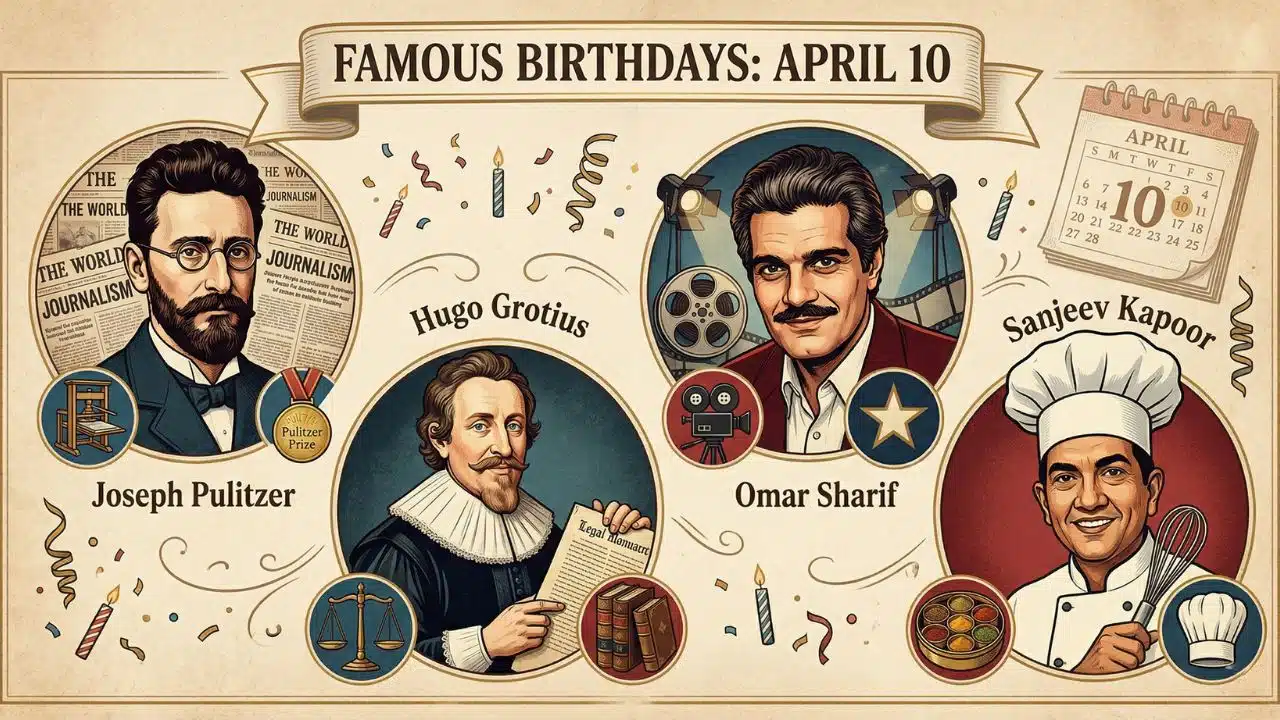
The people born on April 10 have left indelible marks on literature, journalism, acting, and the culinary arts. Here are the most notable figures who celebrate their birth on this day.
1. Joseph Pulitzer (Born 1847)
A Hungarian-born immigrant who arrived in America during the Civil War, Joseph Pulitzer rose to become a towering media mogul and newspaper publisher. Acquiring the St. Louis Post-Dispatch and the New York World, Pulitzer revolutionized the newspaper industry with bold headlines, investigative reporting, and a fierce dedication to championing the working man against corporate corruption. While his intense circulation war with rival William Randolph Hearst gave rise to the sensationalist era of “yellow journalism,” Pulitzer’s enduring legacy is one of journalistic excellence. In his later years, despite suffering from severe blindness and failing health, he endowed the Columbia University Graduate School of Journalism and established the Pulitzer Prizes, which remain the most prestigious awards in American journalism, literature, and musical composition today.
2. Omar Sharif (Born 1932)
Born Michel Yusef Dimitri Chalhoub in Alexandria, Egypt, Omar Sharif became one of the most recognizable, sophisticated, and beloved actors in global cinema. He began his career in Egyptian films before capturing the hearts of global audiences with his magnetic, Academy Award-nominated performance as Sherif Ali in David Lean’s breathtaking epic Lawrence of Arabia (1962). He cemented his legacy as an international leading man in sweeping cinematic masterpieces like Doctor Zhivago (1965) and Funny Girl (1968). Beyond his acting prowess, Sharif was a brilliant polyglot who spoke numerous languages fluently, and he was simultaneously celebrated as one of the world’s highest-ranked and most deeply passionate contract bridge players, even writing a syndicated column on the card game for years.
3. Hugo Grotius (Born 1583)
A brilliant Dutch humanist, diplomat, lawyer, theologian, and poet, Hugo Grotius was a true Renaissance man whose intellect shaped the modern world. He is widely revered as the founding father of modern international law. His seminal 1625 masterwork, De Jure Belli ac Pacis (On the Law of War and Peace), laid the theoretical groundwork for the concept that an international society of states should be governed by mutual agreement, natural law, and legal principles rather than sheer military force. His earlier work, Mare Liberum (The Free Sea), established the enduring legal principle that the oceans are international territory, free for all nations to navigate. Remarkably, Grotius wrote many of his foundational texts while imprisoned in Loevestein Castle, from which he famously escaped by hiding in a large wooden chest meant for transporting his books.
4. Sanjeev Kapoor (Born 1964)
Sanjeev Kapoor is an absolute household name in India and a revered culinary icon among the South Asian diaspora globally. As a pioneering chef, astute entrepreneur, and charismatic television personality, he revolutionized food media in India by hosting the incredibly popular culinary show Khana Khazana, which ran continuously for 18 years. He played a massive, singular role in modernizing traditional Indian cuisine and making complex regional recipes accessible to the everyday home cook. Kapoor successfully elevated the profession of a chef in India from a behind-the-scenes kitchen worker to a celebrated, mainstream media personality. His immense contributions to the culinary arts were officially recognized when the Government of India awarded him the Padma Shri, one of the country’s highest civilian honors.
5. Charlie Hunnam (Born 1980)
Charles Matthew Hunnam is an English actor who first gained attention for his role in the groundbreaking UK drama Queer as Folk, but he achieved massive international superstardom for his gritty, deeply compelling portrayal of the conflicted motorcycle club vice-president Jackson “Jax” Teller in the FX drama series Sons of Anarchy. Over the course of seven seasons, Hunnam’s performance anchored the show, making Jax Teller one of the most iconic anti-heroes of modern television. Following the series’ conclusion, Hunnam successfully transitioned into a dynamic film career, taking on physically demanding leading roles in major blockbuster and independent movies alike, including Guillermo del Toro’s Pacific Rim, Guy Ritchie’s The Gentlemen, and The Lost City of Z.
Just as we celebrate those whose journeys began on this day, it is equally important to honor the legacies of those whose lives came to an end.
Notable Deaths: Remembering Legacies Lost on April 10
The world bid farewell to revolutionary leaders, visionary poets, and comedic talents on April 10. Here are the notable figures who passed away on this date.
1. Kahlil Gibran (Died 1931)
Born in the mountainous region of Bsharri, Lebanon, and later immigrating to Boston, Kahlil Gibran was a profoundly influential writer, poet, and visual artist. He died in New York City at the age of 48 from cirrhosis and tuberculosis, but he left behind a literary legacy that continues to resonate globally. He is best known for his 1923 philosophical masterpiece, The Prophet. Consisting of 26 prose poetry fables delivered by a wise sage, the book explores universal themes of love, marriage, joy, sorrow, and work. While it initially received a quiet critical reception, it became a massive counter-cultural hit in the 1960s. Today, it remains one of the best-selling books in human history, translated into over 100 languages, proving Gibran’s unique ability to seamlessly bridge Eastern mysticism with Western literary formats.
2. Emiliano Zapata (Died 1919)
Emiliano Zapata Salazar was a leading, fiercely dedicated, and uncompromising figure in the Mexican Revolution. As the main leader of the peasant revolution in the southern state of Morelos, he championed the cause of agrarianism—the forceful redistribution of land from wealthy hacienda owners back to the impoverished working peasants—under the famous, enduring slogan “Tierra y Libertad” (Land and Liberty). His ideology was formalized in the Plan of Ayala. Zapata’s relentless campaign made him a massive threat to the government. On April 10, 1919, he was lured into a carefully orchestrated trap at the Hacienda de Chinameca by a treacherous military officer and assassinated in a hail of bullets. His death instantly cemented his status as a national martyr, and his iconic imagery continues to inspire indigenous and social justice movements across the globe today.
3. Evelyn Waugh (Died 1966)
Arthur Evelyn St. John Waugh was a brilliantly sharp English writer of novels, biographies, and travel books, widely recognized as one of the greatest English prose stylists of the 20th century. He died of heart failure at his home in Somerset on this day. Waugh is best known for his biting, darkly comedic, and often cynical early satires like Decline and Fall, Vile Bodies, and A Handful of Dust, which perfectly skewered the frivolous, decaying British aristocracy between the World Wars. Following a profound conversion to Catholicism, his work took on deeper theological and nostalgic tones, resulting in his acclaimed masterpiece Brideshead Revisited and the masterful World War II trilogy Sword of Honour. Despite being notoriously misanthropic in his personal life, his literary genius remains undisputed.
4. Morarji Desai (Died 1995)
Morarji Ranchhodji Desai was a steadfast Indian independence activist and a titan of post-colonial South Asian politics, passing away at the impressive age of 99. He served as the fourth Prime Minister of India from 1977 to 1979, making history by leading the first non-Congress government in the country’s independent history following the controversial Emergency period. Known for his austere, incredibly rigid lifestyle, strict adherence to Gandhian principles, and eccentric personal health practices, Desai played a crucial role in restoring democratic norms in India. Furthermore, he dedicated significant effort to improving foreign relations, famously restoring friendly diplomatic ties with neighboring Pakistan and China. In recognition of his efforts toward peace, he remains the only Indian national to be awarded the Nishan-e-Pakistan, Pakistan’s highest civilian honor.
5. Stuart Sutcliffe (Died 1962)
A talented Scottish painter and musician, Stuart Sutcliffe holds a unique and tragic place in music history as the original bass guitarist for the Beatles. Often affectionately referred to as the “Fifth Beatle,” Sutcliffe was a close art school friend of John Lennon. He played with the band primarily during their grueling, formative, and chaotic club days in Hamburg, Germany. It was Sutcliffe and Lennon who are credited with coming up with the name “Beetles” (later changed to the Beatles), inspired by Buddy Holly’s band, the Crickets. Sutcliffe’s aesthetic, deeply influenced by his fiancée, photographer Astrid Kirchherr, heavily shaped the band’s early iconic look. He tragically died of a sudden brain hemorrhage in Hamburg at the incredibly young age of 21, choosing to pursue his true passion for avant-garde painting just as the band was on the precipice of global superstardom.
To keep these important names and dates easily accessible, we have created a rapid-reference directory for the notable births and deaths.
Quick Reference: April 10 Births and Deaths
Use this table to quickly find the vital information regarding the most famous individuals associated with April 10.
| Name | Year | Category | Profession / Claim to Fame |
| Hugo Grotius | 1583 | Birth | Dutch Philosopher & Father of International Law |
| Joseph Pulitzer | 1847 | Birth | Media Mogul & Founder of the Pulitzer Prizes |
| Omar Sharif | 1932 | Birth | Academy Award-nominated Egyptian Actor |
| Sanjeev Kapoor | 1964 | Birth | Pioneering Indian Celebrity Chef |
| Charlie Hunnam | 1980 | Birth | English Actor (Sons of Anarchy) |
| Emiliano Zapata | 1919 | Death | Mexican Revolutionary Leader |
| Kahlil Gibran | 1931 | Death | Lebanese-American Poet & Author of The Prophet |
| Stuart Sutcliffe | 1962 | Death | Original Bassist for the Beatles |
| Evelyn Waugh | 1966 | Death | Acclaimed British Satirical Novelist |
| Morarji Desai | 1995 | Death | Former Prime Minister of India |
Beyond the lives of individuals, April 10 is also a day dedicated to global awareness, alternative medicine, and communal celebrations.
Global Observances and International Holidays
Around the world, different cultures and organizations use April 10 to highlight specific causes, historical foundations, and familial bonds. Here are the observances held on this day.
1. World Homeopathy Day
This international observance marks the birth anniversary of Dr. Christian Friedrich Samuel Hahnemann, the German physician who founded the system of homeopathy in 1796. Hahnemann developed the doctrine of “like cures like,” a belief that a substance that causes symptoms of a disease in healthy people would cure similar symptoms in sick people when heavily diluted. The day is used globally by practitioners and advocates to promote the integration of homeopathic medicine into traditional healthcare systems, to host symposiums on holistic healing, and to commemorate Hahnemann’s contributions to alternative medicine.
2. National Siblings Day
Primarily celebrated in the United States, Canada, and parts of Europe, this holiday was conceived by native New Yorker Claudia Evart in 1995 to honor the memory of her brother and sister, both of whom tragically passed away at early ages. She chose April 10 to mark her late sister’s birthday. Unlike Mother’s Day or Father’s Day, it is not a federally recognized public holiday, but it has gained massive, widespread popularity through social media as a dedicated day to celebrate the unique, lifelong, and often complex bond between brothers and sisters. People traditionally observe the day by sharing nostalgic childhood photos, reuniting for family dinners, and acknowledging the irreplaceable support system that siblings provide.
3. Salvation Army Founder’s Day
While not an official public holiday, April 10 is widely recognized and celebrated within the global Salvation Army community as the birthday of its founder, William Booth, born in Nottingham, England, in 1829. Booth was a passionate British Methodist preacher who, alongside his wife Catherine, chose to take his evangelical mission out of the traditional church and directly to the impoverished, grimy streets of East London. His mission was to serve the outcasts of Victorian society—the alcoholics, criminals, and destitute—who were traditionally shunned by mainstream congregations. Today, the organization he founded on those streets has grown into one of the largest and most recognizable providers of humanitarian social aid in the world, operating in over 130 countries.
We have journeyed through volcanic ash, across icy oceans, and through the lives of artists and revolutionaries. Let us now reflect on the broader narrative woven by these isolated moments in time.
Final Thoughts
When we review the expansive and detailed history of April 10, it becomes abundantly clear that our present reality is built upon the triumphs, tragedies, and creative outbursts of the past. The sinking of the Titanic remains a stark lesson in the limits of human hubris and the constant necessity of prioritizing safety over luxury and speed. The poetic wisdom of Kahlil Gibran continues to offer profound solace to millions navigating the complexities of modern love and loss, while the rigorous journalistic standards established by Joseph Pulitzer remain the essential ethical north star for reporters fighting for truth worldwide. Even the catastrophic eruption of Mount Tambora serves as a permanent, chilling reminder of the Earth’s fragile climate balance and humanity’s vulnerability to the sheer forces of nature. By understanding the true breadth and depth of what happened on this day, we not only honor the memory of those who came before us, but we also equip ourselves with the vital historical context needed to navigate the challenges of our own time.