

We have all been there. You buy a bag of spinach with the best intentions, planning a week of healthy salads. But three days later, you open the crisper drawer to find a slimy, green mess staring back at you. It feels terrible, doesn’t it? You are not just throwing away food; you are throwing away your hard-earned cash. In fact, recent data shows the average household tosses out roughly $1,500 worth of perfectly good food every single year. That is the cost of a nice vacation or a significant chunk of a mortgage payment, sitting right there in your trash can.
But here is the good news: you do not have to be a zero-waste expert to fix this. Technology has finally caught up with our kitchen habits. The best food waste apps are designed to make saving food easy, fun, and surprisingly cheap. Whether you want to buy discounted meals from local restaurants, share surplus ingredients with neighbors, or just manage your own pantry better, there is a tool for that. This guide digs deep into the top five apps that are actually worth your storage space in 2026. We are looking at real usability, genuine savings, and how these tools fit into a busy life.
Why Food Waste Is a Bigger Deal Than You Think?
It is easy to think that tossing a half-eaten sandwich or a bruised apple does not matter much. But when you zoom out, the picture gets scary fast. Food waste is not just an ethical issue; it is an economic and environmental disaster that affects everyone. First, let us talk about your wallet. When you waste food, you are paying for the product, the gas to get it, the electricity to store it, and often the taxes on top. In a time of rising inflation, cutting waste is the fastest way to give yourself a raise. If you could stop throwing away 20% of your groceries, that is instant cash back in your pocket.
Then there is the planet. If food waste were a country, it would be the third-largest emitter of greenhouse gases, right behind China and the United States. Rotting food in landfills releases methane, a gas that is far more potent than carbon dioxide at trapping heat. Using the best food waste apps is one of the single most effective actions an individual can take to fight climate change. It is low effort, high reward. We are seeing a massive shift in 2026 where “eco-anxiety” is being replaced by “eco-action,” and these digital tools are leading the charge.
| Cost Type | Description | Who Pays? |
| Direct Financial | Money spent on purchasing the food. | You (The Consumer). |
| Resource Loss | Water, land, and energy used to grow crops. | The Planet. |
| Disposal Cost | Municipal fees for trash collection and landfill management. | Taxpayers. |
| Environmental | Methane emissions from landfills. | Everyone (Climate Change). |
| Global Impact | 8-10% of total greenhouse gas emissions come from waste. | Future Generations. |
How We Chose These Top 5 Apps?
There are dozens of sustainability apps out there, but let’s be honest—most of them just clutter up your phone. To find the true winners, we looked for apps that solve specific problems without adding more chores to your day. We did not just look at download numbers; we looked at utility. We judged them on four main things. First, Ease of Use. If it takes ten minutes to log a banana, nobody is going to do it. The interface needs to be snappy and intuitive.
Second, Cost. Does the app save you more money than it costs? (Spoiler: most of these are free to use). Third, Impact. Does it actually keep food out of the bin, or is it just a gimmick? We looked for verified data on meals saved. And finally, Community. Apps like Olio rely on active users, so we checked if real people are actually using them in 2026. The apps below cover the full spectrum. Some help you buy cheap food, others help you share it, and some help you cook what you already have.
| Criteria | What We Looked For | Why It Matters |
| User Interface | Clean, intuitive design. | Complexity kills habit formation. |
| Real Savings | Verified discounts or money saved. | Inflation is high; every cent counts. |
| Accessibility | Available on iOS and Android. | Everyone should have access. |
| Reliability | Regular updates and bug fixes (2025/26). | A crashing app is useless. |
| User Base | Active local communities. | Sharing apps need neighbors to work. |
1. Too Good To Go: The Treasure Hunter’s Choice
If you love a bargain and a bit of mystery, Too Good To Go is the undisputed king of the best food waste apps. This app connects you with local restaurants, bakeries, and supermarkets that have surplus food at the end of the day. Instead of throwing it away, they sell it to you in a “Surprise Bag” for a fraction of the price—usually about one-third of the original cost. It has become a cultural phenomenon, with users sharing their “hauls” on social media.
How It Works?
You open the app and browse a map of nearby stores. You will see icons for pizza places, bagel shops, or high-end grocery stores. You reserve a bag, pay through the app (usually between $3.99 and $5.99), and head to the store during the specified pickup window. You show your phone to the staff, they swipe to confirm, and you walk out with a bag of food. The “Surprise” element is key here—you might get three slices of gourmet pizza, a loaf of artisan bread, or a box of pastries. It turns the mundane act of grocery shopping into a treasure hunt.
| Feature | Details |
| Best For | Adventurous eaters and bargain hunters. |
| Cost | Free to download; pay per bag. |
| Average Savings | 60-70% off retail price. |
| Downside | You cannot choose specific items (Dietary restrictions beware). |
| User Base | Over 100 million registered users globally. |
| Top Tip | Check the app right after lunch rush (2 PM) for dinner deals. |
2. Olio: The Community Builder
Olio operates on a beautiful, simple premise: there is probably someone walking distance from you who wants the food you are about to throw away. It is essentially a hyper-local freecycle network for food (and now, non-food household items too). In 2026, the app has evolved to become a major hub for community connection, helping neighbors break the ice while breaking bread. It is perfect for those times you buy a massive bag of lemons and only need one.
How It Works & The “Food Waste Heroes”?
Let’s say you are going on vacation and have a carton of eggs and some yogurt that will spoil before you get back. You snap a photo, add a quick description, and list it on the app. Neighbors get a notification, browse the listings, and message you to arrange a pickup. It is usually contactless—you just leave it on your porch. Beyond neighbor-to-neighbor sharing, Olio’s “Food Waste Heroes” program is a game changer. Volunteers collect unsold food from local businesses (like Tesco or Pret A Manger) and list it on the app for free. This means you can often find bakery items or grocery staples in bulk, completely free of charge.
| Feature | Details |
| Best For | Social butterflies and community-minded folks. |
| Cost | 100% Free. |
| Unique Feature | Includes non-food items like toiletries or cleaning supplies. |
| Downside | Relies heavily on how active your local neighborhood is. |
| Safety | Verified profiles and star ratings build trust. |
| Impact | Over 200 million portions of food shared to date. |
3. Flashfood: The Grocery Bill Slasher
While Too Good To Go focuses on restaurants, Flashfood is all about the grocery store. This app partners with major supermarket chains to sell food that is nearing its “best by” date at a massive discount—often 50% off or more. It is a more practical, less “mysterious” option compared to other apps because you see exactly what you are buying before you pay. For families trying to stretch a dollar, this is arguably the most valuable tool on the list.
How It Works?
You open the app and choose a participating grocery store near you. You can browse specific items—meat, dairy, produce boxes, bakery goods—and see the discounted price right there. You pay for the items in the app, then go to the store. There is usually a dedicated “Flashfood Zone” (often a bright purple fridge or rack) near the front of the store where you grab your items and confirm pickup at customer service. It is fantastic for stocking up on expensive items like steak or chicken that you can freeze immediately for later use.
| Feature | Details |
| Best For | Families, meal preppers, and budget shoppers. |
| Cost | Free app; pay for groceries. |
| Transparency | High. You see exactly what you are buying (photo included). |
| Downside | Limited to partner grocery chains (location dependent). |
| Hidden Gem | “Veggie Boxes” often cost $5 for $15+ worth of produce. |
| Tech Update | New 2026 update allows SNAP/EBT payments in some regions. |
4. Kitche: The Smart Kitchen Assistant
Buying cheap food is great, but what about the stuff you already bought and forgot about? Kitche is designed to stop you from buying a jar of oregano when you already have three at home. It is a home inventory manager that takes the work out of tracking your food. Unlike other inventory apps that require tedious manual entry, Kitche uses smart scanning technology to do the heavy lifting for you, making it one of the best food waste apps for the disorganized.
How It Works & “Swipe to Toss”?
The genius of Kitche is the receipt scanning. You simply snap a photo of your grocery receipt, and the app automatically identifies the items and adds them to your digital pantry. It then estimates how long those items will last and categorizes them. It also has a “Swipe to Toss” feature that tracks the monetary value of the food you waste. Seeing that you just threw $15 of produce in the bin is a powerful wake-up call. It also integrates with recipe suggestions, so if you have a lot of tomatoes expiring, it will suggest a tomato soup recipe.
| Feature | Details |
| Best For | Disorganized shoppers and data lovers. |
| Cost | Free. |
| Tech Magic | Optical Character Recognition (OCR) for receipts. |
| Downside | Requires a habit change to scan receipts consistently. |
| Motivation | Tracks money wasted to guilt/inspire you into action. |
| Platform | Works on both iOS and Android. |
5. SuperCook: The “Zero Waste” Chef
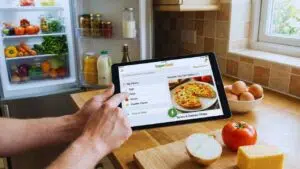
We have all stood in front of an open fridge, full of random ingredients, and thought, “I have nothing to eat.” SuperCook proves you wrong. This is the ultimate engine for reverse-engineering your dinner. Instead of deciding what you want to eat and then buying ingredients, SuperCook asks what you have and tells you what you can make. It is the perfect antidote to “food fatigue” and the impulse to order takeout when the fridge looks uninspiring.
How It Works?
You select ingredients from a massive digital list to populate your virtual pantry. You can type them in or use voice dictation (which is surprisingly fast). Once you tell SuperCook that you have onions, eggs, a calm tomato, and some cheddar cheese, it instantly searches thousands of recipe sites to find meals that match those exact items. It distinguishes itself from Google by filtering out recipes that require ingredients you don’t have. In 2026, its AI has gotten even smarter, suggesting substitutions (e.g., “Use yogurt instead of sour cream”) to help you use what is on hand.
| Feature | Details |
| Best For | Creative cooks and avoiding grocery trips. |
| Cost | Free (ad-supported). |
| Database | Access to millions of recipes from across the web. |
| Downside | The interface can be a bit cluttered with ads. |
| Convenience | Voice dictation makes adding ingredients super fast. |
| Flexibility | Filters for diet (Vegan, Gluten-Free, Keto). |
Comparison Table: Which App Suits Your Lifestyle?
Finding the right tool depends on your personal struggles. Do you buy too much? Do you cook too little? Or do you just love a deal? Here is how they stack up against each other.
| App Name | Primary Goal | Effort Level | Best For… |
| Too Good To Go | Buying cheap surplus meals | Low | Treat seekers & non-cooks |
| Olio | Sharing with community | Medium | Social people & declutterers |
| Flashfood | Discounted groceries | Low | Families & Meat eaters |
| Kitche | Inventory management | High (initially) | Organized planners |
| SuperCook | Recipe generation | Low | Home cooks |
Beyond the Screen: Manual Habits to Pair with Apps
Apps are fantastic tools, but they cannot physically stop an apple from rotting if you leave it in a warm sunbeam. To truly master the art of zero waste, you need to combine technology with some good old-fashioned kitchen common sense. The apps are the software, but your habits are the hardware. You need both to run a sustainable kitchen.
First, learn proper storage. Did you know that onions make potatoes sprout faster if stored together? Or that herbs stay fresh for weeks if you treat them like flowers in a glass of water? Small tweaks in how you put away groceries can double their lifespan. Second, try the “Eat Me First” box. Grab a simple plastic bin, label it “Eat Me First,” and put it at eye level in your fridge. Any open sauces, leftovers, or produce that is looking sad goes in there. When you open the fridge for a snack, you look there first. It is a physical reminder that works perfectly alongside digital reminders from apps like Kitche.
| Hack | Action | Result |
| Zone Your Fridge | Designate shelves for specific items. | No more lost yogurt at the back. |
| The Freezer Bag | Keep a bag for veggie scraps. | Make free stock when it is full. |
| Label Leftovers | Use masking tape and a marker for dates. | No more “mystery tupperware.” |
| FIFO Method | “First In, First Out” rotation. | Older items get used before new ones. |
Final Thoughts
Reducing food waste does not require a complete lifestyle overhaul. You do not need to start composting in your studio apartment or canning your own jams tomorrow. It starts with awareness. The best food waste apps act as that bridge between your good intentions and your daily reality. They lower the barrier to entry, making sustainability accessible to everyone, regardless of budget or cooking skill.
If you download just one of these apps today, you are taking a massive step. Maybe you grab a pizza on Too Good To Go this Friday instead of ordering full-price delivery. Maybe you use SuperCook to figure out what to do with that lonely can of chickpeas. These small wins add up—saving you hundreds of dollars a year and keeping tons of CO2 out of the atmosphere. So, pick your tool, save a meal, and feel good about it. Your wallet and the planet will thank you.






















