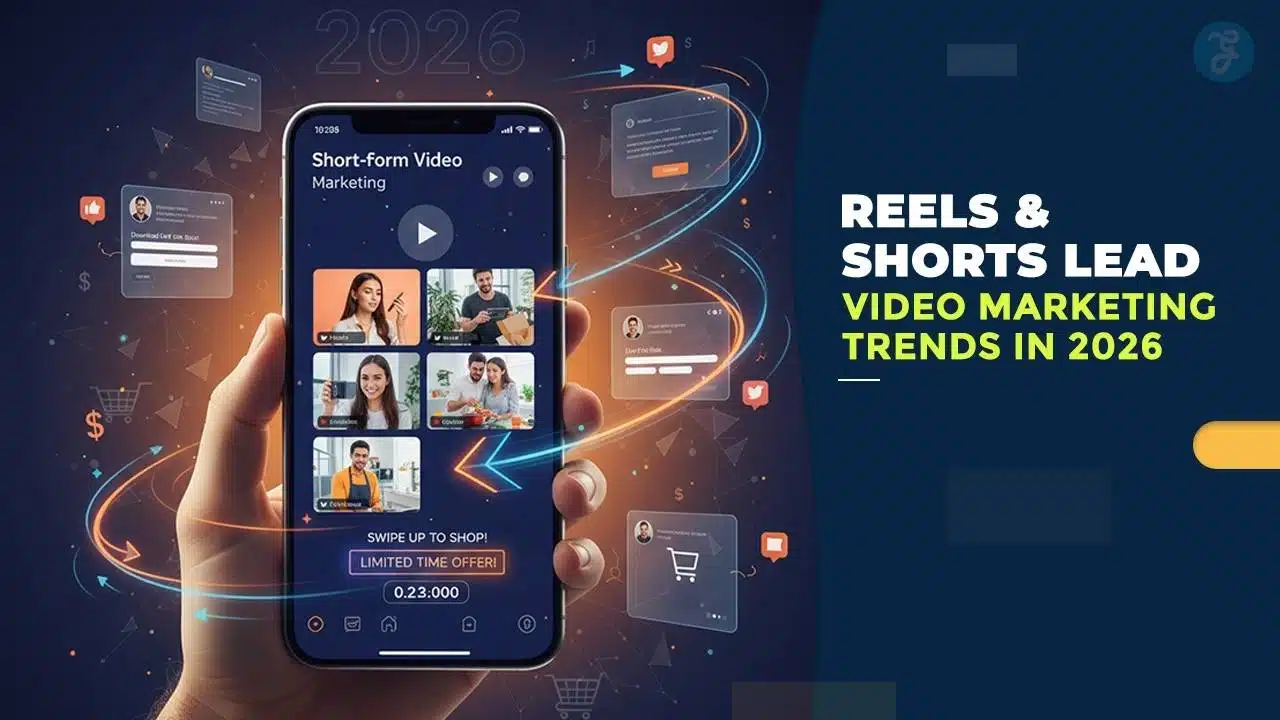
The digital landscape has shifted beneath our feet. If you are still treating video as just another content bucket in your marketing strategy, you are already behind. Short-Form Video Marketing Trends 2026 indicate a fundamental restructuring of how consumers discover, learn about, and purchase products. The era of the “viral hit” is over; we have entered the era of “video utility.”
In 2026, short-form video is not just a format; it is the operating system of the internet, driving 82% of all global web traffic and fundamentally replacing text-based search for the Gen Z and Alpha demographics. The dominance of platforms like TikTok, YouTube Shorts, and Instagram Reels has forced a “quality reset” across the industry. It is no longer enough to post a dancing influencer and hope for engagement. The algorithms of 2026 prioritize “Search Experience Optimization” (SXO), value retention, and “zero-click” commerce.
As attention spans average out at 8.25 seconds, the brands winning today are the ones that have mastered the art of the “micro-narrative”, delivering a complete emotional and informational arc in under 60 seconds. This analysis delves deep into the data, the technology, and the strategies that define video marketing in 2026.
The Landscape of 2026: By The Numbers
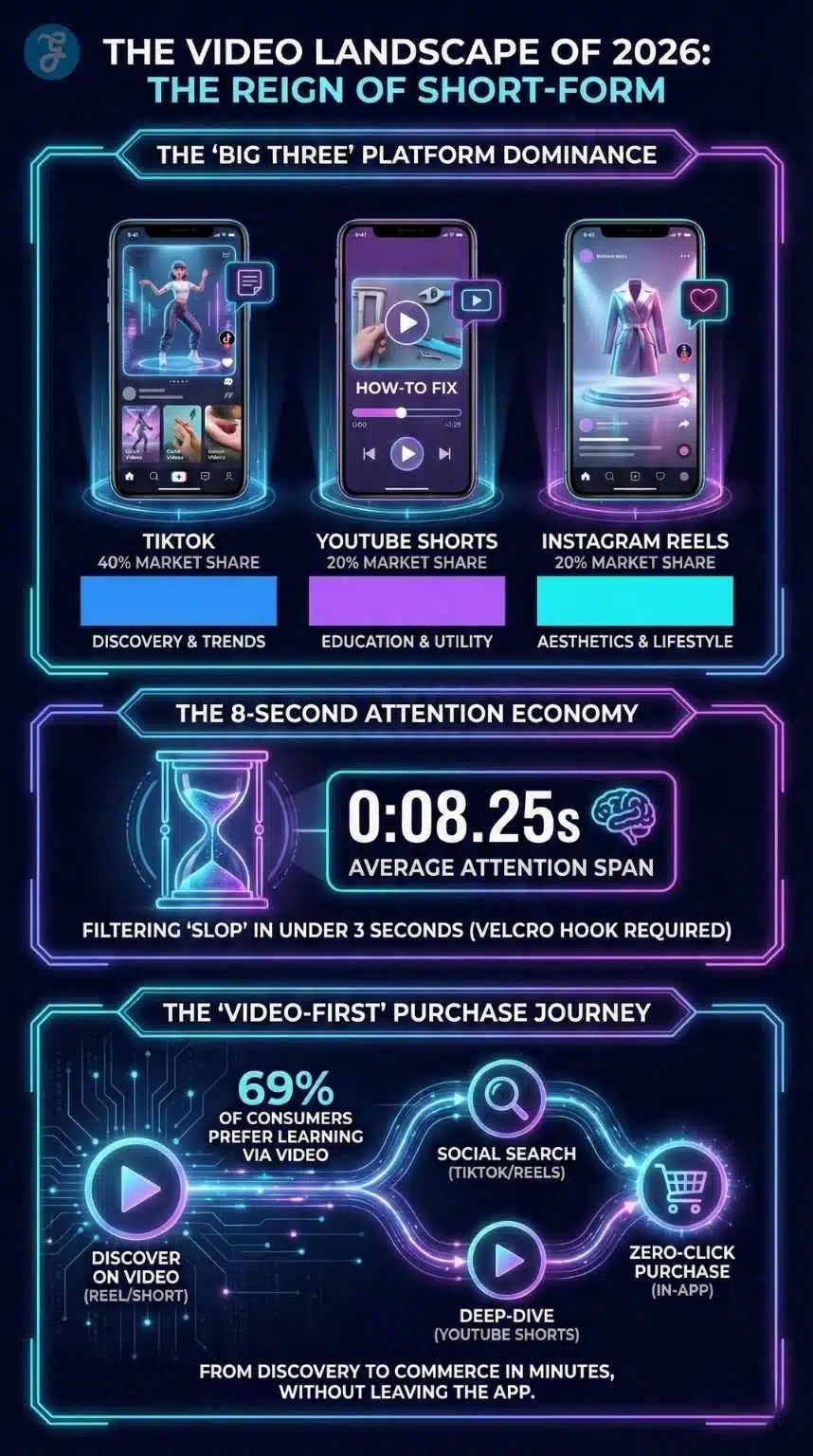
To understand why short-form content is king, we must first look at the sheer scale of consumption. In 2024, we spoke of “growth”; in 2026, we speak of “saturation.” Video is no longer a subset of the internet; for millions of users, it is the internet.
The “Attention Economy” and the 8-Second Rule
The most critical metric in 2026 is not “views” but “retention rate.” Data from the 2026 Global Digital Report highlights a stark reality: human attention spans have stabilized at approximately 8.25 seconds, less than that of a goldfish. However, this statistic is often potentially misinterpreted. It is not that humans cannot pay attention; it is that they have become ruthlessly efficient at filtering out “slop.”
Users in 2026 make a subconscious decision to scroll or stay within the first 3 seconds of a video. This has given rise to the “Velcro Hook” method, a creative standard where the visual and audio hook must happen instantaneously. There is no “intro music,” no “hey guys,” and no slow fades. The content begins in media res.
Platform Dominance: The “Big Three”
While new challengers continually emerge, the market in 2026 is solidified around three primary giants, each serving a distinct psychological function for the user.
| Platform | Market Share (Est.) | User Intent & “Vibe” | Primary Use Case for Marketers |
| TikTok | 40% | Discovery & Entertainment. Users are in a “lean-back” mode but switch to “lean-forward” for search. It is the cultural engine where trends are born. | Brand Awareness, Viral Reach, Impulse Buying (TikTok Shop). |
| YouTube Shorts | 20% | Education & Utility. Users are often seeking answers. The content is more “evergreen” and less trend-dependent. | SEO Traffic, How-To Guides, Long-form Teasers, B2B Marketing. |
| Instagram Reels | 20% | Aesthetics & Lifestyle. Highly curated. Users are looking for inspiration (fashion, travel, decor). | High-End Retail, Local Business Discovery, Influencer Partnerships. |
| Other (LinkedIn, Snap) | 20% | Professional & Niche. LinkedIn video has exploded for B2B, focusing on “silent” expertise. | Thought Leadership, Corporate Branding, Direct Messaging. |
The “Video-First” Purchase Journey
Perhaps the most stunning statistic of 2026 is that 69% of consumers now prefer to watch a short video to learn about a product rather than read a text-based article or view a static image. The “video-first” journey means that a customer might see a product on a Reel, search for a review on TikTok, and watch a detailed breakdown on YouTube Shorts—all before ever visiting a brand’s website.
Trend #1: Social SEO & “Google Zero”
The single biggest shift in Video Marketing Strategy 2026 is the decline of traditional search engines for lifestyle queries. For anyone under the age of 30, TikTok and Instagram are Google. This phenomenon, known as “Social Search,” requires a completely different optimization strategy.
Why Social Search is Winning
When a user searches “best budget laptop 2026” on Google, they often get a list of SEO-spam blogs filled with affiliate links. When they search the same term on TikTok or Reddit (via video), they get a real human showing the product, turning it around, and giving an honest opinion. This “authenticity gap” has driven users away from the SERP (Search Engine Results Page) and into the app.
Optimizing for the Algorithm (SXO)
In 2026, algorithms are multimodal. They “watch” and “listen” to your video. To rank in these social search engines, you must optimize three layers of your content:
- Visual Layer (OCR): Algorithms use Optical Character Recognition to read the text on your video screen. If your video is about “email marketing,” that phrase must appear physically on the screen in the first few seconds.
- Audio Layer (NLP): Natural Language Processing scripts transcribe your audio. You must speak your keywords clearly. “Hey guys” is a waste; “Here is the best email marketing strategy” is gold.
- Metadata Layer: This is the traditional caption and hashtag game. However, in 2026, keywords in the caption outweigh hashtags. A detailed, keyword-rich caption of 100-200 words helps the algorithm categorize your content accurately.
Strategic Takeaway: Stop treating captions as afterthoughts. Treat them like mini-blog posts. If you want to rank for “Video Marketing Trends 2026,” that phrase needs to be on the screen, spoken in the audio, and written in the first sentence of your caption.
Trend #2: The “Silent” Revolution & Dynamic Captioning
We are living in a “sound-off” world. Data indicates that up to 85% of short-form video consumption on platforms like Facebook and LinkedIn happens with the sound off. On TikTok and Reels, while sound is more common, “mixed-mode” viewing (watching while commuting, in bed next to a sleeping partner, or in a waiting room) is the norm.
The Accessibility Standard
In 2026, captions are not an accessibility “feature”—they are a retention requirement. Videos without captions see a drop-off rate of nearly 40% within the first 3 seconds. The modern viewer will not turn their volume up for you; they will simply scroll past.
The Rise of “Kinetic Typography”
This trend has birthed a specific aesthetic known as “Kinetic Typography.” These are not the static subtitles of Netflix. These are dynamic, word-by-word animations that pop onto the screen in sync with the audio.
- Color-Coded Emphasis: Key words are highlighted in different colors (e.g., “The secret to sales is…”).
- Visual Pacing: The speed of the text forces the eye to track the movement, effectively “hypnotizing” the viewer and preventing them from looking away (or scrolling).
Strategic Takeaway: If you are editing your own videos, you must use AI captioning tools (like Captions.ai or Adobe Premiere’s auto-transcription) to generate these effects. A video with static, small text at the bottom will underperform against a video with dynamic, center-screen text.
Trend #3: AI-Driven Production vs. Human Authenticity
The conversation around AI in 2026 is nuanced. The initial flood of “AI Slop”, low-quality, purely AI-generated videos, has largely been filtered out by platform algorithms. What remains is “High-Fidelity AI” used as a production assistant, clashing with a counter-trend of “Radical Authenticity.”
The AI Workflow: Volume & Efficiency
For marketing teams, AI is the only way to sustain the volume required in 2026. To grow a channel, daily posting is the baseline.
- AI B-Roll: Tools like OpenAI’s Sora and Google’s Veo allow creators to generate specific B-roll shots (e.g., “drone shot of a futuristic city with neon lights”) instantly, saving thousands on stock footage licensing.
- Virtual Avatars: Brands are increasingly using hyper-realistic AI avatars (built on tools like HeyGen) for routine updates, FAQs, and educational content. These avatars never age, never sleep, and speak 40 languages fluently.
- Scripting & Ideation: LLMs are used to generate 50 video ideas in seconds, based on trending keywords.
The “Uncanny Valley” Backlash
However, there is a strong consumer reaction against polished perfection. As AI content becomes indistinguishable from reality, users have begun to crave “proof of humanity.”
- The “Shaky Cam” Aesthetic: High-performing ads in 2026 often look like they were filmed on a phone, with bad lighting and messy backgrounds. This signals to the viewer: “This is real. This is not a bot.”
- Verification: Platforms are testing “Human Verified” badges for content that is certified to be filmed by a person without generative AI alteration.
| Feature | AI-Driven Content | Human-First Content |
| Best Used For | Scalable tutorials, international dubbing, B-roll, and visual effects. | Founder stories, vlogs, trust-building, crisis management. |
| Cost | Low (Subscription-based). | High (Time, equipment, talent). |
| Trust Factor | Low to Medium. | High. |
| 2026 Trend | Used for “Filler” and “Utility” content. | Used for “Connection” and “Sales” content. |
Trend #4: Shoppable Video & The “Zero-Click” Funnel
In traditional digital marketing, the goal was to get the user to click a link and visit a website. In 2026, the funnel collapsed. The goal is now to get the user to buy without ever leaving the video.
TikTok Shop and the Integration of Commerce
TikTok Shop set the standard, and now YouTube Shopping and Instagram Checkout have followed. The “Shop” button is overlaid directly on the video.
- Impulse Economics: The friction of “Link in Bio” -> “Open Browser” -> “Add to Cart” -> “Checkout” killed conversion rates. The 2026 “Zero-Click” model allows a purchase in 2 taps.
- Live Shopping: Livestream shopping has finally matured in the West, mirroring the massive success it saw in China earlier in the decade. Brands run 2-hour “shopping events” where hosts demo products and offer limited-time flash sales that appear on-screen.
The Affiliate Army
This trend has democratized marketing. Brands in 2026 don’t just hire agencies; they hire armies of micro-affiliates. A brand puts its product in the “TikTok Shop Affiliate Center,” and thousands of creators can make videos about it. If they sell a unit, they get a commission automatically. This “decentralized sales force” is the most powerful growth engine for D2C (Direct-to-Consumer) brands in 2026.
Trend #5: The “Glocal” Strategy [AI Dubbing & Localization]
In 2024, if you wanted to reach a Spanish-speaking audience, you would hire a translation agency and wait three weeks. In 2026, you click a button. The rise of “Glocal” (Global reach, Local feel) marketing is powered by AI dubbing tools that have achieved 98% accuracy in lip-synchronization.
The End of Subtitles?
While captions remain vital for sound-off viewing, audio is still the primary emotional driver. New tools like Keevx and Rask AI 2.0 allow marketers to take a single English video and instantly generate versions in Mandarin, Hindi, Spanish, and Arabic.
- Visual Translation: It is not just the voice; the AI adjusts the speaker’s lip movements to match the new language phonetically. This creates an eerie but effective illusion that the CEO or influencer is actually speaking that language fluently.
- The “MrBeast Effect” for Everyone: What was once a strategy available only to top YouTubers is now standard for SMEs. A US-based software company can now run localized video ads in Brazil with a native-sounding Portuguese voiceover, increasing conversion rates by up to 40% compared to subtitled content.
Strategic Takeaway: Stop limiting your viral videos to one language. If a video performs well in the US, use AI to “clone” it for 10 other markets overnight.
Trend #6: B2B Goes Vertical [The LinkedIn Shift]
For years, B2B video was synonymous with boring webinars and zoomed-out conference panels. 2026 has flipped this script. LinkedIn’s algorithm now aggressively prioritizes vertical, short-form video, forcing B2B leaders to become “corporate influencers.”
The Rise of “Zero-Click” Content
The most successful B2B strategy in 2026 is “Zero-Click Consumption.”
- The Old Way: “Watch this 2-minute teaser and click the link to see the full webinar.”
- The New Way: “Here is the single most valuable 60-second clip from that webinar. No need to click anywhere.”
- Why It Works: Platforms like LinkedIn penalize posts that drive users off the platform. By giving away the value upfront within the feed, you build “Authority Score” with the algorithm, which eventually leads to inbound DMs rather than outbound clicks.
The “1:1 Video Audit”
Sales teams have largely abandoned cold calling in favor of the “1:1 Video Audit.”
- The Tactic: A sales rep records a 60-second screen-share video analyzing a prospect’s website or current setup, pointing out one specific fix.
- The Result: These hyper-personalized videos have a 3x higher response rate than text emails because they provide “proof of work” before the conversation even starts.
Strategy Guide: Building a “Search-First” Video Engine
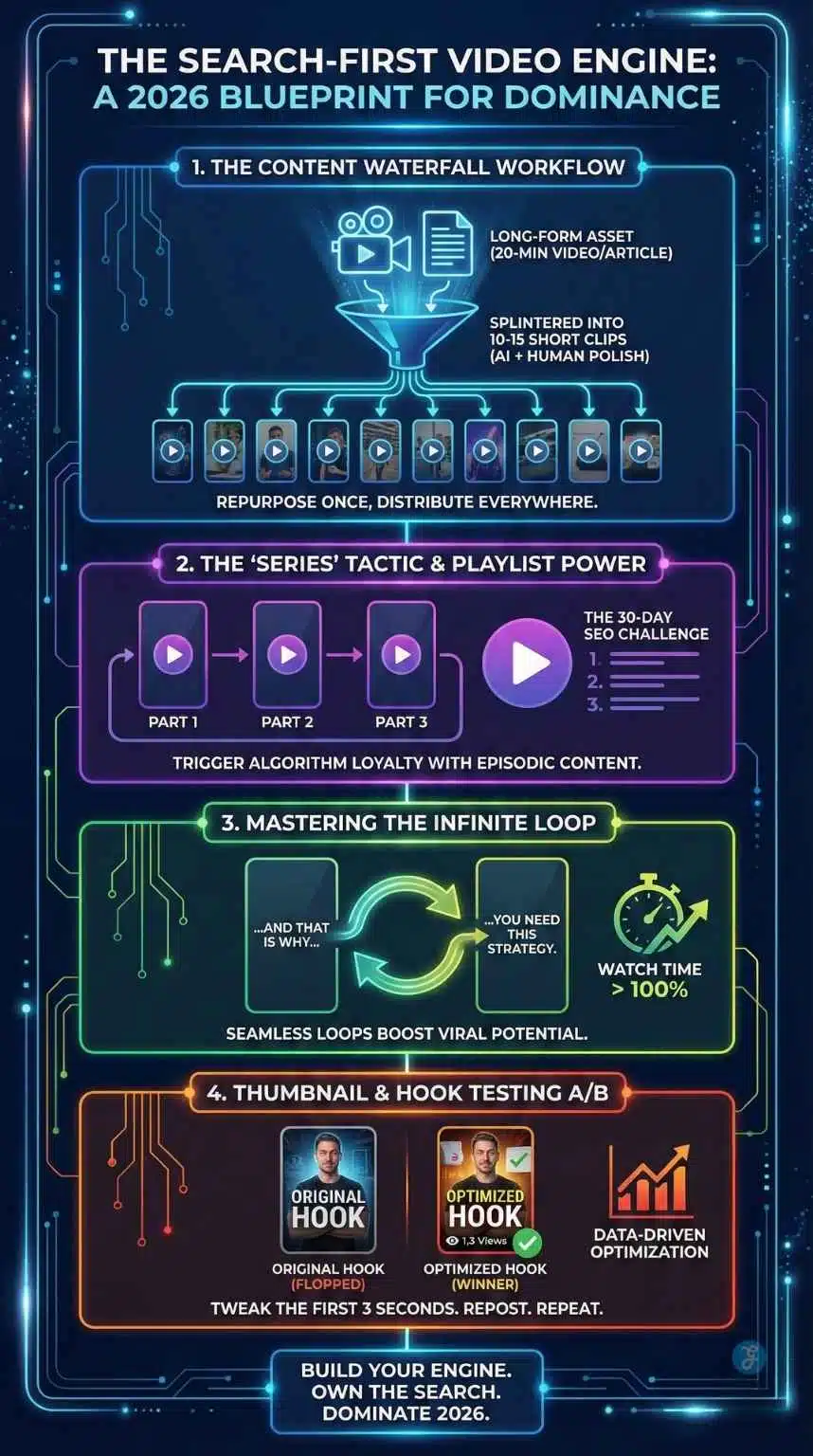
Knowing the trends is one thing; executing them is another. Here is a step-by-step blueprint for building a winning Video Marketing Strategy 2026.
Step 1: The “Content Waterfall” Workflow
You cannot create unique videos for every platform. You need a repurposing engine.
- The Core Asset: Record a long-form video (e.g., a 20-minute podcast or tutorial) or write a deep-dive article (like this one).
- The Splintering: Use AI tools (like Opus Clip) to slice that long asset into 10-15 short vertical clips.
- The Polish: Manually adjust the hooks. The AI is good at finding clips, but humans are better at writing hooks. Ensure the first 3 seconds of every clip are visually arresting.
Step 2: The “Series” Tactic
One-off videos do not build loyalty. Algorithms love “Series.”
- Create a bucket of content called “The 30-Day SEO Challenge” or “Marketing Myths, Part 1.”
- Psychology: When a user sees “Part 4” on their feed, they instinctively check your profile to find Parts 1, 2, and 3. This signals “high engagement” to the algorithm and boosts your entire account.
Step 3: Mastering the “Loop”
The perfect short-form video in 2026 doesn’t end; it loops.
- The Technique: Write your script so the last sentence flows seamlessly into the first sentence.
- Example:
- End of video: “…and that is exactly why…”
- Start of video: “…you are failing at video marketing.”
- Result: The viewer watches the video 1.5 times before realizing it has restarted. This “Watch Time > 100%” metric is rocket fuel for viral growth.
Step 4: Thumbnail & Hook Testing
Even for Shorts/Reels, the “Cover Image” (Thumbnail) matters on the profile grid.
- Use consistent typography.
- Use “face-forward” emotions (surprise, anger, joy).
- Test hooks: If a video flops, download it, change the opening 3 seconds (the hook), and repost it. 2026 algorithms are forgiving of reposts if the creative is tweaked.
Analytics 2.0: Beyond Vanity Metrics
In the “Viral Era,” we counted Views. In the “Utility Era” of 2026, we count Revenue Velocity. If you are reporting “1 million views” to your CMO, you are reporting noise. Here are the three metrics that actually matter in 2026.
1. Consumption Rate (CR)
- What it is: The percentage of your video watched by the average user.
- The Benchmark: In 2026, a “good” video has a >90% completion rate for videos under 30 seconds.
- The Insight: If your drop-off point is at the 7-second mark, your content isn’t “boring”—your hook promised something the body didn’t deliver immediately.
- What it is: The number of times a video is forwarded via DM, WhatsApp, or Slack.
- Why it matters: Public likes are vanity; private shares are intent. When a user shares your video privately, they are usually saying, “We should buy this” or “Look at this strategy.”
- Tracking: Platforms now offer “Share Copy” metrics that track when a link is copied to the clipboard, serving as a proxy for Dark Social activity.
3. Return on Attention (ROA)
- The New ROI: Instead of just measuring ad spend vs. revenue, 2026 marketers measure the time users spend with the brand vs. revenue.
- Calculation: If users spent a collective 50,000 hours watching your content this month, and you generated $50k, your ROA is $1 per hour of attention. Increasing this density is the primary goal of retention editing.
Platform Specifics: Where to Post What?
While you should cross-post, nuance is key.
TikTok: The “Raw” Engine
- Vibe: Messy, chaotic, honest.
- Best For: Behind-the-scenes, trending audio memes, employee takeovers.
- Don’t: Post highly polished, TV-commercial style ads. You will be bullied in the comments.
YouTube Shorts: The “Library”
- Vibe: Informative, clean, structured.
- Best For: “How to fix X,” “3 tips for Y,” Summaries of long videos.
- SEO Tip: The title of your Short functions exactly like a Google search title. Keyword stuff it.
Instagram Reels: The “Magazine”
- Vibe: Aesthetic, high-resolution, aspirational.
- Best For: Product showcases, travel montages, client testimonials.
- Audio: Trending audio tracks are critical here. Using a trending sound can 10x your reach, even if the video is mediocre.
Future Outlook: Beyond the Screen
As we look toward the latter half of 2026 and into 2027, the definition of “video” is expanding. The release of affordable consumer AR (Augmented Reality) glasses is beginning to overlay video content onto the real world. Imagine looking at a restaurant and seeing a TikTok review floating next to the menu.
While this technology is in its infancy, the “Video Marketing” skills you build today, concise storytelling, visual hooks, and “silent” communication, are the exact skills that will define the AR era.
Final Words: The “Utility” Mandate
The Video Marketing Trends of 2026 tell a clear story: The party is over, and the workday has begun. Short-form video has graduated from a novelty act to the primary mode of human communication.
For brands, the mandate is simple: Be useful, be brief, and be searchable. The winners will not be the ones with the biggest budgets, but the ones who understand that every video is a potential answer to a customer’s question. If you can answer that question in 60 seconds, with clarity and authenticity, you will own the market.