Imagine this scenario: You unlock your phone and ask Google, “What is the best project management software for small creative teams?” In the old days, let’s say, 2023, you would have been presented with ten blue links. You would have clicked on TechRadar, then PCMag, and maybe a blog post from Monday.com. You, the user, were the explorer, and the search engine was merely the map.
Today, in 2026, the experience is radically different. You ask the question, and before you can even blink, Google’s AI Overview (formerly SGE) constructs a comprehensive, paragraph-long answer. It compares three top tools, lists their pricing in a neat table, and offers a “Key Takeaway.” You get your answer. You lock your phone. You never visit a single website.
This is the Zero-Click Search phenomenon. It is the defining shift of the decade, transforming the internet from a library of links into a direct-answer machine.
The Zero-Click Crisis: Why Traffic Is Vanishing
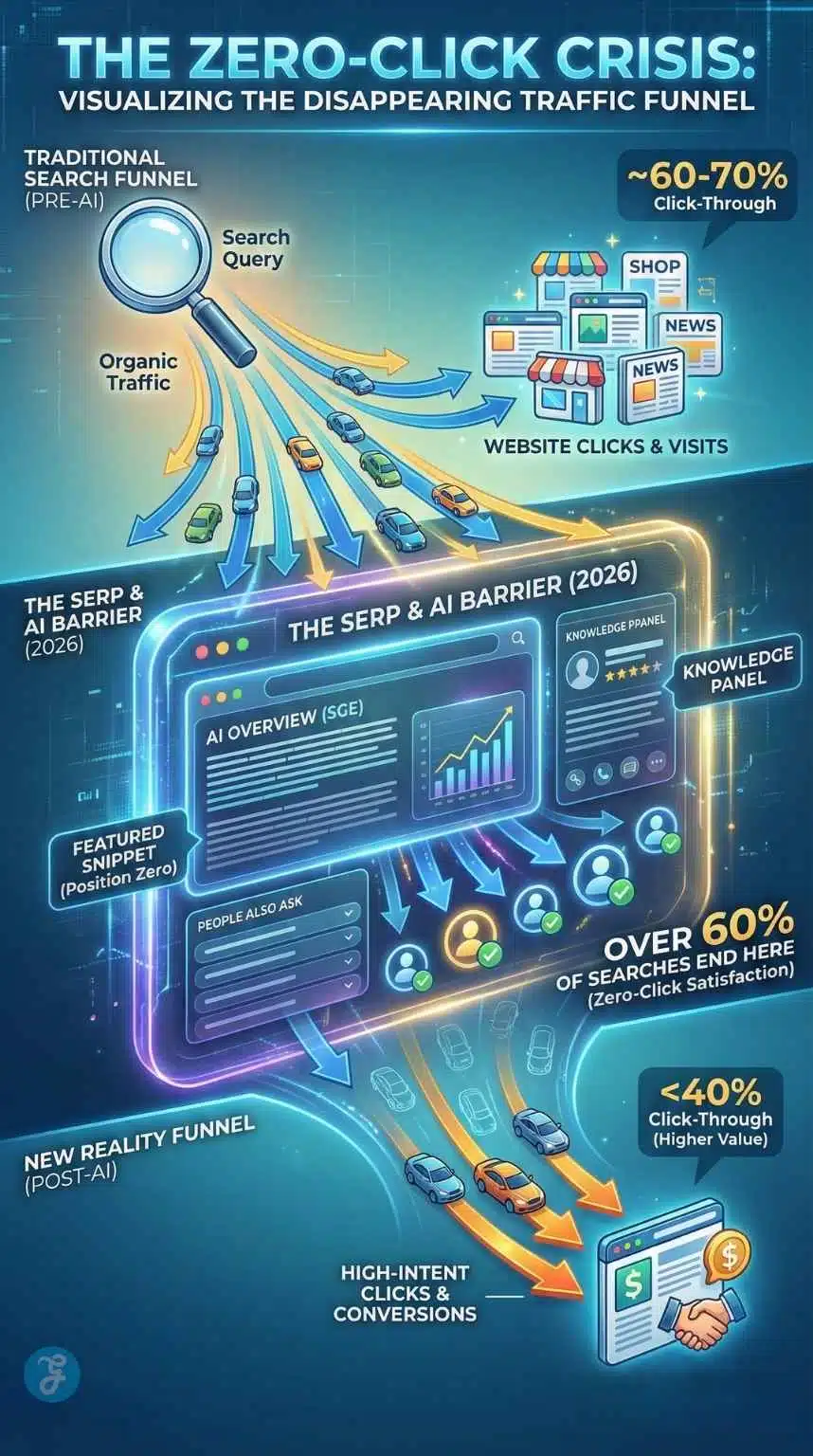
For marketers, business owners, and content creators, this initially feels like a catastrophe. According to the latest data from early 2026, over 60% of all Google searches now end without a click. For mobile users, that number is creeping even higher. The rise of AI Overviews, interactive Knowledge Panels, and “People Also Ask” expansions has fundamentally broken the traditional SEO funnel. If users aren’t clicking, how do we get traffic? If we don’t get traffic, how do we get leads?
These are the questions keeping SEOs up at night. But here is the hard truth: The “click” is becoming a vanity metric. The new battleground isn’t about driving traffic to your site; it is about Brand Visibility and Influence right there on the search results page (SERP). It is about ensuring that when Google answers the question for the user, your brand is the one providing the data.
This guide is your survival manual. We are going to dismantle the old “traffic-first” mindset and replace it with a robust Zero-Click SEO Strategy. We will explore how to optimize for “Answer Engines,” how to leverage third-party platforms via “Barnacle SEO,” and how to measure success when your analytics dashboard shows fewer sessions but your revenue keeps growing.
Welcome to the era of Answer Engine Optimization (AEO).
Anatomy of a Zero-Click SERP: What Are We Fighting Against?
To defeat the enemy—or in this case, adapt to the platform, you must understand the terrain. The Google SERP of 2026 is no longer a list; it is a dashboard. It is designed to keep users inside Google’s “Walled Garden” for as long as possible.
Let’s break down the core features that are stealing your clicks.
The AI Overview [The Elephant in the Room]
Sitting at “Position Zero,” the AI Overview is a generative response synthesized from multiple sources. It doesn’t just quote text; it understands nuance. If a user asks “how to tie a tie,” it doesn’t just link to a video; it shows a step-by-step diagram generated by AI.
- The Threat: It pushes organic results, even the #1-ranked site, way down the page, often below the fold on mobile.
- The Opportunity: The AI cites its sources. Being one of the 3-5 links in the “carousel” within the AI answer is the new #1 ranking.
Featured Snippets & Knowledge Panels
These are the veterans of zero-click. A Featured Snippet is the direct paragraph or list pulled from a webpage. A Knowledge Panel is the information box on the right (desktop) or top (mobile) that displays facts about entities (people, companies, movies).
- 2026 Update: These are now dynamic. Knowledge panels allow users to book appointments, view products, and read reviews without visiting the business website.
People Also Ask (PAA) – The Infinite Loop
The “People Also Ask” box is a trapdoor. Click one question, and two more appear. It is designed to satisfy every possible follow-up query a user might have, effectively removing the need for them to “pogo-stick” (click back and forth) between different websites.
Local Packs & Map Integrations
For local businesses, the “Map Pack” is the ultimate zero-click feature. A user searches for “Italian restaurant near me,” sees a 4.8-star rating, reads three reviews, looks at the menu photos, and clicks the “Call” button. They have converted into a customer without ever seeing the restaurant’s homepage.
The Takeaway: The SERP is no longer a highway to your website; it is a destination in itself. Your content needs to be optimized to perform on this destination.
Why “Click” Metrics Are Failing
Before we dive into the “how-to,” we need a mindset shift regarding the “why.” If you report to a boss or clients, you might be seeing a sea of red arrows in your “Organic Traffic” reports. Panic ensues.
But are those lost clicks actually lost business? Not necessarily.
The Rise of “Good Abandonment”
Google engineers use a term called “Good Abandonment.” This describes a user who searches for something, sees the answer on the SERP, and leaves satisfied.
- Example: A user searches for your brand’s customer service number. They see it in the Knowledge Panel and dial it.
- The Result: 0 Website Visits. 1 Customer Conversion.
- The Metric: Traditional SEO calls this a “bounce” or a “failed search.” Reality calls it a success.
Why CTR is Irrelevant for Brand Awareness
In 2026, Share of Voice is the new Click-Through Rate (CTR). If your brand is consistently cited in AI Overviews for high-value queries (e.g., “safest CRM for healthcare”), you are building massive authority. When that user is finally ready to buy, they will search for your brand directly (Direct Traffic).
Actionable Insight: Stop obsessing over “Sessions.” Start measuring “Brand Lift” and “Direct Traffic” correlations. If your organic traffic drops by 20% but your direct traffic and branded search volume rise by 15%, you are winning the Zero-Click game.
Core Strategy 1: Optimizing for “Answer Engines” [AEO]
Answer Engine Optimization (AEO) is the practice of formatting your content so that AI models (like Google Gemini, ChatGPT, and Perplexity) can easily understand it, extract it, and serve it to users.
Here is the step-by-step execution plan for AEO:
Targeting “Q&A” Intent
Keywords are dead; long live “Queries.” Users don’t search for “running shoes” anymore; that’s too broad. They search for “what are the best running shoes for flat feet under $100?”
- Tool Tip: Use tools like AnswerThePublic, Quora, or the “People Also Ask” section itself to find the exact questions your audience is asking.
- Strategy: Every single article you write must have a dedicated section that explicitly answers these specific questions.
The “40-60 Word” Rule [The Golden Ratio]
This is the most critical tactical advice in this guide. When answering a question, AI models prefer concise, definitive summaries.
- The Technique: Immediately following a header (e.g., “## What is Zero-Click SEO?”), your first paragraph must be a direct definition.
- Length: Keep it between 40 and 60 words.
- Structure: Start with the subject. “Zero-Click SEO is…” not “In this fast-paced world, we often find…”
- Why it works: This block of text is perfectly sized for a Featured Snippet or an AI citation bubble.
Structure for Machines: Formatting Matters
AI is smart, but it is also lazy. It prefers structured data over walls of text. If you want to be the answer, you must look like an answer.
- Use Lists: If you are explaining a process, use a numbered list (<ol>).
- Use Tables: If you are comparing data (prices, features, pros/cons), always use a table. AI models can scrape table data with near-100% accuracy.
- Use Headers: Maintain a strict hierarchy (H1 -> H2 -> H3). Do not skip levels.
Table: AEO Formatting Checklist
| Element | Best Practice | Why It Wins Zero-Click |
| H2/H3 Headers | Phrased as questions (“How to…”, “What is…”) | Matches voice search queries directly. |
| Intro Paragraph | 40-60 words, direct answer. | perfect size for Snippets/AI summaries. |
| Comparisons | HTML Table with clear row/col headers. | Easily parsed by LLMs for “Best X vs Y” queries. |
| Steps/Process | Numbered List (Step 1, Step 2…). | Google prefers ordered lists for “How-to” intent. |
| Tone | Objective, authoritative, third-person. | AI views “I think” statements as opinion, not fact. |
Conversational Language (NLP)
Write how people speak. Google’s BERT and MUM updates focus on Natural Language Processing (NLP). Avoid academic jargon. If a user asks, “Why is the sky blue?”, answer with “The sky is blue because…” rather than “The atmospheric scattering phenomenon known as Rayleigh…”
The Rise of Multimodal Zero-Click: Eyes and Ears Over Fingers
In 2026, “search” is no longer just typing text into a box. It is snapping a photo with Google Lens or asking a question to Gemini Live while driving. These are the ultimate zero-click experiences because there is often no screen interface at all, or the answer is purely visual.
Why This Matters:
If a user points their camera at a strange plant in their garden, Google Lens identifies it instantly. If you are a gardening blog, how do you get credit for that? If a user asks their earbuds, “How long do I boil an egg?”, and the voice assistant reads the answer, how do you ensure it reads your advice?
Strategy A: Visual Search Optimization (VSO)
Google Lens doesn’t “read” alt text the way old crawlers did; it “sees” the image contents using computer vision.
- High-Resolution Originality: Stock photos are invisible to Lens. You must use original, high-definition images.
- EXIF Data Optimization: Before uploading an image, modify the file’s EXIF data (metadata) to include your Brand Name, GPS coordinates (for local businesses), and the focus keyword. This helps Google associate the image with your entity.
- Descriptive Filenames: IMG_5920.jpg is a wasted opportunity. Use spotted-fern-care-guide-2026.jpg.
Strategy B: Voice Search Optimization [The “Read-Aloud” Test]
Voice assistants read the Featured Snippet. Therefore, winning the snippet is winning voice search.
- The Conversational Trigger: Voice queries are 2x longer than text queries. They often start with “Who,” “What,” “Where,” or “How.”
- The “Speakable” Schema: For news publishers, using the <speakable> schema marks specific sections of an article as being suitable for text-to-speech playback (TTS).
Table: Text vs. Voice vs. Visual Intent
| Search Type | User Intent | Optimization Strategy |
| Text Search | “Detailed research/Comparison” | Long-form content, tables, headers. |
| Voice Search | “Instant Answer/Hands-free” | 40-word summary, natural language, no jargon. |
| Visual Search | “Identification/Shopping” | High-res original images, Product Schema, EXIF data. |
Core Strategy 2: The “Information Gain” Approach
In a world where AI can write a 2,000-word article in 10 seconds, “average” content is worthless. AI is trained on the average of the internet. If you produce generic content, you are just feeding the beast more of what it already knows.
To rank in 2026, you need Information Gain. You must provide something the AI doesn’t know yet.
Surviving the AI Flattening
“AI Flattening” is the phenomenon where all content starts to sound the same. To break through, your content must have “spikes” of human uniqueness.
How to Inject Information Gain:
1. Original Data & Research: Do not just quote Statista. Run your own survey. Even a small poll of 100 industry peers gives you proprietary data that Google must cite you for.
Example: Instead of “SEO is important,” write “Our 2026 survey of 50 agencies shows 70% prioritize AEO over backlinks.”
2. Contrarian Views: AI is designed to be safe and neutral. It rarely takes a strong, controversial stance. Humans do. If everyone says “X is good,” write an article titled “Why X is Actually Killing Your Business.” This signals a unique perspective (E-E-A-T).
3. Personal Experience (The “E” in E-E-A-T): Google explicitly added “Experience” to its quality guidelines. AI has never used a product, visited a location, or tested software. You have.
Tactic: Use phrases like “In our testing…”, “When we tried this…”, or “I struggled with…”
Visuals: Include original photos (not stock photos) of you or your team actually doing the thing you are writing about.
Creating “Click-Worthy” Deep Dives
While simple queries (“What is a meta tag?”) are lost to zero-click, complex queries are not.
The Strategy: Surrender the top of the funnel. Let the AI have the simple definitions. Focus your efforts on deep, complex, nuance-heavy guides that cannot be summarized in a paragraph.
Example:
- Zero-Click Query: “Average cost of a kitchen remodel.” (AI answers this).
- Click-Worthy Query: “Case study: How we remodeled a 1920s Victorian kitchen under $30k with layout blueprints.” (User MUST click to see the blueprints and photos).
Cracking the “Perspectives” Filter: The Anti-AI Strategy
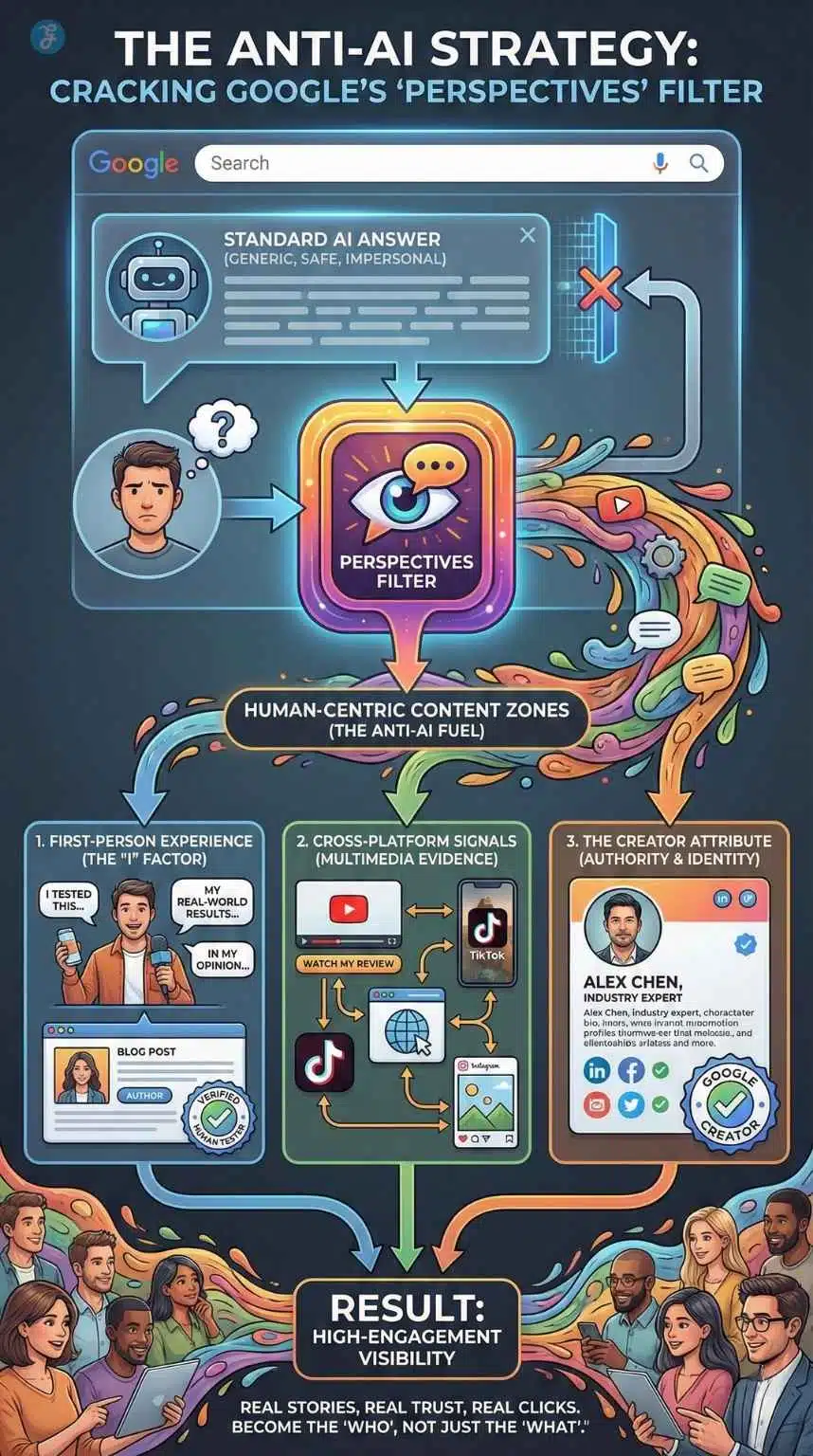
As AI Overviews take over the main results, Google has introduced a specific filter called “Perspectives.” This feed aggregates videos, social media posts, and forum discussions from real humans to offer subjective advice.
This is your “escape hatch” from the zero-click wall. If users are annoyed by the robotic AI answer, they click “Perspectives.” You need to be there.
How to Rank in Perspectives:
- First-Person Narrative: The algorithm looks for “I” statements. “I tested this,” “My experience was,” “I felt that.” Passive voice (“It was observed that…”) is a death sentence here.
- Cross-Platform Signals: Google correlates your blog post with your social presence. Embed your own TikTok or YouTube Short inside your blog post. This signals that the content has a “multimedia human element.”
- The “Creator” Attribute: Google now highlights the creator prominently. Ensure your “Author Page” links to all your social handles. Google needs to verify you are a real person, not a “content farm” persona.
Actionable Tip: Update your old reviews. Instead of “The battery lasts 10 hours,” change it to “In my tests, the battery lasted 10 hours during heavy video editing, which was a surprise.”
The “Snippet Heist”: How to Steal Position Zero from Competitors
You don’t always need to create new content. Sometimes, the fastest route to zero-click dominance is stealing the spot from a competitor who currently holds it. This is a tactical “Gap Analysis.”
Step 1: Identify the Victim
Search for your target keywords. Look for queries where a competitor holds the Featured Snippet (the box at the top), but their content is outdated, poorly formatted, or vague.
Step 2: The “Better Answer” Protocol
Google changes the snippet holder if it finds a “more precise” answer.
- Word Count Precision: If the current winner uses 80 words to define the term, rewrite your definition in 45 words. Be punchier.
- Format Upgrade: If the current winner uses a paragraph to list steps, rewrite yours as a Numbered List. Google prefers lists for processes.
- Fact Update: If their snippet mentions “2024 data,” explicitly put “2026 Update:” in your header or text.
Step 3: The “Trigger” Heading
Ensure your H2 matches the query exactly.
- Competitor H2: “Understanding the basics of SEO.”
- Your H2: “What is SEO?” (This matches the user query what is seo perfectly).
Step 4: Fetch as Google
Once you update your content, go to Google Search Console and request indexing immediately. Snippet shifts can happen in hours.
Core Strategy 3: Technical SEO & Structured Data
Technical SEO in 2026 is less about “fixing broken links” and more about “speaking the robot’s language.” Schema Markup (Structured Data) is the translator.
If you don’t use Schema, you are asking Google to guess what your content is. If you use Schema, you are handing Google a business card that says precisely who you are and what you offer.
Schema as a Translator
Schema is JSON-LD code that sits in the background of your site. It tells Google: “This text is a recipe,” or “This text is a software review,” or “This text is an FAQ.”
Must-Have Schemas for Zero-Click Visibility:
- FAQ Schema: This is non-negotiable. If you have an FAQ section, wrap it in FAQ Schema. This drastically increases the chance of your questions appearing in the “People Also Ask” or directly in the AI Overview.
- How-To Schema: For any instructional content. It allows Google to pull your steps directly into the SERP.
- Organization & Person Schema: This feeds the Knowledge Graph. It connects your “Author” profile to your “Brand,” establishing authority.
- LocalBusiness Schema: Vital for brick-and-mortar. It ensures your hours, location, and “Area Served” are machine-readable.
The Importance of “Entities”
Google doesn’t think in keywords anymore; it thinks in “Entities” (Things). It knows that “Apple” is a fruit AND a company.
- Strategy: Ensure your content reinforces the entity connection. If you are writing about “Jaguar” (the car), use semantic words like “speed,” “engine,” “luxury,” and “sedan,” so the AI never confuses it with the animal.
Building a Bulletproof “Knowledge Graph” Entity
The ultimate defense against Zero-Click obscurity is having a Knowledge Panel. This is the information box that appears for brands, famous people, and large organizations. It signals that Google knows who you are, not just what keywords you use.
In 2026, you cannot just “wait” for a Knowledge Panel; you must engineer it.
1. “SameAs” Schema Markup
In your Organization Schema, you must use the SameAs property. This lists all the other places you exist on the web (LinkedIn, Crunchbase, Wikipedia, Wikidata). It connects the dots for Google.
2. Wikidata & Crunchbase
Google heavily relies on Wikidata (a sister project of Wikipedia) and Crunchbase to verify entities. If your company does not have a Crunchbase profile, create one. It is a primary data source for the Knowledge Graph.
3. Consistent NAPW [Name, Address, Phone, Website]
Conflicting data confuses the Knowledge Graph. If your Facebook page says “123 Main St” and your footer says “123 Main Street, Suite B,” the entity confidence score drops. Audit every single profile on the web for 100% consistency.
4. The “About Us” Page Overhaul
Your “About Us” page is the most important page for Entity SEO. It should clearly state:
- Who founded the company?
- When it was founded.
- Where is it headquartered?
- What awards has it won?
- Why: These are “facts” that Google extracts for the Knowledge Panel.
Table: Knowledge Graph Trust Signals
| Signal Source | Impact Level | Action Required |
| Wikipedia Backlink | Very High | Difficult to get; requires notable press coverage. |
| Crunchbase Profile | High | Create and verify a detailed company profile. |
| Google Books Citation | Medium | If your brand has published books/ebooks, list them. |
| SSN (Social Handlers) | Medium | Ensure all social profiles link back to the website. |
Core Strategy 4: “Barnacle SEO” & Third-Party Platforms
Here is a radical thought: Your website might not be the best place to rank.
In highly competitive niches, the top 10 results are often dominated by giants: Wikipedia, Reddit, Quora, G2, Yelp, LinkedIn. Instead of trying to beat them, attach yourself to them like a barnacle on a whale.
If You Can’t Beat Them, Join Them. “Barnacle SEO” means leveraging the authority of other sites to get visibility for your brand.
1. Reddit & Quora (The “Human” Element)
Google has explicitly partnered with Reddit to feed its AI models. “Discussions and Forums” often appear above traditional blogs.
- Action: Don’t just spam links. Participate in discussions. Answer questions genuinely. If your detailed answer on Reddit gets upvoted, it might appear on the Google SERP inside the Reddit thread discussion box. That is zero-click visibility.
2. YouTube is a Search Engine
Video carousels appear in over 45% of Google searches.
- Video AEO: Google listens to your video. It transcribes the audio.
- Tactic: Say your keyword in the first 10 seconds of the video. Use “Chapter Markers” in the description. Google often pulls a single “Chapter” from a video and plays it directly on the SERP as a featured answer.
3. Review Sites & Directories [G2, Capterra, Yelp]
For software (SaaS) and local businesses, users trust directories more than vendor sites.
- Strategy: Ensure your profiles on these sites are immaculate. Optimize your descriptions on their platforms with your focus keywords. If G2 ranks #1 for “Best Accounting Software,” and you are #1 on the G2 list, you have effectively won the keyword.
4. LinkedIn Articles [Parasite SEO]
LinkedIn has a Domain Authority (DA) of 99. An article published on LinkedIn Pulse will often rank faster and higher than the same article on your new blog.
- Tactic: Publish a summary or a “teaser” article on LinkedIn that ranks for the zero-click term, then link back to your site for the deep dive.
Measuring Success in a Zero-Click World
We established earlier that Traffic/Sessions are a fading metric. So, what should you put in your monthly report in 2026?
New KPIs for the AEO Era
- On-SERP Impressions:
- Use Google Search Console (GSC). Filter for queries where your “Impressions” are high but “Clicks” are low.
- Analysis: Check the SERP. Is there an AI answer or Snippet there? If yes, and you are in the top positions, you are likely getting “Zero-Click Visibility.” You are being seen, just not clicked.
- Brand Search Volume:
- This is the holy grail. Are more people searching for your Brand Name?
- If your Zero-Click strategy is working, users will see your name in the AI answer, remember it, and search for “YourCompany Reviews” or “YourCompany vs Competitor” later.
- Share of Voice (SoV):
- Use SEO tools (like Semrush or Ahrefs) to track your visibility percentage for your core keywords, irrespective of clicks.
- Conversion Rate (CVR):
- Ironically, as zero-click rises, your website’s conversion rate should increase. Why? Because the “tire kickers” are getting their answers on Google. The only people clicking through are the ones who are deeply interested and ready to engage. You are getting less traffic, but better traffic.
Zero-Click SEO Strategy Checklist [2026 Edition]
| Phase | Action Item | Priority |
| Audit | Identify the top 20 keywords losing traffic to AI/Snippets. | High |
| Content | Add 40-60-word “Definition” blocks to all key articles. | Critical |
| Content | Create dedicated “FAQ” sections for every major topic. | High |
| Tech | Implement FAQ, How-To, and Organization Schema. | Critical |
| Barnacle | Update and optimize profiles on G2, Yelp, LinkedIn, and Reddit. | Medium |
| Metrics | Set up tracking for Brand Search Volume and Direct Traffic. | Medium |
Final Thought: The Pivot from Traffic to Truth
The “Zero-Click” era is not the apocalypse of SEO; it is the maturation of it.
For twenty years, we chased the algorithm to get a click. Now, we must chase the truth to get a citation. The goal has shifted from being a “destination” to being a “source.” The active weapons in your arsenal, stealing snippets, optimizing for voice, and visual search, are about aggression. The passive shields, AEO, and schema are about resilience.
If you can position your brand as the ultimate authority, the source that Google’s AI trusts enough to learn from, you win. You win not just a visit, but the user’s trust before they even land on your page. The internet is becoming a single, giant AI brain. Your job is no longer just to build a website; it is to teach that brain that you are the expert.