In the high-stakes arena of global mobility, two indices dominate the conversation, yet they tell fundamentally different stories about Switzerland. While the Henley Passport Index consistently crowns Singapore and Japan as the world’s most powerful travel documents based on sheer access, Nomad Capitalist’s data persistently highlights Switzerland as the superior asset for the ultra-wealthy. This discrepancy is not a statistical error; it marks a pivotal shift in the definition of “value” in 2026. It signals the end of “travel access” as the sole metric of power and the rise of “sovereign liberty”—a transition where Swiss neutrality, privacy, and dual citizenship rights outweigh a handful of extra visa-free destinations.
Contextual Background: From Travel Documents to Asset Classes
For nearly two decades, the strength of a passport was measured by a single, simple metric: the airport arrival hall. The Henley Passport Index, launched in 2006, pioneered this approach by ranking nations strictly on the number of destinations their citizens could access visa-free. For years, this mirrored the aspirations of a globalizing world where friction-less travel was the ultimate luxury.
However, the post-2020 landscape—defined by pandemic closures, geopolitical polarization, and aggressive cross-border taxation—reshaped these priorities. High-net-worth individuals (HNWIs) stopped asking just “Where can I go?” and started asking “How well can I live?”
Enter Nomad Capitalist, a boutique consultancy that disrupted the ranking ecosystem by introducing a holistic “lifestyle” algorithm. Their index argues that a passport is not just a travel document; it is an asset class that confers tax efficiency, reputational safety, and personal freedom. This philosophical divergence has made Switzerland the battleground for two competing visions of global citizenship: one focused on quantity of access, the other on quality of life.
Core Analysis: The “Access vs. Autonomy” Divide
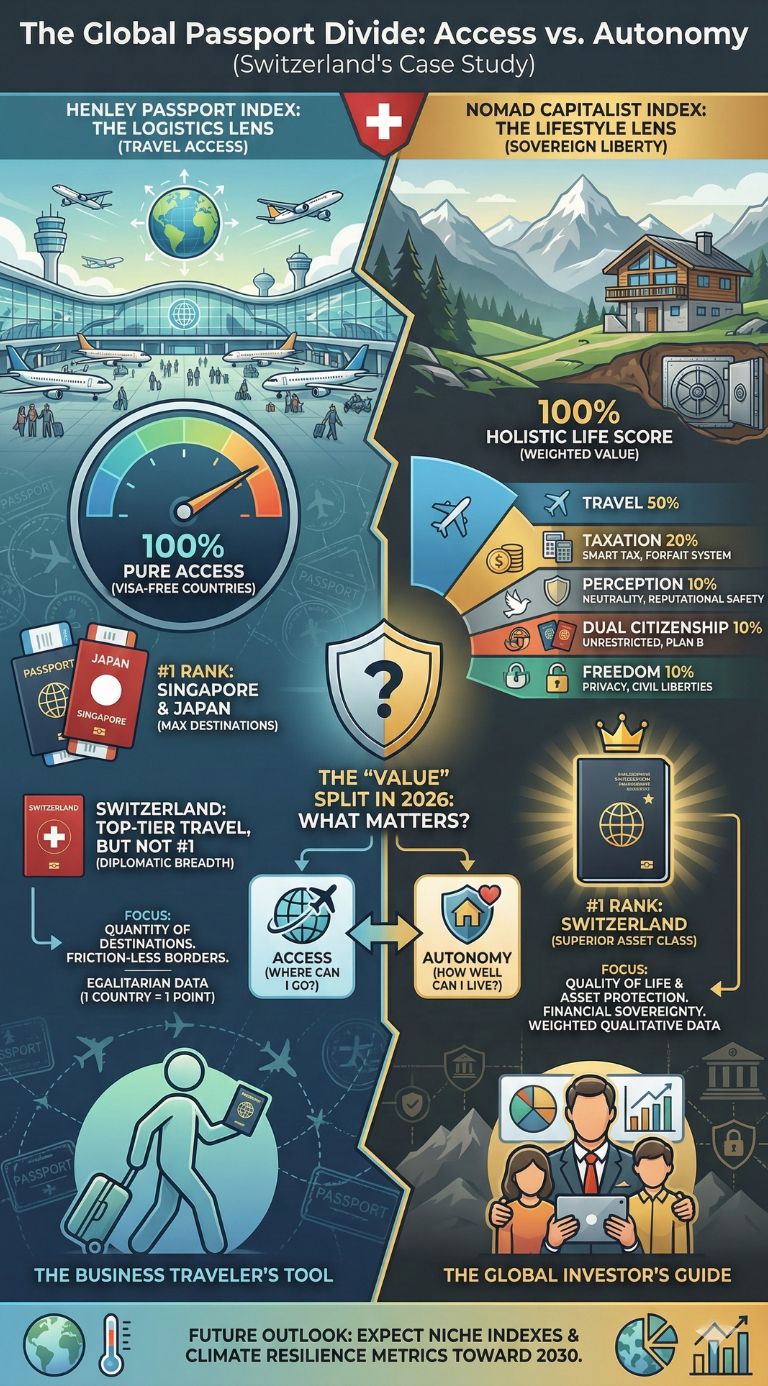
The disagreement over Switzerland’s ranking is best understood through distinct analytical lenses. These themes highlight why the Swiss cross is the ultimate status symbol for one group, while merely “top tier” for another.
1. The Methodology Wars: Binary Data vs. Weighted Value
The root of the discrepancy lies in the algorithm. Henley’s methodology is binary and egalitarian: a visa-free entry to a minor developing nation counts exactly the same as a visa-free entry to the United States. It is a measure of diplomatic breadth.
Nomad Capitalist’s methodology is weighted and qualitative. It operates on the premise that not all visa-free access is equal and that travel is only half the battle.
- Henley: Relies 100% on IATA travel data.
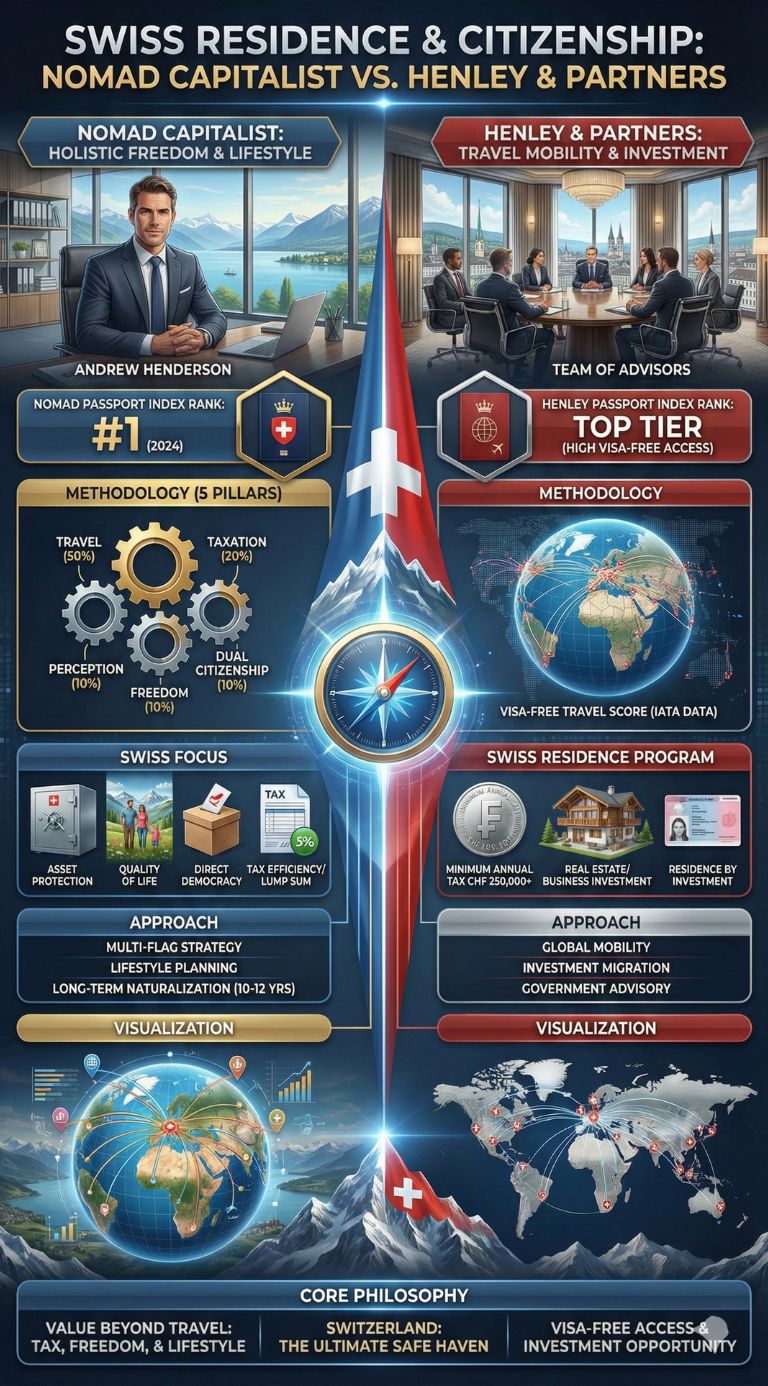
- Nomad Capitalist: Uses a weighted “Life Score” (Travel 50%, Tax 20%, Perception 10%, Dual Citizenship 10%, Freedom 10%).
Because Switzerland requires visas for a few specific developing nations that EU neighbors or Singapore might not, it mathematically cannot win Henley’s numbers game. However, Nomad’s algorithm acts as a “quality filter,” boosting Switzerland for its non-travel attributes.
Table 1: The Methodology Split
This table illustrates the weight assigned to different life factors by the two major indices.
| Metric | Henley Passport Index | Nomad Capitalist Index |
| Visa-Free Travel | 100% | 50% |
| Taxation Laws | 0% | 20% |
| Global Perception | 0% | 10% |
| Dual Citizenship | 0% | 10% |
| Personal Freedom | 0% | 10% |
| Primary Focus | Quantity of Access | Quality of Life & Asset Protection |
2. Taxation: The “Sovereign” Sweet Spot
Switzerland is not a tax haven in the traditional zero-tax sense (like the UAE or Monaco), which is why it escapes the “grey lists” that plague other low-tax jurisdictions. However, Nomad Capitalist rewards it for “smart taxation.”
Through the Forfait (lump-sum taxation) system, wealthy foreigners can pay a fixed tax based on living expenses rather than global income. Furthermore, unlike the United States, Switzerland applies residency-based taxation. A Swiss citizen living abroad is generally not taxed by Switzerland. Nomad penalizes the US heavily for its citizenship-based taxation (FATCA), causing the US to rank poorly (~45th), while Switzerland soars because it respects the financial sovereignty of its non-resident citizens.
Table 2: Switzerland’s “Lump Sum” Advantage (2025/2026 Rules)
Why Switzerland scores high on the “Taxation” metric despite high local tax rates.
| Feature | Details (Federal Level) |
| System Name | Forfait Fiscal (Expenditure-Based Taxation) |
| Eligibility | Non-Swiss citizens who do not work locally in Switzerland. |
| Tax Base | Based on annual living expenses (rent, lifestyle) rather than global income. |
| Min. Taxable Base | CHF 434,700 (Federal minimum as of 2025/2026). |
| Key Benefit | Exempts foreign investment income/capital gains from Swiss tax. |
| Impact on Ranking | Boosts Switzerland’s “Tax Score” to 30/50 (High Efficiency) vs US (10/50). |
3. Dual Citizenship: The Dealbreaker
This is the single biggest technical differentiator. Singapore, often Henley’s #1, strictly forbids dual citizenship for adults. To become Singaporean, you must renounce your previous nationality.
For the modern “global citizen” building a portfolio of passports, this is a fatal flaw. Nomad Capitalist heavily penalizes countries that restrict dual citizenship. Switzerland, conversely, permits it without restriction. For an entrepreneur seeking a “Plan B,” a passport that forces you to burn your “Plan A” (Singapore) is less valuable than one that complements it (Switzerland), regardless of how many countries it accesses.
Table 3: The “Plan B” Compatibility Check
Comparison of top-tier passports on their ability to be held as a secondary asset.
| Country | Henley Rank | Dual Citizenship Allowed? | Portfolio Suitability |
| Switzerland | Top 5 | Yes (Unrestricted) | High (Perfect “Plan B” or primary base). |
| Singapore | #1 | No (Forbidden) | Low (Must renounce all others). |
| Japan | Top 3 | No (Forbidden) | Low (Must renounce all others). |
| UAE | Top 10 | Yes (Selectively) | Medium (Subject to investment criteria). |
4. The “Perception” Premium: The Value of Neutrality
One of Nomad Capitalist’s most subjective yet critical metrics is “Perception.” This measures how a passport holder is received globally. Is the passport associated with political baggage, conflict, or overreach?
- The US Problem: An American passport is powerful for travel, but it carries significant geopolitical weight and risk (e.g., kidnapping risk, political hostility, scrutiny at borders).
- The Swiss Advantage: Switzerland’s centuries-old neutrality means a Swiss passport holder is rarely viewed as a political pawn. In a polarized 2026 geopolitical climate, this “reputational safety” is valued higher by Nomad Capitalist than the raw number of borders one can cross. Henley does not account for the experience of the traveler, only the possibility of travel.
5. Freedom and Privacy
In an era of increasing digital surveillance, Nomad Capitalist includes a “Freedom” score, aggregating data on press freedom, mandatory military service, and surveillance laws. Switzerland’s strong constitutional protections for privacy and its direct democracy model provide a score boost that purely administrative indices like Henley miss. While Henley tells you where you can fly, Nomad tells you how free you are once you land.
Expert Perspectives
To interpret these findings, we analyze the views of industry experts who advise clients on citizenship acquisition.
The Investment Migration View:
“Clients in 2026 rarely ask for the passport with the most visa-free countries. They already have good travel documents. They want a ‘Safe Haven’ asset. Switzerland represents the gold standard of insurance—political stability and banking access that a Singaporean or Japanese passport cannot fully replicate due to their restrictions on holding multiple nationalities.”
— Senior Analyst, Investment Migration Council
The Banking Perspective:
“From a compliance standpoint, a Swiss passport is a ‘Tier A’ document. When opening bank accounts in volatile regions or high-compliance jurisdictions (like the EU or UK), presenting a Swiss passport often triggers fewer Red Flags than passports from zero-tax Caribbean nations. Nomad Capitalist captures this ‘banking utility’ in their Perception score, whereas Henley does not.”
The Counter-Argument (Pro-Henley):
“For the pure business traveler, friction is the enemy. The Henley Index remains the most practical tool for logistics. If you need to fly to Vietnam or China tomorrow for a meeting, the philosophical value of Swiss neutrality doesn’t help you if you need a visa and your Singaporean counterpart doesn’t. Access remains king for the working executive.”
Future Outlook: The “Climate Passport” Era?
As we look toward 2030, the criteria for passport rankings are likely to fracture further. The disagreement between Nomad Capitalist and Henley is just the beginning of a trend toward niche indexes.
- Prediction 1: The Decline of “Travel” Weighting.
As electronic travel authorizations (ETAs) become universal (like the European ETIAS or UK ETA), the gap between a “Tier 1” and “Tier 2” passport will narrow. If everyone needs an online pre-check, the distinction between “visa-free” and “e-visa” blurs. This validates Nomad Capitalist’s decision to weigh travel at only 50%. - Prediction 2: Climate Resilience as a Metric.
Future iterations of these indices will likely incorporate Climate Resilience. Switzerland sits in a geographically advantageous position relative to rising sea levels, unlike the Maldives or certain Caribbean nations popular for citizenship-by-investment. Expect “Geographic Safety” to become a sub-metric in lifestyle-based rankings. - Prediction 3: The “Sovereign” Split.
We will see a permanent divergence. Henley will remain the Bible for logistics and travel agencies, while Nomad Capitalist (and imitators) will become the Bible for Family Offices and Wealth Managers. Switzerland will likely maintain its dominance in the latter, even if it never reclaims the #1 spot in the former.
What This Means for You
If you are strategizing your global portfolio, do not rely on a single number.
- Use Henley if your primary goal is friction-less corporate travel.
- Use Nomad Capitalist if your goal is asset protection, tax planning, and finding a permanent home base.
Switzerland’s split ranking is a reminder: In 2026, true freedom isn’t just about where you can go—it’s about who owns you when you get there.