
In 2026, hosting is no longer a behind-the-scenes decision that only developers care about. Your hosting stack shapes speed, stability, and user experience, which all influence the signals that search engines and real people respond to. It also affects how efficiently search bots crawl your site, how often pages return errors, and how consistently your content stays accessible.
At the same time, sustainability has moved from a nice-to-have to a baseline expectation. Buyers, partners, and even editorial teams increasingly treat environmental responsibility as part of brand credibility. That makes green hosting for SEO in 2026 less of a trend and more of a practical requirement for competitive websites that want to grow and stay resilient.
This article breaks down what green hosting really means today, how it connects to SEO outcomes, and how to choose a provider without sacrificing performance.
What Green Hosting Means In 2026
Green hosting in 2026 is not a single feature and it is not just a marketing badge. It is a combination of how a hosting company powers and operates its infrastructure, how efficiently it runs workloads, and how transparently it reports environmental impact. A serious green host focuses on renewable energy sourcing, data center efficiency, and measurable reduction strategies.
You will see providers use terms like renewable powered, carbon neutral, climate positive, or net zero. Those phrases can mean very different things depending on the methodology. Some providers match electricity use with renewable energy credits, while others sign long-term agreements that support renewable generation. Some rely heavily on offsets, which can be legitimate but vary widely in quality and transparency.
A practical definition is simple: green hosting reduces the environmental footprint of your website’s infrastructure while still meeting modern performance and reliability expectations. In the best cases, the same efficiency practices that cut emissions also reduce waste, improve stability, and support faster delivery.
Green Hosting Vs Greenwashing
Greenwashing happens when a hosting company uses sustainability language without providing meaningful proof. This is common because hosting is technical, and many buyers do not know what to ask for. You can avoid most traps by looking for clarity and consistency.
Watch for vague claims like “eco friendly servers” with no explanation of energy sourcing, audits, or reporting. Be cautious if the provider only talks about planting trees, offsets, or donations while ignoring efficiency, cooling, or data center operations. Also be wary when there is no public documentation that defines how they measure impact.
Credible green hosting is transparent. It explains renewable energy strategy, provides reporting, and can point to third-party validation or verifiable standards. It also answers performance questions directly instead of distracting you with branding.
Why Hosting Influences SEO More In 2026
Hosting impacts SEO because it shapes the environment where your pages load, render, and stay available. Google does not publish a “green hosting” ranking factor, but it does reward outcomes that hosting strongly affects. Those outcomes include speed, stability, and a consistently accessible site.
Server response time influences how quickly your HTML arrives and how soon rendering can begin. When response time spikes, user experience suffers and engagement often drops. If your site regularly produces errors or timeouts, search bots waste crawl resources and may reduce how aggressively they revisit key pages.
Modern SEO is also more sensitive to real-world performance across devices and locations. A host with strong global delivery, reliable caching, and stable infrastructure gives you a more predictable baseline. That baseline makes technical SEO improvements more effective because you are not fighting the platform.
Performance Signals That Tie Hosting To Rankings
Performance is the most direct connection between hosting and SEO outcomes. Your host influences time to first byte, backend processing speed, and how well your site handles concurrency. A host that supports modern protocols, efficient caching, and reliable scaling can reduce delays that users feel immediately.
Core Web Vitals are not purely a hosting issue, but hosting sets the limits for what is possible. Slow server response, unstable resources, and poor caching can drag down your best front-end work. On the other hand, efficient infrastructure, edge caching, and well-tuned stacks help your optimizations stick.
A practical takeaway is this: green hosting often overlaps with performance hosting when the provider invests in efficiency. Efficient systems reduce wasted compute and heat. That tends to correlate with better engineering and smoother delivery, especially under load.
Crawl Efficiency, Uptime, And Index Stability
Search engines crawl your site with finite time and attention. When your server responds slowly, returns 5xx errors, or times out, crawlers waste requests. Over time, that can reduce crawl coverage, delay recrawls, and slow down how quickly updates appear in search.
Uptime matters for users and bots. A site that drops during peak hours can lose conversions, but it can also send negative reliability signals through repeated error encounters. Even short incidents can create a chain reaction if they affect critical pages, feeds, or API endpoints.
A host with strong uptime practices, incident transparency, and resilient architecture protects your SEO investment. It keeps content available when campaigns spike, when bots revisit, and when customers arrive ready to buy.
Why Green Hosting Is No Longer Optional For SEO In 2026

In 2026, sustainability expectations affect brand trust, procurement decisions, and partnership eligibility. Even smaller brands face pressure when they work with larger clients, marketplaces, or publishers that ask vendors for sustainability proof. Hosting often becomes part of those checks because it is measurable and tied to operations.
Sustainability also affects how people talk about brands online. A credible environmental stance can support PR, thought leadership, and community trust. That can lead to more mentions, more links, and stronger brand signals over time.
Most importantly, green hosting aligns with the direction the web is moving. The industry is pushing toward efficient delivery, smarter caching, and modern infrastructure. If you treat sustainability as a core requirement, you tend to make better platform decisions that also support SEO outcomes.
The SEO Benefits Of Green Hosting
The biggest SEO benefits come from improvements you can measure, not from slogans. Green hosting can support speed and stability when the provider invests in efficient infrastructure and modern delivery. It can also support growth by reducing risk and supporting stronger trust narratives.
Here are the practical benefits many sites see when they switch to a well-run green host:
- More consistent server response time during traffic spikes
- Better uptime and fewer error bursts that disrupt crawling
- Easier CDN and edge caching integration
- Cleaner infrastructure choices that encourage leaner site builds
- Stronger brand story when sustainability claims are documented
The key is to choose a provider that is both genuinely sustainable and technically strong. If you choose a “green” host that is slow or unstable, you can lose more in performance than you gain in credibility.
How To Choose A Green Host Without Sacrificing SEO
A good selection process separates SEO requirements from sustainability requirements, then looks for overlap. You want a provider that can prove sustainability while still delivering modern performance. If you only evaluate one side, you risk buying a badge or buying speed without accountability.
SEO Non Negotiables
- Data center locations that match your audience regions
- Strong uptime track record and clear SLA terms
- Fast TTFB in realistic tests
- CDN support and simple edge caching options
- Modern stack support, including HTTP versions and TLS defaults
- Backups, security controls, and predictable scaling paths
- Support that can solve technical issues quickly
Sustainability Non Negotiables
- Clear explanation of renewable energy sourcing
- Transparent carbon accounting or impact reporting
- Third-party validation, audits, or credible certifications when available
- Efficiency practices like optimized cooling, hardware lifecycle planning, and workload management
- Consistent claims across marketing, documentation, and reporting
If a host cannot answer basic questions, treat that as your answer. A serious provider welcomes scrutiny.
Quick Comparison Table For Evaluating Providers
Use this table as a simple scoring model. It helps you compare hosts without getting lost in branding.
| Evaluation Area | What To Look For | Why It Matters For SEO |
| Energy Sourcing | Renewable strategy explained clearly | Supports credibility and reduces greenwashing risk |
| Transparency | Public reporting and methodology | Builds trust and supports PR claims |
| Data Center Efficiency | Evidence of efficiency practices | Often correlates with modern infrastructure |
| Performance Baseline | Strong TTFB and consistent load handling | Improves speed and stability outcomes |
| Uptime And Incidents | Clear status history and incident detail | Protects crawl stability and user trust |
| CDN And Caching | Edge options and simple configuration | Reduces origin load and speeds delivery |
| Support Quality | Technical support that can troubleshoot | Avoids long outages and ranking disruptions |
| Security Defaults | TLS, WAF options, backups | Protects availability and site integrity |
Do not aim for perfection across every row. Aim for strong performance and strong proof, with no major weak spots.
Green Hosting Plus Technical SEO Optimization
Hosting is a foundation, not a complete strategy. The strongest results happen when you pair green hosting with efficiency-focused technical SEO. That approach improves rankings and reduces waste at the same time.
Start by reducing origin load. Use full-page caching where it fits, and use object caching for database-heavy sites. Push static assets through a CDN and cache aggressively at the edge for repeat visitors.
Next, reduce page weight. Compress images and serve modern formats, lazy load below-the-fold assets, and minimize heavy third-party scripts. Audit fonts, remove unused libraries, and keep plugin stacks lean.
Around this stage, revisit your hosting configuration so it matches the new workload. This is where you should re-check green hosting for SEO in 2026 as a performance strategy, not only a sustainability checkbox.
Architectures That Are Fast And Efficient
Efficiency improves when you choose an architecture that fits your traffic patterns. Many sites do not need constant heavy compute. They need fast delivery for most requests and strong scaling for peaks.
Static or hybrid rendering can reduce server work for content-heavy pages. Edge caching can deliver repeat requests without hitting the origin. Autoscaling or serverless components can handle bursts without keeping oversized servers running all day.
Database optimization also matters more than many teams expect. Slow queries waste compute and increase response times, which hurts user experience and crawlers. Clean indexing, query tuning, and smart caching can deliver both speed and lower infrastructure load.
The goal is not to chase complexity. The goal is to remove waste while keeping delivery consistent.
Migration Plan That Protects Rankings
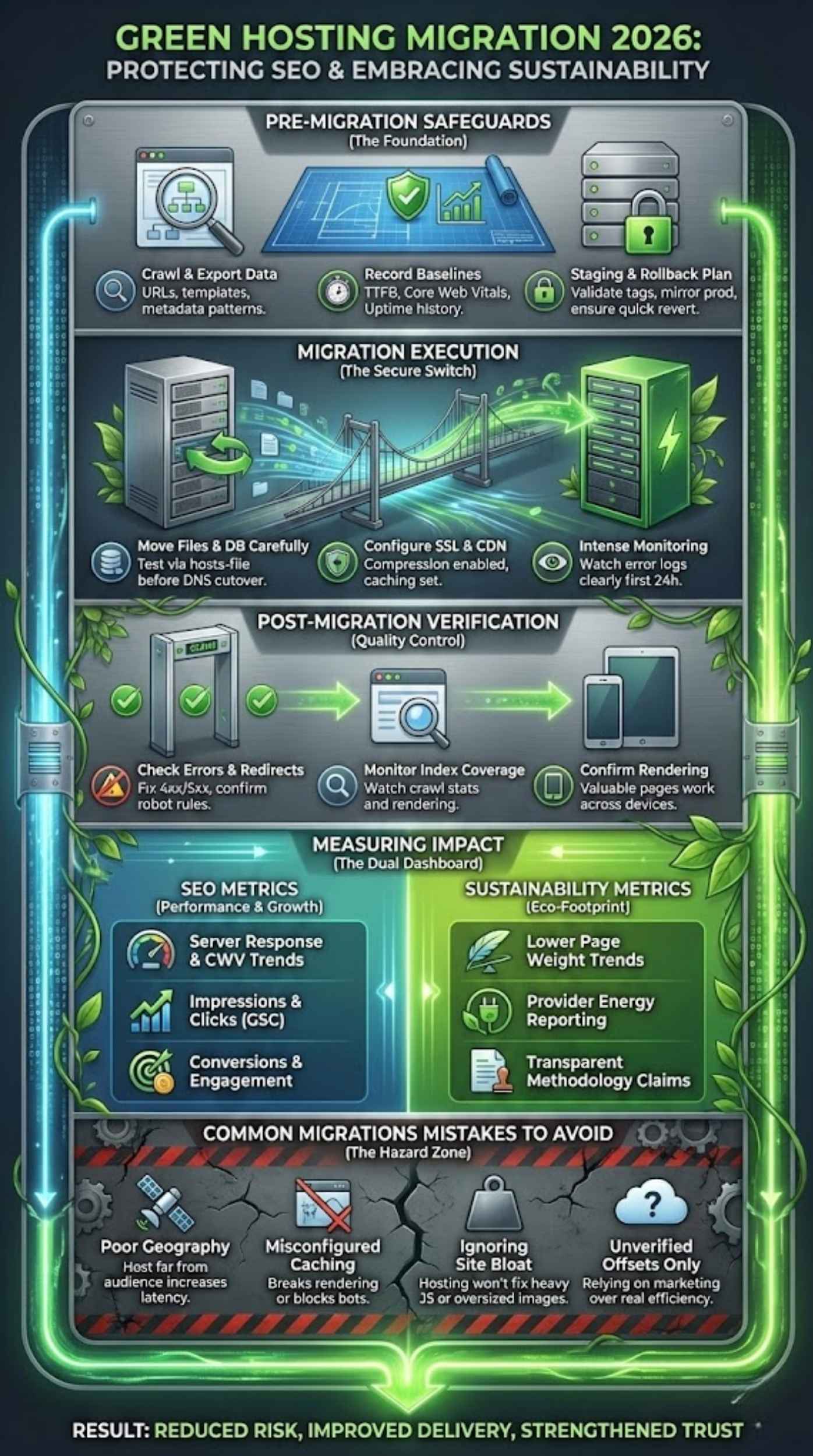
A hosting change can be safe for SEO when you plan it like a technical release. Most ranking drops after migrations happen because of avoidable mistakes like caching misconfigurations, downtime, or missing redirects. You can reduce risk with a structured checklist.
Pre Migration Safeguards
Crawl your site and export key URLs, templates, and metadata patterns. Record baseline performance metrics like TTFB, Core Web Vitals trends, and uptime history. Document server rules, caching behavior, and any edge configurations.
Set up a staging environment that matches production as closely as possible. Validate canonical tags, robots directives, sitemaps, and structured data. Plan a rollback strategy so you can revert quickly if issues appear.
Migration Execution
Move files and databases carefully, then test with hosts-file or staging domains before DNS cutover. Configure SSL, caching, CDN integration, and compression. Monitor error logs closely during the first hours and the first full day.
Post Migration Verification
Check for 4xx and 5xx errors, redirect behavior, and robots rules. Monitor index coverage, crawl stats, and performance changes. Confirm that your most valuable pages render correctly across devices and regions.
This process protects your rankings and helps you realize the performance upside of a strong host.
How To Measure SEO And Sustainability Impact
You should measure what changed, not what you hoped would change. A solid measurement plan also helps you communicate results to stakeholders who care about growth, risk, and brand reputation.
SEO Metrics To Track
Track server response time, uptime, and error rates. Monitor Core Web Vitals trends, not just single test scores. Watch Search Console for crawl issues, index coverage, and changes in impressions and clicks.
Also track outcomes like conversions, lead quality, and engagement. Performance improvements often show up first in these metrics, even before rankings shift.
Sustainability Metrics To Track
Track page weight trends, because leaner pages often correlate with lower energy use. Use provider reporting when available, especially if they publish methodology. If you produce sustainability content, document your sources and your approach so claims stay consistent.
At this point, you should be able to explain the business case for green hosting for SEO in 2026 in plain terms. You reduced risk, improved delivery, and strengthened trust.
Common Mistakes To Avoid
Many sites fail to see benefits because they treat hosting as a single switch. Green hosting works best when it aligns with performance engineering and operational discipline.
Avoid choosing a “green” host that places your site far from your audience, which increases latency. Avoid relying on offset-only marketing without understanding what offsets cover and how they are verified. Avoid migrating without controlling caching, because misconfigured caching can break rendering, block bots, or serve stale content.
Also avoid expecting hosting to fix heavy pages. If your site ships too much JavaScript, oversized images, or slow database queries, you need to reduce bloat. Hosting helps, but it cannot rescue an inefficient build forever.
Takeaways
Green hosting is no longer optional in 2026 because it aligns with how modern SEO works and how modern buyers judge brands. Hosting influences speed, reliability, and crawl stability, which shape the outcomes that search engines and users reward. Sustainability expectations also influence partnerships, PR, and trust, which supports link earning and brand strength over time.
If you want a practical path forward, start with an audit of performance and uptime, then evaluate hosts using both SEO and sustainability criteria. Pair the move with caching, page weight reduction, and architecture choices that remove waste. When you do it right, green hosting for SEO in 2026 becomes a durable advantage, not a temporary trend.