Implementing a digital detox for kids has become a critical challenge for families in 2026, but the old strategy of strict bans is no longer effective. Instead of simply locking devices away, the modern approach focuses on “Purpose-Driven Use”, teaching children to balance their online lives with the restorative power of the outdoors. If you are exhausted by daily screen negotiations, this guide is your roadmap to a healthier home.
We will move beyond fear-based tactics and introduce the “3-Zone Approach,” a science-backed framework designed to prioritize active creativity over passive consumption. You will discover why nature is the ultimate antidote to screen fatigue and how to build digital resilience in your family.
It is time to stop fighting technology and start managing it intentionally, ensuring your child thrives both online and in the real world.
Key Takeaways: Your 2026 Detox Cheat Sheet
-
Shift the Mindset: Move from “banning screens” to “Purpose-Driven Use.” It’s not about managing minutes; it’s about managing intent.
-
Use the 3-Zones: Prioritize active creation (Zone 1), moderate social connection (Zone 2), and strictly limit passive consumption (Zone 3).
-
Nature is Medicine: Outdoor play isn’t just exercise; it is essential “cognitive restoration” that counteracts screen fatigue and lowers stress.
-
Design the Environment: Use physical boundaries like “Dinner Docks” and screen-free bedrooms to reduce the reliance on willpower.
-
Offer Better Alternatives: Replace cheap digital dopamine with engaging, real-world challenges like geocaching, building, or risky play.
-
Be a Mentor, Not a Dictator: Adjust your strategy according to age, moving from control with toddlers to collaboration with teens.
The “Why”: The Science of Screen vs. Green
To effectively manage screen time, we first need to understand what is happening inside our children’s rapidly developing brains. Why is it so hard for them to put the tablet down, and why does a walk in the park seem so boring by comparison?
The Dopamine Feedback Loop
Modern apps and games are engineered by behavioral psychologists to be hyper-engaging. They utilize variable reward schedules—like a slot machine—to provide hits of dopamine, the brain’s “feel-good” neurotransmitter. When a child gets a “like,” levels up in a game, or watches a 15-second viral video, they get a quick, cheap hit of dopamine.
The problem isn’t the dopamine itself; it’s the speed and ease of access. Compared to the instant gratification of a screen, real-world activities feel slow. Building a Lego tower, reading a book, or waiting for a seed to sprout requires patience and sustained effort for a “delayed dopamine” reward. Over time, excessive passive screen use can desensitize the brain’s reward system, making non-digital activities seem painfully dull.
The “Green Antidote”: Cognitive Restoration
This is where the outdoors becomes medicinal. Recent research from 2024-2026 highlights the critical role of nature in what scientists call “cognitive restoration.” Use eco-friendly and sustainable things.
Intense focus on screens, especially fast-paced gaming or social media, draws heavily on a child’s directed attention resources, leading to cognitive fatigue, irritability, and impulsivity. Nature, however, engages “soft fascination.” The rustle of leaves, the movement of clouds, or the texture of dirt are engaging without demanding intense focus. This allows the brain’s directed attention mechanisms to rest and recover. Furthermore, “green time” has been proven to significantly lower cortisol (the stress hormone) levels that are often spiked by competitive digital environments.
Here is a breakdown of how different environments affect your child’s physiology:
Physiological Impacts of Environments:
| Feature | High-Intensity Screen Use (e.g., Competitive Gaming, Social Scrolling) | Nature Immersion & Outdoor Play |
| Primary Neurotransmitter | Quick Dopamine (Instant Gratification) | Slow Dopamine & Serotonin (Mood Stabilization) |
| Cortisol (Stress) Levels | Typically elevated due to overstimulation or anxiety. | Significantly reduced; promotes relaxation response. |
| Attention Type | “Directed Attention” (Draining leading to fatigue). | “Soft Fascination” (Restorative and replenishing). |
| Physical State | Sedentary; often poor posture (“tech neck”). | Active; engages gross motor skills and the vestibular system. |
| Sensory Input | Hyper-focused visual/auditory; ignores bodily cues. | Full sensory integration (touch, smell, sight, sound, balance). |
The Solution: The 2026 “3-Zone Approach”
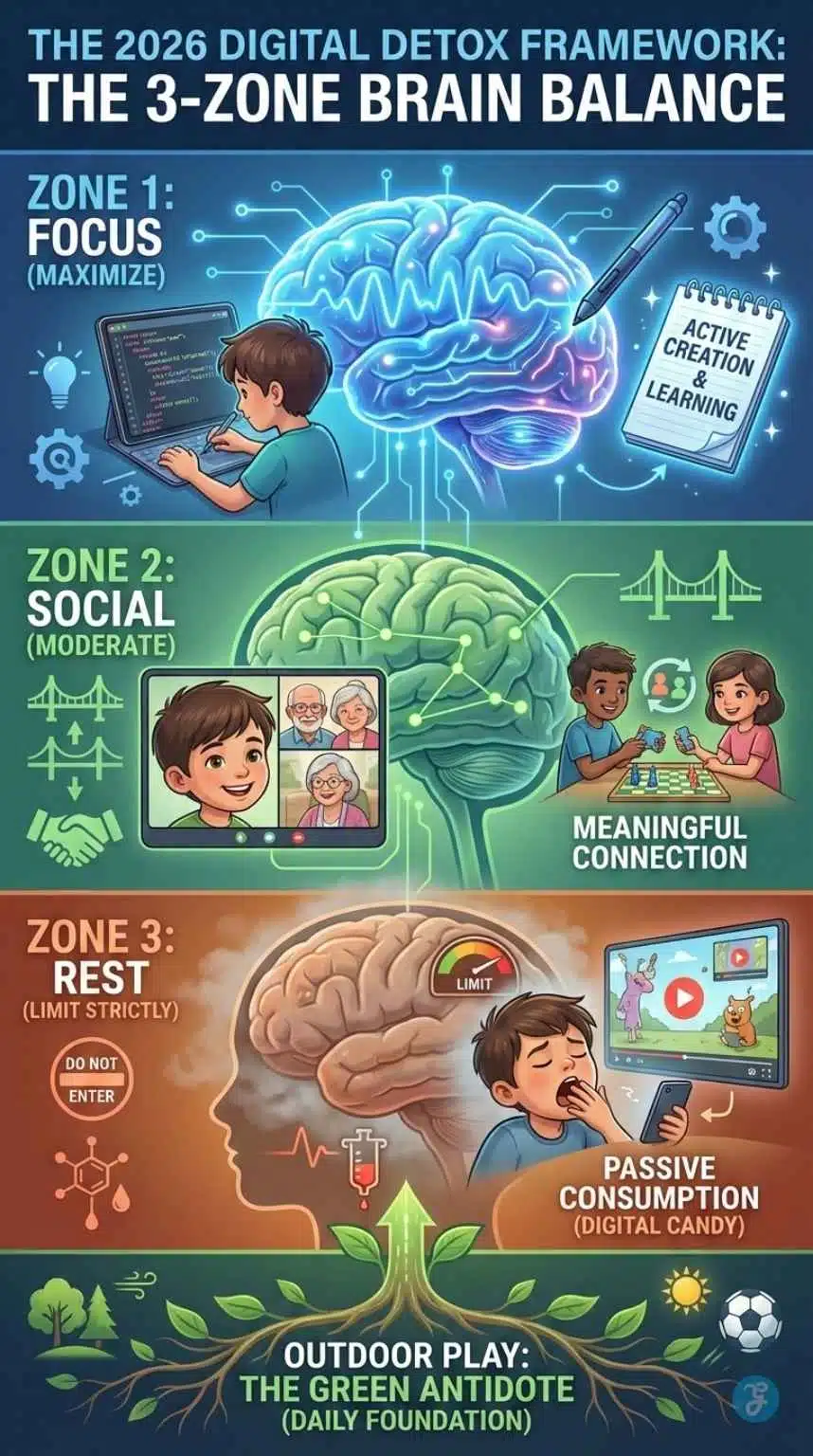
Forget counting minutes. The most effective strategy in 2026 is teaching your children to categorize how and why they are using screens. We call this the 3-Zone Approach. It moves the goalpost from “less screen time” to “better screen time,” while carving out non-negotiable space for the real world.
Understanding the Zones
Not all screen time is created equal. An hour spent coding a website is vastly different from an hour spent mindlessly scrolling through short-form videos. The 3-Zone framework helps parents and kids identify the purpose of their digital engagement.
The 3-Zone Digital Framework:
| Zone | Color Code | Description | Examples of Activities | The 2026 Parental Rule |
| Zone 1: Focus | Blue | High-Quality Active Use. The child is creating, learning, or problem-solving. The screen is a tool for output, not just input. | Coding, digital art/animation, writing, educational apps (math/science), researching a hobby. | Maximize. Encourage this. “As long as you are creating, not just consuming.” |
| Zone 2: Social | Green | Connection. Using technology to maintain genuine relationships. Crucial for older kids, but needs boundaries. | Video calling grandparents, playing multiplayer games with real-life friends while chatting, and collaborative school projects. | Moderate. “Screens can build bridges, but they shouldn’t replace face-to-face play.” |
| Zone 3: Rest | Orange | Passive Consumption. Mindless entertainment. Low cognitive effort. The digital equivalent of junk food. | Streaming endless cartoons, scrolling social media feeds, watching other people play video games (without interacting). | Limit Strictly. Treat this like candy—okay as a small, occasional treat, but never the main meal. |
Implementing the Zones
The goal of a sustainable, eco-friendly digital detox for kids in 2026 is to drastically reduce Zone 3 (Orange) time, moderate Zone 2 (Green), and encourage Zone 1 (Blue), all while ensuring that outdoor play and offline activities remain the foundation of their day. When a child asks for screen time, the first question shouldn’t be “How long?” but “Which zone?”
Actionable Strategies for Parents
Knowing the zones is one thing; implementing them in the heat of a Tuesday afternoon meltdown is another. Here are practical strategies designed for the reality of modern parenting.
1. The “Intent Check-In”
We need to move children from mindless clicking to mindful usage. Before handing over a device or unlocking a tablet, establish a ritual of asking two simple questions. This forces the prefrontal cortex (the planning part of the brain) to engage before the dopamine centers take over.
-
Question 1: “What is your purpose for being on the screen right now?” (Are they relaxing, learning about sharks, or talking to a friend? Help them identify the Zone.)
-
Question 2: “How long do you think you need for that purpose?”
If the answer is “I don’t know, just bored,” that is a signal that they are heading straight for Zone 3 passive consumption. Suggest an offline alternative first. If they have a specific purpose, agree on a time and set a timer together.
2. Environmental Design: The “Tech-Free Zones”
Willpower is a finite resource, especially for kids. Don’t rely on them to resist the temptation of a buzzing phone on the table. Design your home environment to make unplugging the easiest option in certain spaces.
-
The “Dinner Dock”: Place a charging station or a simple basket at the entrance to the dining area. Every family member’s phone goes into the dock before the first fork is lifted. No exceptions for adults. This reclaims mealtime for connection.
-
Bedroom Sanctuary: This is perhaps the most critical rule for neurodevelopment and sleep hygiene. No screens in the bedroom after a certain hour (e.g., 8:00 PM), and absolutely no sleeping with phones in the room. Use “old school” alarm clocks. The blue light interferes with melatonin production, and the psychological pull of the device fragments sleep.
3. High-Dopamine Outdoor Alternatives
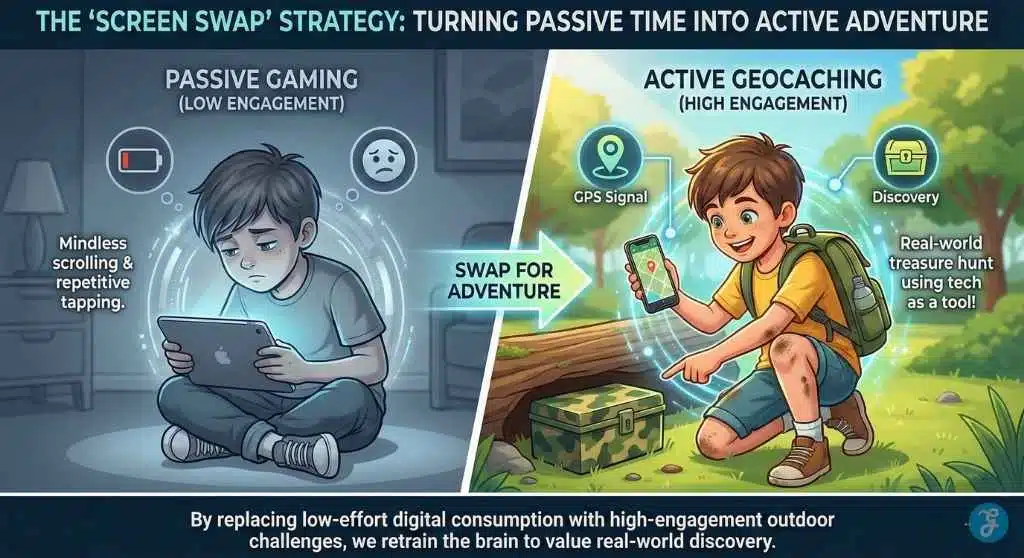
You cannot simply remove the high-stimulation environment of video games and replace it with sitting quietly in the backyard. The detox will fail because the contrast is too painful. You must offer “high-dopamine” outdoor alternatives that compete with the excitement of screens, especially initially.
-
Geocaching: This is an excellent bridge activity. It uses a GPS app on a phone to find real-world hidden containers (“caches”) in your area. It gamifies hiking and outdoor exploration, blending tech use with physical activity.
-
“Maker” Challenges: Instead of watching someone build in Minecraft, challenge them to build in real life. Provide cardboard, duct tape, and real tools (age-appropriate). The mission: build a fort that can withstand a “water balloon siege.” The tangible reward of building something real is incredibly satisfying.
-
Risky Play: In 2026, experts are encouraging more “risky play” (climbing trees, balancing on logs, using tools with supervision). This type of play provides a natural adrenaline rush and teaches risk assessment—skills that gaming only simulates.
Swapping Screen Time for Green Time:
| If they want to do this (Zone 3 Passive): | Try swapping it with this (Active/Outdoor): | Why it works: |
| Mindlessly watching YouTube videos of people opening toys. | A real-world scavenger hunt in the park with a physical list of items to find. | Replaces passive watching with active seeking and discovery. |
| Scrolling through short-form dance videos. | An outdoor dance-off with music played on a portable speaker, or learning a physical skill like jump rope or hula hooping. | Moves the body and builds real physical competence instead of just watching it. |
| Playing a repetitive, low-skill mobile tapping game to kill time. | Gardening: giving them their own small plot to dig, plant, and water. | Provides sensory engagement (dirt, water) and the slow, deeply satisfying reward of watching something grow. |
Age-Specific Guidelines for 2026
A “one-size-fits-all” approach does not work. A toddler’s brain is vastly different from a teenager’s.
Toddlers and Preschoolers (Ages 0-5): The Sensory Years
At this age, cognitive development is entirely dependent on sensory input and real-world interaction.
-
The Guideline: Aim for near-zero Zone 3 (passive) screen time for under-2s. For ages 2-5, limit high-quality programming (Zone 1) to one hour daily, always co-viewed with a parent.
-
The Focus: Maximize gross motor movement and sensory play. Their brains literally need to touch, taste, and move to wire themselves correctly.
-
The 2026 Insight: Be wary of “educational” apps that claim to teach skills faster. Research shows young children learn best through manipulation of three-dimensional objects and face-to-face interaction.
School Age (Ages 6-12): The Negotiation Years
This is where habits are formed. Peer influence begins to creep in, and gaming becomes a primary social outlet.
-
The Guideline: Implement the 3-Zone approach rigorously. Ensure that for every hour of screen time, there is at least an hour of outdoor or physical play.
-
The Focus: Establish clear boundaries and the “tech-free zones.” Start teaching digital citizenship and online safety.
-
The 2026 Insight: Use parental controls not just to block content, but to enforce “downtime” schedules that lock devices automatically during homework time or bedtime.
Teens (Ages 13+): The Autonomy Years
Strict control backfires with teens. The goal now is mentorship and helping them develop self-regulation.
-
The Guideline: Shift from managing their time to managing their impact. Focus on how their screen use affects their mood, sleep, and grades.
-
The Focus: Open dialogue about social media pressures, algorithms, and mental health. Keep the bedroom a screen-free sanctuary—this is non-negotiable for teen mental health.
-
The 2026 Insight: Collaborate on the rules. If they help set the boundaries, they are more likely to respect them. Appeal to their desire for independence: “Real maturity is knowing when to turn the phone off so you can focus on your goals.”
Frequently Asked Questions (FAQs)
1. Are you saying all passive screen time (Zone 3) is bad and should be banned?
No. In the same way that having a slice of cake occasionally isn’t “bad” for you, some passive relaxation is fine. The issue is when the “cake” becomes the entire diet. A movie night on Friday or 30 minutes of cartoons on a Saturday morning is perfectly healthy. The goal of a digital detox for kids is to ensure Zone 3 doesn’t become the default activity for every free moment.
2. My child throws massive tantrums when I take the device away. How do I handle the “detox crash”?
This is normal. You are essentially cutting off a dopamine supply. The key is preparation. Never abruptly stop a session. Give warnings: “10 minutes left,” “5 minutes left,” “Finish your level.” When the time is up, be firm but empathetic. Validate their feelings: “I know you’re furious. It feels awful to stop playing. But our agreement was 30 minutes.” Then, immediately bridge them to a physical activity or a snack to help regulate their body.
3. We don’t have an easily accessible nature nearby. How can we get “green time”?
Nature doesn’t have to mean a national park. A local pocket park, a patch of grass in an urban courtyard, or even tending to indoor plants can provide benefits. The goal is to step away from the man-made, highly structured digital world and interact with something organic. Even looking at the sky and identifying clouds is a break for the brain’s attention mechanisms.
This is a valid concern for a 2026 teenager. Dismissing it will shut down communication. Acknowledge the importance of their digital social life (Zone 2), but challenge them on the quality of that connection. Are they actively video chatting with friends (good), or just anxiously watching everyone else’s curated life on a feed (stressful)? Negotiate boundaries that allow for connection without constant tethering, such as “phone-free study hours” or putting the phone away during family activities so they can connect with the people right in front of them.
5. I’m exhausted. Sometimes the screen is the only babysitter I have. Am I failing?
Absolutely not. You are a human being parenting in an incredibly demanding era. Give yourself grace. Screens are useful tools when you need to cook dinner or take a shower. The goal here isn’t perfection; it’s consciousness. If you need to use a screen as a babysitter, try to steer them toward Zone 1 (educational app) or Zone 2 (calling Grandma) rather than passive Zone 3 watching. Do the best you can, and prioritize reconnection when you have the energy.
Final Thought: The Long Game of Digital Resilience
A digital detox for kids in 2026 is not a one-time event; it is an ongoing lifestyle adjustment. There will be good days where the balance feels effortless, and bad days where everyone retreats to a screen. That’s okay.
The ultimate goal isn’t to raise a child who has never seen a YouTube video. The goal is to raise a digitally resilient human being—someone who can wield the immense power of technology to create and learn, but who also knows deep in their bones that their truest happiness, health, and connection will always be found in the beautiful, messy, real world outside.
Start small today. Put the phones in the basket during dinner. Take a walk after the meal. The benefits will start compounding immediately.