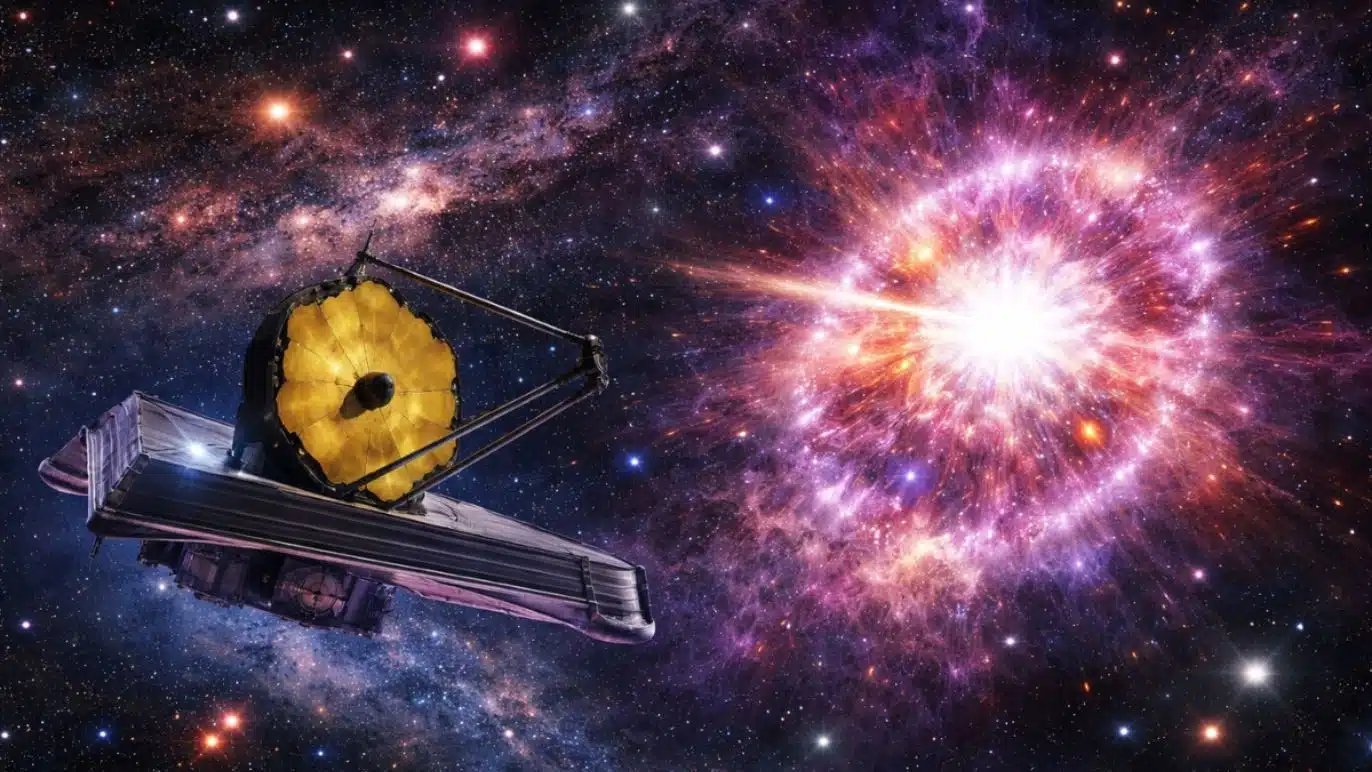
NASA’s James Webb Space Telescope (JWST) has shattered records by detecting the most distant supernova ever observed, marking a pivotal moment in our understanding of the early universe. This extraordinary discovery, made possible by Webb’s advanced infrared capabilities, reveals a stellar explosion that occurred just 730 million years after the Big Bang—far earlier than any previously confirmed supernova. The finding not only pushes the boundaries of observational astronomy but also offers new insights into the lives and deaths of the first massive stars.
Record-Breaking Discovery
On March 14, 2025, the Franco-Chinese SVOM (Space-based Multi-band Astronomical Variable Objects Monitor) mission detected a gamma-ray burst, designated GRB 250314A. This initial alert triggered a rapid international response, with NASA’s Neil Gehrels Swift Observatory quickly pinpointing the X-ray source. Within hours, the Nordic Optical Telescope and the European Southern Observatory’s Very Large Telescope provided follow-up observations, confirming the event’s extreme distance. The James Webb Space Telescope then conducted near-infrared observations on July 1, 2025, capturing the supernova’s faint glow and its elusive host galaxy—the earliest direct detection of such an event in cosmic history.
Webb’s Unique Capabilities
Webb’s Near-Infrared Camera (NIRCam) was crucial for this breakthrough. The telescope’s sensitivity to infrared light allows it to peer through cosmic dust and detect objects whose visible light has been redshifted by the expansion of the universe. For the first time, astronomers have a direct, unambiguous view of a supernova and its host galaxy from the universe’s infancy, without relying on secondary modeling or simulations. Webb’s rapid follow-up and precise measurements enabled scientists to study the supernova at its brightest, even as it began to fade, demonstrating the telescope’s unparalleled ability to track transient cosmic events.
The Supernova and Its Host Galaxy
The supernova, linked to the gamma-ray burst GRB 250314A, was produced by the collapse of a massive star—likely dozens of times the mass of our Sun. Such stars have short, furious lives, burning through their nuclear fuel rapidly before collapsing under their own gravity, unleashing a supernova that can outshine billions of stars. The event occurred during the Era of Reionization, a period when the first stars and galaxies were forming, and the universe was transitioning from a dark, neutral state to one filled with light and ionized gas.
Webb’s observations revealed not only the supernova’s light but also its host galaxy—a faint, reddened cluster of pixels in the near-infrared images. The galaxy exhibits characteristics typical of others from the same era, with low metal content and a high rate of star formation. This provides a rare glimpse into the conditions of the early universe and the processes that shaped its evolution.
Scientific Significance
The detection of such an ancient supernova is significant for several reasons. First, it confirms that massive stars existed and exploded as supernovae very early in cosmic history, contributing to the enrichment of the universe with heavy elements. Second, the supernova’s properties—such as its explosion energy and light curve—appear remarkably similar to those of modern supernovae, despite the vastly different conditions of the early universe. This challenges existing theories and suggests that the mechanisms driving stellar explosions may have been consistent throughout cosmic time.
Researchers are now eager to study the supernova’s metal content and exact distance in greater detail. These measurements will help refine models of stellar evolution and the chemical enrichment of the early universe. The discovery also underscores the importance of rapid follow-up observations for transient events, as the window to study such phenomena is often brief.
Broader Implications
This milestone not only redefines astronomical records but also clarifies how the universe’s first stars and supermassive black holes came to be. By studying the light from the earliest supernovae, astronomers can trace the history of star formation, galaxy evolution, and the distribution of heavy elements across cosmic time. The James Webb Space Telescope continues to push the boundaries of space exploration, providing valuable insights into the mysteries of our universe and the processes that shaped its development.
The Future of Supernova Research
The detection of GRB 250314A is just the beginning. Webb’s ongoing surveys, such as the JWST Advanced Deep Extragalactic Survey (JADES), are expected to uncover many more supernovae in the early universe. These discoveries will further increase our understanding of stellar life cycles, galaxy formation, and the cosmic timeline. The unprecedented number of supernovae detected by Webb—over 80 in a single patch of sky—demonstrates the telescope’s power as a “supernova discovery machine” and opens new avenues for research in astrophysics.
Final Words
The James Webb Space Telescope’s detection of the most distant supernova ever seen is a landmark achievement in astronomy. By capturing the light from a stellar explosion that occurred just 730 million years after the Big Bang, Webb has provided a direct view of the universe’s infancy and challenged our understanding of stellar evolution. This discovery not only sets a new record but also highlights the importance of advanced technology and international collaboration in exploring the cosmos. As Webb continues its mission, we can expect many more groundbreaking revelations about the origins and evolution of the universe.