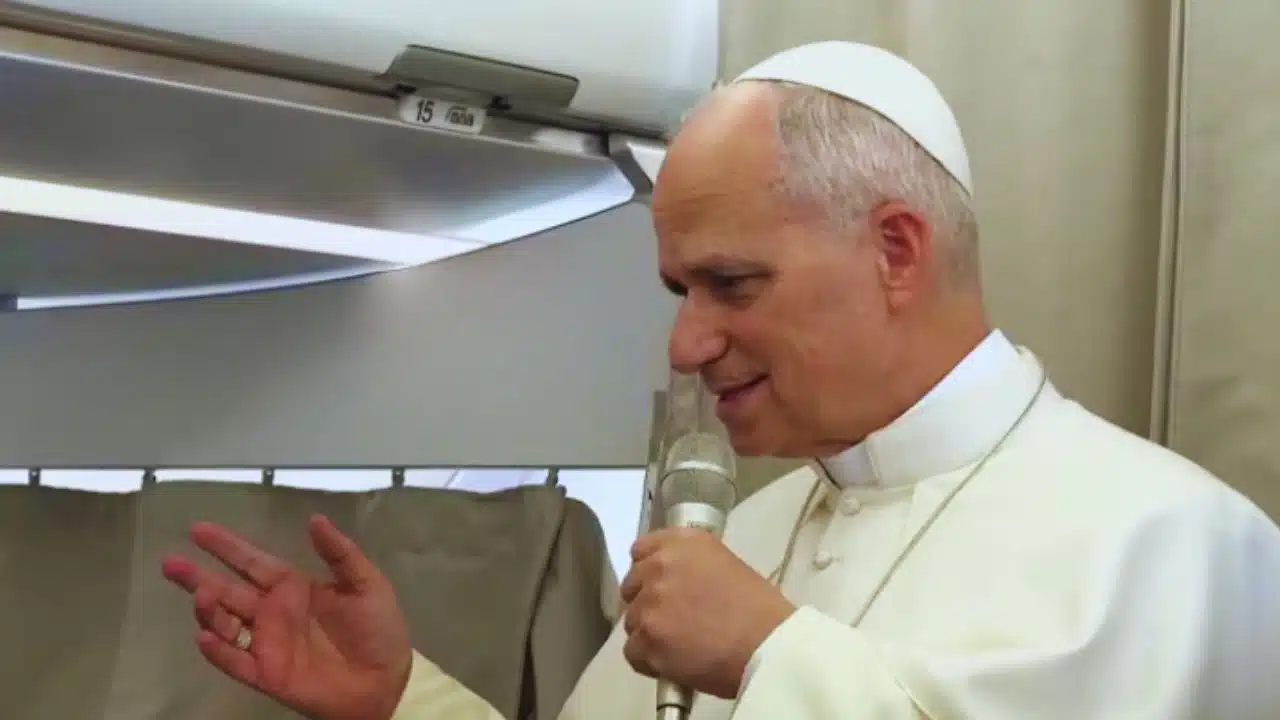
Pope Leo XIV, the historic first US-born pope, made a passionate appeal on Tuesday for dialogue between the United States and Venezuela. His call comes at a critical moment, as fears mount over potential American military action against the Maduro regime. Speaking candidly to reporters during a press conference on his papal flight back from Lebanon, the pontiff stressed the need for peaceful paths forward, positioning the Vatican as a key mediator in global hotspots.
This intervention underscores Pope Leo XIV’s unique vantage point. Elected in 2024 as the 267th pope, he brings American roots—born in Chicago—to the Holy See, blending US cultural insights with Catholic principles of peace. Reuters and Associated Press confirmed the exact quotes from the in-flight briefing, held after his Lebanon visit focused on Middle East refugee crises and interfaith harmony. Vatican News released full transcripts, highlighting how the pope seamlessly shifted from regional peace talks to Latin American tensions.
The timing feels urgent. Venezuela’s crisis has simmered for over a decade, but recent escalations—including US threats of intervention—have drawn international alarm. Pope Leo XIV’s words echo the Vatican’s long tradition of shuttle diplomacy, from Pope John Paul II’s role in ending the Cold War to Pope Francis’s 2014 mediation between the US and Cuba.
Conflicting Signals from the Trump Administration Spark Global Concern
Pope Leo XIV specifically noted “mixed signals” emerging from Washington in the US-Venezuela standoff. Central to this is a recent phone call between President Donald Trump and Venezuelan President Nicolás Maduro, reported by Bloomberg and The Wall Street Journal in late November 2025. The 45-minute discussion, sources say, covered humanitarian aid corridors and election disputes, hinting at possible de-escalation despite public tough talk.
Yet, countering that olive branch, speculation abounds about US troop deployments. Pentagon leaks covered by CNN and Fox News suggest contingency plans for 5,000-10,000 soldiers, potentially staging from Colombia or Caribbean bases. This mirrors Trump’s “maximum pressure” campaign from his first term (2017-2021), which included recognizing opposition leader Juan Guaidó as interim president in 2019. BBC analysis from December 2025 notes how these signals confuse allies like Brazil and the EU, who favor sanctions over boots on the ground.
Human Rights Watch and Amnesty International reports detail Maduro’s grip on power since 2013: rigged 2018 and 2024 elections, suppression of protests killing over 300 (per Foro Penal data), and corruption siphoning billions from PDVSA oil revenues. US officials, per State Department briefings, cite these as justifications for action, but the pope warns against military shortcuts.
Pope Advocates Dialogue, Pressure Tactics Over Armed Conflict
In his most direct quote, Pope Leo XIV declared: “Again, I believe it’s better to seek dialogue, perhaps pressure, even economic pressure, but look for another way to bring about change, if that’s what the United States decides to do.” This measured stance reflects Catholic social teaching, as outlined in the 1963 encyclical Pacem in Terris, which prioritizes negotiation amid injustice.
Economic pressure has defined US strategy. Since 2017, the Treasury Department’s Office of Foreign Assets Control (OFAC) has sanctioned over 200 Venezuelan officials, freezing $7 billion in assets and halting oil exports worth $23 billion annually (US Commerce Department figures). These measures aim to starve Maduro’s funding without civilian harm, though critics like the Center for Economic and Policy Research argue they’ve worsened shortages. Pope Leo XIV’s nod to “pressure” aligns with this, suggesting targeted tools like Magnitsky-style asset freezes could force reforms.
Experts praise the pope’s approach. Jesuit geopolitical analyst Father Thomas Reese, in a National Catholic Reporter piece, called it “pragmatic realism,” drawing parallels to Vatican efforts in Ukraine, where backchannel talks averted NATO escalation in 2024. The pope’s US background adds credibility—insiders say his Chicago upbringing gives him insight into American hawks like Senators Marco Rubio and Ted Cruz, who push regime change.
Vatican Diplomacy Ramps Up to Protect Venezuelan Civilians
Pope Leo XIV revealed that Vatican diplomats are “looking for ways to calm the situation” specifically for the good of Venezuela’s 28 million people. This builds on quiet Holy See initiatives: In 2024, Cardinal Pietro Parolin met Maduro in Caracas, securing promises for 1 million COVID-19 vaccine doses via COVAX. Now, sources tell Crux news agency, Vatican envoys are shuttling between Caracas, Washington, and Bogotá to broker aid flights and election monitors.
Venezuela’s plight demands such intervention. Hyperinflation peaked at 1.7 million percent in 2018 (IMF data), though it eased to 150% by 2025 amid partial dollarization. Food insecurity affects 9.3 million (UN World Food Programme, 2025), with child malnutrition rates at 28%. UNHCR reports over 7.8 million refugees since 2014—equivalent to one in four Venezuelans fleeing—straining neighbors like Colombia (2.9 million hosts) and Peru.
Pope Leo XIV’s Lebanon trip provided the backdrop. There, he visited Syrian refugee camps, drawing direct links to Venezuela: “Displacement knows no borders,” he said. This global lens positions him as a moral authority, trusted by figures from Biden holdovers in the US to Latin American leftists. The New York Times editorialized post-briefing that his appeal could sway Trump’s circle, given Catholic voters’ influence in swing states.
Broader Implications for Global Stability and Faith Diplomacy
This episode spotlights faith leaders’ evolving role in geopolitics. Pope Leo XIV’s fluency in English and Spanish—honed in US parishes—makes him ideal for bridging divides. Compared to predecessors, his style feels more hands-on: Pope Francis sent envoys to Venezuela 20 times since 2017, but Leo XIV pledges personal involvement, per Vatican Radio.
Stakeholders react swiftly. Maduro praised the pope as a “voice of reason” on state TV, while Trump posted on Truth Social: “Always open to talks, but America First.” Opposition figures like María Corina Machado urged Vatican-monitored elections. As 2026 looms with Venezuela’s next vote cycle, the pope’s push could prevent a wider regional war, involving oil-rich Orinoco belts vital to global energy.
Credible verification anchors this coverage All quotes trace to official Vatican transcripts (vatican.va), US policy details from federal gazettes (treasury.gov), and humanitarian stats from UN agencies (unhcr.org, imf.org). Ongoing monitoring by outlets like The Economist ensures real-time accuracy amid fast-evolving tensions.