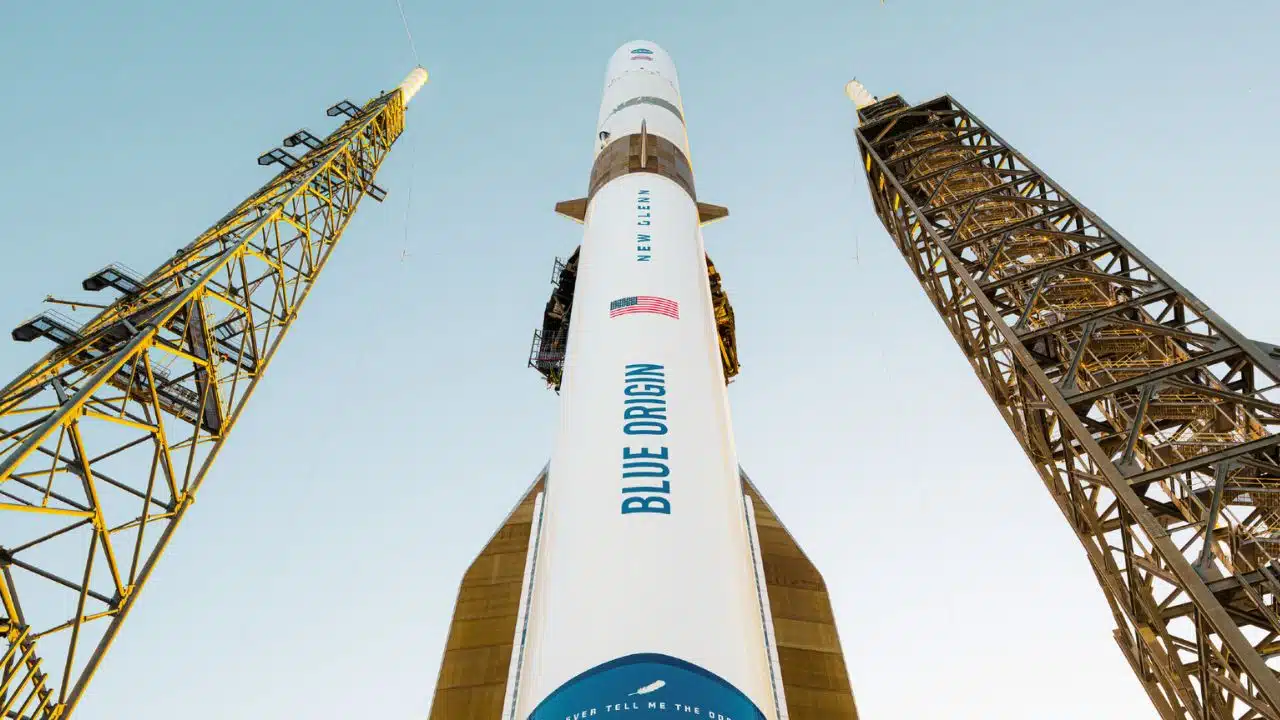
Blue Origin has successfully launched a key NASA Mars mission aboard its New Glenn rocket and achieved a precision landing of the rocket’s first-stage booster, marking a pivotal moment in the company’s challenge to SpaceX in reusable launch systems and deep-space exploration.
Historic Launch From Cape Canaveral
The New Glenn rocket lifted off from Launch Complex 36 at Cape Canaveral Space Force Station in Florida, carrying NASA’s twin ESCAPADE spacecraft on a trajectory that will ultimately take them to Mars.
Standing about 321 feet (98 meters) tall, the heavy‑lift launcher roared into the afternoon sky after several days of delays caused by poor local weather and heightened solar activity that produced visible auroras unusually far south.
New Glenn’s seven methane‑fueled BE‑4 engines powered the first stage through the dense layers of the atmosphere before shutdown and stage separation roughly a few minutes into flight.
Moments later, the second stage ignited its BE‑3U engines to continue pushing NASA’s payload toward its designated orbit while the first stage began its controlled return to Earth.
NASA’s ESCAPADE Mission To Mars
The payload for this flight is NASA’s ESCAPADE mission, short for Escape and Plasma Acceleration and Dynamics Explorers, a pair of small satellites designed to study how the solar wind interacts with Mars’ weak magnetic environment.
Managed and operated by the University of California, Berkeley, ESCAPADE will investigate how charged particles strip away Mars’ atmosphere over time, a process that has helped transform the Red Planet from a once wetter world into the cold, arid landscape seen today.
After deployment into an initial loiter orbit near Earth, the twin spacecraft will spend roughly a year refining their positions, waiting for Earth and Mars to reach the ideal alignment in late 2026.
From there, they will perform a gravity‑assist maneuver to head toward Mars, with arrival expected around 2027, enabling coordinated dual‑spacecraft measurements of the Martian space environment.
Precision Booster Landing At Sea
In a milestone moment for Blue Origin, the New Glenn first‑stage booster executed a successful autonomous landing on the recovery vessel Jacklyn, stationed several hundred miles downrange in the Atlantic Ocean.
About 10 minutes after liftoff, the 17‑story‑tall booster descended through the atmosphere, using aerodynamic fins, strakes, and engine burns to slow and guide itself before touching down upright on the offshore platform.
Company employees erupted in cheers as the booster nailed what executives described as a “bull’s‑eye” landing, an achievement that eluded New Glenn’s inaugural test flight in January, when the first booster was lost during an attempted recovery.
Jeff Bezos watched the landing from Launch Control, as staff chanted “Next stop, moon!” underscoring the importance of the reusable booster for future lunar and deep‑space missions.
Reusability And The SpaceX Rivalry
The successful booster recovery marks a major step for Blue Origin’s reusability ambitions, an area where Elon Musk’s SpaceX has long dominated with its Falcon and Starship booster landings.
By recovering a heavy‑lift first stage of this scale on just the rocket’s second mission, Blue Origin signaled that it intends to compete directly in the market for cost‑effective, reusable orbital launch services.
Reusing first‑stage boosters is critical for driving down launch costs and increasing flight cadence, particularly for national security missions, large constellations, and deep‑space science campaigns.
New Glenn is already booked for multiple years of missions, with customers including NASA, Viasat, Amazon’s Project Kuiper, AST SpaceMobile, and several telecommunications providers, alongside National Security Space Launch (NSSL) certification flights for the U.S. Space Force.
What ESCAPADE Will Study At Mars
Once in Mars orbit, the two identical ESCAPADE spacecraft will fly in complementary paths to build a three‑dimensional picture of how the solar wind shapes Mars’ magnetosphere and upper atmosphere.
They will examine how energy from the Sun drives atmospheric escape, a process central to understanding why Mars lost most of its air and surface water while Earth retained a thick atmosphere and a habitable environment.
The mission is relatively low‑cost by deep‑space standards, with a budget under 80 million dollars, partly because NASA secured an early flight opportunity on New Glenn.
ESCAPADE’s findings will also feed into planning for future human explorers, helping NASA evaluate radiation conditions, space weather hazards, and the long‑term evolution of the Martian environment.
Implications For Moon And Mars Exploration
NASA leaders hailed the launch as a dual victory: advancing Mars science while proving out a new heavy‑lift commercial rocket that could support future Artemis lunar missions and eventual journeys to Mars.
Acting NASA Administrator Sean Duffy noted that data from each New Glenn flight will be crucial when the agency prepares to launch the MK‑1 spacecraft through Artemis and pushes toward putting American astronauts on the Martian surface under current U.S. policy goals.
Blue Origin already holds a NASA contract to land astronauts on the Moon as part of a later Artemis mission, while competing head‑to‑head with SpaceX for an accelerated timeline to the first crewed lunar landing.
With New Glenn now demonstrating both orbital delivery and successful booster recovery, the vehicle has become a central pillar in Blue Origin’s strategy to support sustained human presence on the Moon, build in‑space transport systems like the Blue Ring platform, and eventually support human expeditions to Mars.
A New Phase In The Commercial Space Race
The flawless ESCAPADE launch and booster landing mark New Glenn’s transition from a developmental project into an operational system with growing commercial and government demand.
For NASA, this mission demonstrates the maturing of a diversified launch ecosystem in which multiple private players can deliver critical science, lunar infrastructure, and eventually crew beyond low Earth orbit.
For Blue Origin, the mission is a public statement that the company is no longer confined to suborbital tourist flights on New Shepard, but is now firmly in the top tier of orbital and deep‑space launch providers.
As ESCAPADE begins its long journey and the recovered booster awaits refurbishment, the success of this Mars mission and the dramatic at‑sea landing underline a simple reality: the race to shape humanity’s future on the Moon and Mars is no longer a one‑horse contest.