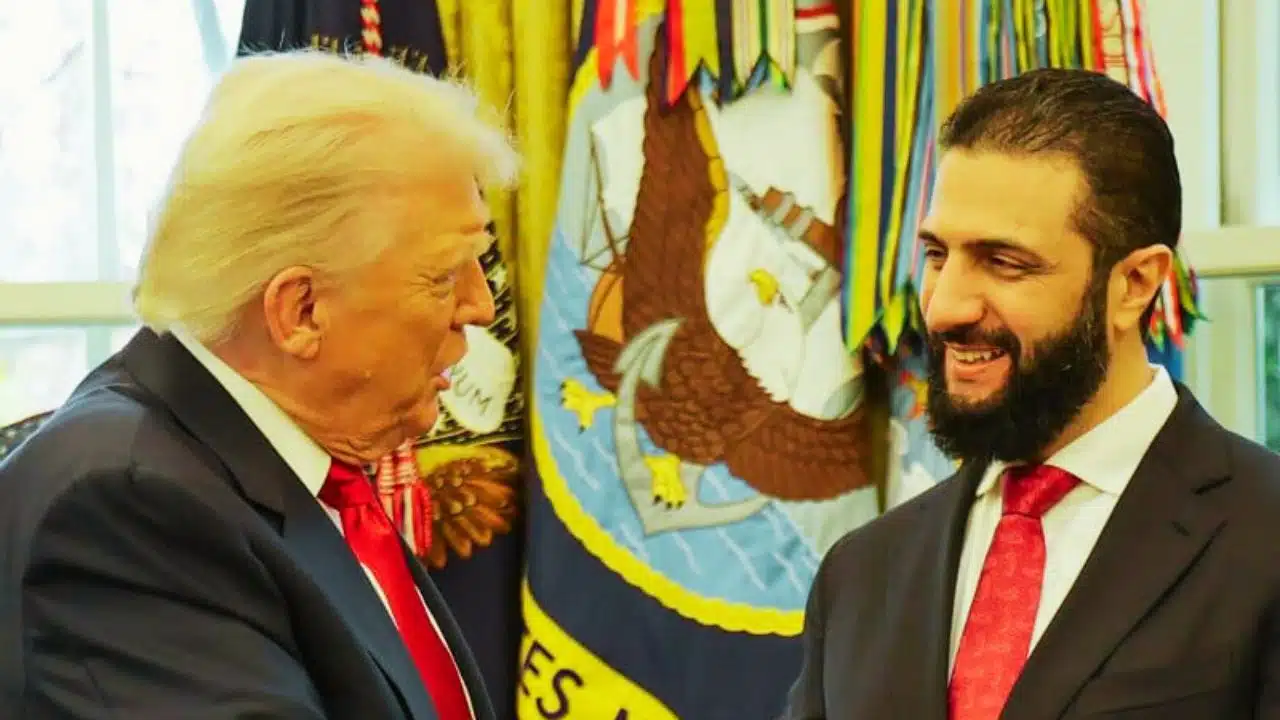
In a groundbreaking development, US President Donald Trump hosted Syrian interim President Ahmed al-Sharaa at the White House on November 10, 2025, in the first-ever visit by a Syrian leader to Washington since the country’s independence from France in 1946. The summit, shrouded in secrecy with no media access to the main discussions, signals a dramatic thaw in bilateral relations following the ouster of longtime Syrian dictator Bashar al-Assad last December. Accompanying the meeting, the US Treasury announced a partial 180-day suspension of Caesar Act sanctions on Syria, excluding transactions linked to Russia and Iran, as a step toward economic normalization and regional stability.
This encounter, the third between the two leaders since their initial meeting in Saudi Arabia in May, underscores Trump’s push for pragmatic diplomacy in the Middle East, praising al-Sharaa as a “strong leader” with a “tough background” who is “doing a very good job so far”. White House Press Secretary Karoline Leavitt described the talks as part of Trump’s broader efforts to engage world leaders in pursuit of peace, while the Syrian Foreign Ministry hailed the discussions as “constructive,” focusing on shared interests and a new chapter in relations.
Al-Sharaa’s Remarkable Journey from Terrorist Label to Diplomatic Partner
Ahmed al-Sharaa, 42, embodies Syria’s turbulent recent history. Once a commander in al-Qaeda-linked groups with a $10 million US bounty on his head, he led the rebel forces—through his Hay’at Tahrir al-Sham (HTS) organization—that toppled Assad’s regime after decades of civil war, assuming the role of interim president in January 2025. The US had designated HTS as a terrorist organization until July, when it revoked the label, and just days before the summit, removed al-Sharaa from its Specially Designated Global Terrorist list.
Trump’s administration has framed al-Sharaa’s evolution as a redemption arc, with the president noting in the Oval Office that he believes the Syrian leader can make his country “successful.” The low-profile entry—al-Sharaa arriving via a secure side entrance—reflected sensitivities around his past, but the meeting included high-level US officials like Secretary of State Marco Rubio, Vice President JD Vance, and special envoy Tom Barrack, alongside Turkish Foreign Minister Hakan Fidan, highlighting Ankara’s mediation role. For Syrians, the visit sparked celebrations in diaspora communities, with hundreds gathering outside the White House to cheer what they see as a path to legitimacy and rebuilding.
Sanctions Relief: A Partial Lift with Strings Attached
The US Treasury’s announcement of a 180-day partial suspension of the Caesar Syria Civilian Protection Act—enacted in 2019 to punish Assad’s regime for human rights abuses—marks the second such waiver this year, following a May general license that allowed transactions with Syria’s interim government. This move halts sanctions enforcement except for dealings involving Russian or Iranian entities, aiming to encourage investment while blocking resources to “harmful actors” like Assad and his inner circle, who remain sanctioned.
Secretary Rubio emphasized the suspension as recognition of Syria’s progress in countering narcotics, eliminating chemical weapons, and bolstering regional security since Assad’s fall. The State Department is also reviewing Syria’s designation as a State Sponsor of Terrorism, a status tied to Assad-era policies. Trump has vowed to “do everything possible” to support Syria’s economic recovery, potentially paving the way for full sanctions relief if Damascus meets US conditions on governance and counterterrorism. Critics in Congress, however, have raised concerns over the rapid embrace of al-Sharaa, questioning the administration’s counterterrorism strategy amid Syria’s fragile transition.
Key Agreements: Counter-ISIS Coalition and Regional Integration
A centerpiece of the summit was Syria’s formal commitment to join the US-led global coalition against the Islamic State (ISIS), a shift that could enhance coordination with US forces and Kurdish-led Syrian Democratic Forces (SDF) in the northeast. Administration officials confirmed that al-Sharaa’s government will integrate the SDF into the Syrian Arab Army, fulfilling terms of a March 10 agreement to unify state institutions and national security.
The talks also addressed broader regional stability, with the US expressing support for a potential security pact between Syria and Israel to ease border tensions. Economically, Trump pledged backing for Syria’s reconstruction efforts, including attracting foreign investment once sanctions are further eased. The Syrian side reciprocated by agreeing to mechanisms for implementing bilateral pacts, ending the two-hour session with an exchange of gifts in a “friendly atmosphere”. This coalition move comes as ISIS remnants persist in Syria and Iraq, and analysts see it as a strategic win for Washington in countering Iranian influence post-Assad.
Implications for the Middle East and Beyond
The summit arrives amid Syria’s delicate post-Assad transition, where al-Sharaa’s HTS roots have drawn scrutiny from human rights groups wary of Islamist governance. Yet, Trump’s approach—bypassing traditional allies’ hesitations—could accelerate Syria’s reintegration into the Arab world, following its readmission to the Arab League earlier this year. With Russia and Iran sidelined by ongoing sanctions carve-outs, the US aims to fill the power vacuum, potentially stabilizing a key conflict zone.
For the Syrian people, weary from over a decade of war that displaced millions and devastated the economy, these developments offer hope for aid inflows and normalcy, though challenges like rebuilding infrastructure and reconciling factions remain daunting. As Trump hinted at “more announcements” ahead, the White House meeting may prove a pivotal pivot, transforming a pariah state into a tentative partner in the fight against extremism and for Middle East peace.