In a surprising strategic shift, Apple has quietly formed a new internal division focused on developing an advanced AI-driven search system that could directly rival ChatGPT and Google’s Gemini. The initiative, internally dubbed the “Answers, Knowledge, and Information” team, signals a major evolution in Apple’s approach to artificial intelligence and online search—areas where the tech giant has historically remained cautious or even resistant.
For years, Apple positioned itself as a company committed to on-device privacy and minimal cloud dependence, especially when it came to AI technologies. Its flagship voice assistant, Siri, has long reflected this philosophy, processing queries using local resources rather than cloud-based models. However, with competitors like OpenAI, Microsoft, and Google racing ahead with dynamic AI capabilities, Apple now appears to be rethinking its strategy in a fundamental way.
Led by a Former Siri Veteran
The newly created team is being led by Robby Walker, a former executive who previously worked on Siri. Walker was involved in some of Apple’s earliest voice assistant projects and understands the pain points all too well. He had once described past delays in Siri’s development as embarrassing for the company and demoralizing for the teams involved.
Now, under Walker’s direction, Apple is working to create a comprehensive “answer engine”—an AI platform capable of searching and synthesizing real-time web data to provide informative responses to user questions. This would effectively mark Apple’s first major foray into web-based search, a realm dominated by Google for decades.
Building a New Kind of Search Engine
Apple’s “answer engine” is not just another upgrade to Siri—it’s a completely new infrastructure being designed to support multiple services within the Apple ecosystem. The goal is to integrate this advanced search technology into Siri, Spotlight, Safari, and possibly even launch a standalone AI-powered search app in the future.
Unlike traditional search, which provides users with a list of links, Apple’s system aims to deliver direct answers, much like OpenAI’s ChatGPT or Google’s AI Overviews. To make this happen, Apple is now hiring aggressively. The company’s careers page lists over a dozen open positions for this new team, with roles spread across the United States and China. Many of these positions are focused on training large language models (LLMs) and improving natural language understanding—critical components of any modern AI assistant.
Pressure from a Weak Siri and a Strong Google
Apple’s decision to pivot into AI search is also influenced by mounting criticism of Siri, which has consistently lagged behind its competitors in performance and usability. Despite promises of smarter features, Siri has continued to disappoint users with its limited understanding and inconsistent behavior.
Originally, Apple had planned to unveil a dramatically improved Siri in fall 2024, but repeated engineering delays have now pushed the internal launch target to spring 2026, with the feature likely to debut in iOS 26.4. According to internal reports, the upgraded Siri still only performs accurately 60–80% of the time, a troubling rate for a product expected to compete with AI tools like ChatGPT and Google Assistant.
These setbacks have also led to organizational shakeups. Apple’s head of AI, John Giannandrea, who was once brought in from Google to revive the company’s AI ambitions, has reportedly been removed from consumer-facing projects, including Siri. Oversight has since been handed to Craig Federighi, Apple’s Senior Vice President of Software Engineering, and Mike Rockwell, who previously led the Vision Pro development.
Internal Frustrations and a Divided Strategy
Inside Apple, the delay in Siri’s capabilities has caused significant morale issues. According to internal sources, engineers and managers expressed deep frustration over missed deadlines, underwhelming product performance, and the intense pressure to deliver on public expectations. These feelings of burnout and disappointment reportedly led to the acknowledgment that continuing to rebuild Siri alone was no longer enough.
Instead, Apple is now pursuing a parallel track: rebuilding Siri from scratch while also investing in the new answer engine. This twin-pronged approach reflects a deeper philosophical divide within Apple’s AI roadmap.
On one hand, Apple Intelligence, the system introduced at WWDC 2024, focuses on privacy-first, on-device AI processing. It includes features such as personalized recommendations, message summaries, and content generation—done without sending personal data to cloud servers.
On the other hand, the search team’s answer engine aims to crawl the internet, retrieve information in real-time, and synthesize accurate answers. This requires cloud-based processing, which could put Apple in a position where it must loosen some of its long-standing privacy restrictions to remain competitive.
A Threat to Apple’s $20 Billion Google Deal
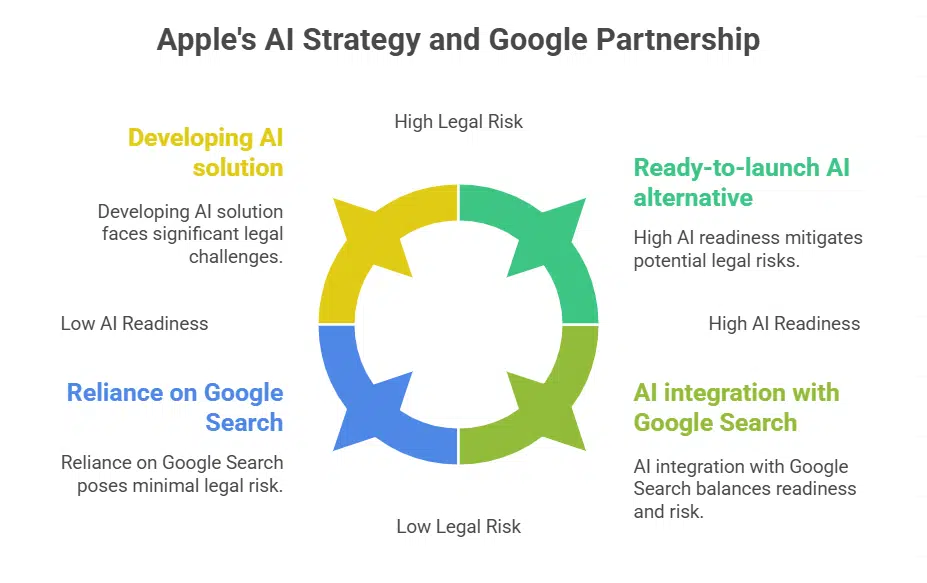
Apple’s new AI direction also comes at a sensitive moment regarding its financial relationship with Google. For years, Apple has relied on Google Search as the default engine across its devices, a partnership estimated to bring Apple nearly $20 billion annually.
However, this deal is now under legal review by the U.S. Department of Justice, which argues that the arrangement stifles competition and locks users into Google’s ecosystem. Should the partnership be ruled anti-competitive or forcibly dismantled, Apple may find itself needing a ready-to-launch alternative—a scenario that the answer engine may be designed to solve.
Industry-Wide AI Trends Prompt Strategic Pivot
Apple’s change in course also mirrors broader shifts in the tech industry. Companies are increasingly moving away from classic keyword-based search and toward AI-generated responses that summarize and contextualize information.
Apple’s Senior VP Eddy Cue has reportedly acknowledged that the search industry is undergoing a massive transformation, where users prefer natural conversation interfaces rather than scrolling through links. That shift, combined with Apple’s lagging position in AI, has likely accelerated the push for a more modern, AI-powered search solution.
Competing with ChatGPT, Gemini, and Microsoft Copilot
With ChatGPT dominating global discussions on AI productivity tools, Google rolling out Gemini across Search and Workspace, and Microsoft embedding Copilot across Windows and Office apps, Apple faces increasing pressure to catch up or risk being left behind.
These companies have already embraced cloud AI, giving their users access to dynamic information updates, document generation, reasoning, summarization, and creative outputs through LLMs. If Apple remains too focused on device-only AI, it may fail to meet the evolving demands of users seeking knowledge-rich, real-time support.
To match these capabilities, Apple’s answer engine would likely need:
-
Robust server infrastructure
-
A scalable cloud AI platform
-
Web crawling and indexing capabilities
-
Fine-tuned language models that can reason, summarize, and contextualize
These tools may ultimately push Apple into new territory—building its own knowledge graph and competing directly in the realm of cloud AI.
Apple’s Search Engine Ambitions
While the answer engine is still in its early development phase, its emergence points to a clear strategic pivot. Apple appears ready to challenge Google’s dominance in web search, OpenAI’s position in conversational AI, and Microsoft’s grip on productivity AI.
Yet the path forward will require significant investments in infrastructure, cultural shifts in how Apple views data privacy, and a rebalancing of its product strategy. The company must now find a way to unify privacy and performance—delivering fast, accurate, and intelligent answers while preserving the trust it has built around user data protection.
If successful, the answer engine could become Apple’s most important AI innovation in a decade, reshaping not only how users interact with Siri or Safari, but how people search, learn, and engage with digital knowledge across the Apple ecosystem.