
France’s top data privacy watchdog, CNIL (Commission Nationale de l’Informatique et des Libertés), has taken a bold step against tech giant Google by proposing a massive €525 million fine. The decision follows a detailed investigation that found Google had violated French privacy laws by displaying personalized ads inside Gmail without obtaining proper consent from users. This case has now become one of the most significant data privacy enforcement actions in Europe and could serve as a landmark moment for digital advertising regulations across the continent.
The Issue: Personalized Gmail Ads Without Consent
At the center of the dispute is how Google’s free version of Gmail operates. Users in France began to notice that promotional ads were being displayed within their inboxes. These ads, which often resembled ordinary emails, were based on user behavior, email content, and tracking cookies. This tracking and personalization happened without any clear consent being given by users, which directly contradicts France’s data protection laws under the ePrivacy Directive and the General Data Protection Regulation (GDPR).
Unlike traditional banner ads or Google Search ads, these inbox advertisements are particularly controversial because they closely mimic regular email messages. Many users found them deceptive and intrusive, believing they were actual communications rather than paid promotions. These concerns led to multiple complaints to CNIL, prompting the authority to open an official investigation into Google’s practices.
CNIL’s Investigation and Findings
The French data regulator conducted a thorough review of how Google configured its Gmail platform, especially focusing on how advertising content is delivered to users. It found that:
-
Google installs tracking cookies the moment a user begins using Gmail, often before any meaningful consent is requested.
-
Personal data such as email behavior, browsing patterns, and device identifiers were used to target users with customized ads inside Gmail.
-
Consent forms or cookie banners were either absent, unclear, or structured in a way that nudged users into agreeing without understanding what they were consenting to.
According to CNIL, these practices breached the principle of informed and explicit consent, which is a core requirement under both French and European Union data protection laws. CNIL also stated that Google’s data collection and ad-serving mechanisms did not offer a genuine choice to users.
Why This Fine Matters
The €525 million penalty is not only the largest ever imposed by CNIL but also one of the biggest data privacy fines in Europe to date. It reflects the growing urgency among regulators to hold tech companies accountable for how they use and monetize user data. Previously, CNIL had fined Google €100 million and Facebook €60 million over cookie policy violations in 2020 and 2022 respectively. However, this new fine dwarfs those and signals a more aggressive stance by French authorities.
If the decision stands, it will have ripple effects across the tech industry. Companies that use dark patterns, misleading ad formats, or vague consent mechanisms will likely face stricter scrutiny. Additionally, this case reinforces France’s intent to lead in the enforcement of data privacy within the EU.
Legal Implications and Broader Impact in Europe
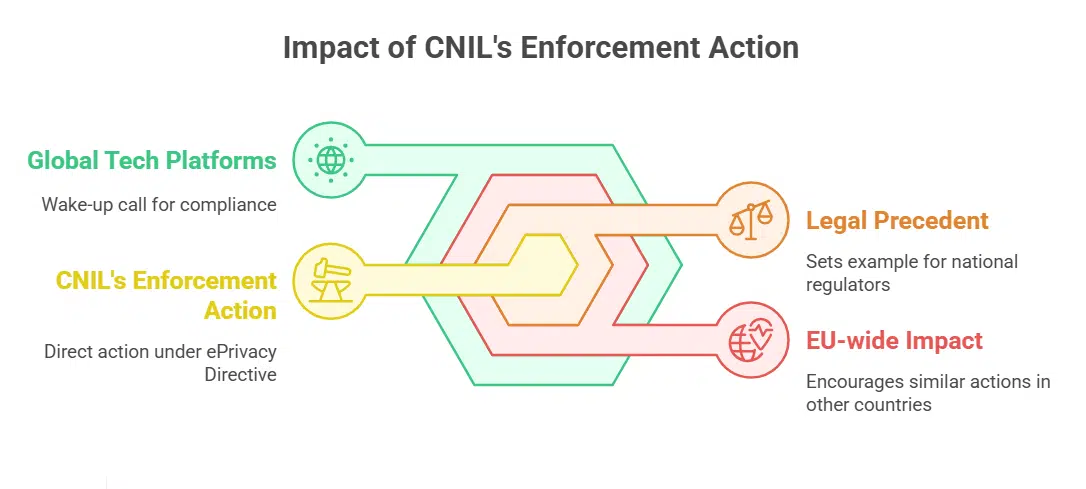
This enforcement action is significant not only because of its financial weight but also due to the legal precedent it could set. CNIL is acting under the ePrivacy Directive, which allows national regulators to take direct action against companies without waiting for cross-border coordination through the GDPR’s “one-stop-shop” mechanism.
That means France can independently penalize global tech platforms if the violations involve privacy issues like cookie tracking and electronic communications—areas specifically governed by national ePrivacy rules.
This approach could encourage other EU countries to enforce similar actions at the national level without being slowed down by lengthy EU-wide GDPR procedures. It’s also a wake-up call to companies that localized versions of global platforms—like Gmail in France—must fully comply with regional data privacy regulations.
Response from Google
As of now, Google has not released an official statement regarding the proposed fine. It is expected that the company may appeal the decision or request a reduction in the fine through legal avenues. Google has previously argued that its ad personalization and consent models are compliant with GDPR and provide users with options to manage their data preferences.
However, critics argue that the default settings in Gmail, and the subtle design of ad placements, do not empower users to make truly informed choices. Unless Google fundamentally changes how it seeks consent and displays personalized ads, it may continue to face enforcement actions across other EU jurisdictions.
Consumer Reactions and Growing User Awareness
French Gmail users have long raised concerns over these ads, particularly those that appear deceptively like ordinary emails. Some users reported accidentally clicking on them, thinking they were personal messages. Others felt their privacy was being exploited, especially since Gmail is widely used for both personal and professional communication.
This growing user dissatisfaction, combined with regulatory action, signals a shift toward greater accountability in how tech companies handle personal data and interface design. More consumers are now becoming aware of their data rights and are calling for transparency and ethical advertising.
What Happens Next?
The final confirmation of the fine will depend on further legal reviews. If upheld, this action by CNIL could lead to:
-
Revised ad practices within Gmail and potentially other Google services in France and beyond.
-
Increased pressure on other tech giants like Microsoft, Apple, Meta, and Amazon to revisit their consent and ad delivery frameworks.
-
A new regulatory benchmark for inbox advertising and cookie-based tracking across Europe.
This development will also likely intensify discussions at the EU level around finalizing the ePrivacy Regulation, a long-delayed but much-anticipated overhaul of Europe’s digital communications privacy framework.