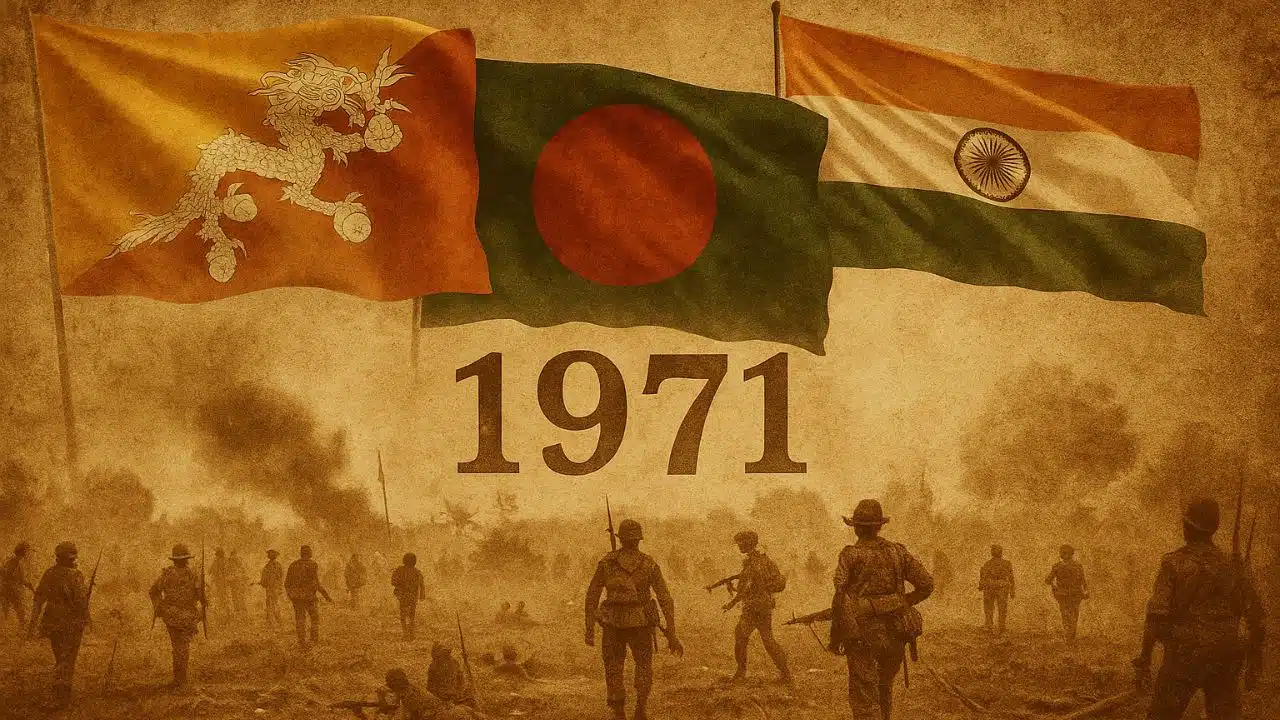
On this historic day in 1971, the struggle for Bangladesh’s independence reached an irreversible turning point. Both Bhutan and India formally recognized Bangladesh as a sovereign nation, a diplomatic breakthrough that dramatically shifted the momentum of the Liberation War.
Their recognition strengthened Bangladesh’s international legitimacy and intensified the pressure on Pakistani occupation forces, whose defeat now appeared inevitable.
Bhutan’s First Recognition: A Telegram That Made History
While debates persisted for decades over who recognized Bangladesh first, historical records and testimonies confirm that Bhutan extended its recognition a few hours before India, sending an official telegram on December 6. This made Bhutan the first country in the world to acknowledge Bangladesh as an independent state.
Shortly afterward, India followed with a formal announcement in its parliament. Prime Minister Indira Gandhi, addressing the Lok Sabha, declared:
“After careful consideration, India has taken the formal decision to recognize Bangladesh in a meeting of the Standing Cabinet. I am recognizing it not only by emotion, but by fully assessing the current and future situation.”
Her words resonated deeply across the subcontinent as India entered the war openly on the side of Bangladesh’s freedom fighters.
Battlefield Momentum Shifts
Following the diplomatic recognition, the battlefield grew increasingly intense. Allied forces—comprising the Mukti Bahini and the Indian military—accelerated their operations. Disoriented and overwhelmed by coordinated attacks, Pakistani troops began abandoning several border positions.
Key victories on December 6 included:
-
Naval Blockade Launched: The Indian Navy imposed a blockade in the Bay of Bengal, isolating the Pakistani military.
-
Liberation of Feni: The 10th East Bengal Regiment and Sub-Sector troops under Colonel Zafar Imam freed Feni from enemy control.
-
Advances Toward Khulna: Forces led by Major Jalil liberated Satkhira and pressed toward Khulna.
-
Ahmednagar Attack: Company Commander Md. Rahmatullah struck the Pakistani base in Jhenaigati.
-
Panchagarh and Thakurgaon Freed: Mukti Bahini fighters secured both districts.
-
Strategic Strongholds Secured: Resistance forces took powerful positions in Laksam, Akhaura, Chauddagram, and Hili.
-
Liberation of Jhenaidah: Joint Bangladesh–India forces captured the key city.
By nightfall, important areas of Akhaura and Shamsernagar in Sylhet were also under allied control.
Diplomatic Ripples Across the World
The day’s events reverberated internationally. From the Swadhin Bangla Betar Kendra, Acting President Syed Nazrul Islam addressed the nation, praising Indian soldiers for their solidarity. Pakistan, in retaliation, cut diplomatic ties with India, while the United States promptly suspended economic assistance to New Delhi.
These shifts highlighted the global stakes surrounding the Bangladesh Liberation War.
Prelude to the Final Victory
The recognition by Bhutan and India came just days after Pakistan’s air attack on India on December 3, 1971. When Indian Army Chief General Sam Manekshaw informed Lieutenant General Jacob, it was clear that all-out war had begun. Indian military leadership, far from being rattled, had anticipated this moment.
What followed was a rapid chain of events. Within 13 days, the Pakistani occupying forces were surrounded, outmaneuvered, and ultimately compelled to surrender—paving the way for the birth of Bangladesh as a free nation.
A Landmark Day in Bangladesh’s Journey to Independence
Today, as Bangladesh observes 54 years since this pivotal moment, December 6 stands as a historic reminder of international friendship, decisive diplomacy, and the unyielding spirit of a nation fighting for its freedom.
Bhutan’s early recognition and India’s steadfast support were instrumental in shaping the final outcome of 1971—a testament to regional solidarity that continues to inspire generations.