Mainstream animation often leans on flashy battles, predictable romance, or familiar fantasy tropes to capture massive audiences. However, a specific corner of the medium exists purely to dismantle reality, challenge moral compasses, and leave viewers questioning their own sanity. These cerebral narratives dig deep into the human condition. They explore trauma, identity, and the fragile nature of memory. For viewers seeking stories that demand active participation and profound introspection, finding an underrated psychological anime provides a uniquely haunting viewing experience. The following report breaks down eight hidden gems that masterfully execute suspense, surrealism, and psychological horror.
Market Trends and the Demand for Dark Anime Narratives
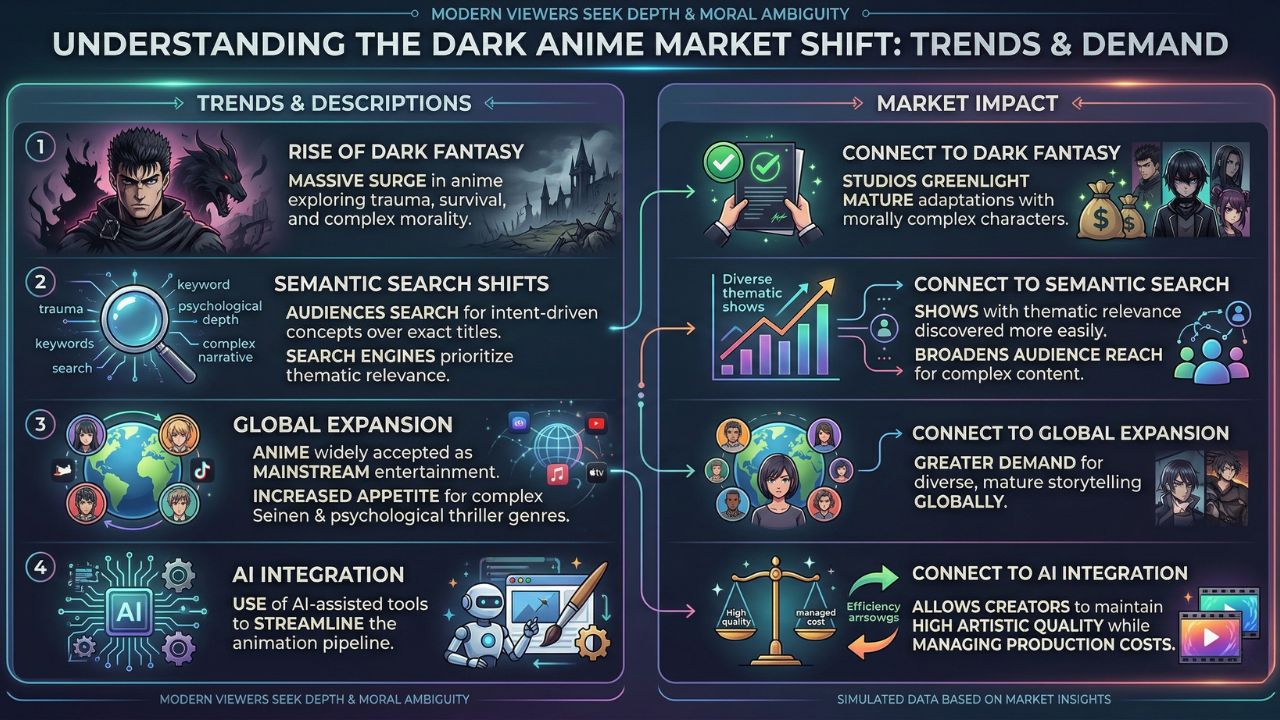
The anime industry constantly shifts, but recent data indicates a massive surge in demand for mature, complex storytelling. Viewers actively seek out narratives that explore moral ambiguity, trauma, and psychological degradation. Modern audiences want more than simple escapism; they want shows that challenge their perceptions. This shift has pushed studios to greenlight dark fantasy projects and psychological thrillers that prioritize atmosphere over action. The integration of advanced production tools and changing search behaviors heavily influences how these specific shows find their audiences today.
| Trend | Description | Market Impact |
| Rise of Dark Fantasy | A massive surge in anime exploring trauma and survival. | Studios greenlight mature adaptations with morally complex characters. |
| Semantic Search Shifts | Audiences search for intent-driven concepts rather than exact titles. | Search engines prioritize thematic relevance over simple keyword matching. |
| Global Expansion | Anime is widely accepted as a mainstream entertainment medium. | Increased appetite for complex genres like Seinen and psychological thrillers. |
| AI Integration | Use of AI-assisted tools to streamline the animation pipeline. | Allows creators to maintain high artistic quality while managing production costs. |
1. Paranoia Agent: A Deep Dive into Societal Delusion
Satoshi Kon’s 2004 television series stands as a towering achievement in the realm of suspense. It blends biting social commentary with surreal nightmare logic to dissect Japanese societal pressures. The narrative spirals around a mysterious juvenile assailant, Lil’ Slugger, whose attacks seemingly relieve his victims of their overwhelming stress. It operates as an intense critique of modern society, showing how rumors, urban legends, and fear spread rapidly through a vulnerable populace. The series remains a prime example of an underrated psychological anime that delivers profound commentary on escapism and mental health.
| Feature | Detail |
| Director | Satoshi Kon |
| Studio | Madhouse |
| Release Year | 2004 |
| MAL Score | 7.67 |
| Core Themes | Mass hysteria, conformity, escapism, mental breakdown |
Satoshi Kon’s Vision and Mass Hysteria
Paranoia Agent acts as a magnifying glass held up to the crushing weight of Japanese societal expectations. The story kicks off with Tsukiko Sagi, a shy character designer who creates a wildly popular pink dog named Maromi. Struggling under immense pressure to replicate her previous success, Tsukiko becomes the first victim of Lil’ Slugger (Shōnen Bat). The genius of the narrative lies in the ambiguity of the attacks. The violence inflicted by the boy’s bent golden baseball bat actually serves as a twisted form of salvation, rescuing desperate individuals from the corners they have been backed into.
Director Satoshi Kon cited William Golding’s Lord of the Flies as a major inspiration for the show’s thematic breakdown of social order. As the urban legend of Lil’ Slugger grows, the collective paranoia manifests into a tangible, destructive force. The adorable mascot Maromi serves as the psychological counterweight to Lil’ Slugger, representing society’s desperate need to numb itself with cute, mindless consumerism. Kon also drew upon the surreal, grotesque paintings of Hieronymus Bosch to craft the show’s nightmarish visual sequences. These artistic choices create an atmosphere where the boundary between objective reality and subjective delusion completely dissolves.
Production Trivia and Reception
The production features high-caliber talent, including music by Susumu Hirasawa and writing by Seishi Minakami. It also features notable voice acting work, with Nana Mizuki taking on the role of Taeko Hirukawa in the original Japanese broadcast. The English dub, which aired on Adult Swim, features prominent actors like Liam O’Brien and Sam Riegel. The show’s structure initially baffled some viewers, particularly the middle episodes. Episodes like “Happy Family Planning” take serious subjects like suicide pacts and turn them entirely upside down, utilizing dark, ironic humor.
Despite its brilliance, the series maintains a relatively modest score of 7.67 on community sites like MyAnimeList. This proves that its unconventional approach filters out viewers looking for traditional linear storytelling. Reviewers praise the series heavily; an IGN review compared the show to the works of David Lynch, noting its eerie and funny atmosphere. Paste Magazine listed it as the 14th best anime series of all time, calling it a sublime exercise in psychological thrillers. It requires patience, but the payoff is an unforgettable look at the psychological toll of modern isolation.
2. Texhnolyze: Cyberpunk Nihilism at Its Peak
Directed by Hiroshi Hamasaki and featuring visionary character designs by Yoshitoshi ABe, this 2003 series redefines the boundaries of the cyberpunk genre. Set in the subterranean, crumbling city of Lux, the story follows a mutilated prize fighter named Ichise as he navigates brutal gang warfare. The pacing is notoriously slow, plunging the audience into a bleak, oppressive atmosphere where hope is practically nonexistent from the opening frame. It demands intense patience but rewards dedicated viewers with a devastating, unforgettable look at human nature and technological overreach.
| Feature | Detail |
| Director | Hiroshi Hamasaki |
| Studio | Madhouse |
| Release Year | 2003 |
| Notable Staff | Yoshitoshi ABe (Character Design), Chiaki J. Konaka (Writer) |
| Core Themes | Nihilism, transhumanism, fate, societal decay |
Existential Themes in the City of Lux
Texhnolyze is not an easy viewing experience; it operates as a grueling endurance test that reflects the absolute despair of its setting. The city of Lux relies entirely on mining raffia, a rare mineral necessary for advanced prosthetics. Three warring factions control the city: the mafia-like Organo, the fanatic Salvation Union, and the marauding Racan youths. Ichise, a man of remarkably few words, angers a promoter and loses his arm and leg. He is rescued by a scientist named Eriko “Doc” Kaneda, who forcefully subjects him to “texhnolyzation”—an experimental prosthetic procedure.
The narrative asks profound questions about what constitutes humanity when machinery replaces the physical body. It heavily mirrors complex medicolegal debates regarding the definition of “brain death” versus physical death. Anthropologists like Margaret Lock extensively researched these concepts regarding Japanese medical ethics during the time of the show’s production, and the anime reflects that cultural struggle to define the end of life. Characters do not find miraculous salvation; instead, the story marches toward a bleak, inevitable conclusion. This unapologetic commitment to nihilism cements its status as a masterpiece of atmospheric storytelling.
Pacing, Reception, and Madhouse’s Legacy
The creative team behind the series practically guarantees high quality. Producer Yasuyuki Ueda, writer Chiaki J. Konaka, and artist Yoshitoshi ABe previously collaborated on the legendary Serial Experiments Lain. They brought that same slow-burn, atmospheric dread to this 22-episode run. The first episode is famous for featuring almost zero dialogue. It forces the audience to absorb the grim, suffocating environment purely through visual storytelling and heavy, industrial sound design.
Critics and hardcore fans praise the series for its uncompromising vision. Reviewers often compare its bleakness to shows like Ergo Proxy and Casshern Sins. It functions as an interesting take on the Yojimbo or Red Harvest formula, where an outsider comes into a town and accidentally precipitates a massive gang war. The anime requires intense focus; the pacing alienates casual viewers, leading to mixed reviews from those expecting fast-paced cyberpunk action. However, for viewers willing to engage with its grim philosophy, the conclusion is poignant, dark, and perfectly fitting for the world it established.
3. Mononoke: Surreal Art Meeting Deep Regret
Spun off from the final story arc of the Ayakashi: Samurai Horror Tales anthology, this 2007 Toei Animation production offers a highly stylized approach to supernatural horror. The unnamed Medicine Seller travels through feudal Japan to exorcise malevolent spirits known as mononoke that plague various households. Before he can draw his mystical sword, he must meticulously uncover the spirit’s specific Form, Truth, and Reason. This underrated psychological anime masterfully blends traditional Japanese aesthetics with deep psychological probing into the darkest corners of the human heart.
| Feature | Detail |
| Director | Kenji Nakamura |
| Studio | Toei Animation |
| Release Year | 2007 |
| Visual Style | Ukiyo-e paintings, traditional Japanese paper textures |
| Core Themes | Regret, human malice, investigative psychology |
The Medicine Seller’s Psychoanalysis
The true horror in Mononoke rarely stems from the spirits themselves. Instead, it originates from the deeply flawed humans who inadvertently create them. A mononoke is born when an ayakashi (a natural spirit) binds itself to negative human emotions—specifically intense regret, malice, or sorrow. The Medicine Seller acts less like a traditional action hero and more like a supernatural psychoanalyst. He cannot simply vanquish the monster with brute force. He must force the human characters to confront their ugliest secrets, hidden traumas, and moral failings to unlock his Exorcism Sword.
The investigative nature of the show turns every arc into a localized psychological thriller. The narrative peels back the layers of deception to reveal the devastating truths that chain the living to the dead. The 12-episode series consists of five distinct arcs, each named after a particular Japanese mythological creature. Viewers watch the Medicine Seller utilize intense psychological analysis and careful investigative work to solve the mystery. It operates as an unflinching yet mature study of man’s dark side, proving that the most terrifying monsters are always human in origin.
Ukiyo-e Aesthetics and Cult Status
Mononoke stands completely apart from its contemporaries due to its utterly unique visual presentation. The art style mimics traditional Japanese ukiyo-e paintings, utilizing vibrant, clashing colors. The production applies a specific visual filter that resembles the coarse texture of traditional paper canvas, making the entire show look like a moving painting. This bold stylistic choice initially alienates some viewers who prefer modern, clean animation. However, the striking, flat visuals create a theatrical, detached environment that allows the horrific psychological elements to take center stage without relying on standard anime gore.
The show utilizes phenomenal sound design to complement the visuals. Often, very realistic, horrifying thumping or breathing noises echo from one side of the room, creating an immersive, unsettling auditory experience. The series maintains a fiercely loyal cult following, leading to manga adaptations, stage plays, and a highly anticipated anime film trilogy launching in 2024. Fans consistently rate it as a 10/10 masterpiece, frequently listing it alongside other acclaimed works like Koe no Katachi and Violet Evergarden. It remains a visually stunning horror series that provides a refreshing break from the norm.
4. Kuuchuu Buranko: A Fever Dream of Psychiatry
Also known as Welcome to Irabu’s Office, this 2009 series directed by Kenji Nakamura takes a vibrant, avant-garde approach to psychiatric care. The episodic plot revolves around various distressed patients visiting the bizarre Dr. Irabu, who invariably administers a strange vitamin injection before diving into their neuroses. It tackles real, relatable mental health issues using a chaotic mixture of live-action footage, rotoscoping, and 2D animation. The sheer absurdity of the presentation hides a surprisingly warm, insightful core that treats its subjects with profound empathy.
| Feature | Detail |
| Director | Kenji Nakamura |
| Studio | Toei Animation |
| Release Year | 2009 |
| Episode Count | 11 |
| Core Themes | Psychiatry, anxiety, obsessive-compulsive disorders |
Dr. Irabu and Relatable Mental Health Struggles
Despite its bizarre exterior, the show handles the topic of mental health with surprising accuracy and warmth. Dr. Irabu alternates between the forms of a giant green bear, an obnoxious child, and an eccentric young man. He acts as a catalyst for self-reflection rather than a traditional healer. Alongside his seductive nurse, Mayumi, Irabu administers a brightly colored vitamin injection to every patient before digging into their personal lives. The patients range from a trapeze artist with the yips to a yakuza boss terrified of sharp objects.
The patients eventually discover that their physical symptoms are manifestations of deeper insecurities and psychological distress. The series connects its standalone episodes through clever background easter eggs, building a cohesive world of flawed, anxious people simply trying to navigate modern life. The depth in this series does not come solely from the individual stories; it layers meaning when viewers look at the big picture. The general message it conveys is genuine and simple, proving that even the most confident individuals harbor secret anxieties.
Avant-Garde Direction and Mixed Media
Kenji Nakamura, fresh off his success with Mononoke, applied his penchant for experimental visuals to a modern, clinical setting. The visual direction is intentionally jarring. It utilizes cardboard cutout textures, live-action heads superimposed onto animated bodies, and neon color palettes. The first episode, directed by Kouhei Hatano, establishes a strange balance of absurdity and seriousness. This sensory overload is not just a gimmick; it perfectly encapsulates the internal chaos and distorted worldviews of patients suffering from severe anxiety and obsessive-compulsive disorder.
When a patient experiences a panic attack or an irrational fear, the chaotic animation actively forces the viewer to experience a fraction of that mental dissonance. Critics point out that the visuals reflect how screwed up the world seems to a bunch of screwed-up people. It visually represents how the patients view themselves and how they fit into society. The combination of different animation techniques and live-action segments creates a lovely pool of visual variety that stands out from generic, reused imagery. It firmly establishes itself as a strange, fun, and wild ride through the human psyche.
5. Aku no Hana: The Rotoscoped Nightmare of Adolescence
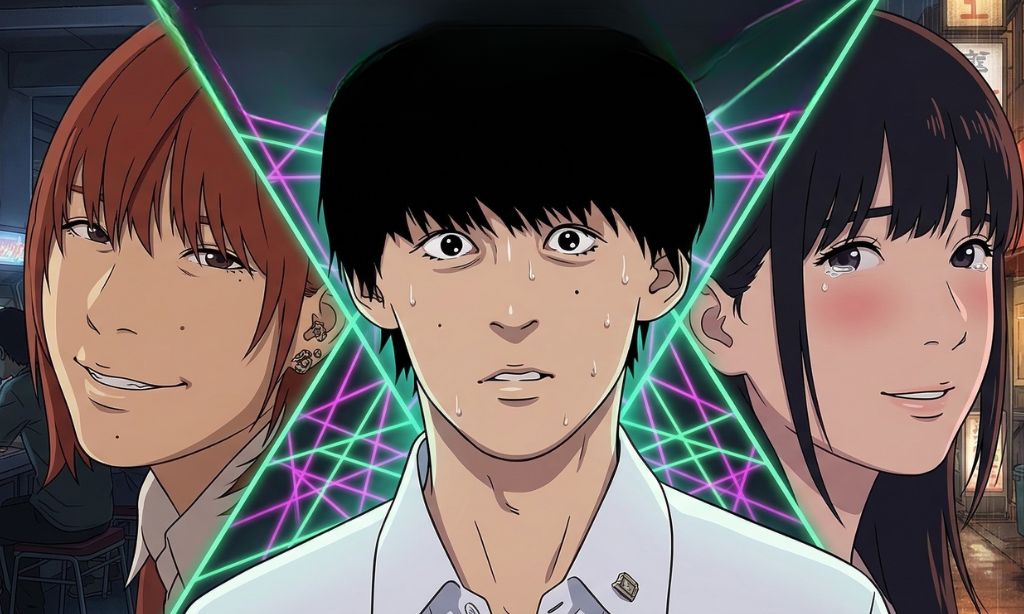
Hiroshi Nagahama’s 2013 adaptation of Shuzo Oshimi’s manga polarized the entire anime community upon its initial broadcast. Following an average teenager who impulsively steals his crush’s gym clothes, the narrative spirals into a toxic triangle of blackmail and teenage angst. The production famously utilized rotoscoping, intentionally creating an uncanny, unsettling visual experience that stripped away traditional anime aesthetics. While heavily criticized for its unconventional look, it perfectly captures the stifling, awkward, and ugly reality of adolescence.
| Feature | Detail |
| Director | Hiroshi Nagahama |
| Studio | Zexcs |
| Release Year | 2013 |
| Animation Style | Rotoscoping |
| Core Themes | Deviancy, teenage angst, moral decay, obsession |
The Rotoscoping Controversy
Aku no Hana stands as one of the most controversial adaptations in recent memory. Director Hiroshi Nagahama made the audacious decision to film the entire series in live-action first, then trace over the footage frame-by-frame—a technique known as rotoscoping. This choice removed the idealized, large-eyed character designs of the original manga. It replaced them with flawed, realistic human proportions. The backlash was immediate and severe. Fans slammed the series on platforms like MyAnimeList, dropping the rating to just over 5 during its initial airing.
Fans of the manga felt betrayed by the “ugly” visuals, missing the profound thematic point the director was making. The rotoscoping forces the audience out of the comfortable escapism normally associated with anime. It offers a stronger realism toward the atmosphere by adding nuanced details to facial patterns, body proportions, and subtler body language cues. The world is meant to look odd and ugly to mirror the protagonist’s skewed view of reality. The animation choice ultimately caused the production company to end the animated series prematurely after only one season, making it a tragic casualty of audience expectation.
Psychological Degradation and Deviance
The story follows Takao Kasuga, who views himself as an intellectual superior due to his obsession with Charles Baudelaire’s poetry collection Les Fleurs du mal. The narrative is inherently uncomfortable. When the sociopathic Sawa Nakamura catches Kasuga stealing the gym clothes of popular girl Nanako Saeki, she forces him into a series of increasingly deviant acts. The slow, suffocating pacing and realistic body language amplify the psychological horror of being trapped by one’s own shameful impulses.
The show is an atmosphere-driven thriller, functioning as psychological horror in the Hitchcockian sense. Suspense builds not from jump scares, but from the unbearable tension of waiting for the other shoe to drop. Nakamura recognizes Kasuga’s kindred deviant spirit and uses her knowledge to take complete control of his life. It forces viewers to watch a teenage love triangle where no one is actually in love; it is purely about control, shame, and destruction. The series remains a masterpiece that uses its repulsive visual style to mirror the internal corruption of its teenage protagonists.
6. Boogiepop Phantom: Non-Linear Memory and Trauma
Airing in 2000, this Madhouse production serves as a highly experimental continuation of Kouhei Kadono’s groundbreaking light novels. The story examines a dreary city reeling from a mysterious pillar of light and a string of gruesome, unsolved murders. It employs a fragmented, non-linear narrative, requiring the audience to meticulously piece together the timeline from multiple, overlapping perspectives. The sepia-toned visuals, vignette structure, and aggressive sound design create a suffocating, inescapable atmosphere of dread.
| Feature | Detail |
| Director | Takashi Watanabe |
| Studio | Madhouse |
| Release Year | 2000 |
| Format | Anime-Original / Light Novel Sequel |
| Core Themes | Dissociative identity, urban legends, trauma |
Connecting the Light Novels to the Anime
Boogiepop Phantom is notoriously hostile to casual viewing. As an original companion piece to the light novels Boogiepop and Others and Boogiepop at Dawn, the anime drops viewers right into the aftermath of a massive supernatural event without holding their hands. The titular Boogiepop is an alternate personality residing within a high school girl named Touka Miyashita. This personality emerges only when “enemies of the world” appear to do battle. However, the anime focuses less on Boogiepop and more on the collateral damage—the ordinary citizens whose lives fracture due to the emergence of supernatural abilities and psychological trauma.
The franchise itself is massive in Japan. The light novels sold over two million copies by the year 2000, effectively launching the entire light novel trend. The anime, however, replaces Boogiepop in the narrative with Boogiepop Phantom, an entity bearing the face of the villainous Manticore. It dives into conspiracy plots, genetically modified humans, and vigilantes with split personalities without apology or explanation. Understanding the main story fully practically requires reading the first two light novels. Despite this barrier to entry, it remains an existentialist work on the search for one’s own identity through the passing of time.
Sound Design and Atmospheric Dread
The series shares significant DNA with Serial Experiments Lain. It utilizes similarly muted color palettes, vignette-style storytelling, and heavy themes of existential alienation. The sound design, handled by Yota Tsuruoka, is a masterclass in psychological manipulation. The constant hum of power lines, skipping CDs, malfunctioning electronics, and dissonant electronic noise keep the viewer in a state of perpetual anxiety. The music consists of ambient, drum and bass, and noise tracks that amplify the creeping dread of the city.
Because episodes overlap and replay events from different characters’ viewpoints, understanding the narrative requires active detective work. The show presents viewers with snapshots of what is happening, leaving them to find clues to understand the greater plot. Some episodes are flashbacks, while others happen in parallel without intersecting, only visible in the background of other scenes. It ranks easily as one of the most highly atmospheric shows ever produced, conveying a sense of mystery and fear that is overwhelmingly effective. It serves as the definitive underrated psychological anime for viewers who want to be deeply unsettled by the quiet horrors lurking within mundane urban environments.
7. Haibane Renmei: Quiet Melancholy and Forgiveness
Created and written by Yoshitoshi ABe, this 2002 series presents a gentle, meticulously crafted fantasy world heavily steeped in melancholy. Young girls with charcoal wings and halos live in an isolated, walled city, working ordinary jobs and waiting for their mysterious “Day of Flight.” The pacing closely resembles an innocent slice-of-life show, but underneath the quiet daily routines lies a profound, devastating allegory for forgiveness, suicide, and the afterlife. It is a subtly underrated psychological anime that leaves a massive emotional footprint.
| Feature | Detail |
| Creator / Writer | Yoshitoshi ABe |
| Studio | Radix |
| Release Year | 2002 |
| Inspirations | Haruki Murakami’s literature |
| Core Themes | The afterlife, forgiveness, sin, psychological recovery |
Yoshitoshi ABe’s Allegory of Limbo
Unlike the aggressive paranoia of other psychological thrillers, Haibane Renmei relies entirely on quiet introspection. The protagonist, Rakka, awakens from a dream of falling, hatches from a massive cocoon, and joins a community of beings known as Haibane. They are bound by strict rules: they cannot own new items, they must use a barter system, and they are forbidden from ever touching or crossing the massive walls that encircle the city of Glie. ABe drew heavy inspiration for this walled purgatory from Haruki Murakami’s novel Hard-Boiled Wonderland and the End of the World.
As the narrative unfolds, it becomes increasingly clear that the Haibane are souls in a state of limbo. They are likely individuals who died tragically or took their own lives in the real world. A Haibane who cannot remember their past dream or forgive themselves becomes “sin-bound,” causing their charcoal feathers to turn black. The core emotional struggle centers on Reki, an artist and mentor figure consumed by self-loathing, and Rakka’s desperate attempt to save her from fading away in despair. The town and Old Home act as a sanctuary for damaged people, providing a safe enclosure to come to terms with their past situations.
Subdued Pacing and Thematic Depth
The technical realization of the anime prioritizes atmosphere over fluid movement. The animation is relatively minimal, featuring lots of simple standing dialogue and basic walking animations. However, the consistent aesthetic provided by ABe unites the comedy and despair into a single, cohesive vision. The orchestral soundtrack, composed by Kow Otani, elevates the restrained color scheme and adds profound emotional weight to the quiet moments.
The show asks profound philosophical questions about existence, purpose, and the necessity of seeking help from others. It operates as a psychological healing journey, utilizing fantasy to explore the very real mechanisms of trauma recovery and self-acceptance. The narrative provides very few direct answers regarding the origins of the Haibane or the city of Glie, which frustrates some viewers who desire explicit exposition. However, for those who appreciate understated, profound storytelling, the show is a cult classic that functions beautifully as an allegory for acceptance and recovery.
8. Kaiba: Memory, Transhumanism, and the Soul
Masaaki Yuasa’s 2008 masterpiece hides incredibly dark, transhumanist themes behind a bubbly art style highly reminiscent of classic Osamu Tezuka cartoons. In this deeply unequal universe, memories can be easily digitized into chips, allowing the ultra-rich to buy new bodies and live forever while the destitute sell their own memories just to survive. The protagonist, Warp, awakens with a hole in his chest and severe amnesia, embarking on a surreal journey across different planets. The juxtaposition of cute character designs with oppressive cyberpunk elements is a brilliant exercise in cognitive dissonance.
| Feature | Detail |
| Director | Masaaki Yuasa |
| Studio | Madhouse |
| Release Year | 2008 |
| Accolades | Excellence Award, 2008 Japan Media Arts Festival |
| Core Themes | Transhumanism, memory manipulation, class disparity |
Masaaki Yuasa’s Deceptive Art Style
At first glance, Kaiba looks like a children’s show from the 1960s. The character designs are soft, round, and wildly imaginative. They float through environments that look and behave like “water balloons”. However, this visual innocence serves merely to disarm the viewer before delivering brutal psychological blows. The digitized memory chips essentially reduce the human soul to a tradable commodity. The poor reside beneath an electrical storm, forced to sell their physical bodies to the elites living above the clouds.
Through Warp’s journey to recover his identity and reunite with a woman named Neiro, the show examines how memories dictate human behavior. Characters constantly have their memories altered, erased, or transplanted into different bodies, leading to a profound loss of self. Yuasa’s direction ensures that the narrative never feels overly melodramatic despite the heavy subject matter. The characters simply accept the cruel reality of their world and press forward, surviving to the best of their abilities. The anime balances childlike wonder with deeply disturbing philosophical implications effortlessly.
Japan Media Arts Festival Recognition
The show’s ambitious depiction of memory manipulation and class struggle did not go unnoticed by critics. In 2008, Kaiba won the prestigious Excellence Award at the 12th Japan Media Arts Festival. The festival committee praised Yuasa for persisting in his quest to create animations completely free from commercial shackles. They recognized the series as an ambitious work that dynamically depicts a battle over memory and the value of human life. The soundtrack, composed by Kiyoshi Yoshida, adds elegant, heart-wrenching music that perfectly fits the lofty, floaty environments.
Despite its critical acclaim and awards, the show remains remarkably obscure. When anime fans discuss Masaaki Yuasa, they frequently bring up The Tatami Galaxy or Ping Pong The Animation, while Kaiba routinely flies under the radar. Many viewers confuse the title with the famous character from Yu-Gi-Oh!, proving its status as a genuine hidden gem. For viewers willing to engage with high-concept sci-fi that deals heavily in social critique and existential philosophy, this 12-episode series provides a uniquely emotional and profound experience.
Final Thoughts
The landscape of Japanese animation is vast, but few genres leave an impact quite like psychological thrillers. Mainstream hits generate the bulk of social media discussion, but these niche titles offer something far more substantial for the analytical viewer. Finding an underrated psychological anime means discovering stories that push the boundaries of animation. They utilize experimental directing techniques, challenging non-linear narratives, and deep philosophical inquiries that refuse to insult the audience’s intelligence.
Whether it is through the transhumanist memory-swapping of Kaiba, the clinical madness of Kuuchuu Buranko, or the biting societal critique of Paranoia Agent, each of these shows offers a unique, profound viewing experience. They force the audience to confront the darkest aspects of the human mind, from teenage deviancy in Aku no Hana to the quiet grief of Haibane Renmei. Diving into these complex narratives requires patience, an open mind, and a willingness to be disturbed. For those brave enough to take the plunge, these masterful stories provide a chilling, unforgettable exploration of what it truly means to be human.
Frequently Asked Questions (FAQs)
What defines a psychological anime compared to mainstream genres?
Psychological anime heavily prioritize atmosphere, introspection, and thematic depth over fast-paced action or traditional fantasy tropes. Instead of physical battles, these narratives focus on internal conflicts, exploring complex concepts like trauma, moral ambiguity, societal pressures, and the fragile nature of human memory and identity.
Why is the animation style in Aku no Hana so controversial?
The creators of Aku no Hana used a technique called rotoscoping—tracing over live-action footage frame-by-frame. This stripped away the idealized, large-eyed designs typical of anime and replaced them with flawed, realistic human proportions. While it caused immense backlash initially, the unsettling and “ugly” visuals were an intentional choice to perfectly mirror the stifling, awkward, and corrupt reality of the teenage protagonists.
Do I need to read the light novels before watching Boogiepop Phantom?
While you can watch the anime on its own, it is notoriously hostile to casual viewing. The anime serves as a highly experimental continuation of the first two light novels (Boogiepop and Others and Boogiepop at Dawn). It drops viewers directly into the aftermath of a major supernatural event without much explanation, so reading the novels beforehand practically acts as a prerequisite for fully understanding the overarching plot.
What makes Mononoke visually distinct from other horror anime?
Mononoke abandons modern, clean animation in favor of a style that mimics traditional Japanese ukiyo-e paintings. It uses vibrant, clashing colors and a specialized visual filter that replicates the coarse texture of paper canvas. This creates a flat, highly theatrical environment that allows the psychological horror to take center stage without relying on standard gore.