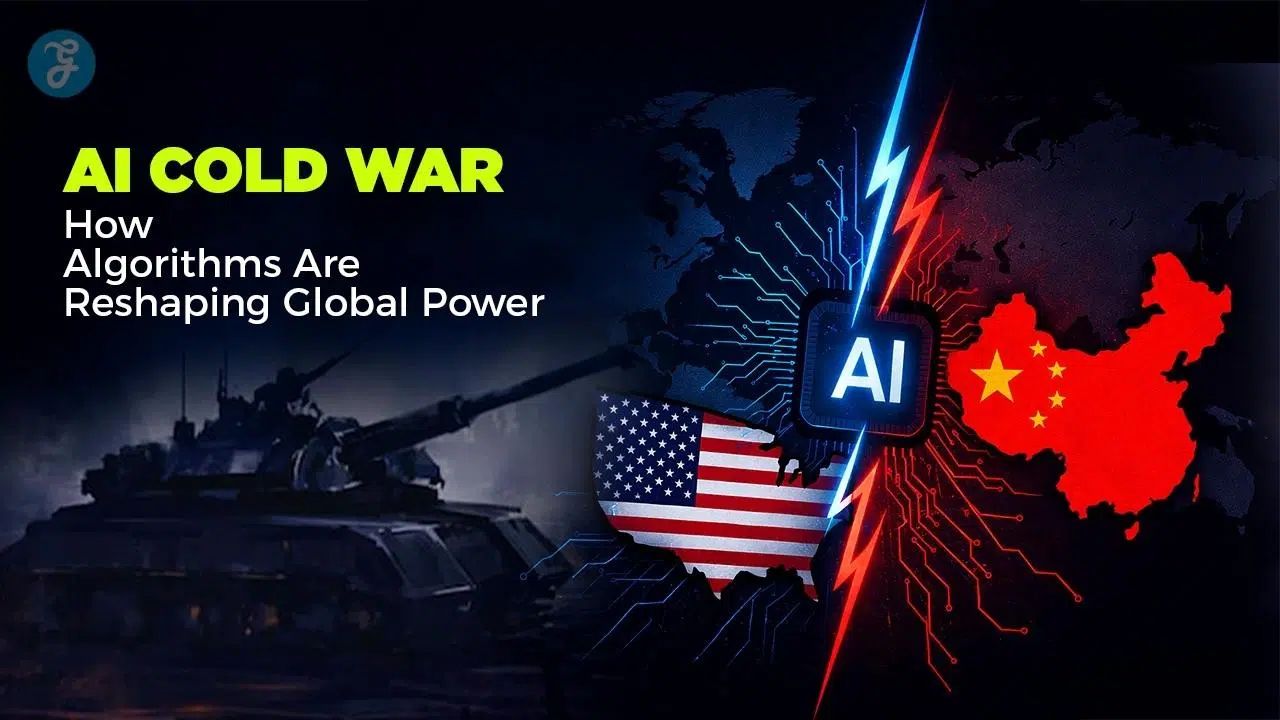
The Energy Weapon is no longer defined by the crude metrics of oil embargoes or nuclear stockpiles; in 2026, it is measured in gigawatts, cooling capacity, and the relentless hum of hyper-scale data centres. As we navigate the complexities of a fragmented geopolitical landscape, the traditional contours of the Cold War have been entirely rewritten. The 20th-century standoff was characterised by mutually assured destruction and the physical partitioning of territory.
Today, global supremacy is not determined by the number of warheads a nation possesses, but by its computing capacity, its algorithmic efficiency, and its control over the physical infrastructure that powers artificial intelligence. We have transitioned from a world where power was measured in atoms to one where power is forged in algorithms.
The Global Reckoning: Avoiding Digital Subjugation
This algorithmic arms race is forcing a fundamental reckoning across the globe. As the United States and China lock horns over semiconductor export controls, tariff walls, and critical mineral supply chains, the rest of the world is waking up to a stark reality: outsourcing a nation’s digital nervous system to foreign tech giants is tantamount to outsourcing national sovereignty.
This realisation has ignited a desperate, high-stakes scramble for “Sovereign AI”, the domestic capability to build, train, and govern AI systems using local data and local power grids. The battle lines of this new era are not drawn on geographic maps, but across supply chains, power networks, and silicon fabrication plants. To understand the future of global power, we must examine how the infrastructure squeeze is forcing nations to choose between digital autonomy and algorithmic subjugation.
The New Currency of Power: From Atoms to Algorithms
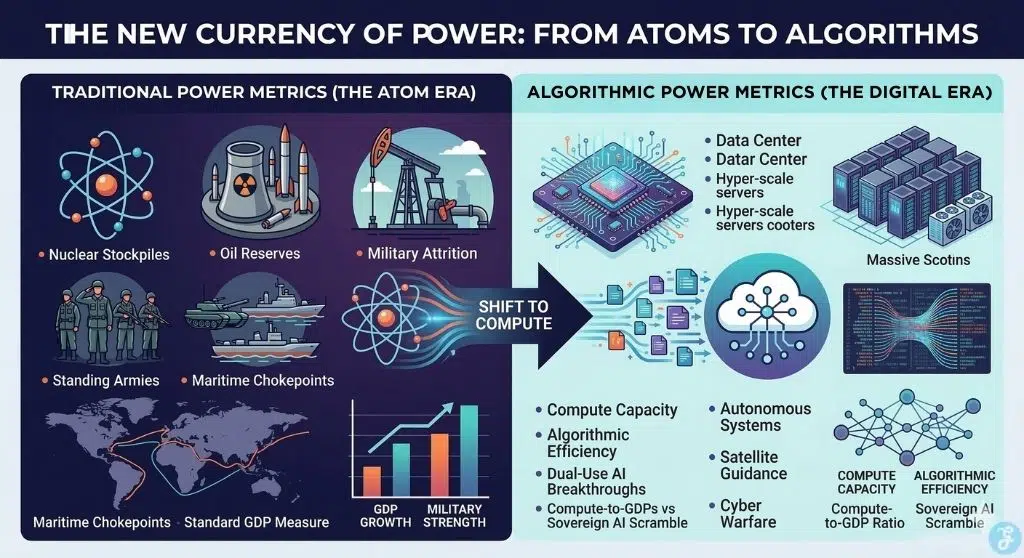
Historically, the geopolitical hierarchy was determined by relatively static metrics: gross domestic product, standing armies, and control over maritime chokepoints. In 2026, these metrics are increasingly becoming downstream of a nation’s AI capabilities. A new metric has emerged at global summits: the “Compute-to-GDP” ratio.
Just as industrial-era power correlated with steel production, modern geopolitical influence is directly tied to a country’s ability to process vast oceans of data into actionable, sovereign intelligence using the energy weapon as its foundational fuel.
Redefining National Security for the Digital Age
For decades, the geopolitical hierarchy was determined by relatively static metrics: gross domestic product, standing armies, and control over maritime chokepoints. In 2026, these metrics are increasingly becoming downstream of a nation’s AI capabilities. A new metric has emerged at forums like the India AI Impact Summit: the “Compute-to-GDP” ratio. Just as industrial-era power was correlated with steel production, modern geopolitical influence is directly tied to a country’s ability to process vast oceans of data into actionable, sovereign intelligence.
The defining characteristic of this new arms race is the dual-use dilemma inherent to artificial intelligence. Unlike a nuclear warhead, which has no commercial utility, AI is driven by the private sector but is inherently militaristic. A breakthrough in a commercial large language model (LLM) or a logistics algorithm can immediately be weaponised for autonomous drone swarms, satellite target identification, and cyber warfare.
Defence departments globally are fundamentally restructuring their budgets. Warfare is shifting away from human attrition and massive, slow-moving carrier strike groups toward algorithmic efficiency, where a “20-second kill chain” orchestrated by AI determines the victor before human operators can even comprehend the battlefield.
The Silicon Chokepoint: Semiconductors as the Ultimate Leverage
Historically, the geopolitical hierarchy was determined by relatively static metrics: gross domestic product, standing armies, and control over maritime chokepoints. In 2026, these metrics are increasingly becoming downstream of a nation’s AI capabilities.
A new metric has emerged at global summits: the “Compute-to-GDP” ratio. Just as industrial-era power correlated with steel production, modern geopolitical influence is directly tied to a country’s ability to process vast oceans of data into actionable, sovereign intelligence using the energy weapon as its foundational fuel.
Weaponising the Supply Chain in 2026
If data is the new oil, advanced semiconductors are the refineries. The highest-performance AI accelerators, such as NVIDIA’s H200 and AMD’s MI325X, are the most strategic commodities on earth. Without this hardware, the most sophisticated algorithms remain theoretical mathematics. Recognising this, the United States has spent the past several years attempting to choke China’s access to these critical components.
However, the strategy has evolved dramatically in 2026. The U.S. Department of Commerce recently shifted its export license review policy from a strict “presumption of denial” to a “case-by-case review” for advanced chips like the H200, choosing instead to impose heavy 25% tariffs while capping export volumes. This recalibration is an admission that overly restrictive bans were proving counterproductive, costing U.S. firms billions in revenue while inadvertently accelerating China’s drive for technological self-sufficiency.
China’s Domestic Push and Mineral Retaliation
The earlier bans acted as a Sputnik moment for Beijing. The Chinese state has poured over $140 billion into its National Integrated Circuit Industry Investment Fund, aggressively backing domestic champions like Huawei and SMIC to build a sovereign AI stack. While U.S. intelligence estimates suggest China’s advanced AI chip production remains lower than domestic demand, their reliance on massive, state-subsidised data centres and sophisticated parallel processing has allowed domestic models like DeepSeek to remain globally competitive.
Furthermore, China has demonstrated its ability to strike back at the foundational level of the hardware supply chain. By restricting the export of rare earth minerals and legacy chips, components critical to Western automotive, defence, and green energy sectors, Beijing has proven that the silicon chokepoint cuts both ways. Meanwhile, the U.S. Congress has responded with legislation like the AI Overwatch Act, attempting to seize control of export licensing from the Commerce Department and creating a permanent state of supply chain uncertainty.
The Rise of Sovereign AI: The Global Non-Aligned Movement
The escalating friction between major technological powers has triggered a profound anxiety across the Global South and the “Middle Powers” of Europe and the Middle East. If a nation relies entirely on foreign cloud providers or state-backed infrastructure to run its healthcare, banking, and defence logistics, it is inherently vulnerable to foreign policy whims. This fear has birthed the Sovereign AI movement, a desperate scramble to decouple from foreign hyperscalers and build indigenous models powered by local energy grids.
The Threat of Digital Colonialism
The escalating friction between Washington and Beijing has triggered a profound anxiety across the Global South and the “Middle Powers” of Europe and the Middle East. If a nation relies entirely on U.S. cloud providers or Chinese state-backed infrastructure to run its healthcare, banking, and defence logistics, it is inherently vulnerable to foreign policy whims. A sudden export ban or an algorithmic “kill switch” could paralyse an entire economy overnight.
This fear has given rise to the Sovereign AI movement. Sovereign AI is the strategic capacity of a nation to build, deploy, and govern its own AI using indigenous infrastructure, local datasets, and domestic talent. It is a fundamental rejection of digital colonialism. When a nation imports a foreign AI model, it also imports the cultural biases, censorship norms, and legal frameworks of Silicon Valley or Shenzhen.
Building the AI Factory
As highlighted at the 2026 India AI Impact Summit, the Global South is rapidly transitioning from a consumer of AI to a provider. Nations are embracing the concept of the “AI Factory”, facilities that turn raw local data into sovereign intelligence without a single byte leaving the country’s borders.
- Zero Data Egress: Countries are enforcing strict data localisation laws to ensure sensitive citizen data remains on-premise, immune to foreign surveillance laws like the U.S. CLOUD Act.
- Cultural Context: Initiatives like India’s Vachana STT or Africa’s Masakhane project are building foundational models natively trained on local languages and dialects, bypassing the English-centric bias of global frontier models.
- Infrastructure Investment: Middle powers are leveraging sovereign wealth funds to secure their own compute. Massive deals, such as the Gorilla Technology and Yotta deployment in India, are establishing large-scale, independent GPU clusters to serve the APAC and Middle East regions.
| AI Strategy Model | Jurisdiction & Control | Cultural Bias | Economic Impact |
| Global Hyperscaler | Subject to foreign laws (e.g., US, China); risk of sudden access revocation. | High models reflect the societal norms of the host nation’s developers. | Capital flight; subscription fees flow outwards to foreign tech giants. |
| Sovereign AI | Strictly governed by domestic laws; complete digital autonomy and auditability. | Low; models are natively trained on local languages and cultural nuances. | Capital retention builds domestic startup ecosystems and infrastructure. |
Geography Returns: The Geopolitics of Power and Cooling
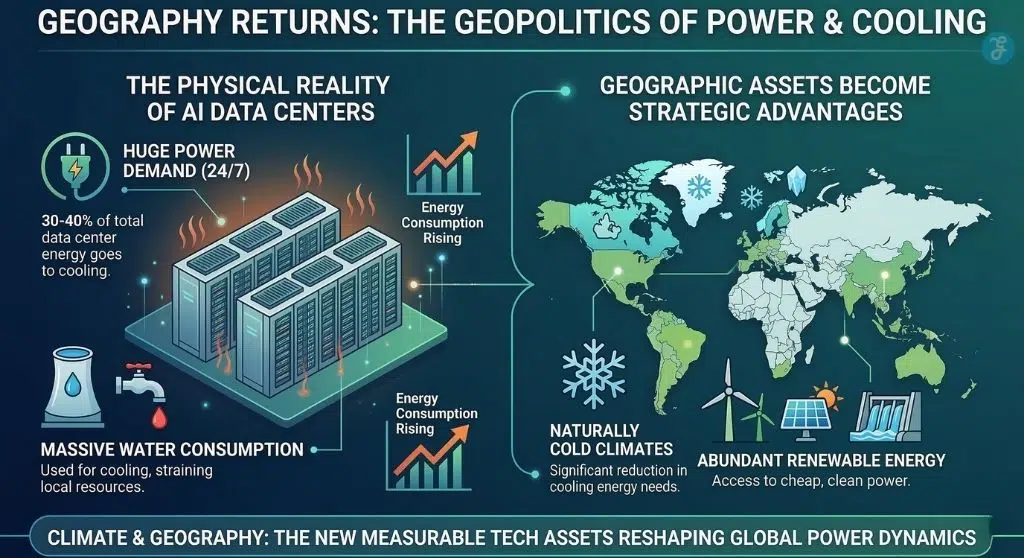
The term “cloud” is perhaps the most successful misnomer in modern history. The cloud is not ethereal; it is astonishingly heavy, deafeningly loud, and incredibly hot. AI lives in hyper-dense physical data centres that require unprecedented amounts of electricity and water. This is where the concept of the energy weapon becomes most literal and unavoidable, fundamentally altering how we value global real estate and natural resources.
The Physical Weight of the Cloud
The term “cloud” is one of the most successful misnomers in modern history. The cloud is not ethereal; it is astonishingly heavy, deafeningly loud, and incredibly hot. AI lives in hyper-dense physical data centres that require unprecedented amounts of electricity and water. This is where the concept of the energy weapon becomes most literal.
According to 2026 data from the International Energy Agency (IEA) and recent industry analyses, global AI data centres are projected to consume up to 945 terawatt-hours (TWh) by 2030, roughly 3% of total global electricity demand. In the U.S. alone, data centre power consumption could reach 606 TWh by the end of the decade, accounting for nearly 12% of the nation’s power demand.
The Shift from Training to Inference
While the initial training of models like GPT-4 required massive bursts of energy (consuming enough power to run a medium-sized city for days), the ongoing “inference” phase, when users actually query the models, now accounts for 80% to 90% of AI’s lifecycle energy consumption. As models become more advanced, their energy appetite explodes. A complex reasoning query from a 2026 model like OpenAI’s o3 or DeepSeek-R1 can consume between 10 and 100 times more energy than a basic search query.
The “Cold Electricity” Advantage
Because AI hardware runs so hot, cooling accounts for roughly 30% to 40% of a data centre’s total energy use, which is radically altering geopolitical geography; a nation’s climate is now a measurable technological asset. Regions with abundant, cheap renewable energy and naturally cold climates, such as the Nordic countries or Canada, are suddenly highly strategic territories for AI infrastructure due to their low Power Usage Effectiveness (PUE).
Furthermore, the water consumption required for cooling is staggering. Global AI-related water demand is expected to exceed 6 billion cubic meters in the coming years, straining local resources and creating fierce political battles between tech giants and local municipalities. The nations that will dominate the next decade are those that can not only secure silicon but also guarantee uninterrupted gigawatts of power and vast reservoirs of cooling water.
The Nuclear Pivot: Big Tech’s Private Power Grids
The energy weapon’s sheer scale is forcing a radical shift. As national grids buckle under gigawatt-scale data centres, global tech giants are bypassing governments to privatise the energy supply chain. To secure the 24/7, zero-carbon power required for AI inference, private hyperscalers are aggressively pivoting to nuclear energy, investing billions in Small Modular Reactors (SMRs) and restarting decommissioned facilities.
This creates a profound geopolitical complication: the emergence of corporate techno-states. When private corporations control both advanced AI and its requisite nuclear infrastructure, state sovereignty blurs, forcing governments to confront alarming questions:
- Who bears the national security risk if a private, AI-dedicated nuclear facility suffers a cyberattack?
- Can a nation claim digital sovereignty if its domestic AI relies on a power grid owned by a foreign tech conglomerate?
- How can developing nations, lacking frameworks for nuclear privatisation, compete when the entry fee is a dedicated reactor?
By establishing their own sovereign grids, these monoliths are becoming the globe’s most powerful geopolitical actors. The energy weapon is no longer wielded solely by states; it has been privatised.
Infrastructure as Ideology: Shaping the Global Mind
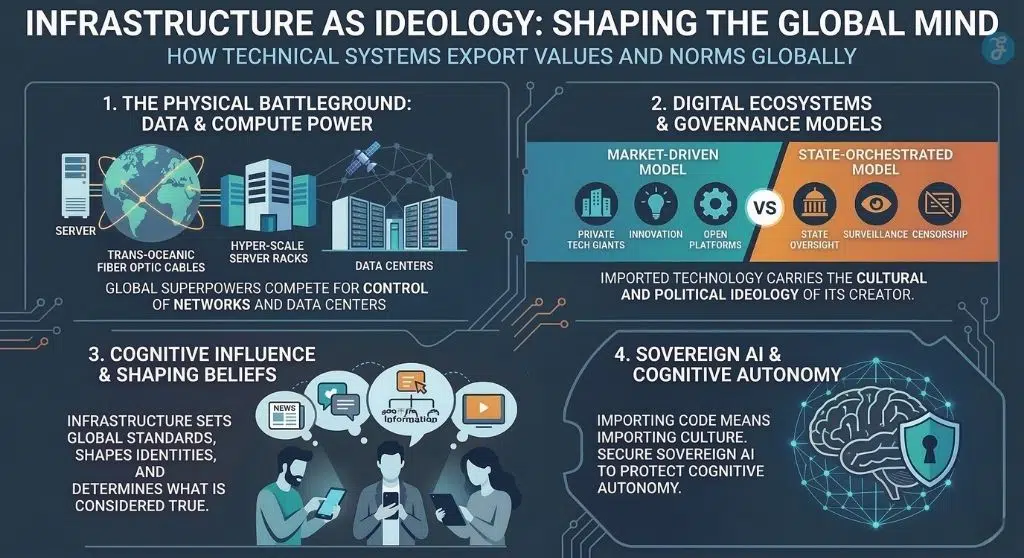
Technology is never neutral; infrastructure is ideology made manifest. The architectural choices embedded in an AI system dictate how information is filtered, who is surveilled, and what is considered truth. As the world’s leading cyber powers export their respective AI infrastructures to developing nations, they are locking in decades of economic and political influence, exporting their cultural norms and governance models byte by byte.
Exporting Digital Ecosystems
Technology is never neutral; infrastructure is ideology made manifest. The architectural choices embedded in an AI system dictate how information is filtered, who is surveilled, and what is considered truth. As the U.S. and China export their respective AI infrastructures to the developing world, they are locking in decades of economic and political influence.
The U.S. model largely relies on market-driven hyperscalers offering highly capable, closed-system models, often bundled with democratic governance standards. Conversely, China is exporting comprehensive “turnkey” AI ecosystems. Through initiatives tied to the Belt and Road framework, Beijing offers developing nations affordable, state-orchestrated data centre infrastructure, which often inherently encodes authoritarian surveillance capabilities and centralized internet control.
The Cognitive War
This ideological clash extends to the cognitive realm. AI is the ultimate tool for global influence operations. The deployment of AI poisoning, hyper-realistic deepfakes, and algorithmic manipulation constitutes a new form of covert warfare. By subtly altering the information diet of a rival nation’s populace, a state can destabilise democratic processes and fracture societal trust without ever crossing a physical border. Sovereign AI is not just about protecting data; it is about protecting the cognitive sovereignty of a nation’s citizens.
Strategic Evaluation: Choosing the Path Forward
As governments and enterprises weigh their infrastructure decisions in the face of this shifting landscape, the choice between relying on global tech giants or investing in domestic capabilities is stark. Navigating this divide requires a clear-eyed assessment of the benefits and immense logistical hurdles of building independent technological ecosystems.
Best for: Nations and large enterprises operating in highly regulated sectors (defence, finance, healthcare) that require absolute data privacy, cultural alignment, and immunity from foreign geopolitical sanctions.
Pros
- Ensures complete compliance with stringent 2026 regulations like the EU AI Act.
- Shield’s proprietary intellectual property and sensitive citizen data behind sovereign borders.
- Fosters local innovation and prevents brain drain by creating domestic high-tech jobs.
Things To Consider:
- Building sovereign infrastructure requires massive upfront capital expenditure in GPUs, cooling, and real estate.
- There is a risk of technological isolation if local ecosystems fail to interoperate with global standards.
- Securing the massive energy grid requirements can delay deployment by years.
The new Cold War has no finish line. Unlike the 20th-century space race, there will be no single definitive moment of victory or a final flag planted on a digital moon. The battle for AI supremacy is an endurance marathon of continuous capital expenditure, relentless talent acquisition, and massive infrastructure scaling, with the energy weapon acting as the ultimate arbiter of success.